
The process of transforming this high-performance polymer into precision functional components is known as elastomer molding. Whether you’re a product designer, procurement specialist, or learner interested in manufacturing techniques, this article provides a detailed breakdown of elastomer molding’s core processes, common materials, application fields, and key selection factors.
What is an Elastomer?
Before delving into molding techniques, we must first understand what an elastomer is. Elastomers are a class of viscoelastic polymeric materials whose most distinctive feature is their ability to deform under external force and rapidly return to their original shape once the force is removed. This unique property stems from their internally loosely crosslinked polymer chain structure.
Common elastomer materials include:
- Silicone: Offers exceptional resistance to high and low temperatures, along with biocompatibility.
- EPDM: Superior weather resistance, ozone resistance, and chemical resistance.
- NBR: Outstanding oil and solvent resistance, commonly used in seals.
- Natural Rubber: Offers superior mechanical strength and abrasion resistance.
- TPE/TPU: Combines the elasticity of rubber with the processability of thermoplastic plastics, and is easily recyclable.
Key Elastomer Molding Processes
Transforming elastomer raw materials into final products requires specific molding techniques. The selection of an appropriate process depends on product complexity, production volume, cost constraints, and precision requirements. Below are the four most prevalent molding methods:
Compression Molding
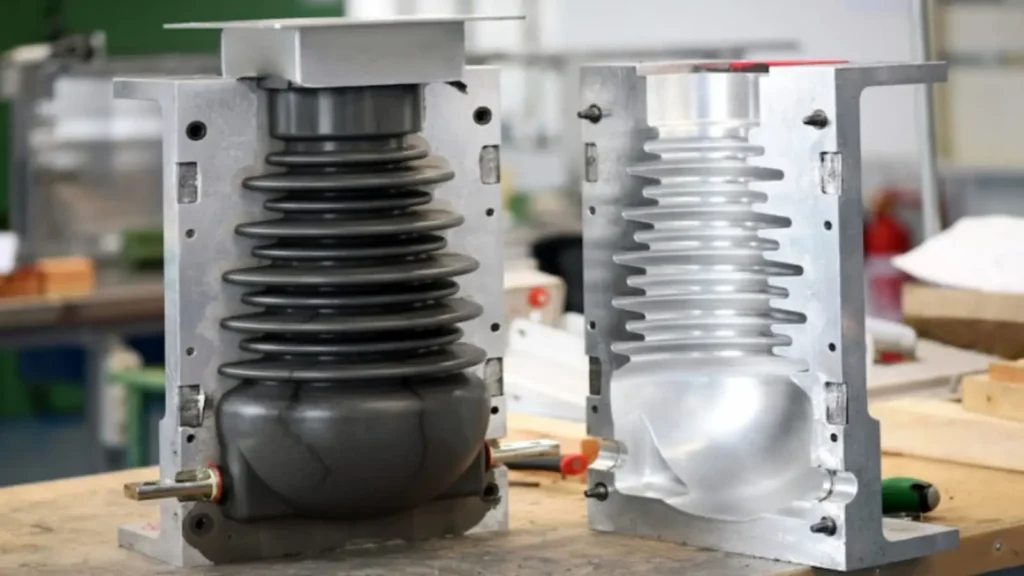
Compression molding is one of the oldest and most widely used elastomer forming processes, particularly suited for producing large-sized or high-hardness components.
- Process: Pre-weighed, unvulcanized rubber blanks are placed directly into the heated lower mold cavity. After mold closure, immense pressure from the upper mold forces the rubber to flow and fill the entire cavity. Under sustained high temperature and pressure, the rubber undergoes vulcanization (cross-linking) and ultimately cures into the desired shape.
- Core Advantages: Relatively simple mold structure with low manufacturing costs; highly suitable for producing large components such as engine mounts and vibration dampers; capable of processing materials across a wide range of hardness levels.
- Typical Applications: Shock absorbers in the automotive industry, industrial seals, gaskets, etc.

Injection Molding
Injection molding is currently the most efficient and precise elastomer forming process, particularly suited for mass production of complex-shaped components, including liquid silicone rubber injection molding.
- Process: For solid silicone or rubber, the process resembles plastic injection molding: the material is plasticized by screw rotation and heating, then injected into a heated closed mold where it vulcanizes. For liquid silicone rubber, two liquid components (A/B) are precisely metered and mixed in a 1:1 ratio via a metering pump before being injected into a heated mold, where rapid curing occurs.
- Core Advantages: Exceptionally high production efficiency with rapid vulcanization; superior dimensional accuracy and repeatability; enables fully automated production with minimal manual intervention, making it ideal for medical-grade cleanroom environments.
- Typical Applications: Medical devices (e.g., breathing masks, syringe pistons), electronic product buttons, precision sealing rings, baby pacifiers, etc.

Transfer Molding
Transfer molding combines compression and injection molding techniques, making it ideal for producing complex components with metal or plastic inserts.
- Process: Unvulcanized rubber is first placed in a dedicated transfer chamber. Pressure is then applied via a piston (plunger), forcing the heated, softened rubber through a runner system (gate and runners) at high speed into the closed mold cavity.
- Core Advantages: Compared to compression molding, it enables the production of more intricate micro-components with tighter tolerances; shorter cycle times; particularly suited for producing overmolded parts requiring a secure bond between rubber and metal reinforcement.
- Typical Applications: Electrical insulation components with metal inserts, precision seals for aerospace applications, rubber-metal dampers.
Cast Molding
Cast molding is an economical and flexible method, particularly suitable for small-batch production or large prototypes.
- Process: Liquid elastomer compounds are mixed and poured directly into an open mold cavity. The mold is then placed in an oven for heating and curing. Secondary curing may be required for certain specialty materials to achieve optimal performance.
- Core Advantages: Simple mold requirements with low investment costs; suitable for producing large-sized, simple-shaped components.
- Typical Applications: Large industrial components, art reproduction, small-batch custom specialty parts.
Applications of Elastomer Molding
Elastomer components, valued for their unique flexibility, sealing properties, and durability, are prevalent across nearly all industrial sectors.
- Automotive Industry: Engine seals, O-rings, dust covers, shock absorber bushings, tubing systems, etc.
- Medical Devices: Syringe pistons, infusion set components, surgical instrument handles, respiratory masks, various medical stoppers and gaskets. Silicone rubber dominates this field due to its biocompatibility and sterilization resistance.
- Consumer Electronics: Mobile phone buttons, camera gaskets, smart wearable device straps, and various connector seals.
- Industrial Manufacturing: Hydraulic and pneumatic seals, pump diaphragms, valve linings, and pipe fittings.
- Aerospace and Defense: Specialized sealing solutions requiring resistance to extreme temperatures and harsh environments.
How to Select the Right Elastomer and Molding Process?
With numerous materials and processes available, how do you make the optimal choice for your project? Key considerations include:
- Performance Requirements: Define the component’s operating environment. Does it require high-temperature resistance? Exposure to oils or chemicals? Biocompatibility? Select base materials accordingly (e.g., oil-resistant NBR, weather-resistant EPDM, high/low-temperature silicone).
- Complexity and Precision: Does the part feature intricate geometries, inserts, or tight dimensional tolerances? Injection molding and transfer molding are preferred. For simple shapes and large dimensions, compression molding offers greater cost efficiency.
- Production Volume: For mass production in the millions, injection molding offers the lowest per-unit cost. For medium-to-small batches of hundreds or thousands , compression or transfer molding provides more advantageous tooling costs.
- Cost Budget: A comprehensive evaluation of mold costs, material expenses, and per-unit processing costs is required.

Summary
At Vista Motion, we offer comprehensive production capabilities spanning compression molding, transfer molding, and high-precision liquid silicone injection molding. Our experienced engineering team provides end-to-end technical support in material selection, mold design, and product optimization. We are dedicated to transforming your innovative concepts into reliable, high-performance customized elastomer components.
Whether you require complex rubber-to-metal bonding assemblies or high-purity medical-grade silicone parts, we stand as your trusted partner. We help you overcome demanding application challenges and enhance your products’ market competitiveness.
FAQ
What is the difference between elastomer molding and plastic molding?
A: The primary distinction lies in the chemical structure of the materials and the molding process. Plastic molding typically involves a physical melting and cooling process, whereas elastomer molding (especially for thermoset elastomers) involves a chemical reaction of vulcanization or cross-linking, which is irreversible. Elastomer-molded parts exhibit high elasticity, while plastic parts are generally stiffer.
What is “vulcanization”? Why is it important?
A: Vulcanization is the critical chemical process in elastomer molding. Under heat and pressure, cross-linking bonds form between rubber molecular chains (usually using sulfur or peroxides), transforming soft linear chains into a three-dimensional network structure. This process imparts strength, elasticity, heat resistance, and deformation resistance to rubber.
Compression molding or injection molding—which should I choose?
A: This primarily depends on your production volume and part complexity. For low-volume runs (e.g., fewer than 1,000 pieces) or larger, simpler parts, compression molding is the more economical choice. For high-volume production of intricate, complex components requiring high consistency and rapid delivery, injection molding is the preferred solution.
What makes Liquid Silicone Rubber Molding (LSR Molding) unique?
A: LSR molding uses low-viscosity liquid two-component silicone, precisely mixed and injected into heated molds. Its advantages include: extremely fast cycle times, high automation, zero scrap, perfect replication of micron-level details, and high product cleanliness due to the closed-system process—making it ideal for medical and food-contact applications.
What materials are commonly used in elastomer molding?
A: The most common materials include silicone rubber, EPDM rubber, nitrile rubber, natural rubber, neoprene rubber, fluorocarbon rubber, and thermoplastic elastomers. Each material possesses unique temperature resistance, oil resistance, and mechanical properties.
Can elastomers be molded onto metal or plastic skeletons?
Answer: Absolutely. This process is known as overmolding. Through transfer molding or injection molding, elastomers can be directly bonded to metal or engineering plastic inserts, creating high-performance composite components such as rubber-to-metal dampers and electrical connectors with integrated seals.
What dimensional tolerances can be achieved for elastomer components?
Answer: Tolerances depend on material, process, and part geometry. Typically, injection molding and transfer molding achieve tighter tolerances than compression molding. For high-precision liquid silicone rubber parts, tolerances can even be controlled at the micron level. Engineering reviews with the manufacturer are critical during the project development phase.
What is the design life of an elastomer mold?
Answer: This depends on the quality of the mold steel, the complexity of the part, and the material being molded. Simple molds for small-batch production may yield several thousand parts, while high-hardness tool steel molds for mass production can remain in good condition after producing millions of parts.
What is Thermoplastic Elastomer (TPE)? Does it also fall under the “molding” process?
A: Yes. TPE is a material that combines the elasticity of rubber with the thermoplastic properties of plastic. It can be processed on conventional plastic injection molding machines without vulcanization, and the resulting scrap can be recycled. Therefore, it is widely used in applications such as handles, grips, and sealing strips.
How is the quality of molded elastomer parts ensured?
Answer: Quality control is integrated throughout the entire production process. Manufacturers typically ensure products meet drawings and industry standards through process control (real-time monitoring of temperature and pressure), sample testing (e.g., hardness testing, tensile strength testing, compression set testing), and 100% inspection (e.g., high-precision optical sorting).
