
If you are looking for vibration isolation solutions for engines, cabs, transmissions, generator sets, or other industrial equipment, conical mounts are often a top priority to consider. This article will guide you through the basics of conical mounts.
What Are Conical Mounts?
You can think of conical mounts as “conical vibration-damping mounts.”
They typically consist of a combination of rubber and metal components, utilizing a conical structure to achieve a more controlled deformation path. This allows the mount to maintain support under vertical loads while providing vibration damping and cushioning in lateral and impact directions.
Common design priorities for this type of structure include high load capacity, progressive deformation, adjustable radial stiffness, and fail-safe protection achieved through the use of washers or support rings under extreme operating conditions.
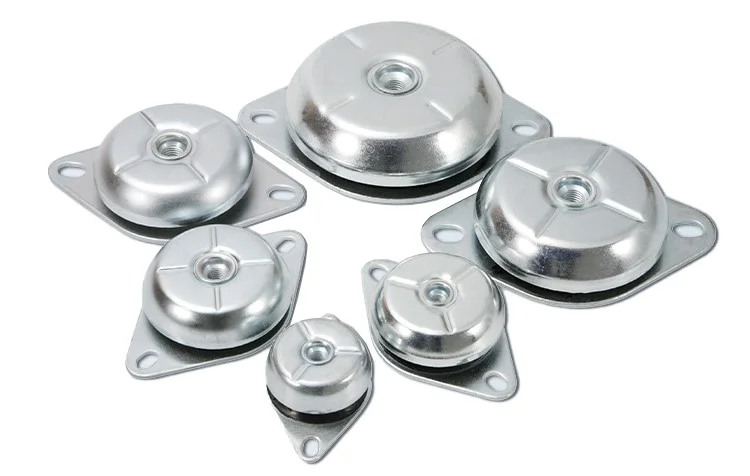
Why Consider Conical Mounts
When actually selecting equipment, you’ll find that the advantages of conical mounts extend beyond mere “vibration damping”; they simultaneously address load-bearing capacity, stability, and service life within limited installation spaces.
These mounts are suitable for compact layouts and can handle multidirectional motion, impact, or misalignment issues; some series also offer different radial stiffness options to match the dynamic response of various equipment.
For you, the most practical approach is not to look at price first, but to assess the operating conditions first.
If your equipment exhibits the following characteristics, conical mounts are generally worth serious consideration:
- The equipment is relatively heavy, but installation space is limited
- Vibration occurs not only vertically but also laterally or in composite directions
- Requires both vibration isolation and control of shock and structural noise
- Operating conditions involve transient overloads or require a certain degree of fail-safe design
- You want to minimize maintenance and ensure more consistent component lifespan
This is why conical vibration mounts are commonly found in trucks, buses, construction machinery, agricultural machinery, generator sets, as well as certain marine vessels and general industrial equipment.
How Conical Mounts Work
From a technical standpoint, the value of conical mounts lies not simply in compressing the rubber, but in using conical geometry and rubber formulations to distribute loads more effectively across compression, shear, and radial deformation.
Some manufacturers explicitly state that certain conical mounts transmit vertical loads through a combination of compression and shear, thereby achieving higher load-bearing capacity and longer service life.
What does this mean for you?
It means that during equipment startup, shutdown, impact loads, or when speed changes pose a risk of resonance, conical rubber mounts often offer greater control than standard “cushion-style” mounts. You’re not just buying a piece of rubber; you’re purchasing a structurally engineered dynamic connection.

When selecting conical mounts, consider these 6 parameters
Load
Many buyers start by asking about dimensions, but that’s not enough. Conical mounts are selected based on operating conditions, not just their shape.
You need to confirm:
- What is the static load?
- What is the peak dynamic load?
- Are there any impact loads?
- Are there any off-center loads?
- Whether the equipment is frequently started and stopped
The load capacity ranges vary significantly across different series of conical mounts. For example, some LORD series publicly list compression load ranges as high as 180 to 2,560 lb, but these figures apply only to specific series and cannot be generalized to all models.
Stiffness Matching
Many people mistakenly believe that the softer the vibration damping component, the better, but this is actually quite dangerous.
If the mount is too soft, the equipment may sway excessively, potentially affecting positioning and shortening the lifespan of connecting components; if it is too stiff, vibrations will be directly transmitted to the frame. Public documentation notes that a key selling point of some conical mounts is their ability to provide varying degrees of radial stiffness to accommodate dynamic requirements in different directions.
Installation Space and Mounting Methods
If the space beneath your equipment is very tight, or if you do not want the mount to protrude too far below, conical mounts often offer an advantage. Some product specifications explicitly state that these mounts are suitable for installations with height constraints and can be secured using 2-hole or 4-hole flanges.
Environmental Media and Rubber Materials
You should confirm in advance whether the operating environment contains oil, heat, ozone, outdoor exposure to sunlight, or chemical agents. Different conical rubber mounts may use natural rubber, neoprene, or nitrile rubber, and different hardness ranges correspond to varying levels of chemical resistance, resilience, and durability.
Common options include Natural Rubber, Neoprene, and Nitrile, available in multiple Shore A hardness grades.
Need for Fail-Safe or Overload Protection
If your equipment poses a safety risk in the event of mount failure, you must consider not only whether it can dampen vibrations but also whether it will disengage upon failure. Some conical mounts are equipped with washers, support rings, or similar structures to provide protection under extreme tension, compression, or impact conditions.
What is your objective?
Is your goal vibration isolation, noise reduction, or shock absorption? These three are related but not the same.
If you simply want to “make the machine quieter,” the selection criteria differ from those required to “withstand engine start-stop impacts.” A truly reliable supplier will typically ask you about the speed range, load, number of mounting points, center of gravity, and allowable displacement first, rather than simply providing a generic model.
What is the difference between Conical Mounts and Cylindrical Mounts?
You can think of it this way:
If your operating conditions lean toward heavy loads, limited space, multi-directional stiffness control, and a need for greater structural stability, then conical mounts are often worth prioritizing. This is because their conical structure is inherently better suited for progressive deformation and high-load designs.
However, if your equipment has more conventional loads, a simple structure, and a budget-sensitive requirement, cylindrical or other basic vibration isolation components may be sufficient.
To put it more simply: don’t ask which mount is better; ask which mount your application requires.

Common Applications of Conical Mounts
Based on publicly available data, the applications of conical mounts are highly concentrated and representative. You’ll see them repeatedly in these scenarios:
- Engine and transmission mounting: Reducing structural vibration and noise transmission
- Cab-to-chassis connection: Improving comfort and reducing structural noise
- Construction and agricultural machinery: Balancing shock absorption, load-bearing capacity, and durability
- Industrial equipment such as generator sets, wind turbines, and compressors: Controlling vibration transmission to the base and housing
- Marine and auxiliary power systems: Some conical mounts are also used for passive vibration isolation in medium-speed engines, generators, and related equipment
If you are working on export projects for vehicles, ships, or industrial equipment, long-tail keywords such as “conical engine mounts,” “conical vibration mounts,” and “conical rubber mounts” typically align more closely with actual procurement search paths.
Important Considerations When Installing Conical Mounts
First, do not treat conical mounts as ordinary fasteners during installation.
Installation torque, washer types, and support directions may vary across different series; specific parameters should be based on drawings and data sheets. Public documentation even lists explicit torque values for certain models, which further illustrates that installation methods are an integral part of the selection process —not an afterthought.
Second, do not overlook preload, alignment, and the flatness of the mounting surface.
No matter how accurate your initial selection is, if the mounting surface is uneven or there is severe off-center loading, the actual service life and vibration isolation performance of conical mounts will be compromised.
Third, regularly inspect for rubber aging, metal corrosion, and abnormal displacement.
Especially in environments with oil contamination, heat sources, outdoor conditions, or high-impact operations, preventive inspections are far more cost-effective than downtime caused by equipment failure.
If you are looking to purchase or customize Conical Mounts
A truly effective inquiry isn’t just a simple “Please quote conical mounts.”
A better approach is to provide all of this information at once:
- Equipment type
- Point load and total weight
- Rotational speed or primary excitation frequency
- Installation space
- Operating environment
- Target Service Life
- Fail-safe required
- Existing drawings, samples, or reference photos
The more complete the information you provide, the easier it will be for suppliers to determine whether to use standard parts or develop a customized conical mount solution. For B2B projects, this directly impacts prototyping lead times, quotation accuracy, and the stability of subsequent mass production.
Summary
If you’ve read this far, you’ve likely realized that what truly matters about conical mounts isn’t whether they’re called “conical mounts,” but whether they can effectively address load-bearing, vibration isolation, noise reduction, service life, and safety in your specific operating conditions.
Publicly available product data generally supports this assessment: high-quality conical mounts typically combine high load-bearing capacity, compact design, multi-directional vibration isolation capabilities, and stiffness and protection designs tailored to specific operating conditions.
If your project is in the prototype validation phase, developing replacement parts, or transitioning from design drawings to mass production, the most effective approach is not to continue making general price comparisons, but to first clearly define the operating conditions and technical requirements.
For manufacturing businesses, this step often determines whether the process will involve repeated rework or whether the right direction is set from the start.
If you are seeking a conical mount solution that is production-ready, compatible with existing components, and optimized for your specific operating conditions, simply send your drawings, dimensions, load requirements, rubber material specifications, metal corrosion protection requirements, and target service life to Vista Motion. This approach is far more likely to yield a realistic quote, samples, and a concrete delivery plan than simply asking, “Do you have stock?”
FAQ
What types of equipment are conical mounts suitable for?
Common applications include engines, transmissions, cabs, trucks, buses, construction machinery, agricultural machinery, generator sets, as well as certain marine and general industrial equipment.
How do I choose between conical mounts and cylindrical mounts?
If your operating conditions involve heavy loads, limited installation space, and require multi-directional stiffness and stability, conical mounts are often the preferred option; if conditions are more conventional and the structure is simpler, other basic vibration-damping mounting components may suffice. The key is not which type is more popular, but which best matches your load, frequency, and displacement requirements.
What are the common materials for conical mounts?
Common materials listed in public product specifications include Natural Rubber, Neoprene, and Nitrile. Different materials affect oil resistance, weather resistance, resilience, and service life. Hardness ranges typically offer multiple Shore A grades to choose from.
What load capacities do conical mounts have?
This depends on the specific series, size, rubber compound, and installation method. Some publicly available series can handle compression loads ranging from 180 to 2,560 lb, but these are specific product data and cannot be directly applied to all conical mounts.
Can conical mounts be used in tension applications?
Not all products are suitable. Public data indicates that some small conical mounts are explicitly designed for compression loads and are not recommended for direct use in tension mode; if your application involves tension, impact, or the risk of detachment, you should prioritize series with fail-safe designs.
What is the most important consideration when installing conical mounts?
The most important thing is to follow the data sheet, including installation orientation, washer configuration, torque, alignment, and mounting surface flatness. Incorrect installation will directly affect the vibration isolation performance and service life of the conical mounts. Some specific models even provide explicit installation torque values.
When should conical mounts be replaced?
You should inspect and assess whether replacement is necessary if you notice rubber cracking, hardening, permanent deformation, abnormal displacement, corrosion of metal components, or a significant increase in equipment vibration and noise. For continuously operating equipment, regular inspections are typically more cost-effective than shutdowns caused by failures.
