
In today’s article, I’ll draw on my hands-on experience to clearly explain once and for all: What exactly is the difference between a shock absorber and a strut assembly, when you should replace each one, and how to choose the right one to avoid pitfalls.
The Core Difference Between Shock Absorbers and Struts
The simplest answer:
Every strut assembly includes a shock absorber, but not every shock absorber is part of a strut assembly.
What Is a Shock Absorber
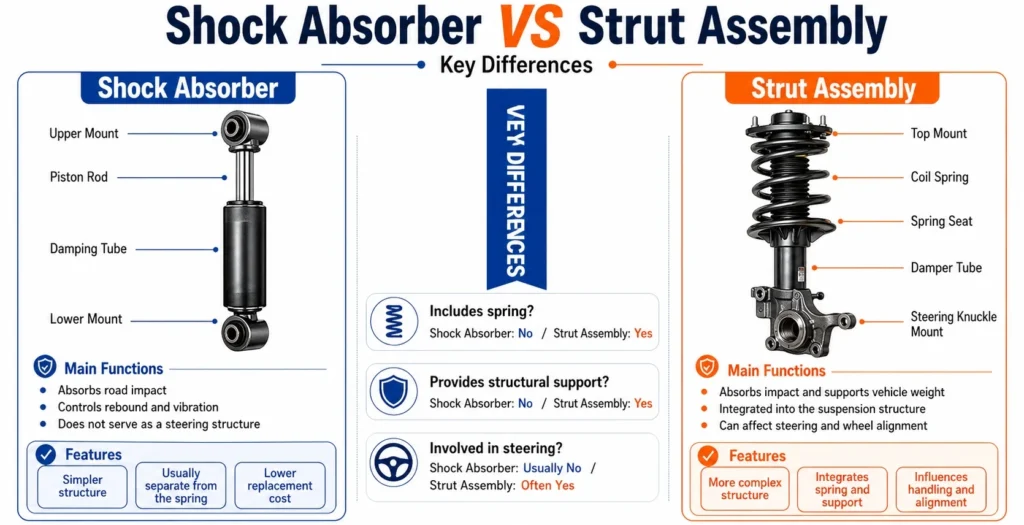
A shock absorber is essentially a “damping device.” Its sole function is to control the movement of the spring; it does not bear the weight of the vehicle itself. If you remove the shock absorber, the car will bounce like a trampoline, but it won’t collapse.
A shock absorber, technically known as a “vibration damper,” is essentially a damping device—its job is to “absorb vibrations.”
When you drive over a pothole or a speed bump, the wheel is first pushed upward, compressing the coil spring in the suspension. After absorbing the impact, the spring rebounds outward. Without a shock absorber to hold it back, the spring would act like the spring in a ballpoint pen that’s been pressed all the way down and then released—it would bounce back and forth several times before coming to a stop.What you feel inside the car is this: after hitting a pothole, the body of the car bounces up and down several times, just like riding a boat.
The internal structure of a shock absorber essentially consists of a piston moving up and down inside a cylinder filled with hydraulic fluid. The piston is equipped with precision valves; as it is forced to move up and down, the hydraulic fluid flowing through these valves creates resistance, converting the kinetic energy generated by the spring into thermal energy, which is then dissipated. This process is called “damping.”
What is a Strut
A strut assembly is different—it integrates the shock absorber with components such as the coil spring, top mount, buffer block, and dust cover into a single structural unit that directly participates in the suspension system’s load-bearing and positioning functions.
If you remove the strut assembly, the wheels would collapse directly into the wheel wells, and the car would be completely undriveable.
This assembly typically includes the following components:
- Shock absorber body (with piston and oil seal)
- Coil spring (supports vehicle weight)
- Top mount/upper mount (connects to the body and absorbs vibrations)
- Bump stops and dust boots (prevent the shock absorber from bottoming out and keep dust out)
- Spring seat/spring pad (secures the spring in place)
Therefore, the strut assembly performs many more functions than a simple shock absorber: it must control spring rebound (just like a shock absorber), support the vehicle’s weight, and maintain the suspension’s geometric alignment.
Shock Absorber vs. Strut
A comparison chart to help you understand the key differences in 30 seconds:
| Comparison Criteria | Shock Absorber | Strut Assembly |
| Primary Function | Dampens spring rebound and controls body roll | Absorbs road impacts + Supports vehicle weight + Maintains suspension alignment |
| Load-bearing | No | Supports vehicle weight |
| Structural components | Single hydraulic cylinder (piston + hydraulic fluid/gas) | Includes shock absorber + coil spring + top rubber + buffer block, etc. |
| Does it affect steering? | No | MacPherson strut rotates with steering |
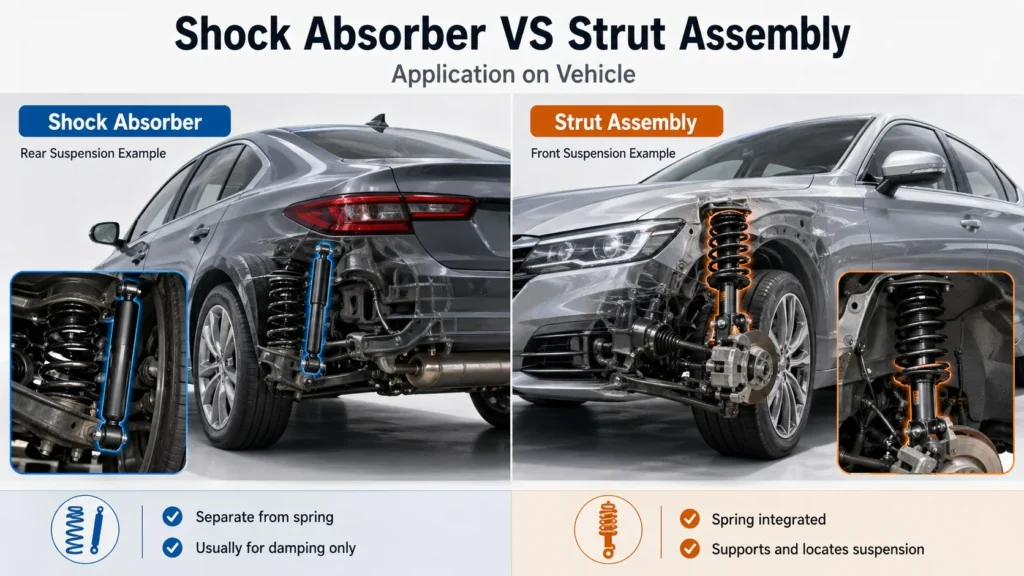
| Common installation locations | Installed on the rear wheels in most vehicles | Installed on the front wheels in most vehicles |
| Difficulty of replacement | Relatively simple; typically two bolts | Complex; requires a spring compressor and involves safety risks |
| Replacement cost | Low | Higher (more parts + more labor) |
| Safety risks (in case of failure) | Longer braking distance, increased body roll when cornering | Longer braking distance + unstable steering + potential spring breakage |
Why do so many people confuse these two?
To be honest, it’s not entirely your fault. There are three reasons:
- Even industry insiders use the terms interchangeably. Many mechanics and parts suppliers casually say, “Replace the four shocks,” when they actually mean replacing four shock absorbers or four strut assemblies. This is especially true for veteran mechanics, who have long conflated shock absorbers and struts—after all, “as long as the car doesn’t shake after the replacement, it’s fine.”
- You can’t tell the difference from the outside. Both shock absorbers and strut assemblies look like thick, round cylinders standing upright in the wheel wells. If you peek through the gap between the tire and the fender, you simply can’t tell which is which.
- The naming conventions for some models are also confusing. Some models use “strut-type shocks” on the rear wheels—components that combine the structural characteristics of a strut with the damping function of a shock absorber. This leads suppliers to label them simply as “rear shock struts,” which only adds to the confusion.
But now that you’ve read this article, it should be clear: look at whether it provides structural support—if it does, it’s a strut assembly; if it only provides damping, it’s a pure shock absorber. This is the key criterion for distinguishing between them.
How to Distinguish Between a Shock Absorber and a Strut
Alright, now that we’ve covered the theory, what you’re probably most curious about is: I just want to know—does my car use a shock absorber or a strut assembly? The following two methods require no crawling under the car or any tools; they’ll help you figure it out quickly from a seasoned driver’s perspective.
Method 1
Open your hood and look directly above the front left and right wheels. You’ll see two black round or square covers (commonly called “strut caps”).
If you see a large, thick coil spring right where your eyes land, with a shiny metal rod protruding from the center of the spring… Congratulations, your front wheels are 100% strut assemblies.
If you only see a small cap, and after unscrewing it you find just a lone piston rod underneath with no sign of a spring… then your front suspension is most likely a double-wishbone or multi-link setup, where the shock absorber and spring are mounted separately.
In this case, you’ll need to look inside the wheel well to see the spring, and the single component you see is simply a shock absorber.
For the vast majority of family sedans, hatchbacks, and city SUVs, what you see when you open the hood is the first scenario.
Method Two
Once you’ve sorted out the front wheels, walk to the rear of the car, crouch down, and look through the gap between the rear tire and the fender.
If you see only a single cylindrical rod standing there on its own, with a mounting point at the top and bottom, and a separate spring nearby… this is a typical separate shock absorber and spring design. Most vehicles with non-independent suspension (torsion beam) have this setup at the rear.
If what you see is a thick spring wrapped around a cylindrical rod, just like the front wheel… then your rear suspension is also a strut-type design (such as Mazda’s E-type multi-link, or the rear suspensions found in some Subaru and older Honda models). This is more common in vehicles that prioritize handling.
What symptoms indicate it’s time for a replacement?
This is the most practical section—I recommend you take note of it.
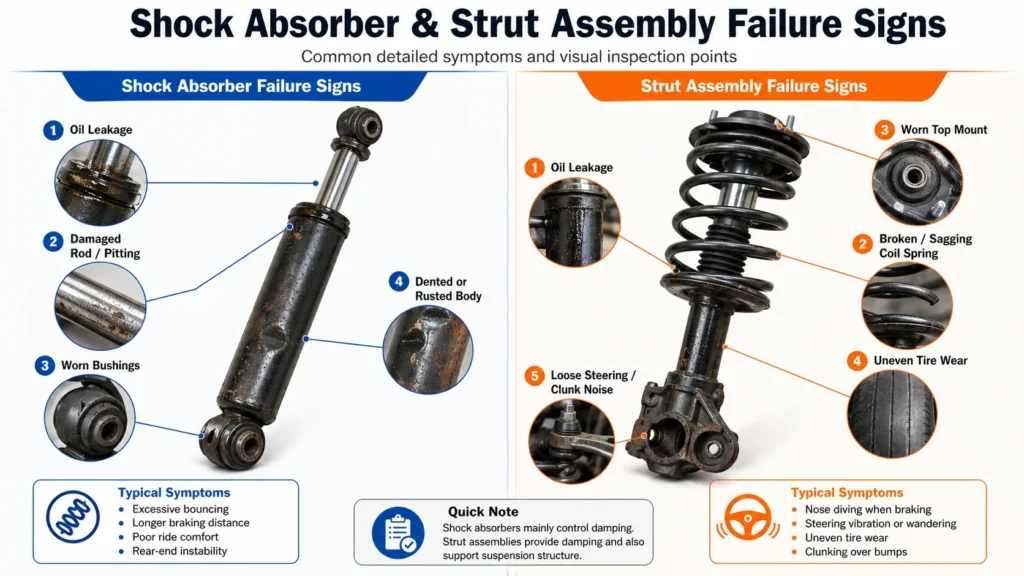
Typical symptoms of shock absorber failure:
- “Boat-like motion”: When driving over a pothole, the body bounces several times before settling down, causing motion sickness-like dizziness.
- Increased body roll when cornering: When turning, the car feels like it’s being thrown outward much more than it did when it was new.
- Unstable at high speeds: The front end feels unstable on the highway, as if the tires can’t grip the road, requiring constant minor adjustments to the steering wheel.
- Severe nose-dive during hard braking: When you slam on the brakes, the front of the car plunges downward sharply.
- “Hand-Press Test”: Park the car on level ground, walk to any corner of the vehicle, and press down firmly on the body with your palm. If, after releasing the pressure, the body bounces back more than twice and continues to shake (as shown at ), the shock absorbers have likely failed.
Additional symptoms of strut assembly failure:
In addition to all the symptoms of shock absorber failure mentioned above, strut assembly failure may also present the following signs:
- Lowered vehicle height: Spring aging and weakening causes one side of the vehicle to sit lower than its normal position
- “Thudding” metallic impact sounds: A noise produced when driving over speed bumps or potholes, caused by damaged internal buffer blocks or loose components within the strut.
- Steering noise: “Clicking” or “squeaking” sounds heard when turning the steering wheel, possibly caused by damaged plain bearings inside the top mount.
- Uneven tire wear: Changes in suspension alignment cause one side of the tire to wear down abnormally fast.
A little-known fact: Worn shock absorbers can directly increase your braking distance. The Royal Automobile Club (RAC) conducted a test: at 50 mph (approximately 80 km/h), a vehicle with rear shock absorbers operating at only 50% efficiency had a braking distance approximately 3.7 meters longer than a vehicle with new shock absorbers. When speed increased to 70 mph (approximately 112 km/h), this gap widened to nearly 6.9 meters.
What does this mean? On the highway, a 6.9-meter difference during an emergency stop could be the difference between an accident and a safe journey home for the whole family.
How to choose when replacing them?
This is the most agonizing question car owners face when considering their budget. Here’s a reliable criterion to help you decide:
When replacing only the shock absorbers (cores):
- The springs are in good condition, with no obvious signs of sagging or rust
- The top mounts show no unusual noises, aging, or cracks
- The vehicle’s ride height is normal, with no sagging
- When your budget is limited but you need to restore damping performance
Situations where replacing the entire assembly is recommended:
- The vehicle has exceeded 100,000 kilometers, so the springs are likely worn out
- One corner of the vehicle is noticeably lower than the others
- The shock absorber mounts are making unusual noises
- It’s an older car, and I don’t want to keep going through this hassle
Based on our extensive experience in the repair shop, replacing the entire assembly on an older vehicle is actually less hassle and more cost-effective. If you only replace the core and not the springs, the springs will likely fail in a few months, forcing you to disassemble the system again—and the small amount you saved on labor costs could end up costing you more due to the additional disassembly work.
Safety Warning
I must emphasize a very important yet often overlooked safety issue here: the coil springs in the strut assemblies store a significant amount of energy. When replacing them, you must use a specialized spring compressor to secure the springs before removal.
If you haven’t received proper training and don’t have the right tools, never attempt to disassemble the strut assembly yourself—the force released by the spring can cause serious injury.
Replacing shock absorbers is relatively safer, and ordinary car owners are more likely to do it themselves, but if you’re not particularly familiar with vehicle mechanics, it’s still recommended to visit a professional repair shop regardless of which part you’re replacing.
Summary
Okay, by now you know more about shock absorbers and strut assemblies than most car owners.
But knowing is one thing; when it comes time to actually order replacement parts, many people still face a dilemma: should you replace just the core or the entire assembly? Are the spring and shock absorber damping properly matched? These aren’t things you can figure out just by staring at a screen and checking specs—you need a reliable source.
Vista Motion can provide you with customized solutions. Contact us directly.
FAQ
How often should shock absorbers or strut assemblies be replaced?
It is generally recommended to inspect them every 80,000–100,000 kilometers. If you frequently drive on rough roads or with heavy loads, inspection may be needed as early as 60,000–80,000 kilometers. Manufacturers typically recommend an evaluation for replacement every 60,000 miles (approximately 96,000 kilometers). However, this varies depending on the vehicle model and driving habits. Replace them when symptoms become apparent; don’t get hung up on the mileage.
Is a four-wheel alignment required when replacing shock absorbers or strut assemblies?
If replacing strut assemblies, a four-wheel alignment is mandatory, as installing or removing them alters the suspension geometry (particularly the camber and toe angles of the front wheels). If replacing rear shock absorbers and the suspension design does not allow for adjustment of alignment parameters, an alignment may not be necessary.
Does a leaking shock absorber have to be replaced?
Yes. Visible oil stains on the exterior of a shock absorber indicate that the seals have failed. Although a slight oil leak may allow the shock to function for a while longer, the damping force has already decreased, which will affect braking distance and handling stability. It is recommended to replace it as soon as possible.
Is it okay to replace just one shock absorber or strut assembly?
No, they must be replaced in pairs—that is, at least the left and right units on the same axle must be replaced simultaneously. Replacing only one will result in asymmetrical damping force between the left and right sides, causing the vehicle to pull to one side during cornering and braking, which is actually more dangerous.
What is a Quick Strut/Complete Strut Assembly?
A Quick Strut is an integrated assembly where all components—including the shock absorber, spring, top mount, and buffer block—have been pre-assembled and tested at the factory. During replacement, the entire unit is simply removed and replaced; there’s no need to use a spring compressor for reassembly. This saves time and effort, making it especially suitable for older vehicles and owners who prefer a hassle-free process.
How do you tell if the shock absorber is faulty or if the top mount is worn out?
A faulty shock absorber typically manifests as repeated bouncing of the vehicle after hitting a pothole, instability at high speeds, and oil leaks. A faulty top mount typically manifests as unusual noises (clunking sounds) when turning the steering wheel and metallic clanging noises from the front end when driving over speed bumps. Sometimes both components fail simultaneously, requiring disassembly and inspection for a definitive diagnosis.
