
Learn the common signs of faulty sway bar links, including clunking noises, loose steering, body roll, uneven tire wear, and poor handling. Find out when to inspect or replace sway bar links.
What Are Sway Bar Links?
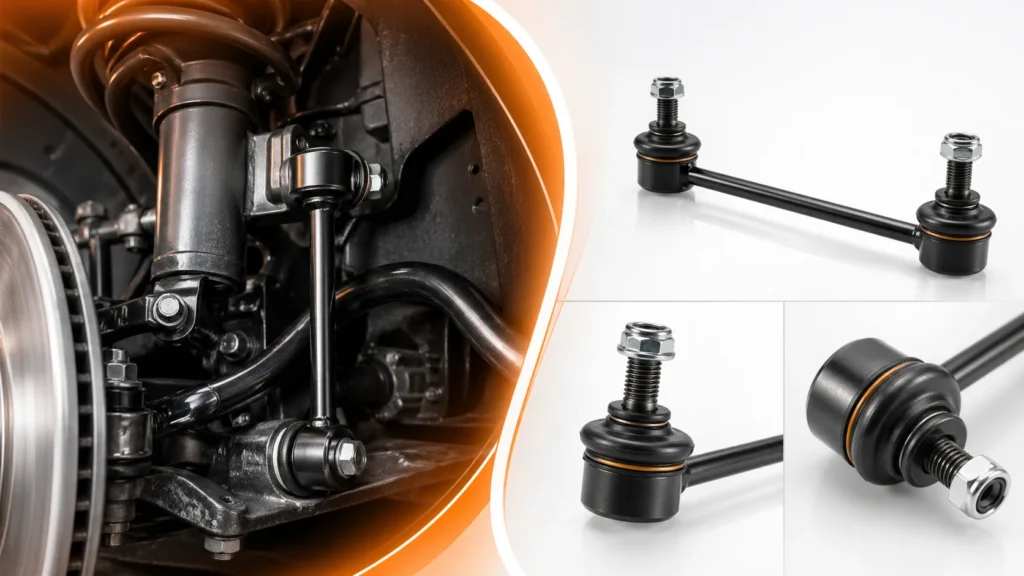
Sway bar links, also known as stabilizer links or anti-roll bar links, connect the stabilizer bar to the suspension system. They help reduce body roll when the vehicle is turning, changing lanes, or driving over uneven surfaces, thereby maintaining better stability.
Simply put, sway bar links aren’t the most noticeable parts on a car, but they act like the “little rivets” of the suspension system. They usually go unnoticed, but once they become loose, worn, or broken, the car’s noise, handling, and stability will start to feel off.
Why Bad Sway Bar Links Matter
When many car owners first hear unusual noises, they assume it’s just a minor issue: “Maybe it’s just the road?”
But if the problem stems from faulty sway bar links, it shouldn’t be dismissed as mere noise.
Faulty sway bar links usually won’t cause the vehicle to break down immediately like an engine failure would, but they do affect suspension response, cornering stability, and driving confidence.
In other words, the danger of faulty sway bar links isn’t that they’ll cause sudden loss of control, but that they gradually erode the vehicle’s stability. This becomes particularly noticeable during high-speed lane changes, sharp turns, on slippery surfaces, or when driving with a full load.
7 Common Signs of Bad Sway Bar Links
The following 7 symptoms are the most important indicators to look for when identifying signs of faulty sway bar links.
Clunking Noise When Driving Over Bumps
The most typical symptom of faulty sway bar links is a clunking noise coming from the undercarriage when the vehicle drives over speed bumps, potholes, gravel roads, or uneven surfaces.
This noise usually originates near the front wheels, though it may also come from the rear suspension area, depending on whether the front or rear sway bar links are faulty.
A popping or knocking noise when driving over bumps is one of the most common signs of a faulty sway bar link.
Why does it make noise?
This is because properly functioning sway bar links should securely connect the sway bar to the suspension components. When the ball joints, bushings, bolts, or connection points wear out, excessive play develops between the parts.
As the wheels bounce up and down, the loose links strike the surrounding structures, creating a sound as if a small hammer were randomly tapping inside the chassis.
If you notice that the noise occurs mainly when driving over bumps at low speeds but is not noticeable when driving on flat roads, then faulty sway bar links are one of the primary components to check.
Rattling or Metal-on-Metal Sound
In addition to obvious clunking noises, faulty sway bar links may also produce a finer, rattling noise. This sound is not a single, sharp knock but rather resembles loose small metal parts vibrating inside the chassis.
Common scenarios include:
- Driving over gravel roads at low speeds
- Driving over a series of small bumps
- When the vehicle is just starting to move or turning at low speed
- When a wheel on one side drives over a manhole cover or road joint
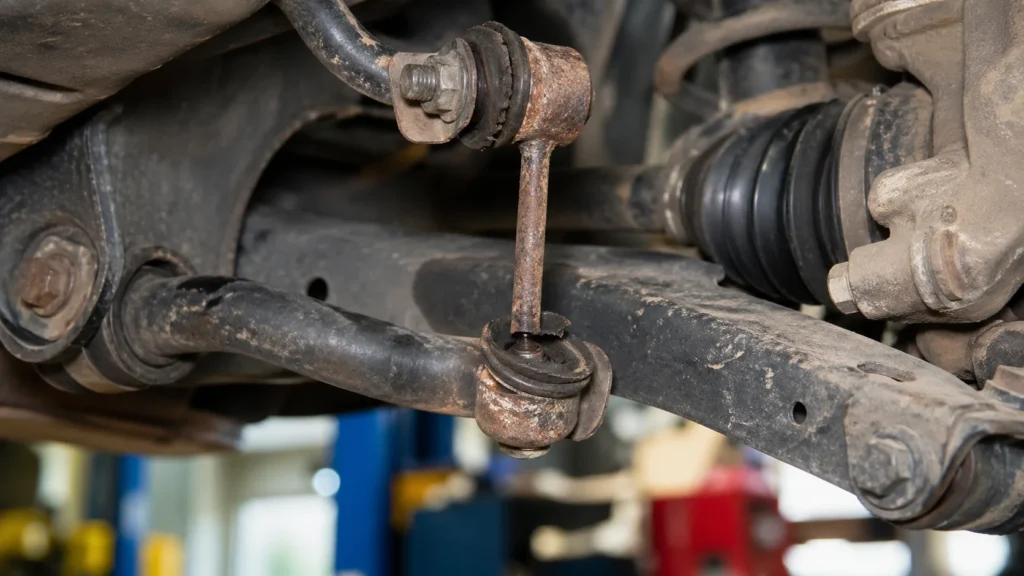
If the noise has a distinct metallic grinding sound, pay special attention. This may indicate that the ball joint has become loose, or that the rubber bushings have aged or cracked, causing the metal components to come into direct contact.
This type of sway bar link noise is easily misdiagnosed as a problem with the shock absorbers, control arms, ball joints, or steering links.
Therefore, the correct approach is not to “guess the part” based on sound alone, but to lift the vehicle and inspect the links for looseness, cracks, deformation, or damaged rubber bushings.
Excessive Body Roll When Turning
If you feel the body of the vehicle is rolling more easily than before when turning—as if the body were being “pushed” outward by the wind—this may be another clear sign of faulty sway bar links.
One of the primary functions of the sway bar is to reduce body roll during turns. When the sway bar links are damaged, the sway bar cannot effectively connect the forces from the left and right suspension systems, causing the vehicle to lean more easily when turning.
You may notice:
- More body sway when turning
- Less stability when cornering
- A slight floating sensation in the front or rear of the vehicle
- A slight delay in the vehicle’s response during sudden lane changes
- More noticeable body roll in SUVs, pickup trucks, or fully loaded vehicles
Excessive body roll is listed as one of the potential symptoms of faulty sway bar links.
However, note that increased body roll is not necessarily caused solely by sway bar links. Aging shock absorbers, spring fatigue, worn control arm bushings, and poor tire condition can also cause similar sensations.
Therefore, this issue should be assessed in conjunction with any unusual noises, inspection results, and the vehicle’s driving behavior.
Loose Steering or Poor Handling
If you notice the steering wheel feels “loose,” steering response is less direct than before, or the vehicle doesn’t change lanes as crisply as it used to, these could also be symptoms of faulty sway bar links.
Faulty sway bar links won’t necessarily cause the steering to fail completely, but they will reduce the stability of the suspension system. When the vehicle’s weight shifts from side to side, the chassis response becomes less precise, and the driver will feel that the handling has become “loose.”
Typical symptoms include
- Unclear steering feedback when turning
- Noticeable body roll when changing lanes at high speeds
- The vehicle tends to sway from side to side even on slightly uneven roads
- The need for more frequent steering corrections
- The vehicle no longer feels as “grounded” as before
A broken sway bar link prevents the sway bar from effectively connecting to the vehicle, which can lead to increased body roll and reduced handling. However, these changes are sometimes subtle, and drivers may not notice them immediately.
This is why many owners wait until the rattling noise becomes increasingly severe before getting it checked. In reality, a loss of steering precision is the chassis’s way of sending an early warning.
Uneven Tire Wear
Faulty sway bar links can also indirectly cause abnormal tire wear, particularly accelerated wear on the outer tire shoulders.
The reason is straightforward: when the sway bar links fail, the vehicle’s ability to control weight transfer during turns deteriorates, causing certain tires to bear more lateral load. Over time, this uneven distribution of force leads to uneven tire wear.
You can look for these signs:
- Different levels of wear on the left and right tires
- The outer shoulder of the tire wears down faster than the inner shoulder
- Abnormal wear on one side of the tires
- Sudden acceleration in tire wear despite no recent impact
- The problem persists even after a four-wheel alignment
Of course, there are many causes of uneven tire wear, including incorrect tire pressure, improper wheel alignment, failed shock absorbers, and control arm issues. Therefore, it is not advisable to conclude that the sway bar links are faulty based solely on tire wear.
However, if uneven tire wear is accompanied by unusual noises from the undercarriage and body roll, it is definitely worth checking the sway bar links.
Vibration Through the Steering Wheel or Floor
Some car owners ask: Can bad sway bar links cause vibration?
The answer is: it’s possible, but it’s usually not the most typical initial symptom. More common signs include rattling noises, loose components, and reduced handling. CarParts.com’s sway bar end link guide notes that loose sway bar links can cause steering wheel vibration, which is often more noticeable at higher speeds.
This vibration may manifest as:
- A slight tremor in the steering wheel
- A loose, rumbling sensation from the undercarriage
- More noticeable vibrations inside the vehicle when driving over rough roads
- A feeling of looseness in the suspension on one side
However, caution is advised. Steering wheel vibration is also commonly caused by tire balancing issues, warped rims, warped brake rotors, loose ball joints, or driveshaft problems. Bad sway bar links can be one cause, but should not be the sole basis for diagnosis.
A more reliable approach is this: if the vibration is accompanied by sway bar link noise, increased body roll when turning, and a loose feeling in the chassis, then the sway bar links should be added to the inspection checklist.
Visible Damage, Rust, Torn Bushings, or Loose Joints
The previous points describe driving sensations, but to definitively confirm faulty sway bar links, a physical inspection is necessary.
You can ask the mechanic to focus on checking:
- Whether the ball joints are loose
- Whether the rubber bushings are cracked
- Whether the dust covers are damaged
- Is the connecting rod bent or deformed?
- Are the nuts and mounting points loose?
- Is there severe rust?
- Are there any signs of metal impact?
- Are there noticeable differences between the left and right sides?
After safely jacking up and supporting the vehicle, visually inspect the sway bar links for damage such as torn bushings or broken ball-and-socket joints, and check for excessive movement.
For everyday car owners, it is not recommended to crawl under the vehicle to perform maintenance without the necessary experience and equipment.
Suspension inspections require the vehicle to be securely supported; do not rely solely on the vehicle’s jack. Safety is far more important than saving a little on inspection costs.
What Causes Bad Sway Bar Links?
Understanding the causes of faulty sway bar links helps you determine why parts fail and assists buyers or repair shops in selecting more reliable replacement parts.
Normal Wear and Tear
Sway bar links are constantly exposed to water, mud, dust, road salt, and temperature fluctuations. Rubber bushings age, ball joints wear down, and metal components may rust. Over time, this leads to looseness and unusual noises.
Rough Roads and Pothole Impact
If a vehicle frequently travels on bumpy roads, gravel roads, construction sites, or rural roads, the impact on sway bar links increases significantly. A single severe impact—such as driving over a pothole at high speed or hitting a curb—can also cause the links to bend or the ball joints to fail.
Heavy Loads
Frequent full loading, towing, or overloading places additional stress on the suspension system. For SUVs, pickup trucks, commercial vehicles, or vehicles that frequently carry cargo, sway bar links and other chassis components are more prone to premature wear.
Poor Part Quality
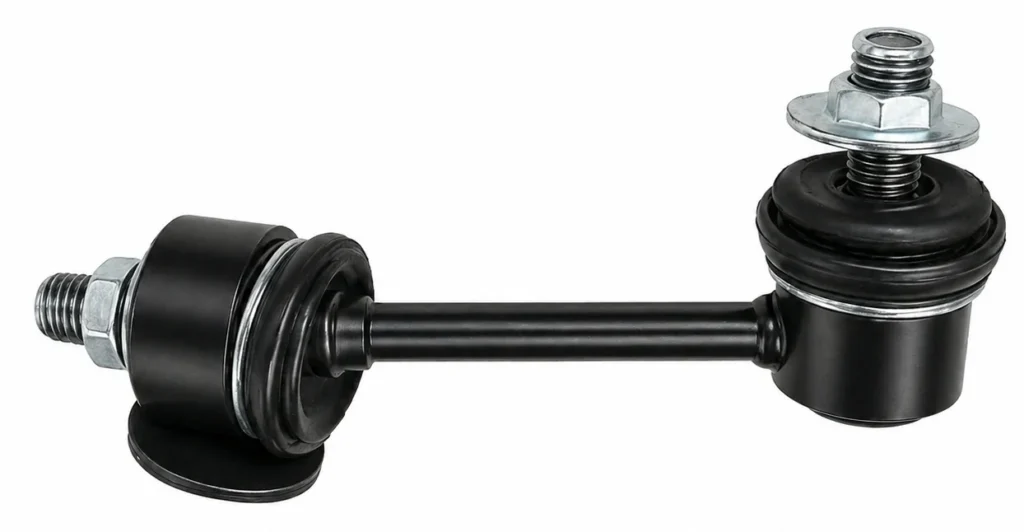
This is particularly important for purchasers. Low-quality sway bar links may suffer from issues such as insufficient material strength, poor ball joint sealing, low-durability rubber bushings, inconsistent thread machining, and inadequate anti-corrosion treatment. While the initial cost may seem low, long-term maintenance costs will be higher.
When it comes to automotive chassis components, low cost is not an advantage—reliability is.
Can You Drive with Bad Sway Bar Links?
Many people ask this question: Can you drive with bad sway bar links?
If the wear is only minor, the vehicle may still be drivable for a while. However, this does not mean the issue can be ignored long-term. A broken sway bar end link may still allow driving, but it will cause noise and may reduce handling performance.
A more practical recommendation is:
- If there is only a slight rattling noise, schedule an inspection as soon as possible
- If you notice significant body roll when turning, avoid high speeds and sudden lane changes
- If the steering feels noticeably loose, don’t delay any further
- If a link is broken, loose, or there are suspension abnormalities, get it repaired as soon as possible
- If you experience brake pull, steering shudder, or abnormal tire wear, have a full undercarriage inspection performed
Faulty sway bar links may not immediately render the vehicle undrivable, but they will reduce the vehicle’s stability during critical maneuvers. The longer such issues are left unaddressed, the more likely they are to affect tires, shock absorbers, control arm bushings, and other suspension components.
Bad Front Sway Bar Links vs. Bad Rear Sway Bar Links
Some vehicles have only a front sway bar, while others have sway bars at both the front and rear. Therefore, symptoms may vary slightly.
Front Sway Bar Link Symptoms
If the front sway bar links are faulty, owners typically notice the following:
- Noises near the front wheels
- Loose steering feel
- Clunking noises from the front suspension when driving over bumps at low speeds
- Noticeable body roll when turning
- Reduced front-end stability when changing lanes at high speeds
Issues with the front stabilizer bar link are easier for drivers to notice because they are more closely related to steering feel.
Rear Sway Bar Link Symptoms
If there is an issue with the rear sway bar links, symptoms may include:
- Knocking noises from the rear suspension area
- Increased rear-end sway during turns
- Reduced rear-end tracking during high-speed lane changes
- Abnormal wear on the rear tires
- A noticeable loose feeling in the rear when driving over uneven surfaces
Symptoms of rear sway bar link issues are sometimes less obvious than those of front suspension problems, but they are more noticeable in SUVs, station wagons, pickup trucks, or vehicles with heavy rear loads.
Bad Sway Bar Links or Other Suspension Problems?
Noises from the undercarriage can originate from many components:
| Symptoms | Possible Causes |
| Clunking over bumps | Sway bar links, control arm bushings, ball joints, struts |
| Steering wheel vibration | Tire balancing, wheel hubs, brake rotors, sway bar links |
| Excessive body roll when turning | Sway bar links, shock absorbers, springs, stabilizer bar bushings |
| Uneven tire wear | Wheel alignment, tire pressure, suspension component wear |
| Metal knocking noise | Loose links, damaged bushings, loose suspension mounts |
Therefore, the correct approach to diagnosing faulty sway bar links should be:
Symptom combination + Vehicle usage conditions + Visual inspection + Play test + Road test confirmation if necessary.
When Should Sway Bar Links Be Replaced?
Sway bar links typically do not have a fixed replacement interval. It is not a matter of replacing them every 30,000 km or 50,000 km; rather, it depends on the actual wear and tear.
Sway bar links are generally not considered wear items with a fixed replacement interval; they only need to be replaced when worn or damaged.
It is recommended to inspect or replace them in the following situations:
- Persistent clunking noise
- Visible signs of cracked bushings
- Loose ball joints
- Damaged dust covers causing grease leakage
- Deformed or broken tie rod
- Chassis inspection reveals abnormal left-right alignment
- Inspect during replacement of shock absorbers, control arms, or tires
- After the vehicle has experienced severe impacts from potholes or an accident
Many mechanics recommend replacing sway bar links in pairs. RepairPal also notes that sway bar links should typically be replaced on both sides simultaneously.
The reason is simple: the operating conditions on both sides are similar, so if one side fails, the other is often nearing the end of its service life. Replacing only one side may save money in the short term, but if the other side starts making noise later, you’ll have to repeat the disassembly and inspection process.
What to Look for in High-Quality Sway Bar Links
If you’re a car owner, the key is to find a reliable repair shop.
If you are an importer, wholesaler, repair chain, or automotive parts buyer, the key is supply chain quality.
When selecting high-quality sway bar links, you should typically consider:
- Material strength
- The link body must possess sufficient tensile strength, impact resistance, and fatigue resistance.
- Ball joint seal design
- If the seal is inadequate, dust and water can enter, significantly accelerating ball joint wear.
- Quality of rubber or polyurethane bushings
- The material of the bushing determines its resistance to aging and cracking, as well as its shock-absorbing performance.
- Thread machining accuracy
- Unstable threads can compromise installation reliability and lead to after-sales issues.
- Corrosion protection
- Salt spray environments, regions with rain and snow, and muddy or sandy road conditions place higher demands on surface treatment.
- Dimensional Consistency
- Length, hole positions, ball joint angles, and mounting threads must all be consistent; otherwise, assembly will be affected.
- Traceability
- For B2B procurement, batch management, inspection records, material certificates, and process control are critical.
This is why automotive chassis components cannot be evaluated based on price alone. An inconsistent sway bar link may ultimately result not just in the cost of the part, but in customer complaints, returns, damage to brand reputation, and extended after-sales service time.
Summary
Defective sway bar links usually don’t cause serious failures right away, but they will alert you through abnormal noises, poor handling, body roll, loose steering, and uneven tire wear—signs that the suspension system is no longer as stable as it once was.
If you hear a clunking noise when driving over bumps, feel the body swaying more easily during turns, or notice a loose sensation in the chassis, don’t just dismiss it as “normal sounds from an older car.”
The correct approach is to inspect the sway bar links, stabilizer bar bushings, control arms, shock absorbers, and tire condition as soon as possible to identify the root cause.
If you’re looking for a reliable supplier of metal components, contact Vista Motion directly. Provide your drawings, material specifications, application details, and quality standards, and our engineering team can help evaluate manufacturing solutions, process risks, and the feasibility of bulk delivery.
FAQ
What happens if a sway bar link breaks completely?
If a sway bar link breaks completely, the sway bar may no longer function properly on that side of the suspension. You may hear louder clunking noises, feel increased body movement when cornering, and notice that the vehicle feels less stable during quick lane changes. A broken sway bar link should be inspected and replaced as soon as possible, especially if the vehicle is driven at highway speeds or on rough roads.
Can faulty sway bar links affect wheel alignment?
Faulty sway bar links typically do not directly alter wheel alignment angles such as camber, caster, or toe. However, they can cause the suspension to feel loose and unstable, which may produce symptoms resembling an alignment issue. If the vehicle pulls to one side, the steering wheel is off-center, or tires wear unevenly, both the sway bar links and the alignment should be checked.
Do faulty sway bar links affect braking performance?
Faulty sway bar links do not directly control the brake system, but they can affect vehicle stability during braking. If the suspension is loose, the vehicle may feel less stable when braking on rough roads or while turning. For safe braking performance, the sway bar links, control arms, struts, tires, and brake components should all be in good condition.
Can a faulty sway bar link damage other suspension components?
Yes, a faulty sway bar link can increase stress on nearby suspension components over time. When the link becomes loose or broken, the sway bar cannot distribute suspension forces as intended. This may contribute to excessive movement in bushings, struts, control arms, and tires, especially if the vehicle is driven for an extended period without repair.
Why do new sway bar links still make noise after replacement?
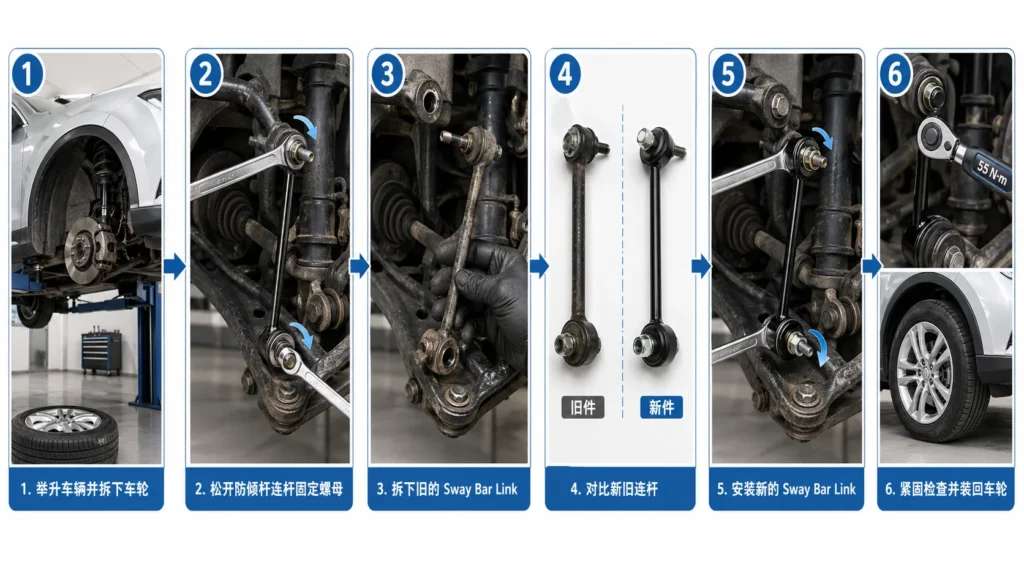
New sway bar links may still make noise if they are not tightened to the correct torque, installed in the wrong position, or paired with worn sway bar bushings. Noise can also persist if the original problem originated from another suspension component, such as a control arm bushing, strut mount, ball joint, or stabilizer bar bushing. After replacement, the entire suspension connection area should be rechecked.
Do sway bar links need to be greased?
Some sway bar links are sealed and do not require additional grease. Others may have grease fittings and need periodic lubrication as part of routine maintenance. The correct answer depends on the part’s design. If the sway bar link has a sealed ball joint, adding grease is usually not possible. If it has a grease nipple, the correct grease type and service interval should follow the manufacturer’s recommendations.
What is the difference between a sway bar link and a sway bar bushing?
A sway bar link connects the sway bar to the suspension, while a sway bar bushing secures the sway bar to the vehicle frame or subframe. Both parts help the sway bar function properly, but they fail in different ways. A faulty sway bar link often causes clunking or looseness, while a worn sway bar bushing may cause squeaking, knocking, or excessive bar movement.
Can faulty sway bar links trigger a dashboard warning light?
Faulty sway bar links typically do not trigger a dashboard warning light because they are mechanical suspension components without direct electronic sensors on most vehicles. However, if unstable handling affects systems such as traction control or stability control while driving, a warning light may illuminate for those systems. In such cases, both the electronic system and the mechanical suspension should be inspected.
What information is needed to source the correct sway bar links?
To source the correct sway bar links, you typically need the vehicle make, model, year, trim, drive type, front or rear axle position, OEM part number (if available), and installation dimensions. For B2B procurement or custom manufacturing, drawings, material requirements, surface treatment, ball joint specifications, rubber hardness, salt spray requirements, and packaging standards are also important. Accurate information helps avoid fitment issues and reduces after-sales problems.
