
Learn about the meaning of Shore hardness in rubber, the difference between Shore A and Shore D, rubber hardness testing methods, and how to select the appropriate rubber hardness based on load, shock absorption, sealing requirements, and the operating environment.
What Is Shore Hardness in Rubber?
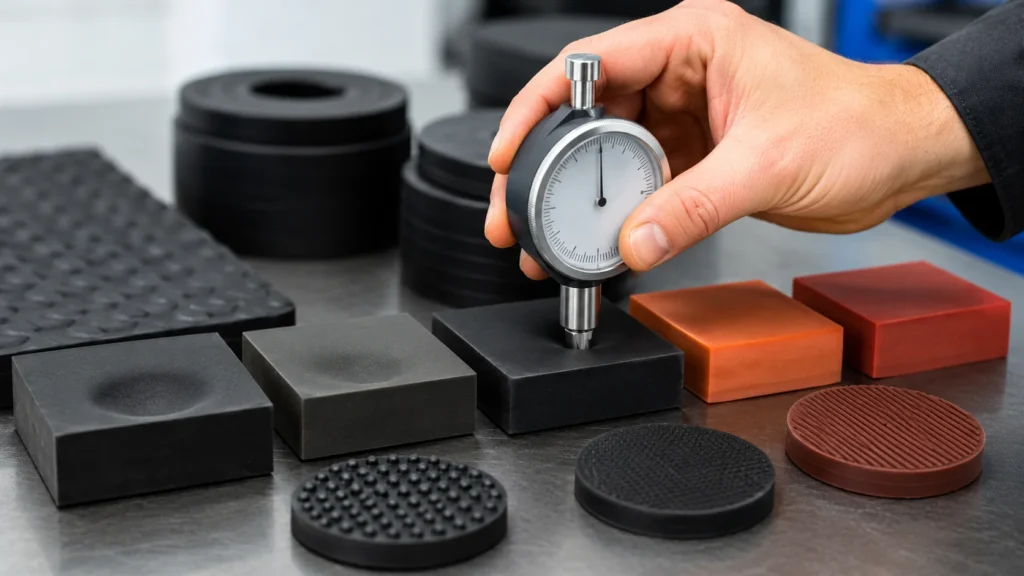
Shore hardness is an important indicator used to measure the softness or hardness of rubber materials. Simply put, it represents the rubber surface’s resistance to indentation by an external force.
Think of it this way: if you press your finger against a very soft rubber pad, it will indent noticeably; if you press against a harder rubber wheel, the surface deformation will be much less. Shore hardness converts this sensation of “soft” and “hard” into a measurable, comparable number that can be included in drawings and technical specifications.
In industrial rubber products, the most common is **Shore A hardness**. For example:
- 40 Shore A: Relatively soft, with good elasticity and deformation capacity;
- 60 Shore A: Medium hardness, commonly used in many industrial rubber parts;
- 70 Shore A: Relatively hard, with superior support and resistance to deformation;
- 90 Shore A: Very hard, approaching the hardness of rigid rubber.
Therefore, when a customer asks, “What is the rubber hardness?”, what they are truly concerned about is often not just a number, but whether the rubber part can bear weight, absorb shock, provide a seal, withstand wear, and remain stable during long-term use.
Why is rubber Shore hardness important?
Rubber Shore hardness directly affects a product’s performance. For seals, rubber gaskets, rubber bushings, rubber shock absorbers, rubber vibration mounts, and rubber-to-metal bonded components, selecting the wrong hardness can lead to premature product failure.
If the rubber is too soft, the following issues may arise:
- Insufficient load-bearing capacity;
- Severe deformation after prolonged compression;
- Dimensional instability after installation;
- Prone to extrusion or tearing;
- Shortened service life under heavy-load conditions.
If the rubber is too hard, it may also cause problems:
- Reduced shock absorption;
- Reduced shock absorption capacity;
- Inadequate sealing fit;
- Increased installation difficulty;
- Vibration and noise are more easily transmitted to the equipment structure.
Therefore, higher rubber hardness is not necessarily better, nor is softer rubber always preferable. The truly appropriate Shore hardness for rubber must be determined by considering the product’s function, load conditions, operating environment, and assembly structure collectively.
For B2B industrial components, selecting the appropriate rubber hardness is fundamentally an engineering problem, not a simple choice of material parameters.
How is rubber Shore hardness tested?
Rubber Shore hardness is typically tested using a Shore hardness tester. During the test, the tester’s indenter is pressed into the rubber surface under a specified force, and the hardness value is determined based on the depth of penetration.
The deeper the indenter penetrates, the softer the rubber and the lower the hardness value; the shallower the penetration, the harder the rubber and the higher the hardness value.
Common expressions include:
- Shore A 60;
- 60 Shore A;
- 60A durometer;
- Rubber hardness 60 Shore A;
- 60 Shore A hardness.
These terms are commonly seen in industrial procurement and technical drawings, but the more standard expression is typically 60 ± 5 Shore A. The “±5” indicates the permissible hardness tolerance range.
It is important to note that rubber hardness testing does not yield accurate results with a single, casual press. Test results are influenced by various factors, such as:
- Sample thickness;
- whether the surface is flat;
- Test temperature;
- Reading time;
- the distance of the test point from the edge;
- Whether the hardness tester is calibrated;
- Whether the rubber has been aged, compressed, or exposed to the environment;
- Consistency in the tester’s operating procedures.
Therefore, in industrial production and quality inspection, Shore hardness testing of rubber must follow a consistent methodology; otherwise, data from different batches, suppliers, or testing conditions may vary.
What is the difference between Shore A and Shore D?
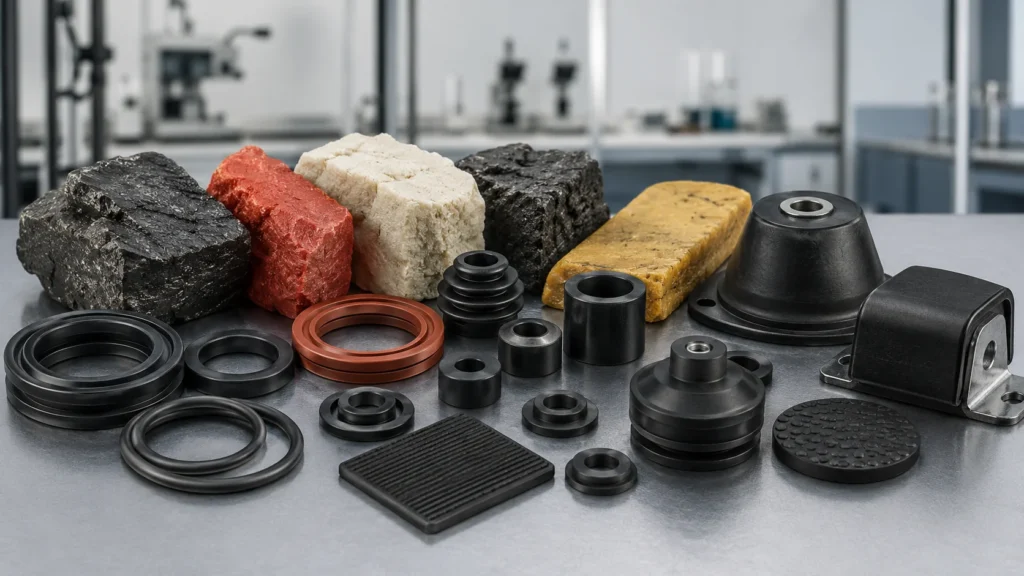
When searching for “rubber Shore hardness,” many people come across different hardness scales such as Shore A, Shore D, and Shore 00. These are all part of the Shore hardness system but are applicable to different materials.
For most rubber products, Shore A is the most commonly used.
| Hardness Scales | Applicable Materials | Common Products |
| Shore 00 | Very soft gels, sponges, and foams | Soft pads, foam materials, gel-like materials |
| Shore A | General-purpose rubber, elastomers | Seals, shock-absorbing pads, rubber bushings, rubber mounts |
| Shore D | Hard rubber, hard plastics, rigid polymers | Hard rubber wheels, engineering plastic parts, rigid polymer components |
In short:
Shore A is used for most rubber materials, while Shore D is used for harder materials.
If the drawing only specifies “Hardness 60” without indicating whether it is Shore A or Shore D, you must confirm this with the customer. This is because 60 Shore A and 60 Shore D are not equivalent and cannot be directly substituted for one another.
For rubber shock absorbers, rubber pads, rubber seals, rubber bushings, and rubber-to-metal bonded parts, Shore A hardness is typically the primary consideration.
Common Shore Hardness Ranges for Rubber
Different rubber products have varying hardness requirements. The following ranges can serve as a preliminary reference:
| Rubber Hardness Range | Perceived Softness/Hardness | Common Applications |
| 20–30 Shore A | Very soft | Soft seals, cushioning pads, flexible protective components |
| 40–50 Shore A | Moderately soft | Shock-absorbing pads, light-duty rubber mounts, flexible seals |
| 55–65 Shore A | Medium hardness | General-purpose rubber parts, rubber feet, vibration dampers, bushings |
| 70–80 Shore A | Slightly hard | Load-bearing rubber pads, rigid bushings, wear-resistant rubber parts |
| 90 Shore A and above | Very hard | Hard rubber wheels, high-load support components, rigid rubber parts |
In many industrial applications, 60 Shore A rubber is a common starting point. It offers a balance of flexibility, support capacity, and resistance to deformation, making it suitable for many general-purpose rubber components.
However, this does not mean that 60 Shore A is suitable for all products. For example, even for rubber shock absorbers, the hardness requirements for use in light equipment and heavy machinery may be completely different; similarly, for rubber seals, the hardness requirements for static and dynamic sealing applications also differ.
Does higher rubber hardness always mean better performance?
No.
This is a common misconception in procurement and engineering discussions. The Shore hardness of rubber only indicates the material’s surface resistance to indentation; it does not, on its own, represent the rubber’s full range of properties.
- Rubber performance also includes:
- tensile strength;
- Elongation at break;
- Tear strength;
- Compression set;
- Abrasion resistance;
- Oil resistance;
- Ageing resistance;
- Ozone resistance;
- High and low temperature resistance;
- Dynamic fatigue resistance;
- Bond strength between rubber and metal.
For example, both types of rubber can achieve a Shore A hardness of 70, but if one is natural rubber and the other is EPDM or NBR, they may differ significantly in terms of oil resistance, weather resistance, elasticity, and aging resistance.
Therefore, determining whether a rubber part is suitable cannot be based solely on hardness values. A more accurate approach is to evaluate **the rubber’s Shore hardness, material type, product structure, operating environment, and testing requirements** together.
How to Select the Appropriate Rubber Shore Hardness?
When selecting rubber hardness, it is not advisable to start by asking, “Which hardness is best?” Instead, you should first assess the product’s actual operating conditions.
Determine if the product needs to bear a load
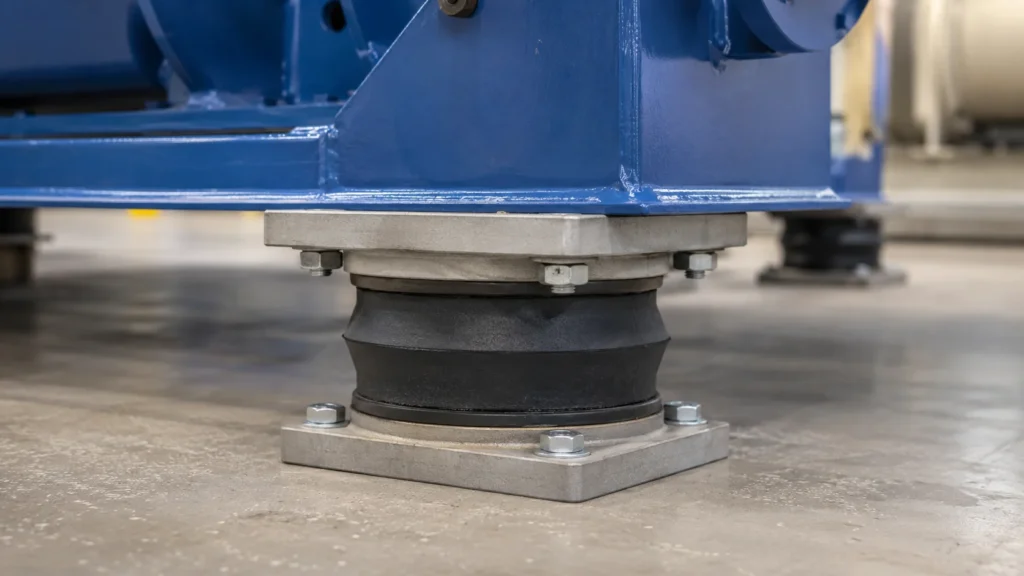
If the rubber component needs to withstand significant loads—such as equipment bases, load-bearing rubber pads, mechanical support components, or heavy-duty rubber shock absorbers—a higher Shore A hardness is generally required to minimize excessive compression and deformation.
However, if the hardness is too high, the rubber may become too stiff, potentially reducing its shock absorption and energy dissipation capabilities. Therefore, load-bearing rubber components should not prioritize hardness alone; compression set and dynamic performance must also be considered.
Determine whether the product is used for vibration damping
The core function of rubber shock absorbers is to absorb vibrations and impacts. Generally, softer rubber deforms more easily and is better at absorbing vibrational energy.
However, if the rubber is too soft, it may collapse, develop fatigue cracks, or experience excessive displacement under prolonged compression and repeated vibrations.
Therefore, when selecting the hardness of rubber vibration damping components, static loads, dynamic loads, vibration frequency, installation space, and target service life must all be considered simultaneously.
Determine if the product is used for sealing
Seals typically require a good seal. If the rubber is too hard, it may not form a proper seal against the contact surface; if it is too soft, it may be squeezed out under pressure or suffer permanent deformation.
Therefore, the hardness of rubber seals must be determined based on sealing pressure, medium type, assembly clearance, and operating temperature.
Consider the operating environment
Different environments have a significant impact on rubber materials. Outdoor use, oily environments, high-temperature environments, low-temperature environments, salt spray environments, and environments with chemical media can all affect the long-term performance of rubber.
For example:
- Outdoor environments prioritize weather resistance, ozone resistance, and aging resistance;
- Oily environments require greater oil resistance;
- High-temperature environments require heat aging resistance;
- Dynamic operating conditions place greater emphasis on fatigue resistance;
- For rubber-to-metal bonded components, bond strength is also a key consideration.
If only hardness is determined while ignoring the material and environment, the product may still fail.
Review drawing and sample requirements
If the customer’s drawings specify a hardness value, such as 65 ± 5 Shore A, production must be controlled within this range.
If only a sample is available and no drawings exist, the sample’s hardness must first be tested, and then a decision made regarding whether to maintain the original hardness based on the actual application. This is because the sample may have aged, and its hardness value may not match that of a new product.
Determine if sample validation is required
For critical components such as rubber shock absorbers, rubber bushings, rubber bearings, and rubber-to-metal bonded parts, sample validation is recommended prior to mass production.
Sample validation helps confirm:
- Whether the hardness is appropriate;
- Whether installation is smooth;
- Whether compression set is within acceptable limits;
- Whether the vibration damping performance meets requirements;
- Whether the metal bond is secure;
- Is there a risk of failure during long-term use?

The Relationship Between Rubber Shore Hardness and Vibration Damping Performance
In rubber vibration damping products, hardness has a significant impact on actual performance.
Softer rubber typically absorbs vibrations more easily but has limited load-bearing capacity; harder rubber can withstand greater loads, but its vibration isolation and cushioning effects may be reduced.
For example, when a piece of equipment generates continuous vibration during operation, the rubber vibration damping component must remain stable through repeated compression and rebound. If the rubber is too soft, the equipment may shake excessively; if the rubber is too hard, the vibration may be directly transmitted to the frame or the ground.
Therefore, the hardness of rubber vibration dampers should not be selected based solely on experience, but must take into account:
- the weight of the equipment;
- Installation location;
- Vibration frequency;
- Load direction;
- compression space;
- Rubber material;
- Whether bonded to metal;
- Expected service life.
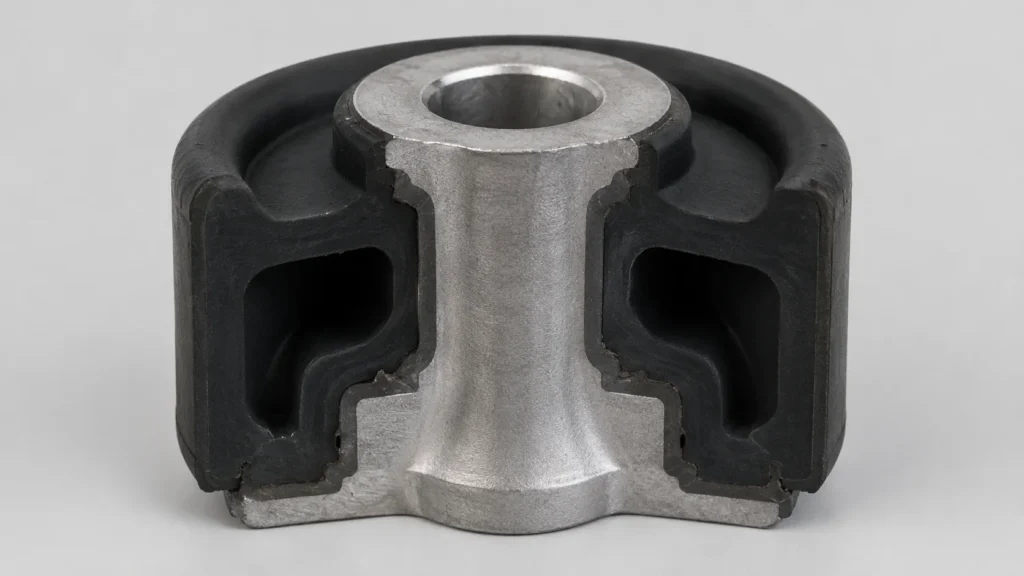
For rubber-to-metal bonded components, hardness also affects stress transfer between the rubber layer and the metal part. If the rubber is too soft, the bonded area may experience excessive displacement; if the rubber is too hard, the cushioning effect may be insufficient.
This is why, in actual projects, professional suppliers do not simply ask, “What hardness do you need?” but instead seek further clarification on load, operating conditions, materials, structure, and testing requirements.
The Relationship Between Different Rubber Materials and Shore Hardness
Shore hardness can be adjusted through formulation, but different rubber materials have different performance foundations. In other words, even at the same 60 Shore A, the actual performance of different materials varies.
Naturaml Rubber
Natural rubber offers good elasticity, tear resistance, and fatigue resistance, and is commonly used for vibration damping, cushioning, and dynamic elastic components. If a product prioritizes elasticity and vibration damping, natural rubber is a common choice.
However, natural rubber does not offer the strongest oil resistance or weather resistance, so it is not suitable for all environments.
NBR (Nitrile Rubber)
The primary advantage of NBR is its excellent oil resistance, making it commonly used for oil seals, O-rings, gaskets, and industrial rubber components that come into contact with oils and greases.
If a rubber part needs to come into contact with lubricants, fuel, or oily media, NBR is generally a better choice than natural rubber.
EPDM (Ethylene Propylene Diene Monomer)
EPDM offers excellent weather resistance, ozone resistance, and aging resistance, and is commonly used in outdoor rubber components, sealing strips, water system components, and rubber products exposed to the environment for extended periods.
If a rubber part is used in an outdoor environment, EPDM is usually a material worth considering.
Silicone Rubber
Silicone rubber offers excellent resistance to both high and low temperatures, making it suitable for applications with demanding temperature ranges. However, its mechanical strength and wear resistance must be evaluated based on the specific application.
Polyurethane Rubber
Polyurethane materials generally offer good wear resistance and load-bearing capacity, and are commonly used in rollers, bushings, spacers, and wear-resistant parts. They can achieve high hardness, making them suitable for certain heavy-duty or wear-resistant applications.
Therefore, when selecting rubber hardness, one should not simply say, “I want 70-degree rubber.” A more accurate statement would be: “I want a rubber part made of a specific material, within a specific hardness range, for a specific operating condition.”
Why Do Rubber Hardness Test Results Vary?
Rubber is an elastic material, unlike metals, which are rigid and stable. Its hardness test results are influenced by testing methods and environmental conditions.
Common sources of error include:
- The sample is too thin;
- Uneven surface;
- Testing near the edge;
- The hardness tester is not pressed vertically;
- Inconsistent reading times;
- Testing was performed at different temperatures;
- The sample has just been compressed and has not yet recovered;
- The hardness tester was not calibrated;
- Operators have different operating habits.
Therefore, it is recommended to establish clear testing methods and acceptance criteria during supplier evaluation, incoming inspection, and mass production. For custom rubber parts, hardness should generally not be specified as an absolute value, but rather as a reasonable range, such as 60 ± 5 Shore A.
This ensures quality control while also taking into account the inherent production characteristics of the rubber material.
Are the Shore hardness and compression properties of rubber the same?
No.
The Shore hardness of rubber reflects the surface’s resistance to indentation by a test needle.
Compression performance reflects the rubber’s deformation, rebound, and long-term retention capabilities under actual loads.
These two indicators are related but cannot be used interchangeably.
For example, a rubber part with high hardness may resist indentation on the surface, but if the material formulation is poor, it may still suffer severe permanent deformation after prolonged compression. Conversely, a rubber part of medium hardness, if formulated and structured appropriately, may perform more stably under long-term dynamic conditions.
For industrial rubber components, particularly rubber shock absorbers, rubber bushings, rubber mounts, and rubber-to-metal bonded parts, in addition to hardness, the following should also be considered:
- Compression set;
- Dynamic fatigue performance;
- Tensile strength;
- Tear strength;
- Bond strength;
- Dimensional stability;
- Environmental aging performance.
If product quality is assessed based solely on Shore hardness, it is easy to draw incomplete or even incorrect conclusions.
When purchasing rubber parts, how should hardness requirements be specified correctly?
If you are preparing drawings, RFQs, or purchasing specifications, it is recommended to specify rubber hardness requirements clearly.
A standard format is:
Material: EPDM Rubber
Hardness: 60 ± 5 Shore A
Color: Black
Application: Outdoor Sealing Component
Testing: Durometer Hardness Test
For rubber-to-metal bonded parts, the following can also be added:
- Metal material;
- Metal surface treatment;
- Rubber material;
- Rubber hardness;
- Bond strength requirements;
- Load direction;
- Operating temperature;
- Salt spray or aging requirements;
- Fatigue testing requirements;
- Drawing dimensions and tolerances.
The more specific this information is, the easier it is for suppliers to assess production feasibility, and the less time will be spent on repeated sample revisions.
When should you seek a supplier’s assistance in determining rubber hardness?
If any of the following situations arise, it is recommended not to rely solely on online rubber hardness charts for selection, but rather to involve the supplier in the technical evaluation:
- Only a sample is available, without complete drawings;
- The drawings only specify “rubber” without indicating the material or hardness;
- The product is used for shock absorption, load-bearing, or safety-critical applications;
- Previous instances of cracking, delamination, deformation, or failure in rubber components;
- The product will be exposed to outdoor conditions for extended periods;
- The product will come into contact with oil, water, salt spray, or chemical agents;
- Rubber-to-metal bonding is required;
- The product has fatigue life requirements;
- The customer requires custom rubber shock absorbers or rubber mounts.
In such projects, the rubber’s Shore hardness is merely a starting point. More importantly, material selection, structure, molding processes, and testing requirements must be comprehensively evaluated based on actual operating conditions.
How do manufacturers control rubber Shore hardness?
Consistent rubber hardness is not achieved through final testing alone, but through control throughout the entire manufacturing process.
A reliable rubber component manufacturer typically implements controls at the following stages:
- Raw material selection;
- Rubber formulation design;
- Compounding process;
- Mold design;
- Vulcanization temperature;
- Vulcanization time;
- Product dimensional control;
- Hardness testing;
- Visual inspection;
- Rubber-to-metal bond quality;
- Batch traceability;
- Required fatigue or durability testing.
For custom rubber parts, suppliers must not only be capable of manufacturing them but also understand the product’s intended application. This is because the same hardness value may yield completely different results when used in different products.
Practical Advice for Selecting Rubber Shore Hardness
If you’re unsure which hardness to choose, start by asking yourself these questions:
1. Is this rubber part intended for sealing, vibration damping, load-bearing, or protection?
2. Will it be subjected to static or dynamic loads?
3. Does the product require long-term compression?
4. Will it come into contact with oil, water, UV light, ozone, salt spray, or chemical media?
5. Does it need to be bonded to metal parts?
6. Are there any drawings, samples, or failed parts available for reference?
7. Are there any fatigue life or durability requirements?
8. Is it necessary to control hardness tolerances?
9. Is the product intended for indoor or outdoor use?
10. Is sample testing required before mass production?
If these questions can be answered clearly, the selection of rubber hardness will be more accurate. Conversely, if this information is unclear and an order is placed based solely on a hardness value, performance instability or product incompatibility issues are likely to arise later on.
Summary
The Shore hardness scale is used to measure the softness or hardness of rubber materials and is a critical parameter in the design, procurement, production, and inspection of rubber components. For most rubber products, Shore A is the most commonly used hardness scale; for harder rubber or plastic materials, Shore D may be used.
However, in real-world industrial applications, rubber hardness alone does not determine a product’s quality. The appropriate rubber hardness must be determined by considering material type, load conditions, vibration damping requirements, sealing requirements, operating environment, structural design, and quality inspection collectively.
This is particularly important for Vista Motion. We do not deal with ordinary standard parts, but rather custom vibration damping components used in industrial equipment, rail transit, agricultural machinery, and various mechanical systems. Whether it is rubber vibration dampers, rubber mounts, rubber bushings, or rubber-to-metal bonded parts, the choice of hardness directly affects the product’s load-bearing capacity, vibration damping performance, assembly stability, and long-term reliability.
Vista Motion can assist in evaluating rubber materials, Shore hardness, metal structures, bonding methods, and testing requirements based on customer drawings, samples, or actual operating conditions. By leveraging our manufacturing and quality control capabilities, we provide rubber vibration damping and industrial component solutions that are better suited to real-world applications. If you are developing custom rubber parts or if your existing products suffer from issues such as deformation, delamination, insufficient vibration damping, or inconsistent service life, please contact us directly.
FAQ
What is the Shore hardness of rubber?
Shore hardness is a measure of the softness or hardness of rubber materials, indicating the rubber’s resistance to indentation. The lower the number, the softer the rubber; the higher the number, the harder the rubber. The most commonly used Shore hardness for industrial rubber parts is Shore A.
What does Shore A hardness mean?
Shore A hardness refers to the Shore A scale, which is primarily used to test rubber, elastomers, and medium-hardness flexible materials. Rubber seals, rubber shock absorbers, rubber pads, rubber bushings, and rubber mounts typically use Shore A as their hardness standard.
What does 60 Shore A rubber mean?
60 Shore A rubber indicates a rubber hardness of 60 on the Shore A scale, which falls within the medium-hardness range. It is relatively common in industrial rubber components, offering a balance of flexibility, support, and resistance to deformation. However, its suitability for a specific product depends on the load, material, and operating environment.
Does higher rubber hardness mean greater durability?
Not necessarily. A higher rubber hardness rating simply indicates that the rubber is harder and less prone to indentation, but it does not necessarily mean it is more durable. Rubber durability also depends on the material formulation, resistance to aging, oil resistance, compression set, fatigue resistance, and product design.
What is the difference between Shore A and Shore D?
Shore A is primarily used for rubber and elastic materials, while Shore D is primarily used for hard rubber, engineering plastics, and rigid polymers. The two are not the same scale and cannot be directly converted or substituted. Rubber part drawings should clearly specify whether Shore A or Shore D is used.
How is rubber hardness measured?
Rubber hardness is typically tested using a Shore hardness tester. The tester’s indenter penetrates the rubber surface, and the Shore A or Shore D ( ) hardness value is displayed based on the depth of penetration. During testing, attention must be paid to sample thickness, surface flatness, temperature, reading time, and test location; otherwise, the results may be inaccurate.
What Shore A hardness is suitable for rubber vibration dampers?
There is no fixed “optimal” hardness for rubber vibration dampers. Softer rubber generally offers better vibration absorption, while harder rubber typically provides greater load-bearing capacity. The actual selection should be based on a comprehensive assessment of equipment weight, vibration frequency, installation method, available compression space, and operating environment.
What is the typical hardness range for common rubber components?
The common hardness range for many industrial rubber components is between 40 and 80 Shore A. Softer seals may use lower hardness values, while general-purpose rubber components typically fall within the 55–65 Shore A range. Load-bearing rubber pads and hard bushings may use hardness values of 70 Shore A or higher.
Does rubber hardness change over time?
Yes. During long-term use, rubber may be affected by heat, UV radiation, ozone, oil, chemical agents, compression, and repeated stress, causing its hardness to increase or decrease. Therefore, for rubber components intended for long-term use, it is essential to consider not only the initial hardness but also resistance to aging and fatigue.
How do you select the appropriate hardness for custom rubber parts?
When selecting custom rubber parts, first clarify the product’s application, load, operating temperature, environmental conditions, assembly method, whether vibration damping or sealing is required, and whether bonding to metal is needed. Then, determine the final solution by combining material selection, Shore hardness ranges, sample testing, and quality inspection.
