
This article will explain how chevron springs bear loads, control wheel set motion, isolate vibrations, and reduce noise in the primary suspension systems of rail vehicles, as well as the key factors to consider during selection, testing, failure analysis, and customization.
What Is a Rail Vehicle Suspension System?
Rail vehicle suspension systems are typically divided into two levels.
Primary Suspension System
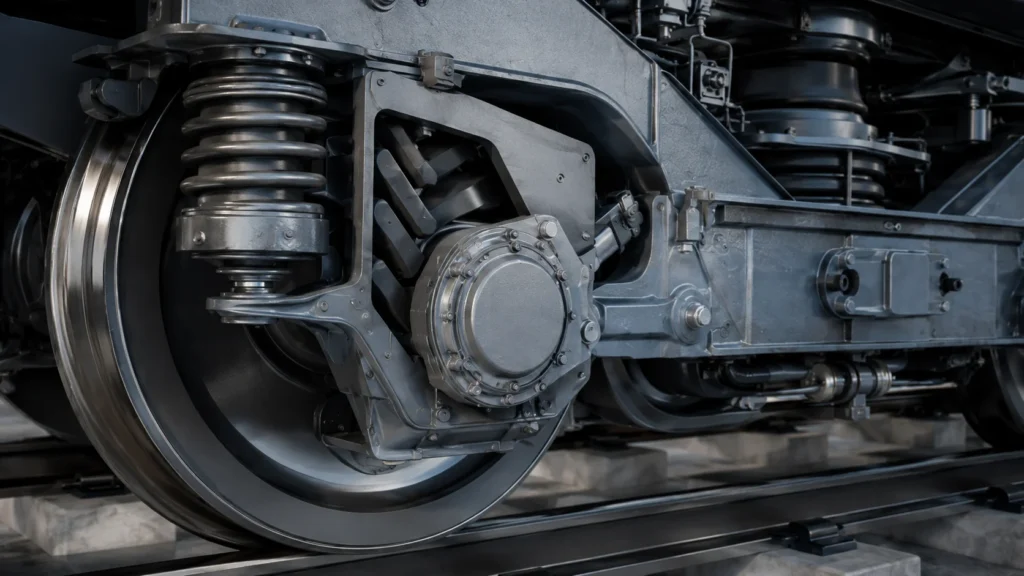
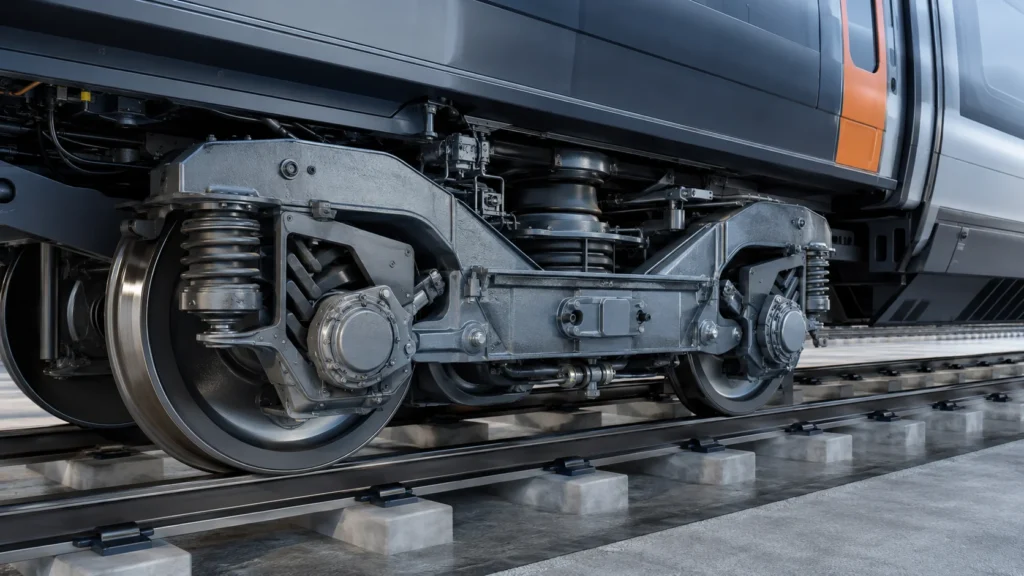
The primary suspension is located between the wheel set axle box and the bogie frame.
It is the first to absorb shocks and vibrations from the wheel-rail contact area and is primarily responsible for:
- supporting the bogie load;
- absorbing shocks caused by track irregularities;
- Controlling the movement of the axle box relative to the bogie;
- reducing dynamic wheel-rail forces;
- helping to maintain wheel set guidance and running stability.
The most common application for the Chevron Spring is in primary suspension, which is why it is often referred to as:
- Railway primary suspension spring;
- Axlebox spring;
- Chevron axle spring;
- V-spring for railway bogie.
Secondary Suspension System
The secondary suspension is located between the bogie and the car body; common types include air springs, steel coil springs, and rubber elastic elements.
Secondary suspension typically has a greater impact on the car body’s low-frequency vibrations, lateral sway, and the comfort directly experienced by passengers.
Therefore, simply describing the Chevron Spring as a “component that enhances passenger comfort” is incomplete. More accurately, it primarily controls the dynamic relationship between the wheel set and the bogie, and by reducing vibrations and impacts transmitted to the upper structure, it indirectly improves the overall smoothness of the train and the ride experience.
What is a Chevron Spring?
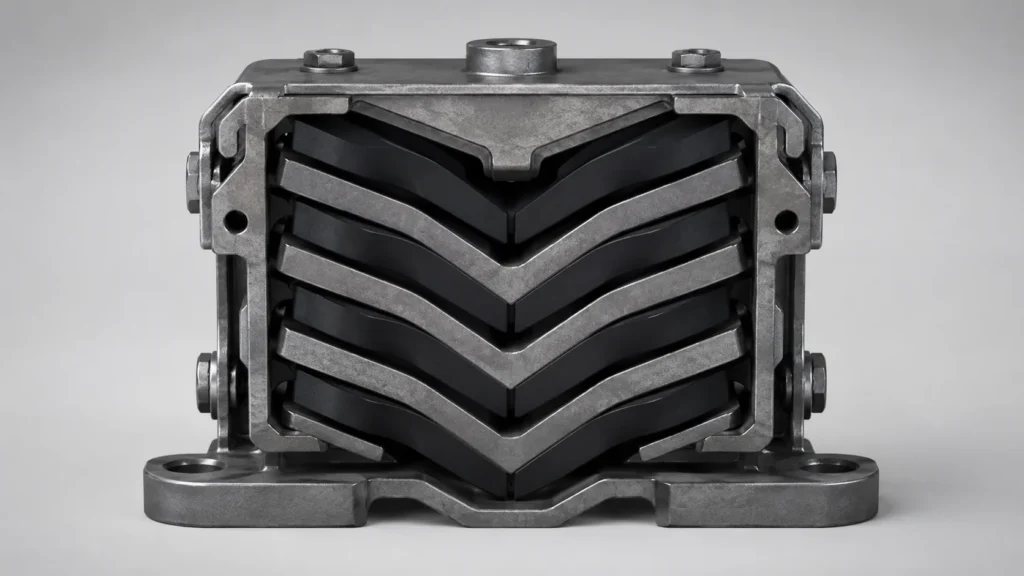
A Chevron Spring is a rubber-metal composite elastic element consisting of alternating layers of rubber and metal plates arranged in a slanted V-shape.
It typically consists of:
- multiple layers of elastic rubber;
- metal reinforcement plates;
- Mounting end plates or connection structures;
- a vulcanized bonding interface between the rubber and metal.
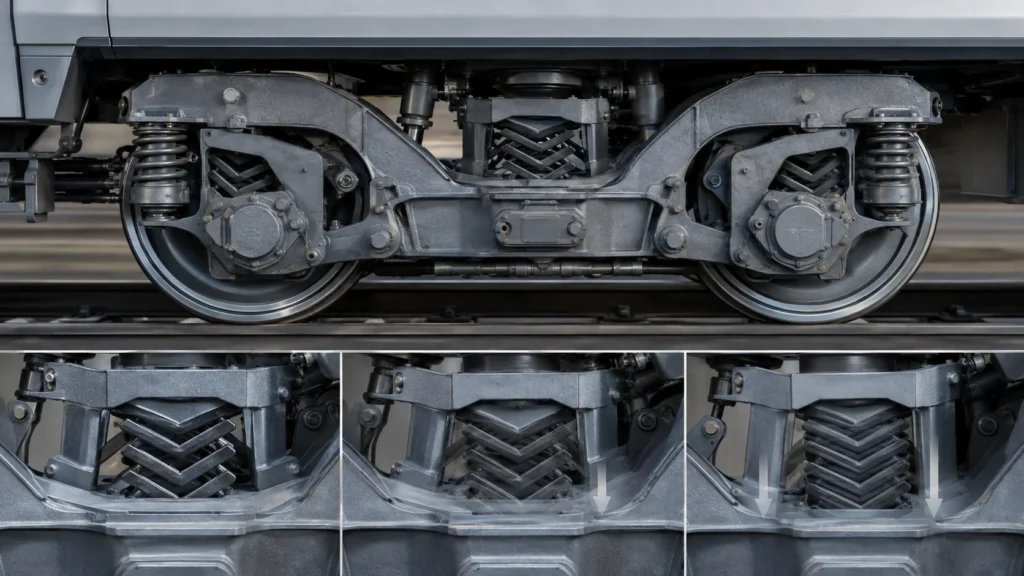
When installed, the rubber layer is not subjected to compression in a single direction but is simultaneously under compression and shear deformation. Trelleborg’s Chevron product documentation also notes that these springs are installed at a specific angle so that the rubber layer bears both shear and compression loads simultaneously. The spring is capable of providing stiffness characteristics in different directions within a limited installation space.
You can think of it this way: it is not a conventional spring that behaves identically in all three directions, but rather a multidirectional elastic component capable of independently controlling vertical, lateral, and longitudinal movements according to vehicle requirements.
How does the Chevron Spring work?
When a wheel passes over an irregular section of track, the wheel set and axle box undergo vertical, lateral, or longitudinal displacement.
The Chevron Springs installed between the axle box and the bogie undergo elastic deformation as a result.
During this process:
- The rubber layers absorb part of the displacement through compression and shear deformation;
- The hysteresis characteristics of the rubber material dissipate some of the vibration energy;
- The metal layer restricts excessive bulging of the rubber and disperses internal stresses;
- The springs generate a restoring force, causing the axle box to gradually return to its designed position;
- stiffness in different directions collectively control the movement of the wheel set.
In its explanation of the principles of rubber vibration damping, Vista Motion also emphasizes that rubber materials possess both elasticity and a certain degree of internal damping, enabling them to function simultaneously as springs and vibration-damping elements. A key difference between Chevron Springs and conventional metal springs is that they not only store and release elastic energy but also reduce vibration peaks through the internal damping of the rubber.
The Seven Core Functions of Chevron Springs in Rail Vehicle Suspension Systems
Absorbing and Transmitting Vertical Loads
First and foremost, Chevron Springs must bear the vertical loads transmitted by the vehicle through the bogie.
These loads may originate from:
- the vehicle’s own weight;
- the weight of the bogie structure;
- Passenger or cargo loads;
- load shifts caused by braking and acceleration;
- dynamic impacts caused by track irregularities.
The springs must produce controllable vertical deflection within the specified load range. If the vertical stiffness is too high, wheel-rail impacts are more likely to be transmitted to the bogie; if the stiffness is too low, excessive displacement, limit-of-travel collisions, or changes in suspension geometry may occur.
Therefore, the design of the Chevron Spring does not aim for “the softer, the better,” but rather seeks to strike a balance between load-carrying capacity, allowable displacement, and dynamic response.
Isolating Rail Impacts and High-Frequency Vibrations
Vibrations generated by wheel-rail contact typically contain multiple frequency components.
For example:
- short-wave track irregularities;
- Rail joint impacts;
- Wheel out-of-roundness;
- Wheel flat spots;
- Point impact;
- Wheel-rail surface roughness;
- Structural resonance.
Chevron Springs are located at the front end of the vibration transmission path and can reduce the efficiency with which vibrations are transmitted from the axle box to the bogie frame.
This is particularly important for urban rail transit, subways, light rail, and passenger vehicles, as continuous vibration not only affects the in-cab environment but can also cause structural noise, fastener loosening, and equipment fatigue.
It should be noted that Chevron Springs alone cannot eliminate all vibrations. The actual vibration isolation performance of the entire vehicle also depends on:
- unsprung mass;
- primary suspension stiffness;
- Second-stage suspension characteristics;
- shock absorber parameters;
- road and tire conditions;
- Vehicle operating speed;
- Bogie structural modes.
It is a critical component of a comprehensive vibration control system, rather than a standalone, universal vibration damping device.
Controls the vertical, lateral, and longitudinal movements of the axle box
When a rail vehicle is in operation, the axle box not only moves vertically but is also subjected to lateral and longitudinal loads.
Lateral loads may result from:
- passing through curves;
- lateral wheel-rail forces;
- Swaying motion;
- track irregularities;
- crosswinds or vehicle dynamics.
Longitudinal loads may result from:
- Traction;
- braking;
- Changes in wheel-rail adhesion;
- track gradient;
- vehicle acceleration and deceleration.
A key advantage of the Chevron Spring is its ability to provide stiffness in different directions through its V-shaped structure.
Designers can alter the spring’s performance by adjusting the following factors:
- Installation angle;
- Rubber layer thickness;
- Number of rubber layers;
- Number of metal plates;
- Effective load-bearing area;
- Rubber compound;
- Rubber hardness;
- Dimensions and boundary structure.
Therefore, products also known as “Chevron Springs” may exhibit significant differences in vertical, lateral, and longitudinal performance and cannot be substituted based solely on external dimensions.
Contributes to wheel set guidance and running stability control
In many bogie designs, the primary suspension not only supports the load but also contributes to the guidance of the axle boxes.
Higher longitudinal or lateral stiffness can more strictly limit wheel set displacement, which helps maintain geometric alignment; however, excessively high stiffness may increase wheel-rail forces during curve traversal.
Conversely, lower stiffness allows the wheel set to undergo a certain degree of adaptive displacement; however, if not properly controlled, this may also affect stability during high-speed operation.
This means that the three-directional stiffness of the Chevron Spring cannot be determined in isolation. Designers need to consider the following factors in combination:
- wheelbase;
- wheel diameter;
- vehicle speed;
- axle load;
- bogie configuration;
- Curve radius;
- Equivalent wheel-rail taper;
- Shock absorber arrangement;
- Vehicle dynamics model.
Therefore, when procuring or developing chevron springs for railway bogies, simply providing the static load capacity is usually insufficient.
Reducing Structural Noise
Train operating noise does not originate entirely from the direct contact between the wheels and the rails.
Wheel-rail excitation also propagates through the axle boxes, bogies, and car body structure, radiating as noise from the structural surfaces.
The rubber layer can reduce the transmission of some structural vibrations and minimize the likelihood of rigid vibration pathways forming between metal components. Chevron springs can therefore help control, to a certain extent:
- structural noise in the bogie;
- vibrations in the axle box area;
- high-frequency impact noise;
- structure-borne noise transmitted into the passenger compartment.
Vista Motion’s rail vehicle business page also lists the Chevron Spring as a rail vibration damping product and highlights the role of rubber vibration damping elements in reducing noise and improving the operating environment of rail vehicles. System testing has confirmed that performance cannot be determined solely based on rubber hardness or product geometry.
Mitigating impacts on bearings and bogie structures
If track impacts are transmitted directly to the axle box, bearing housing, and bogie frame, they increase local stresses and fatigue loads.
By providing controlled displacement and elastic cushioning, Chevron Springs can reduce some transient impacts and ensure a smoother load transfer.
This helps reduce the peak loads experienced by related components during operation; however, it should not be simply assumed that other components will not fail after installing Chevron Springs.
The actual service life of bearings and bogie components remains influenced by the following factors:
- Vehicle load spectrum;
- Track maintenance condition;
- Lubrication conditions;
- Installation accuracy;
- Wheel set condition;
- Operating speed;
- Environmental corrosion;
- Maintenance intervals.
To put it more precisely: a properly matched primary suspension helps control dynamic loads, thereby creating more optimal operating conditions for surrounding components.
Integrating Multiple Functions into a Limited Space
The installation space beneath a rail vehicle’s bogie is extremely limited.
If independent load-bearing springs, guide mechanisms, and multiple rubber bushings were used separately, the system could become more complex, increasing the number of parts, connection points, and maintenance requirements.
The Chevron Spring integrates the following into a single rubber-metal composite component:
- elastic load-bearing;
- multi-directional stiffness control;
- Axle box positioning;
- Vibration isolation;
- Partial structural damping.
This integration of functions makes it suitable for primary suspension arrangements in certain metro, light rail, locomotives, passenger cars, and other rail vehicles.
However, whether the Chevron Spring is suitable ultimately depends on the specific bogie design, rather than the vehicle type designation itself.
Why does the Chevron Spring feature a V-shaped structure?
The most direct purpose of the V-shape is to allow the rubber layer to undergo both compression and shear deformation simultaneously when loaded.
Rubber behaves differently under compression and shear.
Generally:
- Compression provides a higher load-bearing capacity;
- Shear provides greater elastic displacement;
- The metal layer can restrict the rubber’s lateral expansion;
- The angle of inclination can alter the equivalent stiffness in different directions.
By combining these characteristics, designers can achieve the desired load-displacement curve within a relatively compact space.
In addition, the stiffness of a Chevron Spring often exhibits a certain degree of nonlinearity. As deformation increases, the rubber’s geometric configuration, effective load-bearing area, and degree of constraint change, and the spring’s equivalent stiffness may also change accordingly.
This progressive behavior can sometimes help simultaneously meet the requirements for small-displacement vibration isolation and high-load support, but the specific curve must be verified through calculations and testing.
What is the role of the metal layer in a Chevron Spring?
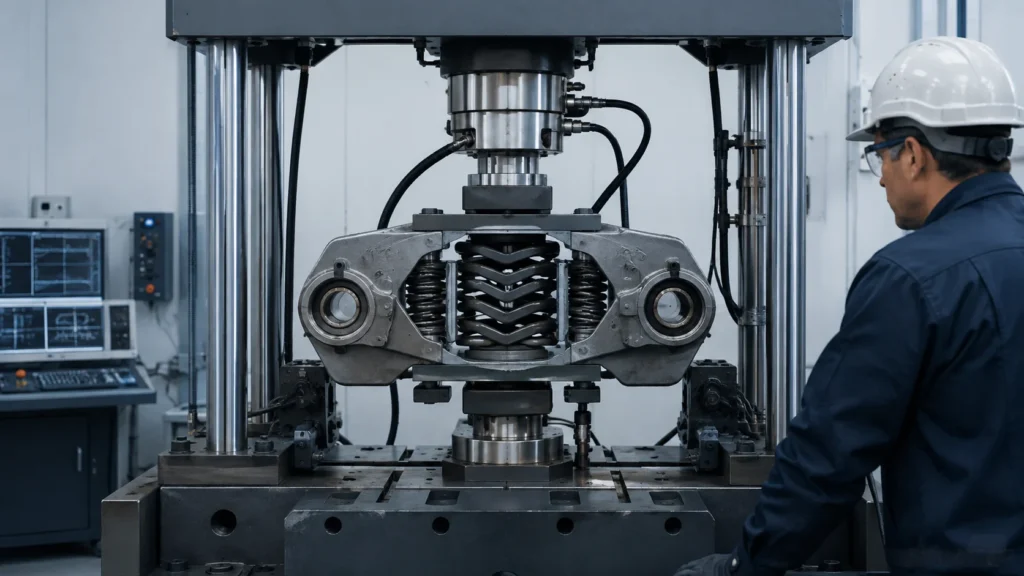
Visually, the elasticity of a Chevron Spring appears to come primarily from the rubber, but the central metal plate is not merely a reinforcing accessory.
The metal layer typically serves the following functions:
- Restricting rubber bulging: When compressed, rubber tends to expand in the direction of freedom. The metal layer provides layered constraint to the rubber, allowing the load to be transferred more uniformly.
- Increasing load-bearing capacity: Dividing a thick rubber block into multiple thinner rubber layers allows for increased structural load-bearing capacity while maintaining a certain degree of elastic displacement.
- Adjusting stiffness: The number, spacing, and angle of the metal plates all affect the overall stiffness of the Chevron Spring.
- Dispersing internal stresses: A well-designed layered structure helps prevent excessive strain concentration in any single area.
- Providing Reliable Connections: The end metal structures are typically responsible for mounting and positioning the product relative to the axle box or bogie.
For this reason, the quality of a Chevron Spring depends not only on the rubber compound but also heavily on the reliability of the bond between the rubber and the metal.
How does the Chevron Spring affect train comfort?
While the Chevron Spring does reduce some of the shocks and vibrations transmitted from the track, the overall ride comfort of the train should not be attributed solely to the primary suspension.
The comfort experienced by passengers is also related to the following systems:
- secondary air springs or coil springs;
- Vertical dampers;
- Lateral dampers;
- anti-sway dampers;
- Body structure;
- Seating system;
- Track-wheel condition;
- Track quality.
The more direct function of the Chevron Spring is to manage the dynamic loads between the wheel set and the bogie.
When the primary suspension effectively controls high-frequency impacts and prevents excessive vibration from reaching the bogie, the secondary suspension and body systems can operate under more optimal conditions.
Therefore, while it makes a genuine contribution to comfort, this is part of the overall synergy of the suspension system.
What is the difference between the Chevron Spring and steel coil springs?
| Comparison Points | Chevron Spring | Steel Coil Spring |
| Primary Material | Rubber-metal composite structure | Spring steel |
| Damping Capability | Rubber inherently possesses a certain degree of damping | The material itself has low damping |
| Multidirectional Stiffness | Can be achieved through structural orientation design | Typically requires coordination with other guiding components |
| Structural integration | Can combine load-bearing, guidance, and vibration isolation | Primarily provides elastic support |
| Factors Affecting Performance | Temperature, frequency, aging, and strain | Load, stress, fatigue, and corrosion |
| Maintenance Characteristics | No sliding friction pairs, but rubber aging and delamination must be inspected | Inspect for cracks, corrosion, and fatigue |
| Risk of Failure | Cracks, delamination, hardening, permanent deformation | Fracture, plastic deformation, corrosion fatigue |
There is no absolute superiority or inferiority between these two types of products.
The decision to use a Chevron Spring should be based on the bogie structure, available space, stiffness requirements, guidance method, and full life cycle requirements.
What is the difference between a Chevron Spring and an air spring?
Chevron springs and air springs are often used together in rail vehicles, but they typically serve different functions.
Chevron springs are commonly used in primary suspension—that is, between the axle box and the bogie—while air springs are more commonly used in secondary suspension—that is, between the bogie and the car body.
Air springs can adjust their support characteristics through air pressure and additional air chambers, and they help maintain the vehicle body height. Chevron springs, on the other hand, have a more compact structure, do not require an air supply system, and can achieve multidirectional stiffness control through their rubber-metal structure.
Therefore, air springs are generally not direct substitutes for Chevron Springs. In a rail vehicle suspension system, both may coexist, each handling loads at different frequencies and locations.
Common Failure Modes of Chevron Springs
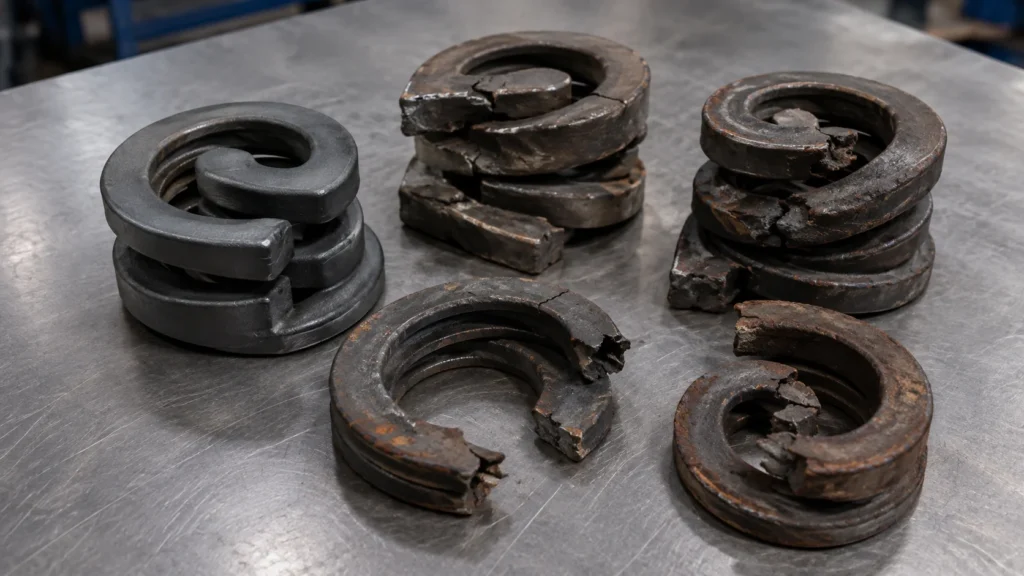
Surface Cracks in the Rubber
Cracks may appear in high-strain areas, at edges, or in areas subject to long-term exposure.
A small number of surface aging cracks do not necessarily indicate imminent failure, but the crack depth, propagation direction, and location must be assessed by a professional.
Delamination Between Rubber and Metal
Delamination generally warrants more attention than ordinary surface cracks, as it can directly alter the load transfer path.
Common causes include:
- Inadequate metal surface preparation;
- Uneven application of the adhesive;
- Inappropriate vulcanization conditions;
- Interface contamination;
- Localized stress concentration;
- Long-term fatigue;
- Moisture or corrosion at the interface;
Permanent compression set
Long-term loading may cause the spring height to decrease. If the left and right products deform unevenly, this may also affect the bearing housing position and load distribution.
Rubber hardening and changes in stiffness
Rubber ages over time and due to environmental factors, and its dynamic properties may change. Studies on the service life of rubber springs in the primary suspension systems of rail vehicles have indicated that the stiffness of Chevron Rubber Springs may increase with service time, thereby altering the vehicle’s dynamic characteristics. In addition to assessing the risk of fracture, it is important to monitor whether the stiffness has deviated from the design range.
Metal Plate Corrosion
Corrosion can weaken metal structures and may spread from the edges toward the rubber-metal interface.
Abnormal Bulging or Asymmetric Deformation
Asymmetric deformation may be related to installation deviations, uneven loading, internal bonding issues, or variations in rubber properties.
Do Chevron Springs Require Maintenance?
Chevron Springs typically have no sliding surfaces that require lubrication, so routine maintenance is relatively limited.
However, “low maintenance” does not mean “no inspection required.”
A maintenance plan should generally cover:
- Rubber cracks;
- delamination;
- Corrosion;
- Permanent deformation;
- Installation location;
- Tightening condition;
- Consistency between left and right components;
- Interference with surrounding structures;
- Re-testing of stiffness when necessary.
Inspection intervals should be determined based on the vehicle manufacturer’s and operator’s requirements, as well as actual track conditions.
Vehicles that frequently traverse tight curves, operate on tracks in poor condition, have high axle loads, or are subject to significant temperature fluctuations may require more rigorous condition monitoring.
Summary
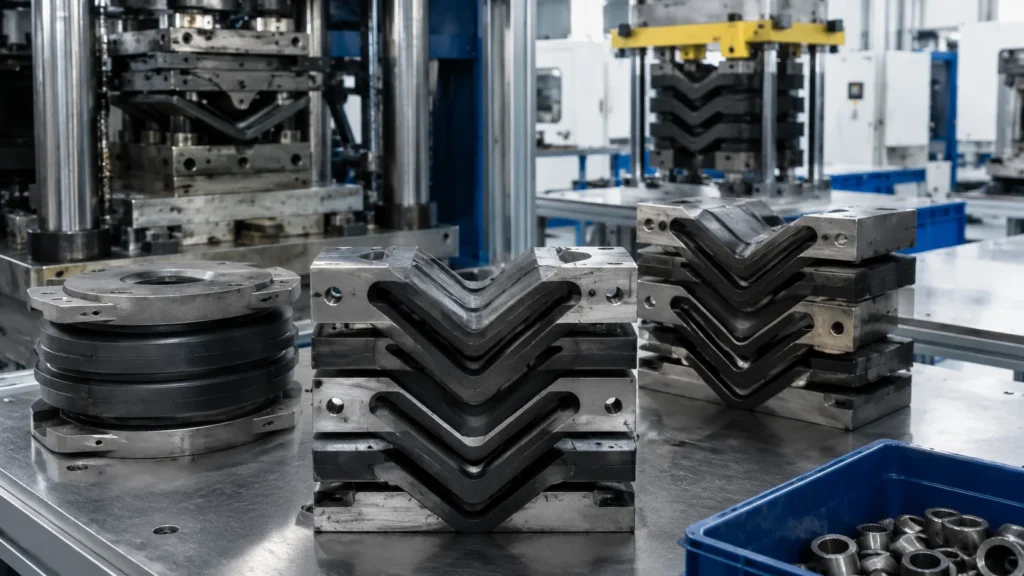
The Chevron Spring is a multifunctional rubber-metal elastic element in the primary suspension system of rail vehicles.
It can bear vertical loads between the axle box and the bogie, control lateral and longitudinal displacement, mitigate wheel-rail impact, and reduce some vibration and structural noise. Its V-shaped layered structure allows the rubber to work under both compression and shear, thereby achieving multidirectional stiffness design within a limited space.
However, the value of the Chevron Spring does not depend solely on the use of rubber.
What truly determines its performance is:
- whether the triaxial stiffness is matched to the bogie;
- whether the rubber compound is suitable for the operating environment;
- whether the metal layers and mounting structure are appropriately designed;
- whether the rubber-to-metal bond is stable;
- whether dynamic and fatigue performance has been verified;
- Is the manufacturing process consistent and traceable?
If you are developing a new rail vehicle suspension system, or if your existing Chevron Springs are experiencing cracking, delamination, permanent deformation, stiffness drift, or insufficient service life, Vista Motion can conduct a technical evaluation based on drawings, samples, installation space, and load conditions.
You can provide us with information on the vehicle type, axle load, triaxial stiffness, operating temperature, fatigue requirements, and issues with existing products. Our team will consider rubber materials, metal structures, vulcanized bonding, and manufacturing feasibility to assist you in developing custom Chevron Springs and rail vehicle rubber vibration-damping components suited for actual operating conditions.
FAQ
What is a Chevron Spring?
A Chevron Spring is a V-shaped rubber-metal laminated spring typically installed between the axle box and the bogie frame of a rail vehicle. It absorbs loads, controls axle box displacement, and reduces the transmission of vibrations to the bogie through the compression and shear deformation of its rubber layers.
Is the Chevron Spring installed in the primary or secondary suspension system?
Chevron Springs are typically used in the primary suspension system, i.e., between the wheel set axle box and the bogie. The secondary suspension, located between the bogie and the car body, usually employs air springs, coil springs, or other elastic elements. The specific installation method depends on the bogie design.
Why does the Chevron Spring feature a V-shaped structure?
The V-shape causes the rubber layers to undergo both compression and shear deformation simultaneously under load. Designers can adjust the vertical, lateral, and longitudinal stiffness independently by varying the angle, rubber thickness, number of metal layers, and material formulation.
How does the Chevron Spring improve train ride comfort?
It cushions some of the impacts caused by rail joints, track irregularities, wheel defects, and switch areas, reducing the transmission of vibrations from the axle box to the bogie. It primarily controls the dynamics of the primary suspension; overall vehicle smoothness also depends on the secondary suspension, shock absorbers, wheel-rail conditions, and car body structure.
What is the difference between the Chevron Spring and a steel coil spring?
The Chevron Spring inherently possesses some material damping and provides stiffness in different directions through its V-shaped structure. Steel coil springs primarily provide elastic support and typically require additional guidance and vibration-damping components. The suitability of each depends on the specific bogie design.
What rubber materials are typically used for railway Chevron Springs?
The material may be natural rubber or a synthetic rubber compound developed for specific environmental conditions. Selection requires comprehensive consideration of dynamic fatigue, resilience, temperature, ozone resistance, oil resistance, weather resistance, and adhesion properties; it cannot be determined solely based on Shore A hardness.
What is the service life of a Chevron Spring?
There is no standardized, fixed service life for Chevron Springs. Actual service life depends on the load spectrum, operating mileage, temperature, track conditions, rubber formulation, bond quality, installation conditions, and maintenance standards. Replacement strategies should be determined through fatigue testing and periodic inspections in accordance with the requirements of the rolling stock project.
What are the common signs of failure for Chevron Springs?
Common signs include deep cracks in the rubber, delamination between the rubber and metal, permanent compression set, localized bulging, metal corrosion, asymmetrical deformation between the left and right sides, and a noticeable increase in vibration or noise in the bogie area.
Can Chevron Springs be customized to meet bogie requirements?
Yes. Customization options may include overall dimensions, installation angle, number of metal layers, rubber compound, triaxial stiffness, working deflection, environmental performance, and fatigue life. Suppliers typically require drawings, samples, axle load, load specifications, and testing requirements.
What information is required when requesting a quote for Chevron Springs?
We recommend providing 2D drawings or 3D models, existing samples, vehicle and bogie models, axle loads, installation space, vertical/lateral/longitudinal stiffness, operating temperature, dynamic test conditions, fatigue requirements, environmental conditions, and any issues with the current product. The more complete the information provided, the more accurate the preliminary technical evaluation will be.
