
A heavily loaded joint often has to do more than hold two parts together. It may need to pivot as a cylinder extends, accommodate changing linkage angles, or allow a suspension connection to move through its travel. Spherical plain bearings provide a sliding joint that can transmit force while permitting angular movement.
Their usefulness depends on the complete application. Load direction, movement, mounting, lubrication and operating conditions all matter. A bearing with an impressive catalog rating may still be unsuitable for the joint around it.
This guide focuses on spherical plain bearings used in loaded mechanical joints. It explains where they are useful, how they differ from spherical roller bearings, and what engineers and buyers should establish before requesting a quotation.
Which Type of Spherical Bearing Does the Application Need?
The term “spherical bearing” can lead buyers toward different products. Establish the construction before comparing specifications.
| Type | Basic construction | Starting point for selection |
|---|---|---|
| Spherical plain bearing | An inner ring with a spherical outer surface slides within a matching outer ring or lining | Joint loads, angular movement and sliding conditions |
| Rod end | A joint assembly with a bearing element housed in an eye and a connection shank | Bearing requirements plus the body and connection design |
| Spherical roller bearing | Rollers run between bearing rings | Shaft rotation, bearing loads and the permitted misalignment |
Spherical Plain Bearings and Rod Ends
A spherical plain bearing is commonly fitted into a housing in the surrounding component. A rod end provides a connection arrangement of its own. A shared bore size does not make the two assemblies equivalent: the connection and housing must also be evaluated. MinebeaMitsumi's rod-end engineering reference illustrates how construction choices affect selection.
How Spherical Roller Bearings Differ
Spherical roller bearings belong to the rolling-bearing family. NSK describes their use in equipment such as gearboxes, conveyors and mining machinery, with radial and axial load capability. Their selection requirements should not be transferred to a plain-bearing pivot simply because both names contain “spherical.” See NSK's product documentation.
How Do Spherical Plain Bearings Carry Load While Allowing Angular Movement?
The curved sliding interface allows the inner and outer rings to change their angular relationship. This geometry makes a spherical plain bearing useful where a connection must carry load while its alignment changes. THK identifies low-speed, heavily loaded oscillating joints among the applications for its SB and SA1 spherical plain bearings.
Load Paths Through the Joint
In a typical pin-mounted arrangement, force passes through the pin, bearing and surrounding housing. The design review therefore needs to include those supporting parts, their interfaces and the bearing's retention.
Identify radial loading perpendicular to the bore axis and axial loading along it. Where both occur, ask for a combined-load assessment for the selected bearing. Do not assume that a radial rating establishes an equal axial capacity.
For a suspension application, also identify the joint's function within the assembly. A connection that permits articulation should not automatically be treated as a substitute for a component selected to provide compliance and isolation. Vista Motion's guide to car suspension components explains these different system functions.
Misalignment Is a Design Input
Record the movement needed throughout the mechanism's travel, including its extreme positions. Distinguish an installed angular offset from repeated oscillation during operation. NHBB lists the required misalignment angle and oscillating motion separately in its selection guidance.
A useful review question is: Can the complete assembled joint reach every required position under the specified conditions? Check the bearing data and the surrounding geometry together, including any spacers, shoulders or protective components.
Where Are Spherical Plain Bearings Useful in High-Load Applications?
Application examples help identify a candidate bearing family, but they do not complete the selection. THK cites cylinder clevises, machinery hinges and truck suspensions as uses for its spherical plain bearings. The table below turns those examples into questions for an application review. THK application reference.
| Application | Joint function | Questions to resolve before selection |
|---|---|---|
| Hydraulic-cylinder connection | Allow the attachment to pivot as the mechanism moves | What forces reach the connection, at which positions, and how will it be serviced? |
| Construction-machine hinge | Support a loaded oscillating connection | What is the working cycle, and what protection is needed at the joint? |
| Suspension linkage or pivot | Permit angular movement while transmitting forces | What is the complete travel envelope, and what compliance does the system require? |
Consider an illustrative cylinder attachment. A drawing gives the available bore and width, but the phrase “heavy duty” leaves key questions unanswered. The reviewer still needs to know whether the greatest force occurs while the joint is moving or while it is held in position. Recording that sequence makes the inquiry more useful than adding a larger nominal load figure without context.
What Must Be Checked Before Selecting a Bearing for High Loads?
Start with a documented operating case. Treat the bearing rating as one input to the assessment, alongside the conditions under which the joint must work.
Load Direction, Peaks and Duty Cycle
Separate normal operation from exceptional events. Describe load direction, reversals and the relationship between force and motion. Include how often each operating condition occurs rather than supplying only a single maximum.
Ask the supplier to identify the assumptions used in its assessment. This is especially useful when different teams have supplied the drawing, load estimate and service-life requirement: discrepancies can be resolved before a part number becomes embedded in the design.
Motion, Environment and Installation
Use a short decision table to make missing information visible. The following is a suggested review format, not a bearing calculation.
| Decision | Evidence to provide | Question for the supplier |
|---|---|---|
| Does the bearing suit the operating cycle? | Load cases and a description of movement | Which conditions govern the selection? |
| Does it fit the complete joint? | Assembly drawing and interface requirements | Which mounting details need confirmation? |
| Is the operating environment covered? | Expected temperatures and exposure conditions | What limits or protection requirements apply? |
| Can it be maintained as specified? | Access restrictions and service plan | What tasks must remain possible after assembly? |
| Can performance be accepted objectively? | Functional requirements and proposed validation | What will be measured, and what constitutes acceptance? |
Sliding speed also needs attention. THK's selection instructions relate permissible speed to load, lubrication and cooling conditions. A description such as “slow moving” is therefore less useful than a defined operating cycle.
Rating Definitions and Validation Requirements
SKF explains that manufacturers may define spherical plain bearing load ratings differently. Its technical brochure also distinguishes a calculated rating life from the life actually achieved in service. These are reasons to compare the underlying assumptions, not just the largest number in competing tables. SKF technical brochure, pages 6–7.
Request the rating basis, relevant operating limits and the proposed verification method. For an existing design, identify which conditions have changed before accepting a replacement as equivalent.
How Should Engineers Compare Metal-to-Metal and Self-Lubricating Designs?
Compare complete bearing designs against the job they must perform. Material names alone do not establish suitability or maintenance requirements.
NHBB describes both metal-to-metal designs and bearings with a PTFE-containing composite liner. It identifies lined designs as an option for oscillating applications where frequent lubrication is undesirable, subject to the application's wear requirements. NHBB engineering guidance.
Lubrication and Access
Avoid a blanket rule that all steel-on-steel bearings require the same maintenance. SKF, for example, describes a sealed, initially lubricated steel-on-steel series intended to operate without relubrication under stated conditions. It also makes clear that its maintenance-free description does not remove inspection from the maintenance program. SKF product-specific guidance.
| Comparison question | Evidence to request for either design |
|---|---|
| Is additional lubrication required or permitted? | Instructions for the exact bearing series |
| What limits apply in this application? | Product-specific assessment against the submitted conditions |
| How will wear be judged? | Agreed inspection method and acceptance criteria |
| What must maintenance personnel do? | Tasks, access needs and replacement instructions |
Wear and Application Limits
Agree what the joint must still be able to do after the required service period. A project may need to control play, movement resistance or positioning accuracy. Define the relevant requirement with the responsible engineer instead of accepting “long life” as a measurable specification.
Keep these criteria in the inquiry and the acceptance documents so procurement can compare offers against the same expectations.
What Can Undermine Performance in Service?
Installation and operating conditions deserve the same attention as initial selection. THK's instructions address mounting orientation and lubrication, while its guidance for the sealed SA1 design explains the importance of contamination protection. Check these requirements for the selected product. THK mounting and maintenance guidance, SA1 contamination protection.
Inspection and Installation Questions
Use observations to guide an investigation rather than assigning a cause from a symptom alone.
| Observation | Investigation questions |
|---|---|
| Movement becomes restricted after installation | Were interfaces and assembly steps checked against the instructions? Does the surrounding geometry permit the required travel? |
| Play increases during service | Where is the movement occurring, and how does it compare with the initial measurements? |
| Seals or protective parts are damaged | What contact, exposure or handling events occurred? |
| A replacement performs differently | Were construction, operating limits and installation requirements compared as well as dimensions? |
Record the operating history and preserve inspection evidence. That gives the engineer and supplier a better basis for deciding what needs to change.
Agreeing Acceptance Criteria
Before approving a sample, document the test conditions, measurements and acceptance limits. Specify who will review the results and how deviations will be handled.
When discussing a custom component, use Vista Motion's stated development and manufacturing process as a starting point for questions about the proposed project. Confirm the applicable verification work as part of that discussion.
What Information Should You Include in a Project Inquiry?
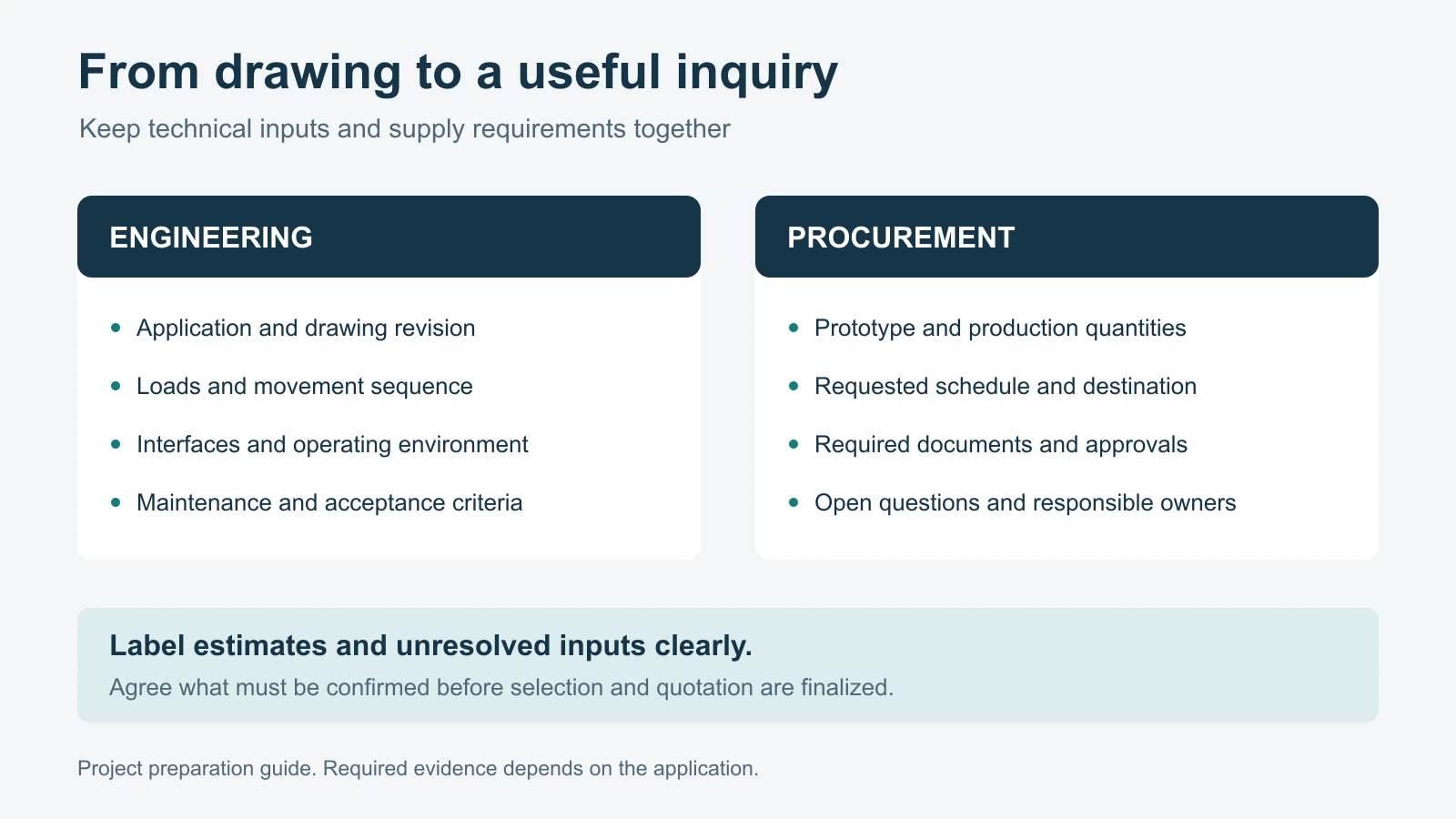
A useful request for quotation connects the drawing to the intended use. Organize it so engineering can confirm the technical inputs and procurement can define the supply requirements.
- Application and drawing: component function, assembly context, drawing revision and interfaces.
- Operating conditions: load cases, movement sequence, environment and service expectations.
- Installation and maintenance: assembly constraints, access and planned service tasks.
- Validation: required evidence, inspection criteria and the sample-approval process.
- Commercial requirements: prototype and production quantities, requested schedule and delivery destination.
Mark unresolved inputs clearly and assign an owner to each. If an operating condition is estimated, label it as an estimate so it can be reviewed before selection is finalized.
For a custom suspension-component project, submit your drawings and requirements to Vista Motion for a project-specific feasibility review and quotation. Include the joint's operating conditions alongside its dimensions so the discussion can address both fit and function.
