
This article will walk you through 10 warning signs to watch for, helping you determine when to inspect or replace your shock mounts, as well as how to select the right replacement products for your industrial equipment.
What Are Shock Mounts?
A shock mount is a mechanical component installed between equipment and its supporting structure, typically made of a combination of rubber, metal, or other elastic materials.
They are widely used in:
- Industrial motors, generators, and power equipment
- Air compressors, pumps, and fans
- Construction machinery and agricultural equipment
- HVAC (Heating, Ventilation, and Air Conditioning) equipment
- Marine and transportation equipment
- All types of industrial machinery requiring vibration isolation and shock absorption
The basic operating principle of vibration-isolating mounts is not complicated.
When equipment is in operation, motor rotation, reciprocating mechanical motion, and external impacts generate varying degrees of vibration. Vibration-isolating mounts reduce the transmission of vibration from the equipment to the frame, base, and surrounding structures through elastic deformation and energy dissipation.
At the same time, they must also support the equipment’s own weight as well as the dynamic loads generated during operation.
This means that a vibration-isolation mount is not merely a rubber pad.
They must maintain sufficient load-bearing capacity while also providing appropriate elasticity and vibration isolation performance.
10 Obvious Signs of Vibration Isolation Mount Wear
Cracks or tears on the rubber surface
Cracks in the rubber are one of the most easily detectable signs of aging in vibration-isolating mounts.
If you inspect the rubber vibration-damping mounts at the bottom of the equipment and notice fine cracks, visible fissures, or localized tears on the surface, further inspection is necessary.
This damage may appear on the rubber surface or be concentrated along the edges, in areas subject to tension, or at the junction between the rubber and metal.
Why do cracks form?
Common causes include long-term dynamic deformation, ozone and environmental aging, exposure to high temperatures, material mismatch, and loads exceeding the design specifications.
Particularly in industrial equipment that has been in operation for a long time, the rubber is constantly subjected to compression, shear, or other alternating loads. If localized stress becomes too high, cracks may gradually propagate.
However, not all fine surface markings indicate that the bracket must be replaced immediately.
When assessing the condition, focus on the following:
- Whether the crack is continuing to propagate or has noticeably deepened.
- Whether the cracks extend into the primary load-bearing area.
- Has rubber tearing or material spalling already occurred?
- Whether there is abnormal deformation, vibration, or displacement.
Recommendation: If the crack has compromised the load-bearing structure, or if it is accompanied by rubber tearing or noticeable deformation, it should no longer be treated as a mere cosmetic issue; instead, it should be evaluated by a professional to determine whether replacement is necessary.
In particular, do not use ordinary adhesive to fill cracks in load-bearing rubber and continue to use the bracket as if it were intact. Such repairs cannot guarantee that the original mechanical properties have been restored.
The rubber has noticeably hardened and lost its original elasticity
If a vibration-damping bracket appears undamaged, does that mean it can definitely continue to be used?
Not necessarily.
Some rubber vibration-isolation mounts may still appear intact on the surface after long-term use, but the material has clearly hardened.
Rubber hardening may be related to thermal aging, oxidation, or prolonged exposure to unsuitable environments.
The problem with these changes is that the stiffness of the mount may be altered.
The vibration-isolation performance of a vibration-isolation mount is closely related to the system’s dynamic stiffness, equipment load, and vibration frequency. When the rubber’s properties change, the original vibration-isolation performance may also change.
For example, an industrial motor that originally ran smoothly may begin to transmit more vibration to the equipment base after many years of use. If no obvious mechanical failure is found, the hardening of the rubber vibration-isolation mount is one possible cause worth investigating.
You should focus on observing:
- Whether there are visible signs of aging on the rubber surface.
- Whether there are fine cracks or signs of embrittlement.
- Whether there has been a significant change in material hardness compared to a normal sample of the same specification.
- Whether vibration transmission has increased noticeably under the same operating conditions.
Please note that a tactile assessment is only for preliminary observation and cannot replace standardized hardness measurements.
Recommendation: For rubber mounts suspected of hardening, use an appropriate hardness testing method after disassembly and compare the results with the product’s original specifications to determine whether the material changes exceed the allowable range.
Do not conclude that a mount has failed simply because it feels hard to the touch. Some heavy-duty vibration-damping mounts inherently require higher design stiffness.
Rubber Swelling, Softening, or Sticky Surface
In contrast to hardening, some vibration-damping mounts may exhibit abnormal softening.
If the rubber has noticeably expanded compared to its original state, its dimensions have changed, its surface has become sticky, or localized softening of the material has occurred, check for media corrosion or material degradation.
These issues warrant particular attention in industrial environments where the rubber comes into contact with oils and fluids.
For example:
- Hydraulic oil leaks may be present near hydraulic equipment.
- Engines and transmission systems may be exposed to lubricating oil or fuel.
- Industrial production equipment may be exposed to cleaning agents, solvents, or other chemical media.
Different rubber materials have varying levels of resistance to these substances.
Upon contact with incompatible oils or chemicals, certain materials may absorb the substances and swell, thereby altering their original dimensions and mechanical properties.
These changes may lead to reduced bracket stiffness, altered installation conditions, and even compromise long-term reliability.
Recommendation: If the mount shows obvious swelling or softening, do not simply clean the surface oil; also identify the source of the leak, the type of medium, and whether the rubber material is suitable for that environment.
For equipment requiring long-term contact with oils, a suitable rubber compound should be selected based on the specific medium, temperature, and usage requirements.
If standard vibration-damping mounts cannot meet these conditions, consider developing custom rubber vibration-damping mounts tailored to the actual operating conditions.
Permanent Compression Deformation of Vibration Isolation Mounts
Some vibration-isolation mounts become increasingly flattened after a period of use.
The installation height at the bottom of the equipment gradually decreases, causing changes in the originally normal clearance and even resulting in noticeable subsidence at a specific support point.
This may be related to permanent deformation caused by the rubber being subjected to compressive loads over a long period.
In the engineering field, “Compression Set” is commonly used to describe the phenomenon where rubber fails to fully recover its original shape after being subjected to compression.
For rubber vibration isolation mounts subjected to long-term loading, this is a performance characteristic that warrants attention.
If the mount cannot maintain the height and deformation state required by the design, the following may occur:
- Changes in the equipment’s installation height.
- Changes in load distribution at each support point.
- A reduction in the original installation clearance.
- A reduction in the available elastic deflection travel.
- The bracket is more likely to come into contact with limit stops during operation.
Here is a detail that is easily overlooked:
The fact that the support is compressed during equipment operation does not necessarily mean that permanent compression deformation has occurred.
When a vibration-isolation hanger is subjected to normal loads, it naturally undergoes static deformation within the design-allowed range.
Whether this constitutes an anomaly must be determined by considering the original installation height, equipment load, product load-deformation data, and, if necessary, the recovery after unloading.
ASTM D395 is one of the standard test methods used to evaluate the compression set performance of rubber and can serve as a technical basis for understanding this metric.
Recommendation: If the equipment installation height continues to decrease, or if the mount is approaching its design limit, prioritize inspecting the actual load and mount deformation; do not mask the problem by arbitrarily adding shims.
Separation of Rubber and Metal Components
Many industrial vibration-isolation mounts utilize a rubber-to-metal bonded structure (Rubber-to-Metal Bonded Mounts).
For example, some cylindrical vibration isolation mounts, sandwich-type vibration isolation mounts, and center-bonded vibration isolation mounts all rely on a reliable connection between the rubber and metal to transfer loads.
The advantage of this type of structure is that it combines elastic vibration isolation with mechanical connection.
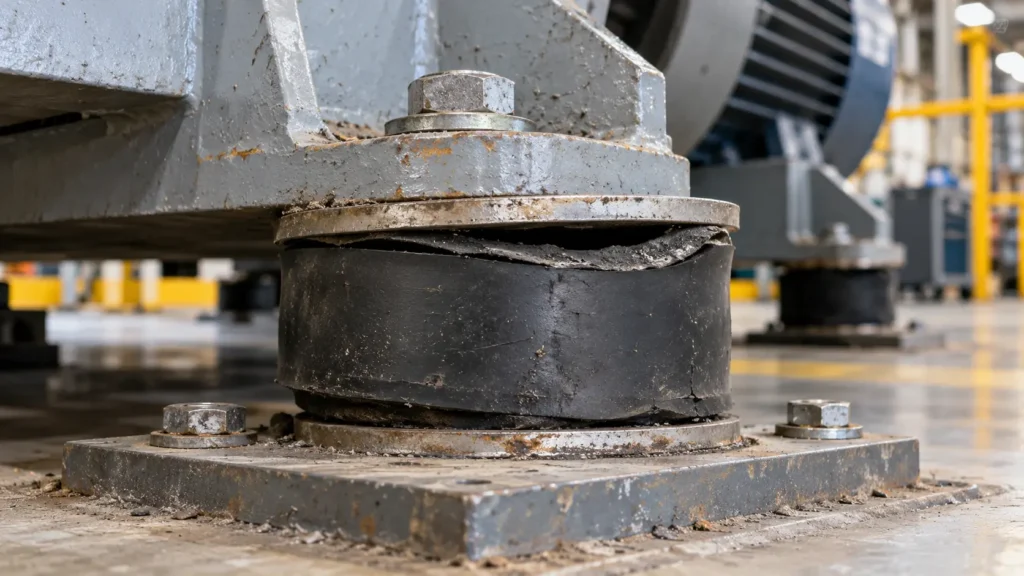
However, if cracking, localized detachment, or noticeable delamination occurs at the bonded interface, this must be taken seriously.
You may notice:
- Abnormal gaps between the rubber and the metal plate.
- Delamination at the edges of the rubber.
- Abnormal movement of the metal insert relative to the rubber.
- Localized detachment in an area that was originally a continuous bond.
This situation may be related to aging of the bonded interface, corrosion, fatigue loads, or issues with the materials or manufacturing process.
It is important to distinguish that surface rubber tearing and true adhesive interface failure are not exactly the same issues, and the appearance at the site does not necessarily allow for an accurate determination of where the failure occurred.
Recommendation: If a vibration-isolation bracket shows signs of significant rubber-to-metal separation, it should be evaluated and replaced by a professional as soon as possible, especially if the bracket serves to position equipment or provide a safety restraint.
Do not treat vibration isolators that have experienced structural separation as if they were merely suffering from ordinary rubber aging.
OEM equipment manufacturers should also pay attention to materials, bonding processes, and validation requirements that match actual loads when purchasing new bonded vibration isolators.
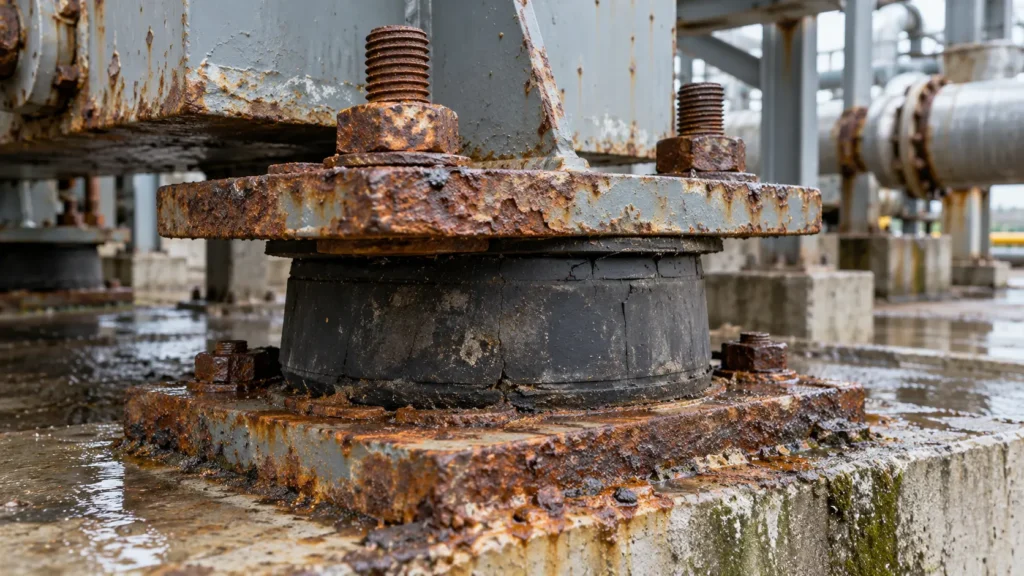
Severe corrosion or structural damage to metal mounting components
Damage to vibration isolators is not necessarily a problem with the rubber itself.
Many products include metal base plates, threaded rods, sleeves, or other connecting components.
These metal components are also affected by the operating environment and mechanical loads.
For example, in environments with moisture, salt fog, or corrosive media, the metal surfaces may gradually corrode.
If corrosion is limited to minor surface discoloration, it may not immediately affect the bracket’s functionality.
However, when corrosion leads to significant loss of cross-sectional area, damage to connection points, or when metal plate cracks or thread damage has already occurred, the problem goes beyond mere cosmetic issues.
Metal fasteners are responsible for transferring the equipment load to the mounting structure.
Once these components lose sufficient structural integrity, even if the rubber remains elastic, proper installation and support may no longer be guaranteed.
Recommendation: When inspecting vibration-isolation brackets, do not limit your inspection to the rubber components; also inspect the metal parts, mounting holes, threads, and support structure.
If the equipment operates for extended periods in marine, high-humidity, or other corrosive environments, consider the metal material, surface corrosion protection, and adaptability to the actual environment when selecting replacement products.
Loose mounting bolts or changes in connection positions
Vibration isolation mounts must be secured between the equipment and the foundation structure using appropriate connection methods.
Therefore, the condition of the mounting bolts, nuts, and washers also affects the reliability of the entire vibration isolation system.
If you notice that bolts repeatedly loosen, the mounting position shifts, or the original tightness cannot be maintained, you need to inspect the overall operational condition of the mount and the equipment.
The causes of these issues are not limited to the aging of the vibration isolation mounts.
Possible causes may also include:
- Installation preload that does not meet requirements.
- Inappropriate fastener specifications or locking methods.
- Abnormal vibration in the equipment.
- The mount is subjected to loads exceeding its design capacity.
- Deformation of the mating surfaces or mounting structure.
The most important thing to avoid here is simply increasing the tightening force upon discovering a loose bolt.
Excessive installation force may damage rubber components, metal fasteners, or threads, and does not resolve all loosening issues.
Recommendation: Check the tightness of fasteners in accordance with the installation requirements of the equipment and bracket manufacturers, use the specified installation procedures and torque values, and verify that the mounting structure is undamaged.
If the same problem recurs, further investigate the source of vibration, the direction of the load, and whether the bracket selection is appropriate.
A noticeable increase in vibration transmitted from the equipment to the base
This is one of the most noticeable operational anomalies in industrial settings.
Suppose a compressor was originally running relatively smoothly, but recently the vibration of the equipment base, surrounding frame, or adjacent structures has noticeably increased.
You might first suspect a problem with the compressor itself.
While this assumption makes sense, vibration-isolating mounts should also be included in the inspection.
When rubber materials age, the stiffness of the mounts changes, the mounting structure fails, or the mounts undergo abnormal deformation, the original vibration isolation performance may be compromised.
As a result, more vibration may be transmitted to the equipment base and surrounding structures.
However, it is important to emphasize that increased vibration does not necessarily mean the vibration-isolating mounts are damaged.
Rotor imbalance, bearing wear, coupling misalignment, mechanical looseness, or changes in equipment operating conditions can also produce similar phenomena.
To determine whether the problem stems from the vibration-isolating mounts, compare the equipment’s historical vibration data under the same load, rotational speed, and operating conditions.
If conditions permit, vibration measurements can also be taken on the equipment itself, the supporting structure, and relevant measurement points, based on the equipment type and applicable measurement requirements.
This makes it easier to distinguish whether the source of the equipment vibration itself has changed or if there is a problem with the vibration transmission path.
Recommendation: If vibration continues to increase, combine an inspection of the vibration-isolating mounts with a diagnostic assessment of the equipment itself, rather than simply purchasing stiffer or softer mounts.
New knocking sounds or abnormal noises occur during equipment operation
If the equipment has recently begun to produce knocking, clanging, or other abnormal mechanical noises that were not present before, this may also be related to the vibration-isolating mounts.
These sounds may be particularly noticeable when the equipment starts up, stops, or experiences sudden changes in load.
For example, when vibration mounts experience excessive displacement, rubber damage, or loose fasteners, the equipment may come into contact with limit stops or adjacent metal components.
In some cases, vibrations that should be isolated by elastic components may be transmitted through rigid contact, leading to increased structural noise.
However, abnormal noises may also originate from bearings, transmission components, loose guards, pipe supports, or other parts.
Therefore, upon hearing unusual noises, one should not simply attribute the problem to the vibration-isolating mount.
A more reasonable approach to troubleshooting is to determine:
- Under what operating conditions the noise occurs.
- Whether it is related to startup, shutdown, or load changes.
- Whether there is metal-to-metal contact or obvious looseness.
- Whether there is visible damage near the mount.
Recommendation: If abnormal noise is accompanied by increased equipment displacement, rubber separation, or obvious structural collisions, shut down the equipment immediately and have it inspected by qualified personnel.
Do not ignore recurring impact noises, as they may indicate that some cushioning or limiting functions have been compromised.
Equipment misalignment, tilting, or abnormal range of motion
The final sign to watch for is a change in the equipment’s installation status.
For example:
- One side of the equipment has noticeably sunk.
- The distance between the unit and its base has changed.
- Greater sway than before during startup or shutdown.
- The original installation clearance has noticeably decreased.
- The support brackets are excessively compressed and are in contact with the limit stops.
- Abnormal displacement relationships have occurred in pipes, couplings, or adjacent structures.
These conditions may indicate that the vibration-isolation supports are not supporting or restraining the equipment as required by the design.
For equipment installed on multiple support points, the deformation patterns of different supports may not be consistent.
If the load on a particular support point increases significantly, localized subsidence may occur, which in turn alters the load conditions at other support points.
Of course, equipment displacement may also result from foundation settlement, deformation of mounting components, thermal expansion, or other mechanical factors.
Therefore, the cause must still be confirmed through measurements and on-site inspections.
Recommendation: When equipment exhibits persistent tilting, abnormal displacement, or repeated impact against limit stops, the load matching, installation position, and structural integrity of the supports should be evaluated as soon as possible.
For safety-critical equipment, operation should not continue without a risk assessment.
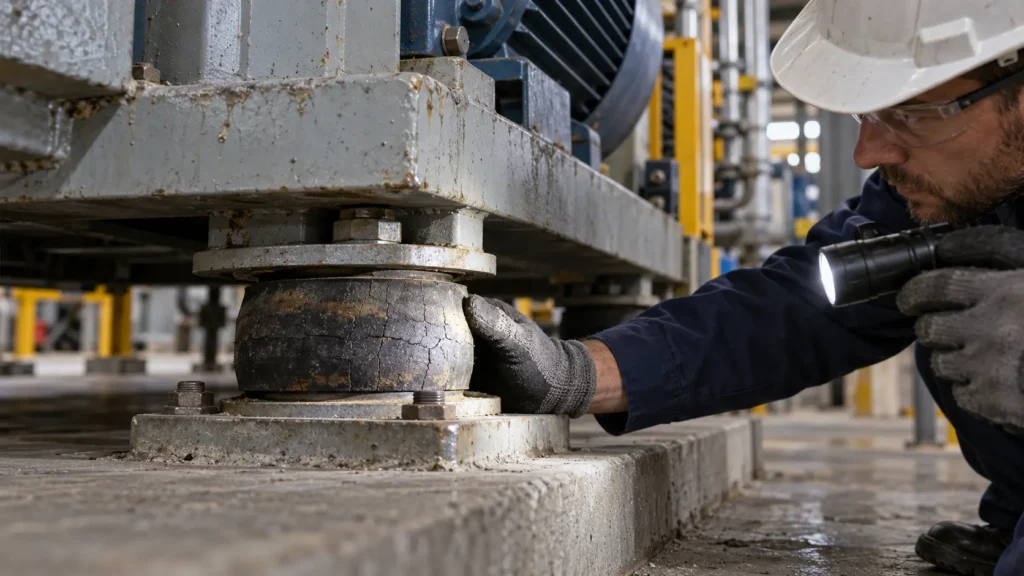
Under what circumstances should vibration-isolating mounts be replaced as soon as possible?
Not all signs of aging pose the same risk.
The table below can help you make a preliminary assessment, but specific actions should still be based on product design requirements, equipment safety regulations, and professional evaluations.
| Observed Phenomena | Preliminary Assessment | Recommended Action |
| Minor surface aging; no other abnormalities | Monitor | Take photos for documentation; re-inspect according to maintenance requirements |
| Noticeable hardening or softening of the rubber | Material properties may have changed | Verify the material and actual operating conditions |
| Persistent abnormal changes in installation height | Possible overloading or deformation | Measure the load, dimensions, and installation status |
| Visible rubber tears | May compromise load-bearing capacity | Evaluate promptly and consider replacement |
| Structural separation between rubber and metal | Structural integrity may be compromised | Stop using it as a normal support; evaluate and consider replacement promptly |
| Fracture of metal mounting hardware | Risk of connection failure | Shut down safely and address the issue |
| Significant increase in equipment vibration | The cause is still unclear | Conduct a comprehensive inspection of the vibration isolation system and the equipment itself |
| The equipment continues to shift or strike limit switches | Possible support or restraint abnormalities | Conduct a safety assessment promptly |
For industrial equipment, the decision to replace vibration-isolation mounts should not be based solely on the cost of the mounts themselves.
It is also necessary to consider equipment downtime costs, the complexity of repairs, the risk of damage to other components, and operational safety requirements.
If the mount no longer meets the demands of actual operating conditions, continuing to use it may result in higher overall costs than replacing it.
When replacing vibration isolation mounts, how do you choose the right product?
Upon discovering damage to an old mount, many people’s first instinct is to look for a replacement with exactly the same dimensions.
For equipment where operating conditions have not changed and the original specifications are clear, this approach may be convenient.
However, if the original mounts have failed prematurely on multiple occasions, simply replicating the dimensions may not be a reasonable solution.
When replacing vibration-damping mounts, it is recommended to focus on the following aspects.
Confirm the actual load-bearing capacity
First, confirm the equipment’s weight, center of gravity, and the actual loads at each support point.
If the equipment is also subject to startup shocks, reciprocating loads, or other dynamic forces, these factors must also be taken into account.
Identify Vibration and Shock Conditions
Understand the equipment’s operating speed, primary vibration frequencies, load variations, and allowable displacement.
If the goal is to reduce vibration transmission, the dynamic characteristics of the mount are often more important than its external dimensions.
Select the Appropriate Rubber Material
Consider requirements for oil resistance, temperature resistance, weather resistance, and other material properties based on the actual operating environment.
Do not select materials based solely on Shore A hardness, as the same hardness does not imply that different rubber formulations will have the same dynamic performance and durability.
Check Installation Dimensions and Connection Structure
Confirm thread specifications, mounting hole spacing, fastener dimensions, installation orientation, and available space on the equipment.
For products featuring rubber-to-metal bonding, also consider the connection structure and the direction of force application.
Determine Whether Standard Parts Are Sufficient
If standard vibration isolation mounts can meet the load, frequency, space, environmental, and installation requirements, using standard components is generally the most straightforward approach.
However, for specialized equipment, custom solutions may need to be considered.
For example:
- Non-standard installation dimensions or threads.
- Special load and shock requirements.
- Multidirectional vibration or shear loads.
- Special rubber materials.
- Specified metal connection structures.
- OEM mass production requirements.
In these situations, custom vibration mounts can help equipment manufacturers balance support structure, vibration isolation performance, and manufacturing feasibility during the design phase.
When should you consider custom vibration-isolation mounts?
If you’re simply looking for a replacement part for a standard piece of equipment, a standard product may suffice.
However, if you are responsible for equipment R&D, mass production, or industrial equipment upgrades and retrofits, the actual requirements may be more complex.
For example, a newly designed piece of industrial equipment may have limited installation space while also needing to withstand significant lateral loads.
In this case, even if a standard vibration-isolation mount fits dimensionally, it may not meet long-term operational requirements.
Another scenario is when the equipment operates in a specialized environment where standard rubber materials cannot simultaneously meet the requirements for oil resistance, temperature resistance, and expected service life.
For these projects, we recommend consulting with a supplier capable of manufacturing rubber vibration-damping components and providing technical support early in the design phase.
Vista Motion offers industrial rubber vibration isolation products as well as custom manufacturing services tailored to various applications.
If you are looking for a replacement for an existing mount or need to develop vibration isolation components for new equipment, please provide Vista Motion with the following information:
- Product model numbers, drawings, or photos of existing vibration-damping mounts.
- Equipment name, purpose, and installation location.
- Equipment weight and loads at each support point.
- Operating speed, primary vibration frequencies, and shock conditions.
- Rubber material or hardness requirements (if known).
- Operating temperature, contact with hydraulic fluid, and other environmental conditions.
- Mounting dimensions, threads, and connection methods.
- Estimated purchase quantity or annual demand.
Even without complete technical drawings, you can start by providing clear photos of the existing mount, its key dimensions, and the equipment’s operating conditions to help both parties determine what additional technical data will be needed later.
Learn about Vista Motion’s products and applications, or contact Vista Motion to discuss replacement parts and OEM customization projects.
How can you extend the service life of a vibration-damping mount?
Even after selecting the appropriate vibration-damping mount, proper maintenance remains crucial.
The following measures can help you reduce unnecessary premature damage.
Select a product that matches the actual operating conditions.
Consider load, vibration frequency, mounting orientation, and environmental conditions; avoid selecting a model based solely on appearance or price.
Install according to the manufacturer’s specifications.
Properly control the installation location, tightening requirements, and necessary operating clearances to avoid additional assembly stresses.
Minimize unnecessary exposure to oils and chemicals.
If equipment leaks occur, promptly address the source of the leak and verify that the rubber material is suitable for the medium.
Include vibration-damping mounts in equipment maintenance inspections.
Schedule appropriate inspection intervals based on the equipment’s criticality, operating time, environment, and history of failures.
Record anomalies and track changes.
Recording visible damage, installation height, vibration trends, and replacement history helps identify recurring issues.
For industrial equipment in long-term operation, continuous monitoring and proper selection are often more valuable than waiting until serious damage occurs before taking action.
Summary
Although vibration-isolation mounts are not the most conspicuous components in large machinery, they are directly related to equipment support, vibration isolation, and operational stability.
Rubber cracking, hardening, abnormal softening, permanent deformation, and adhesive delamination are material or structural changes that warrant attention. Increased vibration, abnormal noise, and equipment displacement may indicate that the entire vibration isolation system requires further inspection.
However, regardless of the symptoms that appear, the correct approach is not to immediately assume that the mount is damaged, but rather to make a judgment based on the actual load, equipment condition, and operating environment.
If existing mounts no longer meet requirements, the selection of replacement products should not be based solely on size and price.
A truly suitable vibration-isolation mount should be matched to the equipment’s actual load, dynamic operating conditions, installation structure, and operating environment.
For equipment maintenance, industrial equipment manufacturing, and OEM projects, early identification of wear signs, determination of failure causes, and selection of appropriately validated replacement solutions help reduce the risk of repetitive repairs and unnecessary downtime.
If you need to evaluate existing vibration-isolation mounts, replace industrial vibration-isolation components, or develop custom rubber vibration-isolation products, please contact Vista Motion. Provide your drawings, operating conditions, and procurement requirements so we can discuss the next steps for product selection and manufacturing solutions.
FAQ
What are the common symptoms of damaged vibration isolation mounts?
Common symptoms include rubber cracking, hardening, softening, swelling, permanent deformation, separation of rubber from metal, as well as equipment vibration, unusual noises, or increased displacement.
However, these signs do not all carry the same diagnostic value. Cracks and structural separation are forms of damage that can be directly inspected, whereas vibration and abnormal noises may also originate from other parts of the equipment.
If multiple abnormalities occur simultaneously—especially those involving damage to load-bearing structures—a professional inspection should be conducted promptly.
How long do industrial rubber vibration isolation mounts typically last?
There is no fixed service life for industrial rubber vibration-damping mounts that applies to all equipment.
Their service life depends on the rubber compound, load levels, dynamic deformation, temperature, contact with media, installation conditions, and product design.
The actual service life of the same type of mount can vary significantly across different pieces of equipment.
Therefore, the need for replacement cannot be determined solely based on the number of years in service. More reliable criteria include the manufacturer’s specifications, on-site damage, changes in performance, and actual operating conditions.
How can you determine if a rubber vibration-isolation mount needs to be replaced?
First, check the rubber for obvious tears, abnormal deformation, or separation from metal components; then inspect the mounting hardware and connection structures for damage.
If vibration or displacement increases during equipment operation, other mechanical faults should also be ruled out.
When a support has lost its normal load-bearing capacity, has suffered structural separation, or can no longer meet the equipment’s safety and operational requirements, it should undergo a professional assessment and be replaced.
Minor surface wear does not necessarily mean immediate replacement is required.
Can vibration-damping mounts still be used after they have worn out?
This depends on the extent of the damage and the equipment’s intended use.
If there are only minor surface changes that do not affect the load-bearing capacity, deformation, or operational performance required by the product, monitoring may continue in accordance with maintenance procedures.
However, if there is obvious rubber tearing, structural separation, metal fracture, or abnormal equipment displacement, operation should not continue without a risk assessment.
For mounts that perform safety-critical functions, follow the equipment manufacturer’s specific requirements.
Why do rubber vibration-isolating mounts crack?
Rubber cracking may be caused by ozone and oxidative aging, repeated mechanical deformation, stress concentration, high temperatures, or unsuitable materials and operating conditions.
The location and pattern of cracks can provide clues for failure analysis, but may not directly identify the sole cause.
If cracking recurs at the same location, it is necessary to inspect the load, installation method, environmental conditions, and product structure, rather than simply replacing the rubber components.
Does a vibration isolation bracket that is too hard or too soft affect vibration isolation performance?
Yes.
The stiffness of a vibration-isolation mount affects the equipment’s static deformation, natural frequency, and vibration transmission characteristics.
If the stiffness is too high, the expected vibration isolation effect may not be achieved; if the stiffness is too low, excessive displacement or support stability issues may arise.
However, vibration isolation performance cannot be determined solely by rubber hardness; the bracket’s shape, the dynamic characteristics of the material, the load, and the operating frequency must also be considered.
When selecting a product, the decision should be based on the equipment’s overall vibration isolation requirements.
Can a damaged rubber vibration isolation mount be repaired?
For vibration isolation mounts where the load-bearing rubber has torn or the structural bonding interface has separated, it is generally not recommended to restore them for use with ordinary adhesives or temporary filler materials.
This is because such repairs cannot reliably ensure that the product has regained the load-bearing capacity and fatigue durability required by the design.
If the issue is merely loose fasteners or other maintainable installation problems, they can be addressed according to the manufacturer’s specifications.
Whether the entire assembly needs to be replaced should be determined based on the product’s structure and the extent of the damage.
When replacing a vibration isolation bracket, do all brackets need to be replaced at the same time?
Not necessarily.
If only one mount is damaged, the others are in good condition, and the manufacturer permits individual replacement, the issue can be addressed on a case-by-case basis.
However, for equipment with high requirements for load distribution, installation height, and dynamic stiffness matching, you should also check whether other support points exhibit similar signs of aging or deformation.
After replacement, verify that the equipment’s position, load distribution, and operating status are normal.
For systems requiring complete matching, the equipment manufacturer’s requirements should take precedence.
Are seismic isolation bearings and vibration isolators the same product?
Not necessarily.
In the industrial field, “shock mounts” generally refer to mounting components used for support, vibration isolation, and shock absorption; common structures include rubber shock mounts and metal-rubber bonded assemblies.
In contrast, “shock absorbers” specifically refer, in certain contexts, to devices that dissipate kinetic energy through hydraulic or other damping mechanisms.
Additionally, “shock mounts” or “strut mounts” in automotive suspensions have specific structures and applications.
Therefore, when purchasing, it is best to provide product drawings, photos, the intended use of the equipment, and actual operating conditions, rather than relying solely on the English product name.
How do you choose the right industrial vibration isolation bracket manufacturer?
First, confirm whether the supplier offers products and manufacturing capabilities that match your application.
For standard replacement parts, focus on specifications, materials, mounting dimensions, and product technical data.
For OEM custom projects, you’ll also need to assess whether the supplier understands requirements such as load capacity, vibration frequency, operating environment, and mounting configurations.
Before purchasing, it is recommended to clarify technical drawings, sample verification requirements, expected purchase quantities, and quality acceptance criteria.
If you are looking for industrial rubber vibration isolation mounts or custom vibration isolation components, you can submit your equipment information and project requirements via the Vista Motion website to further discuss suitable product solutions.
