
A request for “70 Shore A NBR” identifies a rubber family and a hardness target. It leaves other purchasing questions unanswered: which aging requirements apply, what fluid exposure must be evaluated, and what evidence should the supplier provide?
ASTM D2000 provides a structured way to describe rubber material requirements through a line callout. Reading that designation is the first step. The next is connecting it to the drawing, application conditions and test evidence so that engineering, purchasing and the supplier are working from the same requirements.
What Does ASTM D2000 Specify?
ASTM D2000 is a classification system for vulcanized rubber materials. Although developed for automotive applications, its scope extends to other uses. It groups material requirements using Type, based on heat-aging resistance, and Class, based on resistance to swelling in oil. Additional requirements refine the designation. ASTM’s official scope describes this framework.
Material classification and product requirements
A material designation belongs within the component specification. It does not replace dimensions, drawing notes or application-specific requirements. ASTM’s scope states that detailed product specifications take precedence where they conflict with the classification system.
For purchasing, the useful question is therefore more precise than “Does this rubber meet ASTM D2000?” Ask whether the offered compound meets the complete agreed callout and the additional requirements for the part.
Keep the material name separate, too. ASTM D1418 addresses rubber nomenclature; a polymer abbreviation helps identify the material family, while a performance specification describes what must be demonstrated. ASTM D1418 scope.
As checked on 16 September 2026, ASTM lists D2000-18(2024)e1 as active. SAE lists J200_202303, revised in March 2023, for its related rubber classification document. ASTM D2000, SAE J200.
Before requesting a quote, record the standard and edition referenced by the drawing. If an older reference needs updating, obtain an engineering decision and document the change. Do not silently substitute a newer edition or assume that different ASTM and SAE references are interchangeable.
How Do You Read an ASTM D2000 Line Callout?
Read the designation in groups. First identify the reference and units, then the basic material fields, followed by the additional requirements.
For illustration, consider the following example discussed in a Smithers engineering Q&A:
ASTM D2000 M2BC507 A14 EO34
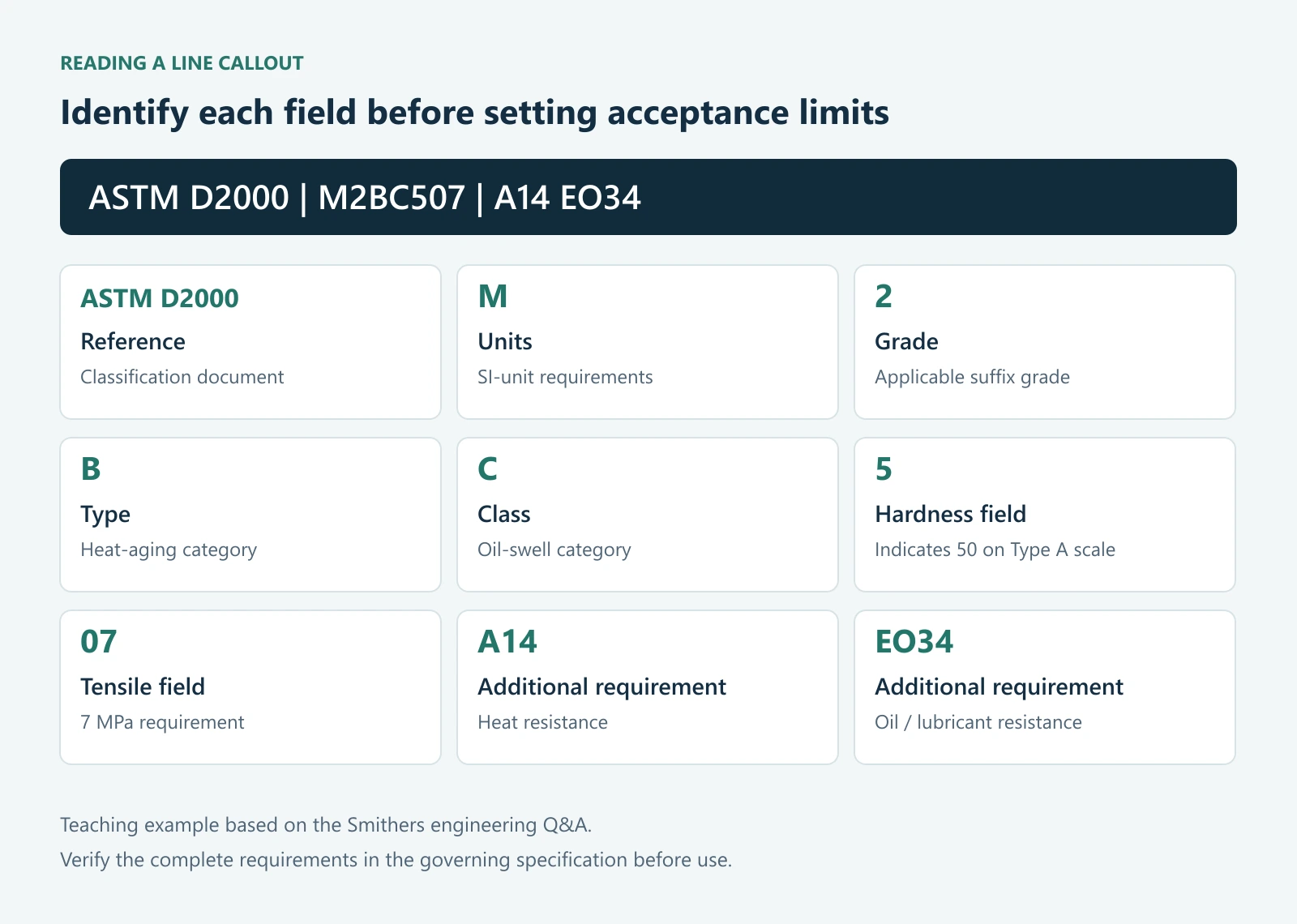
The spacing below separates the fields for learning:
ASTM D2000 | M | 2 | B | C | 5 | 07 | A14 | EO34
| Field | Meaning in this example |
|---|---|
| ASTM D2000 | Classification reference |
| M | SI-unit requirements |
| 2 | Applicable suffix grade |
| B | Type: heat-aging category |
| C | Class: oil-swell category |
| 5 | Hardness field indicating 50 on the Type A scale |
| 07 | Tensile-strength requirement of 7 MPa |
| A14 | Additional heat-resistance requirement |
| EO34 | Additional oil/lubricant-resistance requirement |
This is a teaching example, not a recommended specification for a particular seal, bushing or molded part. Its complete acceptance requirements must be checked in the governing edition before use.
Units, grade, Type and Class
Treat each field as a reference to a requirement. The grade is not a consumer-style quality rating: selecting a larger number is not a substitute for identifying the tests your application needs.
When an incoming drawing contains unfamiliar notation, preserve it in your clarification request. Avoid “tidying up” the designation in a way that loses a suffix or changes a reference. A useful question is: “Please confirm the full material callout, referenced edition and all associated notes.”
Hardness and tensile-strength fields
Hardness and tensile strength describe different measurements. ASTM D2240 addresses indentation hardness. It also explains that the reading does not have a simple relationship with fundamental material properties. A hardness value alone should therefore not stand in for the full performance requirement. ASTM D2240.
On a supplier report, compare the specified hardness scale and limits with the reported result. For tensile strength, check the unit as well as the value. If the callout and report appear inconsistent, request clarification before accepting the document as evidence.
What Do Type and Class Tell You About Material Performance?
Type and Class help organize selection, but their meaning depends on defined tests. Keep three items together when interpreting a result: the property measured, the exposure conditions and the acceptance limit.
Heat-aging conditions versus service temperature
A laboratory aging temperature is not automatically the continuous operating temperature of a finished component. ASTM D573 evaluates the influence of elevated temperature on vulcanized rubber properties and notes that results may not correlate exactly with service performance. ASTM D573.
For a new application, give the supplier the actual temperature profile: normal operation, short peaks, exposure duration and cold starts. Also describe what the component must do during those conditions.
For example, “the assembly experiences a brief hot cleaning cycle” is different from “the loaded component operates at that temperature throughout its service.” This is an application distinction to resolve, not a reason to infer a new rating from the classification letter.
Reference-oil testing versus application fluids
A reference-oil result is evidence about a defined exposure. It does not answer every question about a lubricant, cleaner, fuel blend or mixture encountered in service.
ASTM D471 provides comparative liquid-exposure testing and cautions against assuming direct correlation with actual part performance. Its scope includes several specimen sources, reinforcing the need to identify what was tested. ASTM D471.
List the actual fluids, concentrations, temperatures and contact durations in the project brief. Include occasional exposures such as cleaning agents, not just the normal operating medium. Ask the responsible engineer which additional evaluation is necessary where the service environment differs from the specified reference test.
How Do Suffixes and Z Requirements Complete the Specification?
Suffixes add requirements beyond the basic designation. In Smithers’ teaching example, A14 refers to heat aging using D573 for 70 hours at 100°C, while EO34 refers to D471 exposure in IRM 903 oil for 70 hours at 100°C. These identify test conditions; they are not a complete acceptance specification on their own. Smithers’ example.
Reading additional test requirements
For each suffix, identify the applicable method, conditions, measured properties and limits from the governing requirements. A list of suffix letters is helpful for orientation, but it is not enough to authorize testing or approve a compound.
Use a short requirements register:
| Record | What to capture |
|---|---|
| Reference | Complete suffix and governing specification |
| Procedure | Test method and applicable procedure |
| Exposure | Medium, duration, temperature and other specified conditions |
| Acceptance | Property, unit and allowable limit |
| Evidence | Report or result that addresses the requirement |
This register is a purchasing aid, not an ASTM form. Its purpose is to reveal missing information before quotation or testing starts.
Resolving a missing Z note
Special Z requirements need their definitions. WARCO’s published example, for instance, uses a defined Z1 note to change the hardness requirement. That particular meaning cannot be transferred to every occurrence of Z1. WARCO’s explanation.
If a drawing lists “Z1” without the associated note, ask for the definition and its document reference. Do not infer it from another supplier’s data sheet. Similarly, confirm how a special requirement interacts with the rest of the callout instead of choosing whichever value is easier to meet.
What Else Must Be Specified for a Rubber Component?
Organize the project brief into material requirements, component requirements and validation evidence. This helps expose gaps that a material designation alone cannot resolve.
Dimensions and operating conditions
Provide the drawing revision, interfaces, relevant tolerances and installation conditions. Describe contact fluids and environmental exposure in terms that the supplier can evaluate.
Where the application is still being developed, identify the open decisions explicitly. An unanswered question about duty or geometry should remain an engineering question rather than becoming an assumption hidden in a quote.
Mechanical performance and validation
Consider a hypothetical rubber-to-metal suspension bushing. Alongside its material callout, the design review should establish the applicable component requirements and how they will be verified:
| Requirement area | Question for the project team |
|---|---|
| Load and movement | What forces, directions and displacements must the bushing accommodate? |
| Stiffness | What response is required, and under which measurement conditions? |
| Repeated loading | What duty cycle and durability acceptance criteria apply? |
| Bonded interfaces | What bond requirements and verification are needed? |
| Geometry and assembly | Which dimensions, interfaces and installation limits control fit? |
| Environment | Which temperatures and fluids must the assembled component encounter? |
This is a review framework, not a standard bushing specification or a claim about any manufacturer’s capabilities. The project engineer should determine the applicable criteria and validation plan. A compound-level result and an assembled-component result answer different questions.
How Should You Check a Supplier’s Test Report?
Start with the approved requirement, then find the corresponding evidence. A report title or a general statement of conformity is a starting point for review, not the whole review.
Match each requirement to a result
Use the following worksheet for each required test or property:
| Check | Information to reconcile |
|---|---|
| Requirement | Drawing revision, complete callout and any special note |
| Material identity | Supplier compound code and connection to the offered material |
| Specimen | What was tested and how it relates to the requested product |
| Method | Referenced procedure and any reported deviation |
| Conditions | Time, temperature, medium, conditioning and other relevant settings |
| Acceptance limit | Required value or range, including units |
| Result | Measured value and stated conclusion |
| Traceability | Report identification, date and batch relationship where required |
| Open issue | Missing evidence, inconsistency or clarification owner |
For example, if a report gives a passing result but lists a different limit from the drawing, reconcile the difference before using that conclusion. It may involve a revision, special note, unit conversion or document error. Record the resolution rather than silently editing the report.
Separate typical data from project evidence
Ask whether the document describes typical compound properties, qualification testing, a particular batch or finished-part inspection. Then check whether that evidence matches the agreed purchasing requirement.
A compound data sheet may be useful for screening without answering every lot-specific question. Conversely, do not demand a full qualification programme on every shipment by default. Agree the evidence package and test frequency with the responsible engineering and quality teams.
Compression-set reporting illustrates why method detail matters: ASTM D395 includes different test methods, so the method designation belongs with the result. ASTM D395. Apply the same discipline to other reported properties: the number needs its test context.
What Should You Include in an RFQ for Rubber Components?
An effective RFQ makes the technical scope visible before suppliers price the work. Include:
- The component drawing, revision and relevant assembly information.
- The complete ASTM D2000 reference and all suffix or special-note definitions.
- Any separately specified polymer, compound or material-source requirement.
- Operating temperatures, fluids, contact durations, loads and movement.
- Dimensional, functional and durability requirements for the component.
- Required qualification, inspection and traceability documents, with agreed testing frequency where defined.
- Prototype and production quantities, together with unresolved engineering questions.
Compare quotations against that same package. If a supplier proposes a different material or qualification route, ask for the proposed deviation and supporting evidence so it can receive an explicit engineering decision.
For a custom suspension-component project, bring the drawing and specification questions together at the outset. Submit your suspension-component drawings and requirements to Vista Motion for a project-specific feasibility review and quotation.
