
How much does it cost to repair car suspension?
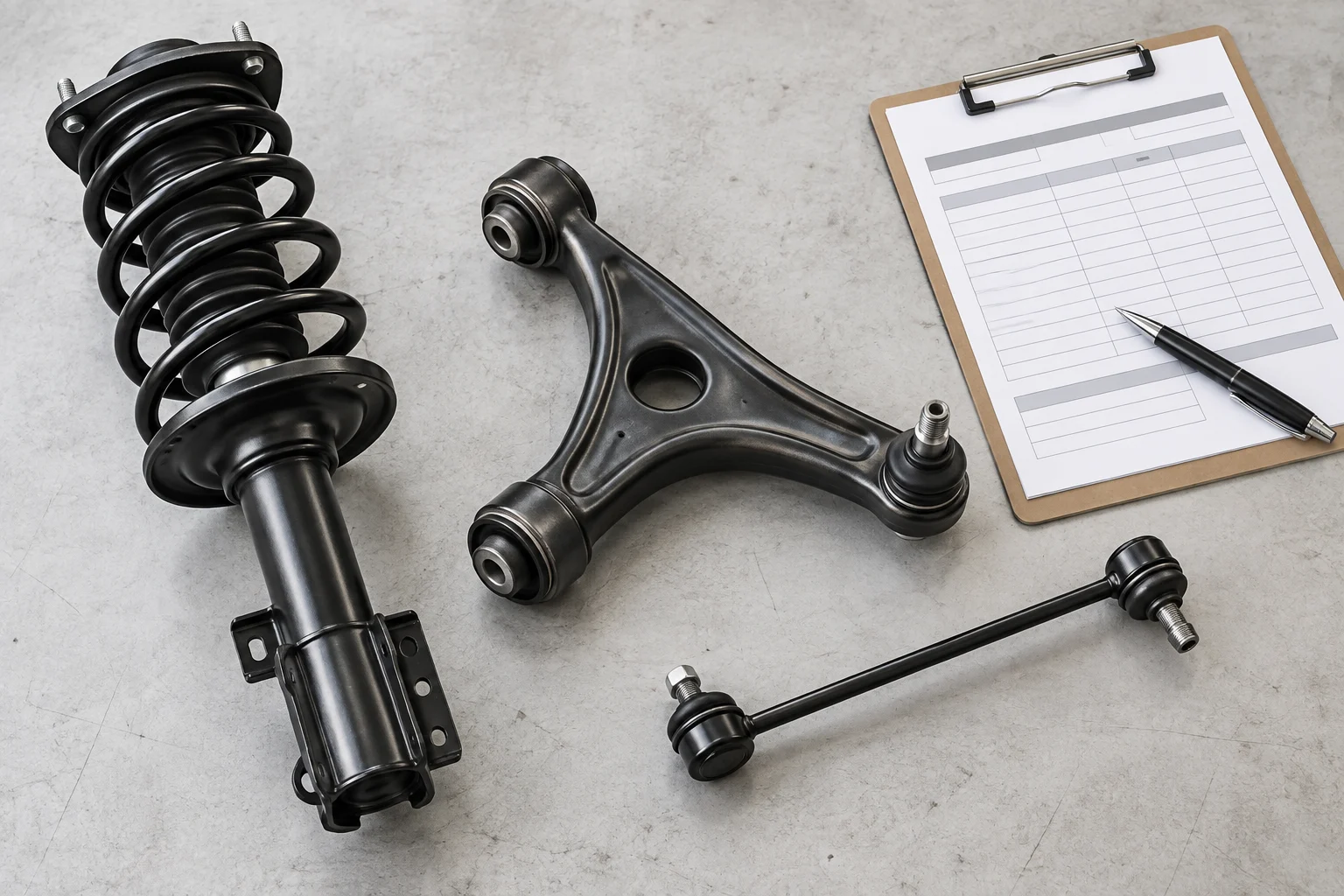
Car suspension repair cost depends on the component and the work included. As US reference points, RepairPal lists $131–$185 for stabilizer bar link kit replacement and $1,144–$1,348 for shock or strut replacement, including parts and labor before taxes and fees. These are estimates for different services, not the lower and upper limits of every suspension repair. RepairPal: link kit, RepairPal: shocks and struts.
To judge your own quote, establish three things first: which parts need replacing, how many are included, and what the installed total covers. A price for a single component, an axle pair and a complete assembly can describe very different work.
How much do common suspension repairs cost?
The table below gives published US estimates for five named repairs. Each includes parts and labor, excludes taxes and fees, and does not account for your specific location. Related repairs can add to the bill. Follow the linked source for vehicle-specific estimates.
Scroll the table sideways to see every column.
| Repair service | Published US estimate | Scope to confirm before comparing |
|---|---|---|
| Stabilizer bar link kit replacement | $131–$185 | Number of links and sides; this is not replacement of the stabilizer bar itself |
| Suspension ball joint replacement | $307–$452 | Joint position, quantity and whether the quote is for a separate joint or an assembly |
| Coil spring replacement | $758–$925 | Axle, spring quantity and associated work |
| Control arm replacement | $791–$909 | Arm position, quantity and components supplied with the arm |
| Suspension shock or strut replacement | $1,144–$1,348 | Axle, quantity, individual dampers or complete assemblies |
Price references checked on 29 September 2026. These general estimates do not establish a consistent per-side or per-axle unit. Do not multiply them by the number of wheels to calculate a whole-car price.
Read the job scope before the price
“Suspension repair” can mean replacing a link, repairing a joint or renewing several assemblies. Start with the named service that matches the workshop's diagnosis. If you cannot identify a part on the estimate, this guide to car suspension parts explains the main component groups.
For bushings—also called suspension bushes—use the more specific bushing replacement cost and repair-options guide. It covers the choice between a separate bushing repair and a control-arm assembly.
A quote outside a published range needs an explanation, but the range alone cannot establish whether the quote is fair. Ask for the vehicle-specific parts and work behind it.
What changes the final repair bill?
The most useful breakdown is the parts supplied, the operations required to fit them, and any additional charges. Comparing these items explains more than comparing two totals with different repair descriptions.
Parts and assemblies
Ask for the part manufacturer, reference number and quantity. If an assembly is listed, have the workshop identify its contents. RepairPal notes that control arms can come with bushings already installed, while other applications require separate installation. That difference belongs in both the parts description and the labor scope. RepairPal control-arm guidance.
For a strut quote, establish whether the workshop will replace the complete assembly or reuse suitable components from the existing one. RepairPal describes both approaches; their operations differ. Compare the actual proposed repair rather than assuming that every “strut replacement” includes the same parts. RepairPal strut replacement guidance.
Labor and additional work
For time-based labor, request the quoted hours and hourly rate. For a fixed-price job, request its inclusions and exclusions. Identify diagnosis, required hardware and any geometry work that is charged separately.
Wheel alignment deserves a specific question. Monroe recommends alignment after strut replacement but also identifies exceptions where alignment angles are unaffected or adjustment provisions differ. Ask what the vehicle's repair procedure requires and whether the quoted price includes that work. Monroe alignment guidance.
Use this accounting check:
Complete quoted cost = parts + labor + required extras + applicable taxes and fees, counting each charge once.
If labor is already a total, hours multiplied by the rate explain that total; they are not another charge. Likewise, do not add alignment again when it is included in a package.
Does the quote cover one side, a pair or a complete assembly?
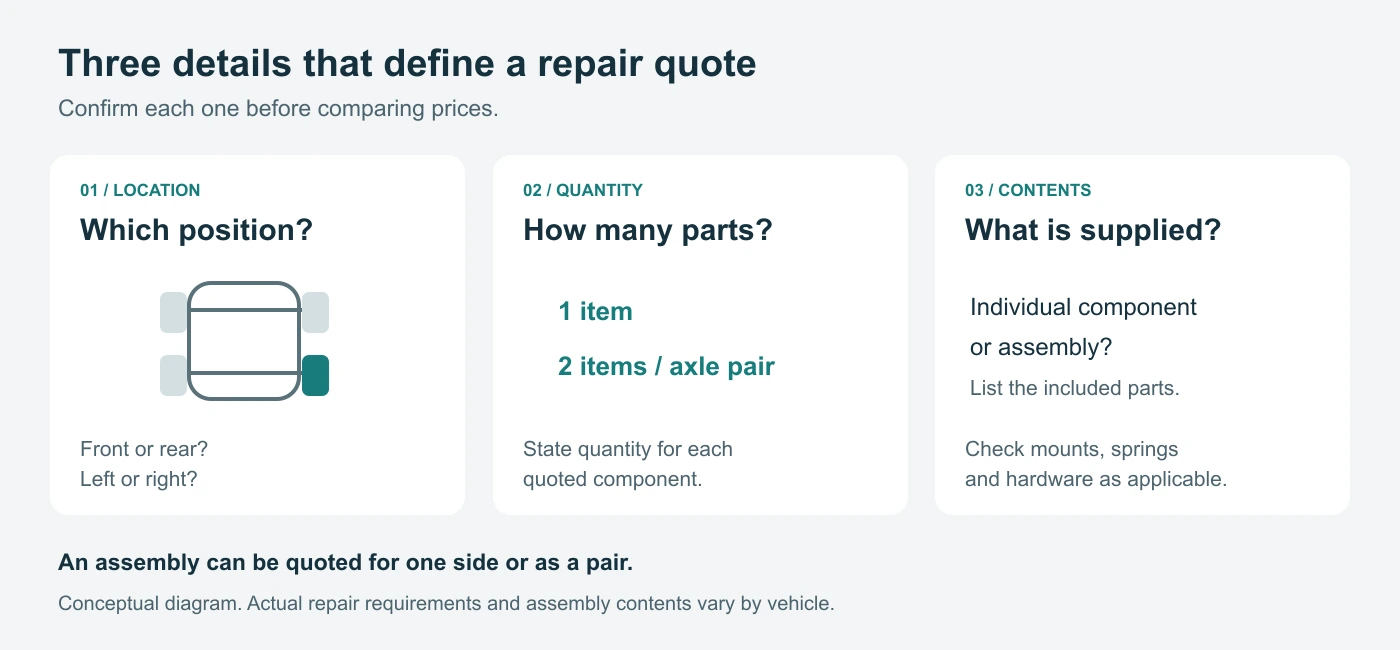
Quantity and assembly contents are separate questions. “Two struts” tells you the quantity; it does not tell you whether springs, mounts or other items are included.
Scroll the table sideways to see every column.
| Wording on an estimate | What to clarify |
|---|---|
| One side or one corner | Which wheel position and which component? |
| Pair or per axle | Does it include both left and right, and on which axle? |
| Complete assembly | Which components and fastening hardware are supplied? |
| Front suspension replacement | What is the full parts list and quantity for each item? |
| Full suspension replacement | Which front and rear components are included, and which remain in use? |
Monroe recommends replacing shocks and struts in pairs on the same axle. That recommendation helps explain why a workshop may quote both sides, but it does not prove that a price estimator's headline covers a pair. Ask the workshop to state the quantity explicitly. Monroe guidance on paired replacement.
Do not apply the same replacement rule automatically to every arm, joint or mounting component. Have the workshop explain the requirement for the actual part and vehicle.
Do you need one repair or a wider suspension replacement?
Ask the workshop to connect every proposed replacement with an inspection finding, a service requirement or the contents of the selected assembly. A description such as “front suspension overhaul” should be followed by an itemized list.
Useful questions include:
- Which components have failed, and what findings support that diagnosis?
- Which additional items are required by the repair procedure?
- Which items are included in an assembly rather than priced separately?
- Are there suitable repair options with different parts and labor requirements?
- Does the combined job share any removal, refitting or alignment work?
For several repairs together, request a combined written quote. Adding separate online averages cannot establish the package price or any saving. Ask the workshop to explain shared operations instead of assuming that each job requires its full standalone labor allowance.
For example, if a quote names struts, mounts and springs, ask whether those are separately supplied components or the contents of the quoted assemblies. This is a scope check, not evidence that the workshop has charged twice.
For air or electronically controlled suspension, make sure the estimate identifies the actual system and parts. Keep that quote separate from generic conventional-suspension references unless the source explicitly covers the same application.
How should you use these prices in your country?
Keep cost references in their original currency and obtain a local quote for the same vehicle and work. Currency conversion does not supply the missing local labor rate, parts price or tax treatment.
Scroll the table sideways to see every column.
| Market | Published reference or practical next step | How to interpret it |
|---|---|---|
| United States | Use the named RepairPal services above, then select your vehicle and location | Confirm quantity, related work, taxes and fees |
| United Kingdom | ClickMechanic gives a broad £100–£600 guide depending on which suspension parts need replacement | This is not a defined whole-system replacement package; confirm quantity, VAT and inclusions in the actual quote |
| Germany | FairGarage describes €200–€600 per axle for shock absorber replacement on many models | Its listed vehicle examples can fall outside that range; it states that its example prices include parts, labor and VAT |
| Other Western European countries | Request a local, vehicle-specific estimate | A German or UK guide does not establish the price in another country |
| Nordic countries | Request the total in the relevant local currency, with parts, labor and taxes identified | This guide does not provide a verified Nordic price range |
| Russia | Moscow workshop Pulam lists rear shock replacement labor from ₽2,000, excluding parts | This is one workshop's starting work charge; confirm quantity and the complete installed price |
These references describe different jobs and pricing methods. They cannot establish which country is cheaper. When a comparison site displays a discount or “average saving,” check the label before treating the amount as the cost of a repair.
What should you check before approving a suspension repair quote?
Compare equivalent work and resolve unclear lines before choosing on price. Copy this worksheet into a note or email and ask each workshop to complete the missing details.
Scroll the table sideways to see every column.
| Quote item | Workshop A | Workshop B | Unresolved difference |
|---|---|---|---|
| Vehicle, year and relevant variant | |||
| Failed components and inspection findings | |||
| Axle, side and quantity | |||
| Part references and manufacturers | |||
| Individual parts or assemblies; contents | |||
| Parts total | |||
| Labor operations and total | |||
| Shared work within a combined repair | |||
| Diagnosis charge, if separate | |||
| Required hardware, if separate | |||
| Alignment or geometry work: required/included? | |||
| Other agreed charges | |||
| Taxes and fees not already included | |||
| Complete quoted total | |||
| Quote validity and warranty terms | |||
| Approval process for additional work |
Mark included items as “included” rather than entering their cost again. If one offer includes a complete assembly and another supplies individual components, resolve that difference before treating the totals as comparable.
For combined repairs, ask whether the labor total already accounts for shared operations. A workshop may explain its package differently from another; the important result is a clear scope and an agreed total, not identical invoice formatting.
Also establish how unexpected work will be handled. Ask the workshop to explain any proposed change in parts, work or price and obtain your agreement before proceeding. Keep the final estimate and part details with the repair record.
Is the repair worth it for your car?
Consider the diagnosed repair alongside the vehicle's overall condition, other known work and how long you intend to keep it. The suspension estimate alone does not answer the whole ownership decision.
Before deciding, gather:
- The itemized cost of the work currently recommended.
- An explanation of its urgency from the inspecting workshop.
- Other known repairs or maintenance you expect to fund.
- The cost and condition of a realistic replacement vehicle.
- Any transport or downtime costs relevant to your situation.
A large estimate is a reason to understand the scope and, where useful, obtain a second inspection or comparable quote. Avoid an arbitrary rule that a repair is worthwhile below one percentage of the car's value. Your plans and the condition of both the current car and its possible replacement matter.
If you are considering postponing the work, ask the inspecting workshop to assess the vehicle's condition. A cost guide cannot determine roadworthiness or a safe distance to drive with a suspected fault.
What should businesses send for a custom suspension-component quote?
For procurement managers and engineers, a custom component project needs its own technical and commercial brief. Retail repair estimates include workshop services and cannot establish a production part's unit price.
Provide the component drawing and revision, application, mating interfaces, material requirements, expected quantities and validation criteria. Include known operating conditions and explain whether the request concerns a sample, a replacement design or a production program.
Submit your suspension-component drawings and requirements to Vista Motion for a project-specific feasibility review and quotation. Feasibility and scope are assessed against the requirements of the individual project.
