
When industrial equipment wobbles, tilts, or operates unsteadily, your first thought might be that the floor is uneven. However, the reality is often more complex: the weight distribution of the equipment, the height of the support points, the rigidity of the base, installation errors, dynamic loads, and operational vibrations can all affect overall stability. Below, we’ll examine how adjustable feet influence the stability of industrial equipment from the perspective of actual equipment use.
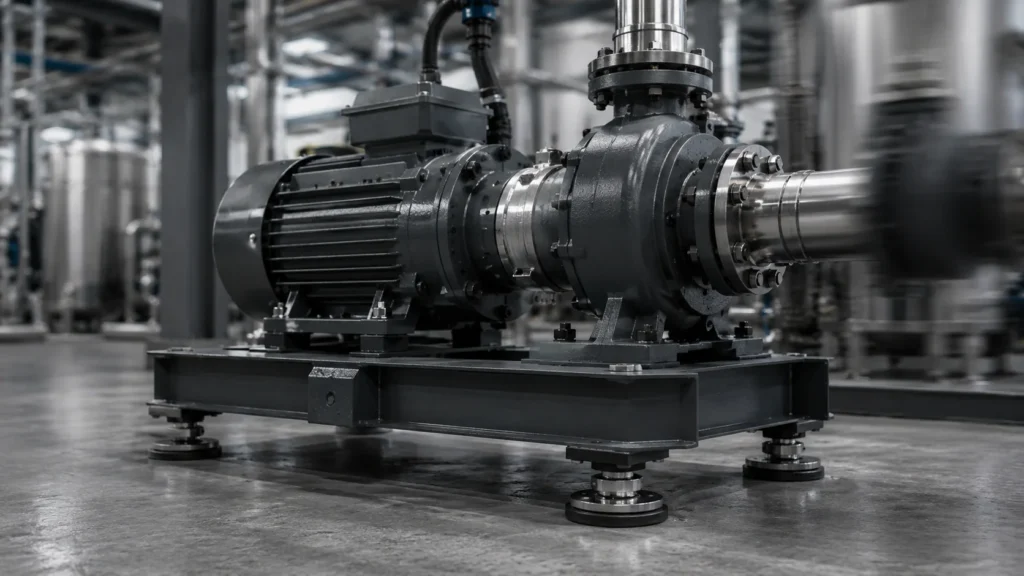
What Are Adjustable Feet?
Adjustable feet are height-adjustable supports installed at the base of equipment, racks, workbenches, or machinery. In the industrial sector, they are also commonly referred to as:
- Adjustable leveling feet
- Leveling feet
- Machine leveling feet
- Machine feet
- Industrial leveling feet
- Leveling mounts
- Adjustable machine feet
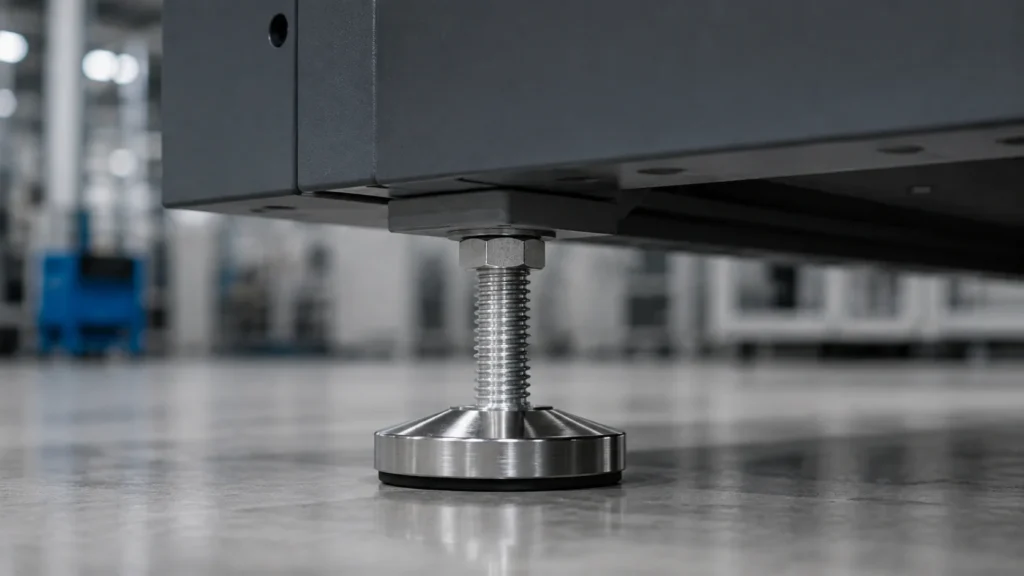
A typical design usually consists of: a threaded rod + an adjustment nut + a support base
Rotating the threaded rod or adjustment nut allows you to change the height at a specific support point of the equipment, thereby compensating for differences in floor level.
Depending on the application environment, the base can be made of steel, stainless steel, engineering plastics, rubber, or a combination of metal and elastomer. Some products feature only a rigid base, while others include anti-slip rubber; still others are specifically designed for vibration control.
Therefore, when selecting adjustable leveling feet, do not focus solely on appearance and thread dimensions.
What you really need to confirm is: Is this foot intended solely for leveling, or does it also need to bear loads, resist lateral forces, provide slip resistance, or offer vibration damping or isolation?
This question determines nearly all subsequent selection criteria.
Why Do Industrial Machines Tend to Become Unstable?
Before discussing the role of leveling feet, let’s first examine why equipment becomes unstable.
You may have encountered this situation: a machine has been placed on the floor, and all four feet appear to be in contact with the ground, but when you push it with your hand, the equipment still wobbles slightly.
The cause may not be that the equipment is not heavy enough, but rather that the force distribution across the support points is uneven.
Common causes include:
Industrial floors are not as level as one might imagine
Concrete floors may have localized slopes, height differences, wear, or construction errors.
For large equipment, even a very small height difference can prevent a single support point from bearing the full load.
The result is:
- Three legs bear most of the weight, while the fourth leg merely “touches the ground.”
- The equipment is naturally prone to rocking.
Uneven weight distribution of the equipment itself
Components such as motors, gearboxes, hydraulic systems, electrical control cabinets, and work units are often not arranged completely symmetrically.
Therefore: total weight ÷ number of support legs
can only serve as a very preliminary average. The actual load may be significantly concentrated on certain support points.
Manufacturing and assembly tolerances in the equipment frame
Welded frames, sheet metal frames, and large machine bases may all be subject to slight deformation.
If fixed-height supports are used directly, these errors will be carried over into the final installed state.
Dynamic loads occur during equipment operation
If the machine contains:
- motors
- Fans
- Pumps
- Compressors
- Reciprocating mechanism
- Eccentric mechanisms
- High-speed rotating components
The support points no longer bear only the static weight of the equipment. Start-up, shutdown, acceleration, impact, and cyclic motion all generate additional forces.
Therefore, when we discuss “stability,” we are not merely referring to the absence of sway when the machine is at rest, but also whether the equipment can maintain proper support, positioning, and structural stability during operation.
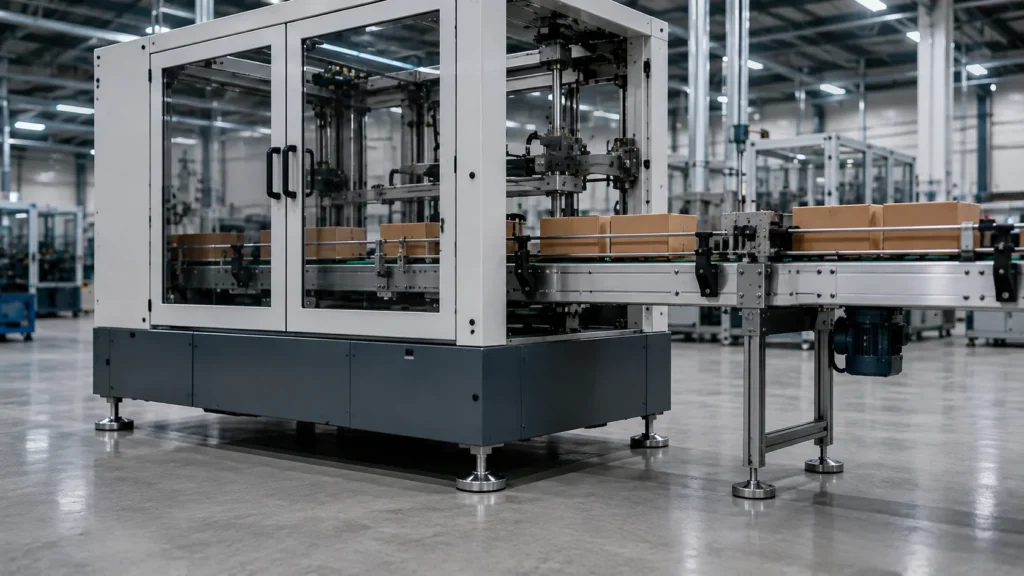
How Do Adjustable Feet Improve the Stability of Industrial Equipment?
Compensating for floor level differences to eliminate equipment wobble
This is the most direct function of adjustable feet.
Suppose a piece of equipment uses a four-point support system, but there is a slight unevenness in the floor. If the heights of all four feet are completely fixed, one of the support points may become suspended or experience insufficient contact pressure.
In this case, the machine is prone to slight swaying around the other support points.
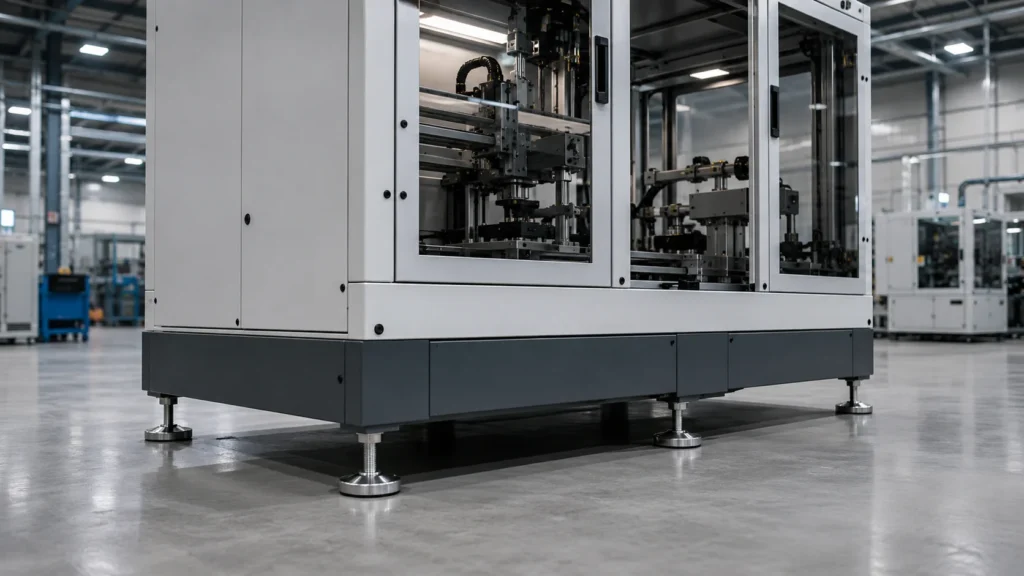
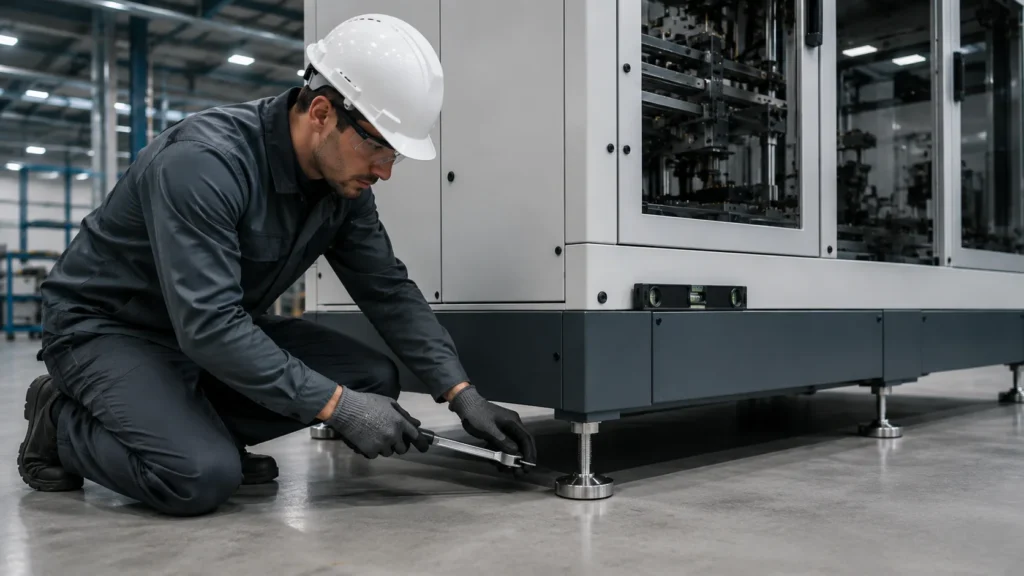
Adjustable leveling feet allow the height of each support point to be adjusted individually, enabling the equipment to be leveled in its actual installation environment and ensuring that all designed support points establish effective contact.
For operators, the most noticeable change is that the machine no longer “wobbles at the slightest push.” However, from an engineering perspective, the subsequent changes in load distribution are even more critical.
Improving load distribution among support points
Equipment stability is not as simple as “every foot touching the ground.”
What really matters is whether each support point is bearing a reasonable load.
If a machine’s four leveling feet are theoretically bearing an equal load, but one of them is set too high, it may cause the two adjacent support points to bear a greater load.
This not only affects the support feet themselves but may also increase:
- Localized stress on the equipment base
- Deformation of the welded frame
- Loads on threaded connections
- Bending of the support plate
- Long-term fatigue risk to the mounting structure
Proper adjustment of the machine leveling feet helps ensure that multiple support points work together, rather than having a few feet bear the vast majority of the weight.
This is why, after the installation of large industrial equipment is complete, simply using a level to check whether “the machine is level” is not sufficient.
Attention should also be paid to: whether the support is uniform, whether there is any noticeable warping of the structure, and whether new displacements occur after the equipment is put into operation.
Reducing Forced Twisting of the Frame
This point is easily overlooked.
For example, a welded frame machine may have slight manufacturing tolerances. If installers forcefully tighten the mounting points to ensure every foot is in full contact with the ground, they may convert installation errors into internal stresses within the frame.
As a result, while the equipment may appear to be “secured,” the entire structure has actually been preloaded or twisted.
For systems with:
- Guide Rails
- precision drives
- sensors
- conveyor mechanisms
- alignment requirements
- Long-span frame
, this issue warrants particular attention.
Using independently adjustable industrial leveling feet allows installers to first establish proper support at each point before completing the equipment leveling and locking process.
In other words, the purpose of adjusting the leveling feet is not to force the machine into a level position, but to allow the equipment to achieve the required installation posture under natural and appropriate load conditions.
Helps Maintain Equipment Geometry and Alignment
Some industrial equipment is not particularly sensitive to levelness but is highly sensitive to the relative positions of its components.
For example:
- Conveying equipment
- Packaging machinery
- Automated production lines
- Pump and motor systems
- Machining Auxiliary Equipment
- Inspection Platforms
- Precision Assembly Equipment
If the base is tilted or warped, the upper structure may also experience positional shifts.
The ultimate problem you may encounter is not that “the machine is tilted,” but rather:
- Conveyor belt misalignment
- Changes in coupler alignment
- Rail operation issues
- Changes in component clearances
- Decreased workpiece positioning repeatability
- Door panels or protective structures fail to close properly
Therefore, the value of machine leveling feet actually extends to the entire equipment structure.
Although they are not core components responsible for manufacturing precision, they help the equipment maintain the geometric relationships intended by the designer after installation.
It is important to note that if the equipment already has mechanical issues such as shaft misalignment, rotor imbalance, or structural looseness, simply adjusting the leveling feet will not resolve the underlying problem.
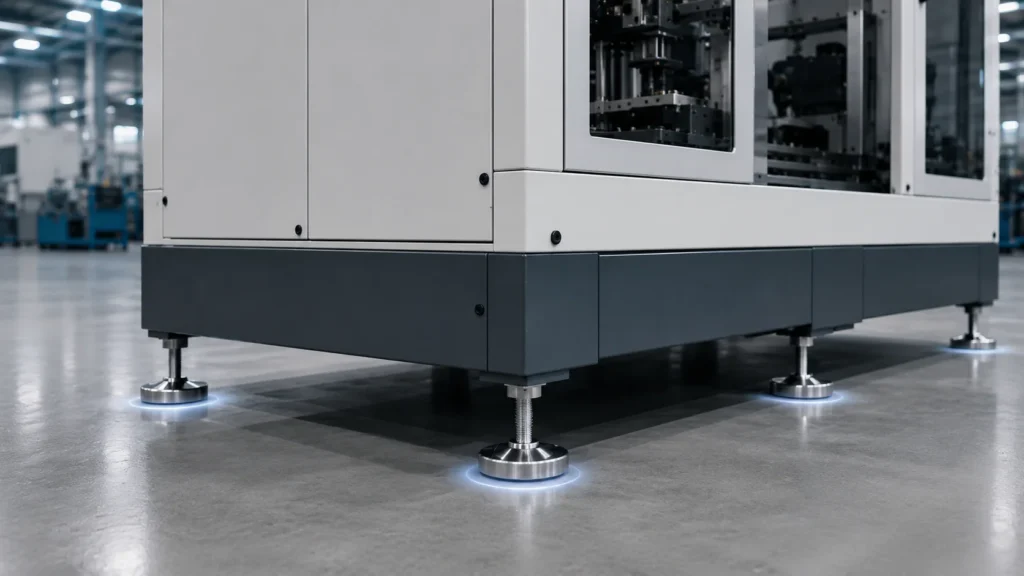
Increase the stable support surface to improve resistance to tipping
The diameter of the leveling feet’ base is also worth considering.
All other things being equal, a larger support base typically:
- Expand the contact area with the ground
- reduce localized contact pressure
- Provide a more stable support base
Especially for equipment that is tall, has a high center of gravity, or has limited support span at the base, it is not enough to simply consider whether “this leg can bear the load.”
One should also consider: the center of gravity of the entire piece of equipment, the support polygon, and any lateral forces that may be exerted.
For example, if the equipment is subject to lateral loads caused by personnel pushing, start-stop inertia, robotic arm movement, or moving materials, relying solely on the friction between standard adjustable feet and the floor may not be sufficient.
In such cases, the following may be required:
- Leveling feet with mounting holes
- Floor fixings
- Anchor bolts
- Larger bases
- Anti-slip features
- Specialized mechanical fastening solutions
Especially for equipment with a significant risk of tipping, leveling feet should not be used as a substitute for the necessary mechanical anchoring design.
Non-slip bases can reduce minor equipment displacement
Many adjustable leveling feet incorporate rubber or other high-friction materials beneath their metal bases. Their value extends beyond simply “protecting the floor.”
Under appropriate load and floor conditions, elastic base pads can also increase friction, reducing the likelihood of equipment slipping under slight lateral loads.
This is particularly valuable for the following equipment:
- Small machine tools
- Industrial workbenches
- Pump sets
- Generator sets
- Automation equipment
- Packaging Machinery
- Laboratory Equipment
- Electrical Cabinets
However, it is important to distinguish between two concepts: “anti-slip” is not the same as “anti-vibration.”
A rubber pad can provide both slip resistance and some cushioning, but this does not mean it has been properly selected as a vibration isolator.
Can adjustable feet reduce machine vibration?
The answer is: some can, but it’s not a universal rule.
This is the area where marketing descriptions most often cause confusion when selecting industrial leveling feet.
Standard Rigid Leveling Feet
Main functions:
- Support
- Leveling
- Adjusting height
- Stabilizing equipment
They can reduce certain abnormal movements caused by looseness or unsupported areas by eliminating wobble and improving the installation condition.
However, for periodic vibrations generated by the equipment itself—such as motors, pumps, and compressors—standard rigid machine feet do not automatically provide effective vibration isolation.
Leveling Feet with Rubber Bases
Adding rubber, NBR, EPDM, or other elastic materials provides a certain degree of:
- Cushioning
- anti-slip properties
- High-frequency vibration attenuation
- Structural noise control
However, the actual results depend on:
- Rubber hardness
- Elastomer thickness
- Load-bearing area
- Load on a single foot
- Equipment excitation frequency
- System Natural Frequency
- Structural stiffness
- Installation Method
Therefore, one cannot judge its vibration isolation performance based solely on the fact that “there is a layer of rubber underneath.”
Anti-Vibration Leveling Feet
If equipment requires both leveling and vibration control, a more reasonable choice might be specially designed anti-vibration leveling feet or standalone anti-vibration mounts.
These products take the following factors into account simultaneously: support + leveling + elastic deformation + vibration transmission
For equipment with significant vibration issues, you should first clarify during the selection process: Do you want to prevent the machine from “shaking,” or do you want to reduce the transmission of vibration to the floor and surrounding structures?
These two requirements may seem similar, but the technical approaches can be entirely different.
When measuring and evaluating industrial machine vibration, you should also refer to the applicable ISO 20816 series standards based on the specific equipment type, rather than relying solely on sound level or tactile sensation to determine whether the equipment is in an ideal state.
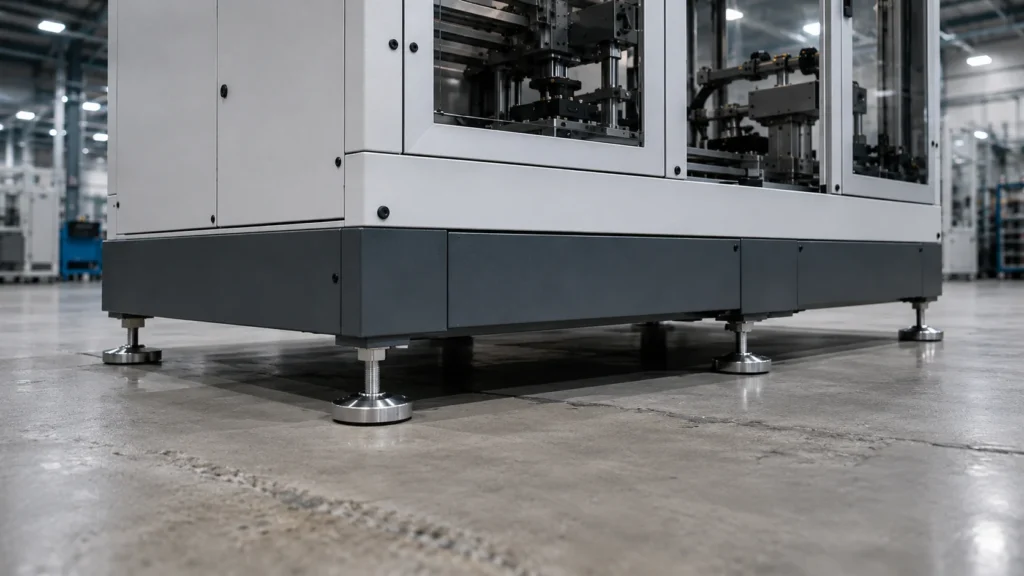
How to Select the Right Adjustable Leveling Feet?
If you are selecting leveling feet, it is not recommended to start by looking at thread sizes. A more reasonable approach is to first answer the following questions.
What is the total weight of the equipment?
This is the most fundamental piece of data.
Assuming the total equipment weight is W and there are n support points, the theoretical average static load can be expressed as: Average Load per Foot = Total Equipment Weight ÷ Number of Supporting Feet
However, do not use this figure directly as the sole basis for your final selection.
This is because actual equipment typically exhibits:
- a shift in the center of gravity
- Dynamic loads
- Installation errors
- Uneven ground
- Variations in support stiffness
Therefore, the heaviest foot may actually bear a load higher than the average.
For heavy-duty leveling feet, the rated load capacity should be determined based on the equipment structure, actual load distribution, and an appropriate design margin, rather than simply relying on the average weight to be “just enough.”
Where is the center of gravity?
Consider a 1,000 kg piece of equipment: if the weight is evenly distributed versus having all major components concentrated on one side, the load conditions on the leveling feet will be completely different.
Particular attention should be paid to:
- Motor location
- Location of the oil tank
- Location of the electrical control cabinet
- Processing unit
- Robotic arm
- Loading/Unloading Area
If conditions permit, it is best to calculate or measure the actual load at each support point based on the equipment’s center of gravity and support locations.
Are there dynamic loads during equipment operation?
For static workbenches, the selection logic is relatively simple.
However, for:
- Stamping equipment
- reciprocating compressors
- Engines
- Diesel generators
- Pumps
- Fans
- High-Speed Rotating Machinery
- Automated robotic arms
it is essential to consider dynamic operating conditions.
Just because an adjustable foot can support the equipment’s “static weight” doesn’t mean it’s necessarily suitable for long-term operation.
How much adjustment range is needed?
A wider adjustment range does not necessarily mean the product is better.
If the threaded rod extends too far, it may alter the overall support stiffness while increasing the risk of bending and lateral load issues.
Therefore, a more reasonable approach is to select the adjustment range that best accommodates actual floor level variations and installation height requirements.
Do not leave the threaded rod extended unnecessarily for long periods just in case “it might be needed later.”
Is the surface sloped or uneven?
If there is a slight angle variation on the equipment installation surface, consider using adjustable leveling feet with a swivel base or articulated base.
This design allows the base of the leveling feet to be adjusted at a certain angle relative to the threaded rod, enabling the base to make better contact with the ground.
For industrial floors that are not perfectly level, this often makes it easier to achieve stable contact than with a base that has a fixed, rigid angle.
What is the base diameter?
A larger base diameter generally helps provide more stable support while reducing localized ground pressure. However, the base cannot be made infinitely larger.
Additional considerations:
- Installation space
- Adjacent structures
- Cleaning space
- Equipment mobility
- Mounting hole locations
Therefore, the base dimensions should be determined based on the equipment weight, installation environment, and structural dimensions.
What materials are needed?
Common materials for industrial adjustable feet include: Carbon Steel / Zinc-Plated Steel: Suitable for most general industrial environments, offering a good balance between cost and mechanical performance.
Stainless Steel is better suited for:
- Humid environments
- Food processing machinery
- Cleaning equipment
- Outdoor equipment
- Areas with a high risk of corrosion
The specific use of 304, 316, or other materials should be determined based on the corrosive medium and the actual environment.
Rubber or Elastomer Base is primarily used to improve:
- Slip resistance
- Shock Absorption
- Contact
- Partial vibration control
If the elastomer is intended to perform a critical vibration-damping function, material selection must also take into account temperature, oil, ozone, UV radiation, and chemical agents.
What should be considered in different industrial environments?
What should be considered in different industrial environments?
| Applications | Adjustable Feet: Key Considerations |
| CNC and Machining Equipment | Load-bearing capacity, stiffness, levelness, dynamic stability |
| Pumps and Motors | Support, Alignment, Vibration Transmission |
| Compressors | Dynamic Loads, Vibration, Anchoring |
| Generator Sets | High Loads, Vibration, Rubber Performance |
| Conveying Equipment | Height Adjustment, Leveling, Continuous Support |
| Packaging Machinery | Leveling, Slip Resistance, Cleanliness |
| Food Processing Equipment | Stainless steel, hygienic design, corrosion resistance |
| Laboratory Equipment | Stability, Micro-Vibration Control |
| Industrial Cabinets | Leveling, slip resistance, installation space |
| Heavy-duty machinery | Heavy-duty leveling feet, base dimensions, mounting methods |
This table actually highlights a very important point: there is no such thing as a “universal leveling foot” that fits all machines.
A truly reliable selection process must start with the equipment’s operating conditions, not with a specific size from a supplier’s catalog.
Conclusion
Adjustable feet improve the stability of industrial equipment primarily by correcting uneven installation surfaces, establishing effective contact at each support point, improving load distribution, and helping the machine maintain its intended position and geometry.
Simply put, adjustable feet truly solve the problem of keeping equipment in the correct position and ensuring it stands securely.
However, if you are dealing with pumps, motors, compressors, engines, generator sets, or other industrial equipment subject to significant dynamic loads and vibrations, simply achieving “levelness” is often not enough.
You also need to consider factors such as load, stiffness, vibration frequency, rubber materials, environmental media, installation methods, and the equipment’s actual operating conditions.
These are precisely the issues Vista Motion prioritizes when selecting industrial support and vibration-damping components.
If you are selecting adjustable leveling feet, rubber vibration mounts, or custom rubber-to-metal components for new industrial equipment, we recommend not providing just a single product size. By providing the equipment weight, support points, operating speed, installation space, environment, and the specific problem you wish to solve, we can typically determine more quickly which design is truly suitable for your equipment and reduce the costs of reinstallation and maintenance later on due to an improper selection.
What are adjustable feet used for on industrial equipment?
Adjustable feet are primarily used to support and level industrial equipment. By adjusting the height at each support point, they compensate for uneven floors, keep the machine stable, and ensure effective contact across multiple support points. They are widely used in machinery, conveyor systems, packaging equipment, workbenches, electrical cabinets, and automated production lines.
How do adjustable leveling feet improve machine stability?
Adjustable leveling feet improve stability by compensating for height differences in the floor, reducing the amount of support points that are off the ground, improving load distribution, and maintaining the equipment’s installation posture.
If machine wobble is caused by an uneven floor, properly adjusting the leveling feet can usually significantly improve the situation. However, if the wobble stems from internal equipment vibration or mechanical failure, further inspection of the vibration source is required.
Can leveling feet reduce vibration?
The primary function of standard leveling feet is to level and support the equipment; they do not automatically provide effective vibration isolation.
Products with rubber bases may provide some cushioning and vibration damping, but true vibration isolation requires a match based on the equipment load, excitation frequency, system stiffness, and elastomer performance.
If vibration control is the primary requirement, it is more appropriate to evaluate anti-vibration leveling feet or anti-vibration mounts.
How do I choose the right leveling feet for industrial equipment?
At a minimum, consider the following:
equipment weight, number of support points, load distribution, thread size, adjustment range, base diameter, dynamic load, installation space, operating temperature, corrosive environment, and whether vibration isolation is required.
For heavy-duty or high-vibration equipment, it is not recommended to select leveling feet based solely on thread size.
How much weight can adjustable leveling feet support?
Load capacity depends on the specific product’s:
thread size
Screw material
Base structure
Base diameter
Mounting method
Load Direction
Differences between models can be significant, so you should refer to the rated load data provided by the manufacturer.
Also, do not simply use “total equipment weight ÷ number of leveling feet” as the sole basis for calculation, as the actual load is usually not completely uniform.
What are heavy-duty leveling feet?
Heavy-duty leveling feet are leveling feet designed for industrial equipment with higher load capacities.
Compared to light-duty adjustable feet, they typically feature higher mechanical strength, larger thread sizes, or more robust support bases, and are commonly used in machine tools, industrial equipment, heavy-duty frames, and other high-load installation environments.
When selecting a model, in addition to the rated load, you should also consider dynamic loads and lateral forces.
Are stainless steel leveling feet better than steel leveling feet?
Not necessarily; it depends on the operating environment.
Standard steel or galvanized leveling feet are sufficient for many indoor industrial environments.
Stainless steel leveling feet are better suited for damp, corrosive, or washdown environments, as well as food processing or outdoor settings.
If specific chemical agents are present, you should further verify whether a particular stainless steel grade is suitable.
What is the difference between leveling feet and vibration mounts?
The core functions of leveling feet are:
Support + Height Adjustment + Leveling
In contrast, the core functions of vibration mounts are:
Support + elastic deformation + control of vibration transmission
Some products can perform both functions simultaneously; these are typically referred to as anti-vibration leveling feet.
If the primary issue with your equipment is an uneven floor, address leveling first; if the core issue is mechanical vibration, you should focus on evaluating vibration isolation.
Should industrial equipment be anchored when using adjustable feet?
It depends on the equipment design and operating conditions.
For equipment subject to significant lateral forces, impacts, the risk of movement, or the risk of overturning, relying solely on the friction between the leveling feet and the floor is generally insufficient.
In such cases, fixing plates, anchor bolts, or other mechanical fastening methods should be used in accordance with the equipment manufacturer’s and engineering design requirements.
How often should machine leveling feet be checked?
There is no single inspection interval that applies to all equipment.
The inspection frequency should be determined based on the equipment’s vibration, load, operating time, and environment.
During routine maintenance, focus on checking the following:
whether nuts are loose
Whether the leveling feet are misaligned
Whether the base is damaged
Whether metal parts are corroded
Whether the rubber is deteriorated
Has the equipment started shaking again or has its level changed?
For equipment subject to continuous vibration, impact loads, or critical production equipment, the condition of the supports should be included in the preventive maintenance plan.
