
This article will explain how buffer rails enhance the safety and operational efficiency of industrial equipment, rail vehicles, and material handling systems by absorbing impacts, reducing peak loads, and minimizing equipment damage and unplanned downtime.
What Are Buffer Rails?
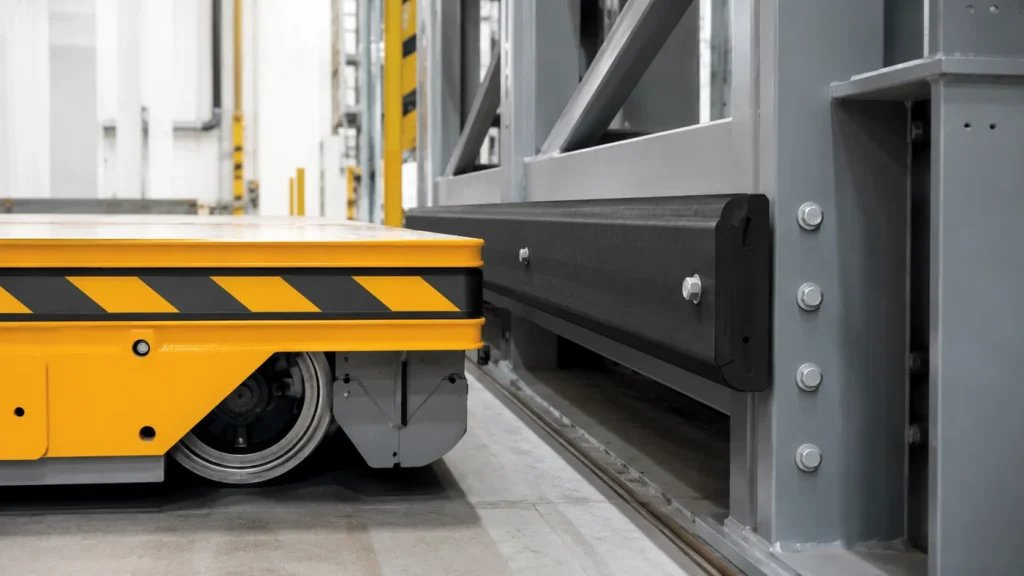
Buffer rails are long, strip-shaped cushioning components installed in the contact areas of equipment, vehicles, or structures. Common types include:
- Solid rubber buffer rails;
- Rubber buffer profiles with cavities;
- Rubber-steel composite structures;
- Rubber buffer strips with mounting holes;
- Rubber-to-metal vulcanized bonded structures;
- Custom-shaped buffer rails tailored to equipment contours.
Compared to individual cylindrical or conical rubber buffers, Buffer Rails typically feature a longer continuous contact surface. They can be arranged along equipment edges, vehicle ends, work platforms, guide structures, or fixed frames, thereby absorbing impacts over a larger area.
This design offers two distinct advantages:
- It distributes the load generated by a localized impact across a larger contact area, reducing the concentrated stress on any single connection point or structural edge.
- Even when the actual point of impact is slightly off-center, continuous buffer rails still provide protection, eliminating the need for moving parts to make precise contact with a single small buffer every time.
It is important to note that buffer rails are not the rails of the railway track itself, nor are they equivalent to buffer stops installed at the end of a track to prevent trains from overshooting the terminus. This article discusses rubber buffer rails and rubber-metal composite buffer components used for industrial impact protection.
How Do Buffer Rails Absorb Impact?
To understand the function of buffer rails, one must first understand what happens during a collision.
The kinetic energy carried by a moving object can be expressed by the following formula: E = 1/2 mv²
Where: E represents kinetic energy; m represents the mass of the moving object; v represents the velocity before contact.
This formula illustrates that velocity has a significant impact on impact energy. If an object’s velocity doubles, its kinetic energy increases to four times its original value.
When a metal component collides directly with a rigid structure, the stopping process is typically very brief. Energy must be transferred over a very short displacement and time span, which can easily result in high instantaneous loads.
When Buffer Rails are compressed, they undergo elastic and viscoelastic deformation, causing the moving object to decelerate over a longer distance and time. Part of the energy is dissipated through hysteresis losses within the rubber, while another portion is temporarily stored in the form of elastic deformation.
Therefore, the core function of Buffer Rails is not to make the impact energy disappear into thin air, but rather to:
- to prolong the deceleration process;
- to reduce peak impact forces;
- Distribute the contact load;
- to reduce the transmission of impact energy to adjacent structures;
- control rebound after impact.
This is why the thickness, cross-section, and allowable compression of buffer rails are typically more important than surface hardness alone. A buffer rail that is very hard but has almost no compression travel may only prevent direct metal-to-metal contact, but it cannot effectively reduce peak loads.
How Do Buffer Rails Improve Industrial Safety?
Reduce peak loads caused by sudden collisions
When mobile equipment reaches the end of its travel, vehicles approach loading/unloading areas, or large components become misaligned, rigid contact can cause sudden deceleration.
This impact can be transmitted to:
- the equipment frame;
- welded joints;
- bolts and fasteners;
- guide rails and bearings;
- hydraulic or electrical connections;
- Adjacent operating areas.
Buffer Rails provide a compressible buffer stroke, allowing impact loads to be transmitted more smoothly into the structure. For equipment subject to frequent low-speed contact, this reduces structural damage caused by the cumulative effect of repeated minor impacts.
Prevents Direct Metal-to-Metal Impact
Direct collisions between metal components often result in high noise levels, surface indentations, coating peeling, and localized plastic deformation.
If the contact point is close to operators, sudden impact noises and equipment vibrations may also lead to operational errors. In more severe cases, loose parts, debris, or loads may become dislodged.
Installing rubber buffer rails between the two components creates a flexible contact interface, reducing damage caused by hard-on-hard contact.
However, buffer rails cannot replace safety guardrails, mechanical stops, braking systems, sensors, interlocks, or standard operating procedures. They are best suited as a passive protective layer within an equipment safety system, providing supplementary protection in the event that primary control measures fail or minor positional errors occur.
Reducing Uncontrolled Rebound After a Collision
Impact protection depends not only on the ability to withstand the initial collision but also on what happens afterward.
If the buffer material is too elastic and lacks sufficient damping, significant rebound may occur upon contact with the equipment. For suspended loads, moving trolleys, rail-mounted equipment, and automated mechanisms, excessive rebound can lead to secondary collisions or positional instability.
The rubber compound, cross-sectional structure, and compression ratio collectively influence the rebound characteristics of buffer rails. A high-damping design converts more of the input energy into internal loss, thereby reducing rebound; however, increased damping may also increase the load transferred to the mounting structure.
Therefore, selecting buffer rails should not be based solely on comparing “soft” versus “hard” options, but rather on striking a balance among the following performance characteristics:
- Energy absorption;
- Peak load;
- compression stroke;
- Rebound extent;
- Fatigue life;
- Structural space.
Protecting critical equipment and infrastructure
In industrial settings, what is truly costly is often not the buffer rail itself, but the equipment it protects.
Buffer Rails can be used to protect:
- Equipment frames and racks;
- crane end structures;
- Automated material-handling equipment;
- Rail vehicles and maintenance equipment;
- Warehouse loading and unloading areas;
- Guidance systems;
- Conveyor systems;
- Industrial doors and mobile platforms;
- Marine or port equipment;
- Heavy machinery housings.
Without buffer protection, a single misalignment can cause guide rail deformation, sensor damage, mounting hole tears, or structural misalignment. Even if the equipment remains operational, abnormal noise, vibration, or reduced accuracy may occur later.
The value of Buffer Rails lies in confining a portion of the impact load to replaceable buffer components, rather than allowing high-value structures to sustain direct damage.
Reducing Vibration and Structural Noise
Buffer Rails are primarily used for impact cushioning, but when in contact, they can also reduce some high-frequency vibrations and structurally transmitted noise.
For example, when a moving device is in continuous contact with a rigid stop at its end position, vibrations generated by the engine, hydraulic system, or other moving parts may travel through the contact surface into the entire frame. The rubber buffer layer can reduce this rigid vibration transmission path.
However, if the primary objective is to isolate continuous vibrations rather than handle occasional impacts, further evaluation of system mass, excitation frequency, natural frequency, and vibration isolation efficiency is required. Buffer Rails should not be used as a direct substitute for engineered dampers, rubber isolation mounts, or spring isolation systems.
How Do Buffer Rails Improve Operational Efficiency?
Industrial efficiency is not just about equipment operating speed; it also encompasses equipment availability, maintenance time, product quality, and the stability of the entire system.
Reducing Unplanned Downtime
After a severe collision, it is usually not sufficient to simply replace parts with surface damage. Maintenance personnel must also check:
- whether the frame is deformed;
- whether the guide rails are misaligned;
- whether welds have cracked;
- whether cables and piping are damaged;
- whether sensor positions have shifted;
- Are any fasteners loose?
- Does the equipment need to be recalibrated?
These inspections and repairs can extend downtime.
Proper buffer rails can provide cushioning between minor contact during normal operation and abnormal low-speed collisions, reducing the likelihood of direct damage to high-value structures. Even if buffer rails eventually need to be replaced, the replacement process is typically simpler than repairing the frame, guide rails, or vehicle structure.
Extending the Service Life of Equipment and Connecting Components
Frequent impacts subject fasteners to repeatedly varying loads. Even if a single impact does not exceed the material’s strength limit, long-term cycling can still lead to fatigue damage.
By reducing instantaneous impacts and structural vibrations, buffer rails can alleviate the additional strain on the following components:
- bolted joints;
- welded areas;
- Bearings and guide components;
- Sensor mounts;
- Wheels and rollers;
- Hydraulic connections;
- Electrical connectors.
This does not mean that equipment no longer requires maintenance after buffer rails are installed; rather, maintenance work can shift from “emergency repairs following incidents” to “scheduled inspections and preventive replacements.”
Improving the Stability of Equipment Repeatability
In automated equipment, rail-mounted trolleys, or mobile work platforms, impacts at the end of a travel stroke can cause the equipment to bounce, sway, or experience brief positional deviations.
By appropriately controlling the stiffness and damping of buffer rails, moving structures can reach their end positions more smoothly, reducing sustained oscillation after contact.
However, if the equipment requires very high repeatability, final positioning should still be achieved using mechanical positioning blocks, servo control, brakes, or precision limit switches. Rubber buffer rails are suitable for absorbing impacts but should not be relied upon to fulfill all functions of a precision positioning reference.
Reducing Total Maintenance and Spare Parts Costs
When purchasing, comparing only the unit price of buffer rails can easily lead to overlooking their lifecycle value.
A more reasonable comparison involves calculating:
- Initial purchase cost;
- Installation costs;
- Routine inspection costs;
- Replacement frequency;
- Losses due to equipment downtime;
- Maintenance costs for the protected structure;
- Recalibration and testing costs;
- Potential losses resulting from safety incidents.
Products that are inexpensive but prone to cracking, permanent deformation, or delamination may require frequent replacement. In contrast, custom rubber buffer rails designed for actual impact conditions, although they have higher initial development costs, may reduce maintenance and downtime over the entire equipment lifecycle.
Improving the Work Environment
Constant metal-on-metal collisions increase on-site noise and cause significant equipment vibration. Even if the noise does not reach hazardous levels, it can impair communication among personnel, hinder the assessment of equipment condition, and reduce work comfort.
By reducing hard contact, rubber buffer rails can minimize impact noise and structural vibration, resulting in smoother equipment operation.
It is important to note that reducing impact noise does not equate to complete occupational noise control. In high-noise environments, independent noise measurements and risk assessments should still be conducted.
Common Applications of Buffer Rails
Rail Vehicles and Maintenance Equipment
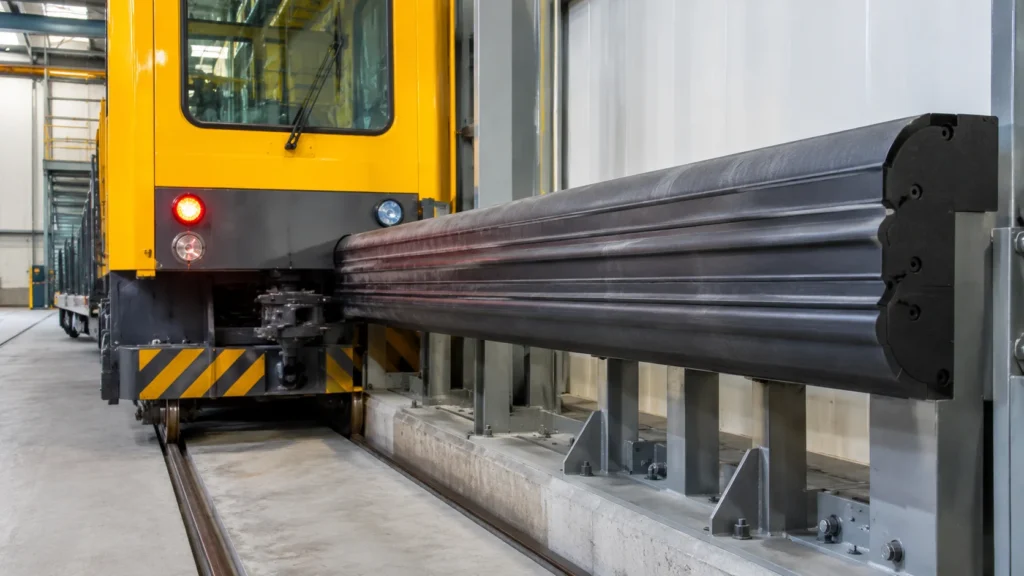
In rail vehicles, maintenance trolleys, workshop transport vehicles, and related mobile equipment, buffer rails can be used to cushion low-speed contact between vehicles or between vehicles and fixed structures.
They also protect vehicle body edges, maintenance facilities, and workshop equipment by reducing the impact and noise generated during contact.
Vista Motion’s application areas include rail vehicles and other industrial systems requiring shock absorption and vibration control.
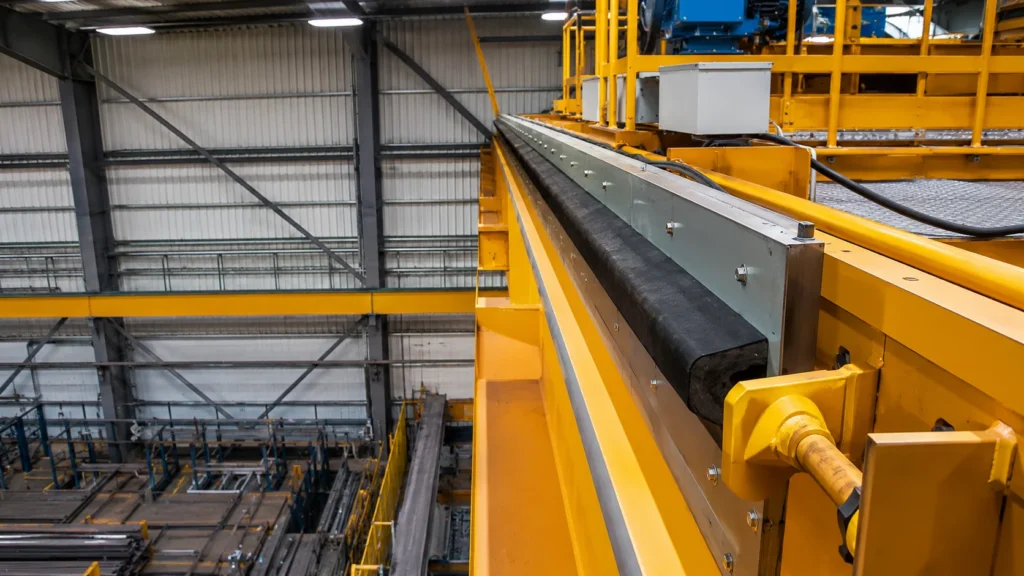
Cranes and End-of-Travel Devices
Overhead cranes, gantry cranes, and mobile lifting systems typically require buffer protection at the end of their travel.
In such applications, it is essential to specify:
- the maximum operating mass of the equipment;
- the permissible contact speed;
- Braking status;
- Number of buffers;
- the direction of contact;
- Maximum allowable compression;
- Load capacity of the support structure.
If the impact energy is very high, using standard rubber buffer rails alone may not be sufficient; hydraulic buffers, spring buffers, or other specialized energy-absorbing devices may also be required.
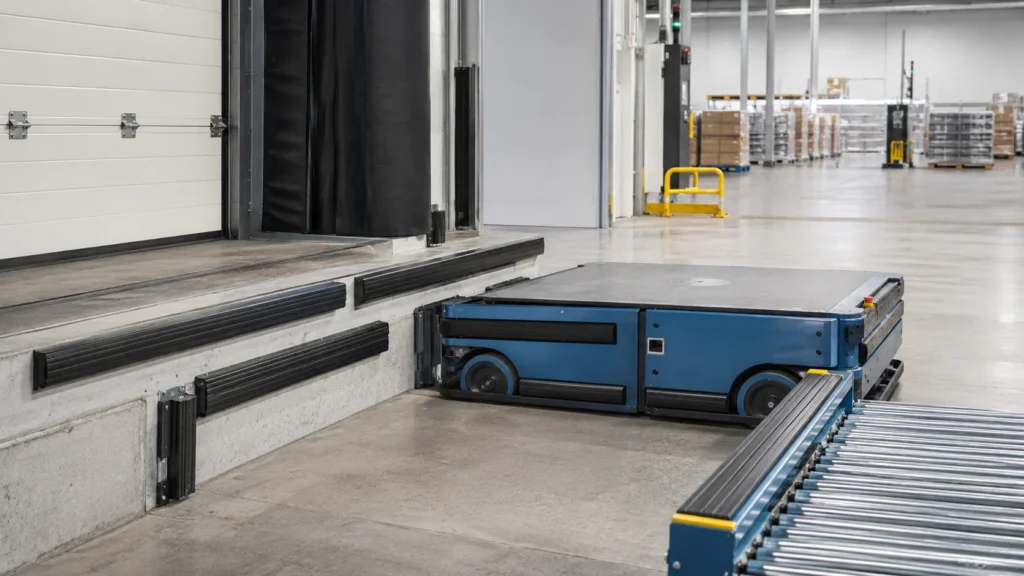
Warehouses and Material Handling Systems
Buffer Rails can be installed on:
- loading docks;
- logistics trolleys;
- conveyor equipment;
- Areas where automated guided vehicles (AGVs) come into contact;
- Equipment protection zones near racking;
- Mobile platforms;
- Industrial doors;
- Lifting equipment.
They help reduce minor collision damage between forklifts, pallet trucks, or cargo and fixed structures.
However, in areas where pedestrians and industrial vehicles share the same space, buffer rails cannot replace vehicle lane planning, collision barriers, warning systems, and pedestrian separation measures.
Automated production equipment
Automated equipment may experience overtravel due to sensor errors, program anomalies, braking deviations, or load changes.
Under normal conditions, equipment should stop accurately based on the control system and mechanical limits. Buffer Rails can serve as a final passive protective measure to mitigate the consequences of impacts during abnormal situations.
Heavy Machinery and Construction Equipment
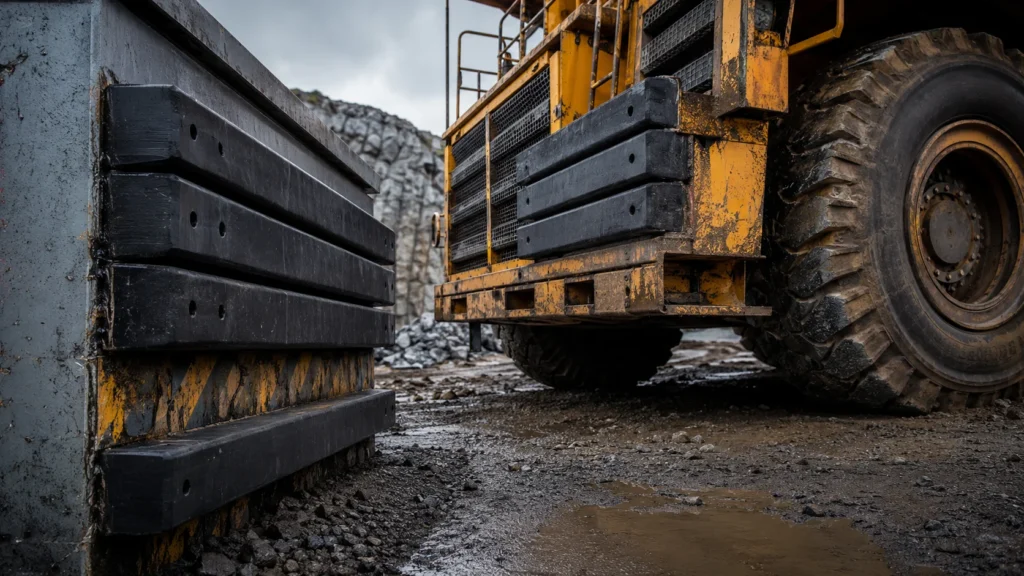
Construction machinery, mining equipment, and large industrial equipment are frequently exposed to vibration, impact, dust, oil contamination, and outdoor aging.
These applications not only require sufficient shock absorption capacity but also demand rubber that is durable in environments exposed to oil, ozone, UV radiation, low temperatures, high temperatures, and mud and sand.
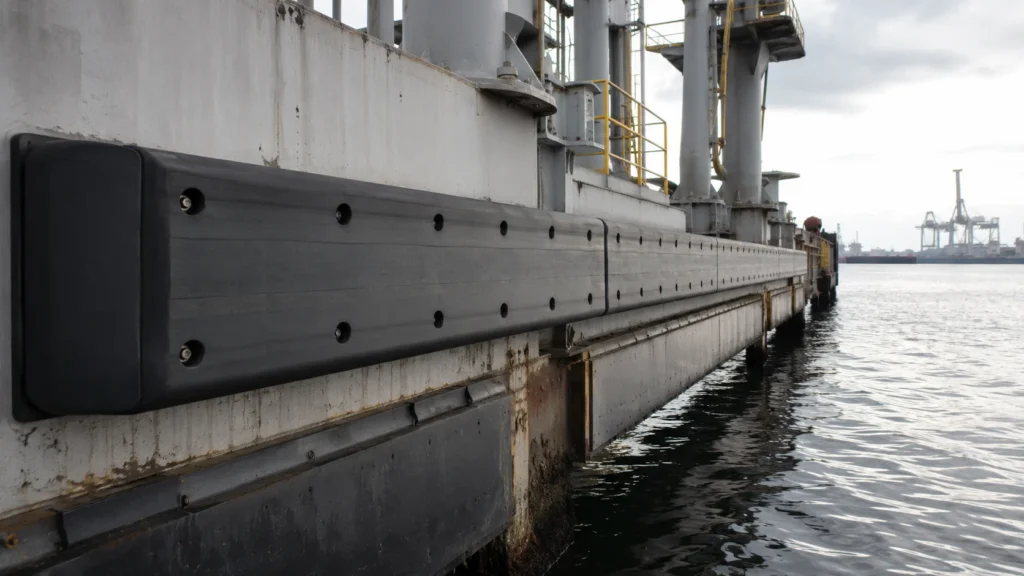
Ships, Ports, and Marine Equipment
Buffer rails in ships and port equipment may be exposed to seawater, salt spray, sunlight, and repeated impacts.
In these cases, in addition to mechanical properties, the following must also be considered:
- Weather resistance;
- Salt fog resistance;
- Corrosion protection for metal components;
- Drainage design;
- Material of mounting hardware;
- Long-term outdoor aging.
How can you verify whether Buffer Rails are suitable for a specific application?
The most reliable method is not to rely solely on material data sheets, but to combine calculations, prototype testing, and testing under actual operating conditions.
Dimensional and visual inspection
Confirm:
- Length and cross-sectional dimensions;
- Mounting hole locations;
- Flatness of the metal backing plate;
- Surface defects;
- Rubber flash;
- Metal corrosion protection treatment.
Rubber performance testing
Depending on project requirements, the following can be evaluated:
- Hardness;
- Tensile strength;
- Elongation at break;
- Tear strength;
- Compression set;
- Aging resistance;
- Oil or media resistance;
- Low-temperature performance.
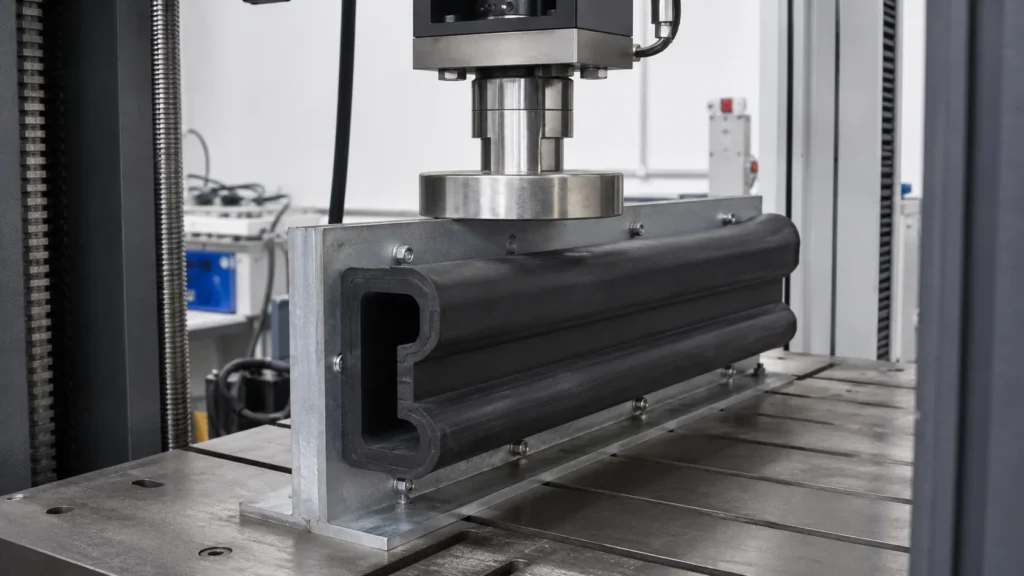
Static Compression Test
Static testing establishes the load-displacement relationship for Buffer Rails, determining the magnitude of the reaction force generated at different compression levels.
This helps confirm:
- whether there is sufficient buffer travel;
- whether premature compaction will occur;
- How much load the structure can withstand;
- how the load is distributed among multiple buffer rails.
Dynamic Impact or Endurance Testing
If the application involves repeated impacts, static hardness and compression data may not fully represent actual operating conditions.
Dynamic testing should replicate actual mass, speed, temperature, impact direction, and installation constraints as closely as possible. After testing, inspect not only the rubber surface but also evaluate:
- changes in height;
- Changes in hardness;
- the bond interface;
- Mounting holes;
- Deformation of metal parts;
- Changes in the force-displacement curve.
Vista Motion’s manufacturing process includes rubber batch control and dimensional inspection of metal components, with an emphasis on production traceability.
Summary
Buffer Rails may appear to be nothing more than a rubber component mounted on the edge of equipment, but they serve very specific engineering functions: absorbing impacts, extending the deceleration process, reducing rigid contact, protecting high-value structures, and minimizing maintenance and downtime caused by repeated collisions.
Truly effective Buffer Rails cannot rely solely on increasing rubber thickness or hardness. The design must simultaneously consider moving mass, contact speed, allowable compression stroke, rubber material, cross-sectional structure, mounting method, bond quality, and operating environment.
Since 2003, Vista Motion has specialized in rubber vibration damping and impact control products, developing custom rubber and rubber-to-metal composite components based on customer drawings, samples, and actual operating conditions. The company’s current business spans applications such as rail vehicles, construction machinery, general industry, marine, and drive systems.
If your project involves selecting or replacing custom rubber buffer rails, please provide Vista Motion with information on equipment quality, contact speed, installation space, operating temperature, environmental conditions, and expected impact frequency. Based on this information, our team can evaluate appropriate materials, hardness, cross-sections, metal frames, mounting structures, and necessary validation protocols—rather than simply replicating existing products based on their external shape.
FAQ
What are Buffer Rails?
Buffer rails are continuous cushioning components installed in the contact areas of equipment, vehicles, or fixed structures. They are typically made of rubber, rubber-metal composites, or other elastic materials. By deforming under compression, they absorb a portion of the impact energy, thereby reducing peak loads, noise, and structural damage caused by direct metal-to-metal collisions.
What is the difference between Buffer Rails and standard rubber buffers?
Standard rubber buffers are typically single-point, cylindrical, conical, or rectangular components, whereas Buffer Rails feature a longer, continuous contact surface. Buffer Rails are suitable for protecting long equipment edges or for scenarios where the actual point of impact may vary. Single-point buffers, on the other hand, are better suited for equipment with clearly defined contact points and limited installation space.
How do Buffer Rails improve equipment safety?
Buffer Rails extend the collision deceleration process, reduce rigid contact and sudden rebound, and protect racks, guide rails, fasteners, and nearby structures. However, they are only part of a safety system and cannot replace brakes, guardrails, sensors, mechanical stops, or personnel isolation measures.
Can Buffer Rails completely prevent equipment collisions?
No. The primary function of buffer rails is to mitigate the consequences of collisions, not to actively prevent them. If there is a risk of runaway or overtravel, the probability of an accident must first be reduced through control systems, brakes, and mechanical safety devices, with buffer rails used only as supplementary cushioning.
What rubber hardness should be selected for buffer rails?
There is no fixed hardness that applies to all projects. The hardness must be determined based on a combination of impact energy, contact area, compression stroke, cross-sectional shape, and installation space. Excessively high hardness may lead to increased peak loads, while excessively low hardness may result in excessive compression or premature compaction. When selecting a product, priority should be given to reviewing the complete load-displacement performance of the finished product, rather than simply comparing Shore A values.
What type of rubber is suitable for outdoor Buffer Rails?
Outdoor applications typically require special consideration of ozone, UV radiation, temperature fluctuations, and rain. EPDM or certain CR formulations may be initial choices, but if oils, fuels, or specific chemical media are present at the site, material compatibility must be reevaluated. Material selection should ultimately be confirmed based on the actual media and temperature conditions.
Can buffer rails be customized in length, cross-section, and mounting holes?
Yes. Custom rubber buffer rails can typically be customized in length, width, height, cavities, hardness, metal backing plates, and mounting holes to fit the installation space. However, the longer the length, the more attention must be paid to mold design, extrusion or vulcanization processes, dimensional shrinkage, straightness, transportation, and segmented installation methods.
How are rubber buffer rails installed?
Common methods include bolt fastening, metal backing plate mounting, T-slot installation, clamping strip fastening, and rubber-to-metal vulcanized bonding. The installation method must be capable of withstanding compression, shear, and eccentric impacts, and must prevent bolt heads from contacting the impact object before the rubber does. For high-impact applications, relying solely on standard adhesive installation is not recommended.
How long do buffer rails last?
Service life depends on impact energy, frequency, compression, materials, temperature, lubricants, ozone, UV exposure, and installation quality; therefore, it cannot be determined solely by a fixed number of years. Regular inspections for cracks, permanent deformation, tears, delamination, and the condition of fasteners are more reliable than relying solely on elapsed time.
What information is required for a quote on custom Buffer Rails?
We recommend providing drawings, installation dimensions, moving mass, contact speed, impact direction, operating temperature, operating environment, impact frequency, target service life, installation method, and annual demand. If existing buffer rails have failed, you should also provide photos of the failure, duration of use, and on-site operating conditions so that the supplier can determine whether the issue stems from the material, structure, installation, or actual impacts exceeding design conditions.
