
Based on real-world engineering applications, this article will help you understand the performance differences among various rubber formulations, the selection process, common causes of failure, and the key test metrics to focus on. If you are developing custom rubber vibration dampers, rubber bushings, or rubber-metal composite parts, you can also use the methods described in this article to specify technical requirements more accurately to manufacturers.
What Is a Rubber Compound?
A rubber compound is not synonymous with natural rubber or any single type of synthetic rubber raw material.
In industrial manufacturing, a rubber compound is a material system formed by combining a base rubber polymer with reinforcing fillers, processing aids, anti-aging systems, vulcanization systems, and other materials in specific proportions, and then undergoing mixing, molding, and vulcanization to meet predetermined performance requirements.
The base polymer determines the material’s primary characteristics, while the specific formulation, mixing quality, and vulcanization conditions further influence the performance of the final product.
For example, suppose you ask a supplier to provide a rubber vibration damping component with a hardness of 60 Shore A.
The supplier may use natural rubber (NR), neoprene (CR), or even other formulations suitable for the operating conditions.
Even if two materials ultimately have the same hardness, their resilience, oil resistance, dynamic stiffness, ozone resistance, and long-term fatigue behavior may still differ significantly.
Therefore, the selection of rubber materials cannot be limited to the question of “which is better: NR, NBR, or EPDM?”
You also need to understand:
- Is the rubber formulation compatible with the oils, water, or chemicals it will actually come into contact with?
- Can it maintain the required elasticity and strength at operating temperatures?
- Is it prone to irreversible deformation after prolonged exposure to static loads?
- How will its dynamic performance change under continuous vibration or impact loads?
- Does it need to be vulcanized in conjunction with a metal reinforcement?
- Will the material’s performance remain stable during mass production?
These questions are more important than simply comparing material names.
Especially in rubber vibration dampers and rubber-to-metal assemblies, the choice of formulation affects not only the material’s service life but also the stiffness, vibration isolation performance, and structural reliability of the entire component.
Before selecting a rubber compound, first identify six key operating conditions
If you are looking for a suitable rubber compound for an industrial component, I recommend not rushing to decide on a material type, but rather clarifying the following six questions first.
Operating Temperature
Temperature is a critical factor affecting rubber performance.
In high-temperature environments, rubber may undergo oxidative aging, hardening, a decrease in strength, or permanent deformation; under low-temperature conditions, it may experience increased stiffness, reduced resilience, and, in severe cases, even brittle fracture.
However, material selection should not be based solely on the equipment’s maximum temperature.
For example, a rubber mount may operate continuously at around 70°C for long periods but occasionally reach 110°C briefly due to equipment malfunctions. This is entirely different from continuous operation at 110°C over the long term.
You should clearly define the following:
the minimum operating temperature, the maximum continuous operating temperature, the short-term peak temperature, and the duration of each temperature range.
If the equipment requires frequent start-up and shutdown, you should also consider the impact of thermal cycling on material performance and the rubber-to-metal interface.
Some materials that perform exceptionally well at high temperatures may not necessarily be suitable for dynamic loads at low temperatures. Therefore, the operating temperature range must match the actual material grade and validation conditions.
Contact Media
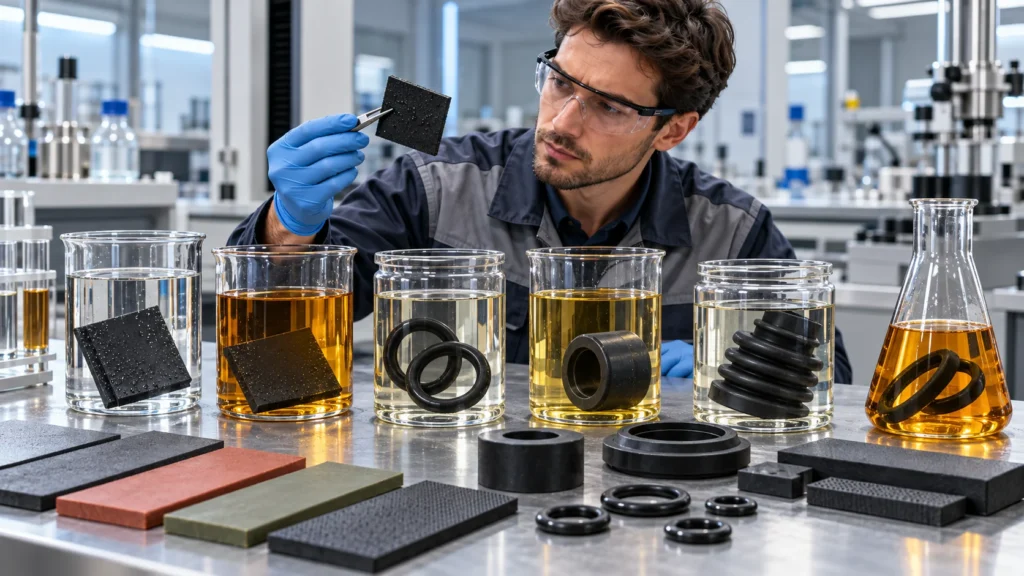
Damage to rubber parts is sometimes caused not by excessive mechanical loads, but by prolonged exposure to unsuitable media.
For example:
- Prolonged exposure to mineral hydraulic oil generally requires prioritizing rubber systems with good oil resistance.
- Outdoor equipment may be exposed to rain, ozone, ultraviolet radiation, and humid, hot environments over extended periods.
- Industrial cleaning equipment may come into contact with cleaning solutions containing special additives.
- Marine equipment, in addition to moisture and salt, may also be affected by lubricants, cleaning agents, or other media.
Here is an easily overlooked detail: “oil resistance” does not mean resistance to all oils, and “chemical resistance” does not mean resistance to all chemicals.
Different fuels, hydraulic fluids, lubricants, or cleaning agents may have varying chemical compositions. Even within the same type of rubber material, there may be significant differences in swelling and performance changes between different formulations.
If possible, it is best to provide the supplier with the specific names, brands, or technical data sheets of the media in question, rather than simply writing “Oil Resistant.”
Load Conditions
Rubber behaves differently under different types of stress.
For example, rubber vibration-damping mounts at the bottom of equipment primarily bear compressive loads, while certain suspension bushings must withstand shear, torsion, and multidirectional composite loads.
Some parts are primarily used for long-term weight support, while others require repeated deformation to absorb vibrations.
Therefore, when selecting materials, you need to consider:
- the magnitude of static and dynamic loads;
- the primary direction of force;
- Maximum allowable deformation;
- whether impact or overload is present;
- The expected number of cycles;
- Whether equipment displacement needs to be restricted.
The same rubber material may exhibit completely different stress and deformation characteristics depending on the geometric structure of the part and the constraints it faces.
For vibration-damping components subjected to cyclic loads, material hardness is only the starting point; fatigue performance and dynamic stiffness are equally important.
Vibration Frequency
This issue is particularly critical if your product falls into the categories of rubber vibration isolators, engine mounts, rubber bushings, or mechanical equipment mounts.
Many people believe that the softer the rubber, the better the vibration damping effect.
In fact, this is not the case.
Softer systems typically exhibit greater deformation and lower natural frequencies, but they can also lead to insufficient equipment support, excessive displacement, or reduced stability.
Stiffer systems typically limit displacement more effectively but may transmit more vibrations at specific frequencies to the supporting structure.
The key balance lies in:
load-carrying capacity, system natural frequency, dynamic stiffness, damping characteristics, and allowable displacement.
At the same time, rubber is viscoelastic, and its dynamic behavior varies with temperature, excitation frequency, deformation amplitude, and preload.
Therefore, one cannot rely solely on the Shore A hardness at room temperature to determine whether a rubber bearing will ultimately achieve the desired vibration isolation effect.
Operating Environment
Indoor industrial equipment may primarily face challenges such as temperature fluctuations and lubricant contamination, while outdoor equipment must also account for ozone, ultraviolet radiation, rain, and seasonal temperature variations.
For marine, rail transit, and outdoor energy equipment, the long-term stability of materials exposed to complex environments is critical.
However, two types of effects must be distinguished.
The first category involves the aging and performance changes of the rubber itself, such as ozone cracking, hardness changes, or fatigue damage.
The second category involves systemic issues with the entire component, such as corrosion of metal inserts, failure at the rubber-to-metal interface, or water accumulation in the mounting structure.
Material selection must address the first type of issue, but the second type must not be overlooked.
For example, even if a rubber with good weather resistance is selected, the entire component may still fail prematurely if the metal surface treatment, corrosion protection design, or bonding process is inappropriate.
Service Life
The service life of rubber components cannot be simply guaranteed by the name of a particular material.
For a standard rubber gasket intended for short-term use, the focus of material selection may be on meeting basic performance requirements and controlling procurement costs.
However, if the part is installed in machinery, vehicles, or other systems that require long-term reliable operation and are difficult to maintain, you must consider material aging, fatigue, maintenance frequency, and replacement costs.
You should clearly define the expected service life, operating cycles, the acceptable degree of performance degradation, and the consequences of failure.
This is because a truly reasonable material selection is not simply the option with the lowest purchase price, but rather one that strikes a balance between reliability and cost under the intended operating conditions.
How should you choose among the eight common rubber materials?
Once you understand the actual operating conditions, the next step is to screen the basic rubber materials.
The comparison table below is intended for preliminary material selection, not for final formulation approval. Specific performance characteristics may vary depending on the formulation, processing methods, temperature, and the media with which the material comes into contact.
| Rubber Material | Key Performance Advantages | Limitations to Note | Typical Applications |
| Natural Rubber (NR) | Good elasticity, resilience, and dynamic fatigue performance | Oil resistance and ozone resistance are generally poor | Rubber shock absorbers, elastic mounts, mechanical bushings |
| Styrene-butadiene rubber (SBR) | Offers advantages in terms of wear resistance and cost-effectiveness | Oil and weather resistance are generally limited | General-purpose industrial rubber parts, wear-resistant components |
| Nitrile rubber (NBR) | Good resistance to a wide range of petroleum-based oils | Ozone and low-temperature resistance are limited by the formulation | Oil seals, hydraulic system components, oil-resistant rubber parts |
| Hydrogenated Nitrile Rubber (HNBR) | Generally offers better heat and aging resistance than standard NBR | Higher cost; suitability for specific media still requires verification | Demanding fluid environments, industrial seals |
| Ethylene Propylene Diene Monomer (EPDM) | Outstanding resistance to ozone, weathering, and water | Generally not suitable for contact with petroleum-based fluids | Outdoor rubber components, protective parts, and certain vibration-damping applications |
| Chloroprene Rubber (CR) | Weather resistance, moderate oil resistance, and comprehensive mechanical properties | Performance with special fluids and at extreme temperatures still requires verification | Industrial protection, rubber vibration damping components |
| Silicone rubber VMQ | Good potential for high- and low-temperature performance | Tear resistance, abrasion resistance, and dynamic mechanical properties require focused evaluation | Elastic components subject to significant temperature fluctuations |
| Fluorocarbon Rubber (FKM) | Suitable for a variety of high-temperature and oil-containing environments | Not resistant to all chemical media; relatively high cost | High-temperature seals, specialized industrial environments |
How to interpret this table?
If you are looking for an oil-resistant rubber material, NBR, HNBR, or a suitable grade of FKM can serve as initial candidates.
If your product is primarily used outdoors and is subject to prolonged exposure to rain and ozone, EPDM may be worth evaluating first.
If the primary application involves withstanding long-term dynamic deformation in a suitable environment, natural rubber should not be overlooked simply because it is not an expensive material.
However, do not place an order based solely on this table.
The material family can only help you narrow down your options; to select a specific rubber formulation, you’ll also need to confirm hardness, tensile properties, compression set, dynamic characteristics, and compatibility with the actual medium.
For special safety requirements or long-term dynamic operating conditions, the final selection should be based on approved material specifications and product validation results.
How should rubber formulations be selected for different industrial applications?
Rather than discussing which rubber is best in isolation, it is better to understand material selection through actual application conditions.
The following are typical engineering scenarios used to illustrate the selection method; they are not test results from completed Vista Motion projects.
Vibration Damping for Industrial Equipment
Suppose you are selecting rubber vibration isolation mounts for an industrial motor, air compressor, or pump unit.
Your goal may be to reduce the vibration transmitted from the equipment to the ground while maintaining the unit’s positional stability.
If you select a rubber component that is “soft enough” based solely on the equipment’s weight, two problems may arise:
- First, excessive rubber deformation could cause the equipment’s displacement to exceed the allowable range during operation.
- Second, the natural frequency of the vibration isolation system may not match the equipment’s operating frequency, resulting in actual vibration isolation performance that falls short of expectations—or even vibration amplification under certain operating conditions.
In such applications, you should first confirm the equipment’s weight, support point distribution, speed range, and target vibration isolation performance before selecting an appropriate rubber system and structural design.
Materials such as natural rubber and neoprene may be considered, but the final selection must be verified by analyzing load-displacement curves, dynamic stiffness, and damping data.
The key is not to find the softest rubber, but to ensure that the entire vibration isolation system operates under suitable dynamic conditions.

Construction Machinery
Construction machinery typically operates in complex working environments.
Equipment may be subject to frequent starts and stops, impact loads, dust, mud and water, lubricant contamination, and significant temperature fluctuations.
For example, in engine mounts or cab vibration-damping components, materials must not only meet vibration-damping requirements but also maintain adequate strength and elasticity under long-term cyclic loading.
If there is a clear risk of mineral oil contact, ordinary natural rubber may not be the most suitable choice.
In such cases, rubber systems with good oil resistance can be considered, but their dynamic fatigue performance must also be evaluated.
Conversely, if oil contact is limited to occasional surface contamination, the decision on whether to increase the oil resistance rating of the entire formulation should be based on the actual degree of exposure and validation results.
Otherwise, there is a risk of incurring additional costs for a non-critical property while sacrificing the more important vibration-damping performance.
Rail Transit
Rubber elastic components used in rail transit typically need to provide support, flexible connections, or vibration control under repeated loading.
For rubber-metal composite vibration dampers, material properties are only one part of the design.
Engineers must also comprehensively consider the rubber’s dynamic stiffness, fatigue characteristics, temperature sensitivity, geometric structure, and the reliability of the bonded interface.
For example, long-term hardening of the rubber may alter the stiffness of the component, while failure at the rubber-to-metal interface may directly affect the load-bearing capacity of the entire assembly.
Therefore, material selection for rail transit applications typically needs to be integrated with product structural design, load spectra, environmental conditions, and prescribed validation procedures.
If a project involves specific industry certifications or customer technical specifications, the corresponding requirements should take precedence and cannot be substituted with general performance descriptions of standard industrial rubber.
Outdoor Energy Equipment
Wind power equipment, outdoor machinery, and other energy facilities are frequently exposed to ultraviolet radiation, ozone, moisture, and significant environmental temperature fluctuations.
For such applications, EPDM may be a candidate material due to its good weather resistance.
However, if the component also serves to provide continuous vibration isolation, its dynamic characteristics must be further evaluated.
Suppose an outdoor rubber mount has good ozone resistance, but after long-term operation, its stiffness changes exceed the design tolerance range; in that case, it may still not be a successful material selection.
Therefore, verification objectives for weather resistance and dynamic performance should be set separately; one should not assume that because a material is “age-resistant,” it is suitable for all outdoor vibration isolation applications.

Marine and Offshore Equipment
Marine equipment may be exposed to environments characterized by prolonged moisture, salt fog, vibration, and periodic impact.
In this scenario, material selection must take into account the rubber material, metal components, and bonding process simultaneously.
An appropriate rubber system can help meet elasticity and environmental tolerance requirements, but the bond strength between rubber and metal, metal corrosion protection, and the product’s drainage design will also affect overall reliability.
Particularly for vibration-damping components used in engines, transmission systems, or equipment foundations, simply increasing the rubber’s weather resistance rating is no substitute for comprehensive component validation.
How does rubber hardness affect vibration damping performance?
Rubber hardness is one of the most common technical specifications in the procurement process.
In the industrial rubber industry, Shore A is commonly used to indicate the indentation hardness of elastic materials.
However, Shore A hardness does not equal the rubber’s actual dynamic stiffness, nor does it alone represent vibration damping capability.
This is a distinction worth emphasizing.
Hardness and stiffness are not the same concept.
Hardness describes a material’s resistance to indentation under specified test conditions.
Stiffness describes the relationship between force and displacement when a component is subjected to a force.
A thick rubber pad and a thin rubber pad may have significantly different compression stiffness even if they are made of the same material and have the same hardness.
In addition, whether the rubber is constrained by a metal plate to prevent lateral expansion, the size of the load-bearing area, and the shape of the part all affect the overall stiffness.
Therefore, specifying “60 Shore A” for vibration-damping products is insufficient for engineering design.
Why is dynamic stiffness more important?
When a rubber component is subjected to cyclic loading, the material continuously deforms and recovers.
During this process, rubber exhibits both energy storage and energy dissipation characteristics.
Its dynamic response is related to the material formulation, temperature, excitation frequency, preload, and deformation amplitude.
If you are selecting a rubber compound for vibration isolation, you should focus on:
static stiffness, dynamic stiffness, damping characteristics, performance changes at operating temperatures, and the actual installation conditions.
For specific vibration isolation projects, you should also further confirm the resonance range, target frequency range, and allowable displacement.
Only by considering both the material and the structure together is it possible to achieve vibration isolation performance that truly meets the application requirements.
How does rubber compound design affect the performance of the final product?
When a standard formulation cannot simultaneously meet multiple performance requirements, it becomes necessary to consider custom rubber compounds.
For example, a project may require a material to possess adequate oil resistance while maintaining stable dynamic performance within a specified frequency range.
In such cases, simply replacing the base rubber material may not resolve all issues.
Formulation design requires a comprehensive consideration of multiple factors.
Base rubber polymer
It determines the material’s primary performance characteristics, such as oil resistance, weather resistance, low-temperature adaptability, and basic elastic properties.
This is the starting point for formulation design, but not the final result.
Reinforcement and Filler System
Carbon black, silica, and other fillers can affect the rubber’s modulus, strength, abrasion resistance, processing behavior, and dynamic loss.
However, more filler is not necessarily better.
Improving one property may simultaneously alter the material’s deformation capacity, heat generation characteristics, or processing difficulty; therefore, a balance must be struck based on the intended application.
Vulcanization System
Vulcanization is a critical process for rubber to develop a stable elastic network.
Different vulcanization systems and process conditions affect the rubber’s cross-linked structure, heat resistance, elasticity, compression set, and fatigue behavior.
In actual production, if vulcanization conditions are not consistently controlled, product performance may fluctuate even when using the same raw material formulation.
Protection and Processing Systems
Anti-aging additives, processing aids, and other functional components can improve specific properties according to material and application requirements.
However, these adjustments must take into account the overall requirements of the finished product; one should not seek to maximize a single parameter in isolation.
For example, increasing the hardness or strength of rubber does not necessarily mean it will have a better dynamic fatigue life.
Truly effective rubber formulation development involves striking an engineering balance among multiple performance metrics.
What test data should be requested when selecting a rubber formulation?
For industrial procurement, a material test report should not merely be a document accompanying the product.
It should help you determine whether the material meets specific technical requirements.
The following test items can serve as a reference for evaluation; the specific standards to be adopted should be determined based on product specifications and contractual requirements.
| Test Items | Common Reference Standards | Key Evaluation Criteria |
| Rubber Hardness | ASTM D2240 | Material Indentation Hardness and Consistency |
| Tensile Properties | ASTM D412 | Tensile Strength, Elongation, etc. |
| Compression Set | ASTM D395 | Compression recovery and residual deformation |
| Effect of Liquid Media | ASTM D471 | Changes in Volume, Mass, and Properties After Immersion |
| Hot-Air Aging | ASTM D573 | Changes in Properties After Heat Aging |
| Adhesion of Rubber to Rigid Substrates | ASTM D429 | Adhesion Performance Under Specific Test Conditions |
| Classification of Rubber Materials | ASTM D2000 | Performance Requirements Specified by Material Designations |
These standards are not an exhaustive list applicable to all parts, nor are they interchangeable.
For example, ASTM D2000 can help purchasers describe material requirements for vulcanized rubber, but if your product is a vibration-damping mount used in a continuously vibrating environment, you may still need to define additional requirements for dynamic stiffness, fatigue life, and product-level validation.
Similarly, compression set testing helps compare a material’s recovery capability under specified compression conditions, but it cannot directly replace dynamic fatigue testing.
What should you focus on in a test report?
In addition to the test results themselves, you should also check:
- Whether the samples were taken from standard test specimens or actual finished products;
- The version of the standard and the test method used;
- Test temperature, duration, and medium;
- Whether there are clear acceptance criteria;
- whether a comparison between pre- and post-aging conditions is included;
- Whether the report corresponds to the actual batch of materials supplied.
If two suppliers use different test conditions, directly comparing a single value from the report may lead to erroneous conclusions.
Therefore, before formally approving the material, it is best to confirm a unified testing method and acceptance criteria with the manufacturer.
How do you choose a manufacturer that can provide customized rubber formulations?
If you are looking for a rubber compound manufacturer or an industrial rubber parts supplier, price and lead time are certainly important.
However, for OEM projects with high technical requirements, I recommend evaluating the following aspects as well.
First, does the supplier understand the application conditions?
A suitable manufacturer should not simply provide a quote based on a single drawing or a hardness value, but should be able to inquire about operating temperature, load, media, operating environment, and target performance.
Second, does the supplier have the capability to support material selection and formulation?
There may be performance conflicts between different materials. Suppliers who can explain these trade-offs and propose a validation path are generally better suited for custom development.
Third, do they have the capability to manufacture rubber-to-metal composite parts?
If the product involves a metal skeleton, vulcanized bonding, or multidirectional loads, simple rubber molding capabilities may not be sufficient to meet the entire project’s requirements.
Fourth, can the supplier provide relevant test data and quality records?
Material selection requires data support. For critical projects, test items, acceptance criteria, and batch traceability requirements should be clearly defined.
Fifth, whether the supplier can support sample development and subsequent mass production.
A reasonable development process typically includes requirements review, preliminary material selection, structural design, sample validation, design adjustments, and mass production confirmation.
This helps minimize rework later in the process caused by incorrect material selection.
Before requesting a quote from a supplier, it is recommended to prepare this technical requirements checklist
A comprehensive list of technical requirements can reduce unnecessary back-and-forth communication and help manufacturers more accurately evaluate formulations and manufacturing processes.
| Information to Provide | Recommendations |
| Product Type | Rubber shock absorbers, rubber bushings, rubber pads, rubber-metal composite parts, etc. |
| Product Drawings | 2D drawings, 3D models, key dimensions and tolerances |
| Application Equipment | Equipment Type, Installation Location, and Function |
| Operating Temperature | Minimum, maximum continuous, and short-term peak temperatures |
| Contact Media | Lubricating oil, fuel, hydraulic fluid, water, or specific chemicals |
| Load Conditions | Static, dynamic, and impact loads, and direction of force |
| Dynamic requirements | Operating frequency, target stiffness, allowable displacement, and damping requirements |
| Operating Environment | Indoor, outdoor, humid and hot environments, ozone, salt spray, etc. |
| Service Life Requirements | Expected service life, operating cycles, or customer specifications |
| Testing and Certification | Applicable standards, verification items, and acceptance criteria |
| Purchase Quantity | Sample Quantity, Annual Demand, and Batch Requirements |
| Current Issues | Cracking, deformation, abnormal noises, aging, or insufficient vibration damping |
If you do not yet have complete material specifications, you do not need to determine all formulation parameters right away.
It is often more helpful to first accurately describe the product’s operating environment and performance goals than to directly specify a particular type of rubber.
For components that have already experienced failure, providing samples of the old parts, installation photos, and the operating conditions at the time of failure can also help further analyze the cause.
The Five Most Common Mistakes When Selecting a Rubber Formulation
Mistake 1: Assuming that more expensive rubber necessarily performs better
Expensive materials are not necessarily suitable for all applications.
For example, in an application where there is no contact with oil and the primary focus is on elasticity and dynamic performance, using a more expensive oil-resistant material may not necessarily improve vibration damping.
Materials should be evaluated based on operating conditions and validation data, rather than judged solely by their unit price.
Mistake 2: Focusing Only on Shore A Hardness
The same hardness does not imply the same stiffness, damping, fatigue performance, or environmental adaptability.
For vibration-damping products, material properties must be considered in conjunction with the product’s geometric structure.
Mistake 3: Verifying Only Initial Performance
The fact that a newly manufactured sample meets requirements does not guarantee that the material will remain compliant after long-term thermal aging, exposure to media, or cyclic loading.
For components intended for long-term use, necessary aging and durability acceptance criteria should be defined.
Mistake 4: Assuming a single type of rubber is suitable for all environments
Material selection typically involves trade-offs in performance.
Good oil resistance does not automatically imply good low-temperature performance; nor does excellent weather resistance guarantee ideal dynamic fatigue performance.
Therefore, when selecting a base polymer, the most critical performance requirements should be identified, and conditions that cannot be compromised should be determined.
Mistake 5: Ignoring the actual manufacturing conditions of the parts
Material formulations, mold designs, vulcanization processes, bond quality, and batch consistency all collectively influence the final product.
Simply comparing raw material data sheets without verifying the final product may fail to reveal risks associated with actual assembly and long-term use.
How can a balance be struck between performance and procurement costs?
When purchasing rubber components, the unit price is usually the easiest metric to compare.
However, for industrial components designed for long-term operation, it is more reasonable to consider the total cost of ownership (TCO).
For example, a rubber formulation may be less expensive, but if it is more prone to permanent deformation or performance degradation under actual operating conditions, it may result in more frequent replacements and downtime.
Another material may have a higher initial price, but if it has been verified to support longer maintenance intervals, it may offer better overall cost-effectiveness.
Of course, this does not mean that higher-priced materials are necessarily more cost-effective. Only when comparisons are made under the same operating conditions and with clear acceptance criteria does the conclusion hold practical significance.
During procurement, one can simultaneously evaluate material and manufacturing costs, tooling investments, testing expenses, expected maintenance cycles, replacement workloads, and downtime risks.
For projects in the development phase, clearly defining key operating conditions in advance and reducing unnecessary repeated testing may yield greater value than simply driving down the unit price of materials.
Summary
Selecting the most suitable rubber compound is not simply a matter of choosing one material from among natural rubber, NBR, EPDM, silicone rubber, or FKM.
What you really need is a component that performs reliably in its intended operating environment.
From operating temperature, media compatibility, and load conditions to dynamic stiffness, aging behavior, adhesion performance, and manufacturing consistency, every factor can influence the final performance.
Particularly for industrial vibration dampers and rubber-to-metal composite parts, material selection must be carried out in conjunction with structural design and performance validation.
If you are developing custom rubber vibration dampers, rubber bushings, or rubber-to-metal assemblies, Vista Motion can be your partner in material selection and custom manufacturing evaluation.
Based on Vista Motion’s publicly disclosed manufacturing processes, the company provides design and application support, rubber compounding, mold manufacturing, rubber-to-metal bonding, batch inspection, and support for verifying product performance.
Whether you need to develop new OEM rubber components or wish to evaluate the materials and vibration damping performance of existing products, please provide us with product drawings, operating conditions, load requirements, and estimated purchase quantities.
Based on your specific project requirements, we can work with you to discuss material selection, structural design, sample validation, and manufacturing feasibility.
Selecting the right material for your operating conditions is the first step toward obtaining reliable rubber components.
Contact Vista Motion – Discuss Your Custom Rubber Components
Frequently Asked Questions
Which rubber compound is best suited for industrial vibration dampers?
No single rubber compound is suitable for all vibration damping applications.
Natural rubber typically offers good elasticity and dynamic performance, making it a candidate material for many industrial vibration damping applications. Neoprene and other synthetic rubber systems may also be considered depending on environmental requirements.
However, for equipment vibration isolators, material selection must take into account static loads, excitation frequency, target natural frequency, dynamic stiffness, damping, and allowable displacement.
If the product is required to operate in high-temperature, oily, or complex outdoor environments, the corresponding environmental resistance must also be evaluated.
The final determination should be made through dynamic testing and application validation of the actual product, rather than simply comparing material hardness.
Which rubber material offers the best oil resistance?
NBR, HNBR, and certain FKM formulations are commonly used in applications requiring resistance to petroleum-based fluids.
NBR is a candidate material for many conventional oil-resistant components; HNBR is typically suitable for scenarios with higher requirements for heat resistance and aging resistance; specific FKM formulations are suitable for certain higher-temperature or more demanding oil environments.
However, no single rubber offers optimal resistance to all types of oils.
The actual choice depends on the medium’s composition, temperature, contact time, and the allowable degree of swelling or performance degradation. For critical parts, it is recommended to conduct compatibility testing using the actual medium.
What is the difference between EPDM and NBR? How should one choose between them?
The main difference between the two lies in their environmental adaptability.
EPDM generally offers good resistance to ozone, weathering, and water, making it suitable for a variety of outdoor or aqueous applications, but it is generally not suitable for contact with petroleum-based fluids.
NBR offers better resistance to many petroleum-based fluids and is therefore widely used in oil-resistant rubber components.
If your parts are in prolonged contact with hydraulic oil, NBR may be worth prioritizing. If the parts are primarily exposed to outdoor sunlight and ozone, with no risk of contact with mineral oil, EPDM may be more suitable.
This should also be confirmed in conjunction with operating temperature, mechanical strength, and the specific formulation.
Which rubber should be chosen for outdoor use?
For rubber components exposed to sunlight, rain, and ozone over extended periods, EPDM is one of the common candidate materials.
However, outdoor operating conditions are not all the same.
For example, rubber vibration-damping mounts in outdoor equipment may be subjected to vibration, mechanical shock, and fluid contamination simultaneously. In such cases, the material must not only be weather-resistant but also meet requirements for dynamic performance and media compatibility.
If the part contains metal inserts, corrosion protection and the long-term stability of the bonded interface should also be considered.
Therefore, the selection of rubber for outdoor applications should involve a comprehensive evaluation of the environment, mechanical loads, and structure—not merely a comparison of UV resistance.
Should silicone rubber or fluorocarbon rubber be chosen for high-temperature applications?
This depends on whether the part comes into contact with oils or chemical media, as well as the mechanical loads it must withstand.
Silicone rubber has a wide temperature range, but its tear resistance, abrasion resistance, and certain dynamic mechanical properties require careful evaluation.
FKM typically offers good high-temperature performance and resistance to a wide range of oils, but it also has chemical compatibility limitations; for example, conventional FKM may not be suitable for certain ketones or amines.
Therefore, if your product is exposed to both high temperatures and contact with lubricating oils, an appropriate grade of FKM may be worth evaluating first; if it is primarily exposed to temperature fluctuations and low mechanical loads, silicone rubber may also be a viable option.
Ultimately, the material grade should be confirmed based on specific operating conditions.
How do you determine the required Shore A hardness for rubber components?
Hardness should be determined based on the component’s load conditions, allowable deformation, and intended function, rather than by directly applying generic values.
For example, a rubber bearing subjected to compressive loads may have entirely different hardness and stiffness requirements than a rubber bushing primarily subjected to shear deformation.
Furthermore, Shore A hardness cannot be directly converted to the dynamic stiffness of an actual part.
If the product is used for vibration isolation or motion control, the hardness should be determined by considering the part’s structure, load-displacement curve, and dynamic test results.
What is compression set in rubber? Why is it important?
Compression set refers to the residual deformation that occurs when rubber is compressed under specified conditions and then unloaded, failing to fully recover its original dimensions.
For rubber pads, mounts, and seals that are subjected to compressive loads over the long term, this is an important material evaluation metric.
If the permanent deformation is too great, the part may lose the required support height or sealing compression.
However, the compression set test primarily reflects the material’s recovery behavior under specified compression conditions and does not directly represent the rubber’s dynamic fatigue life or overall vibration damping performance.
If two types of rubber have the same Shore A hardness, can they be directly substituted for one another?
Direct substitution based solely on identical hardness is not recommended.
Even if two rubbers have the same hardness, they may differ in terms of elastic modulus, dynamic loss, oil resistance, aging performance, and fatigue characteristics.
If the part is a shock absorber, suspension mount, or other stiffness-sensitive component, replacing the material may also alter the system’s dynamic performance.
Therefore, material substitutions should be verified based on the original design requirements, applicable material specifications, and necessary performance tests.
For critical industrial applications, unverified material substitutions may pose reliability risks.
How can you determine whether a rubber compound can withstand a particular chemical?
First, you need to identify the specific chemicals involved, their concentrations, temperatures, and duration of exposure.
Next, refer to relevant material compatibility data to conduct a preliminary screening of candidate formulations and perform immersion tests according to project requirements.
ASTM D471 is one of the test methods commonly used to evaluate the effects of liquid media on rubber.
During the evaluation, changes in volume, mass, and, where necessary, mechanical properties should be observed.
If the product is simultaneously subjected to mechanical stress, high temperatures, or cyclic loading, immersion testing alone may not be sufficient to verify its long-term reliability; appropriate product-level testing must also be conducted.
What information is required when customizing rubber formulations and rubber components?
If you plan to purchase custom rubber components, we recommend prioritizing the provision of product drawings, actual applications, operating temperatures, contact media, load conditions, hardness or stiffness targets, and the expected purchase quantity.
For vibration dampers and rubber-to-metal assemblies, you should also provide, whenever possible, the installation method, primary vibration frequencies, allowable displacement, and service life requirements.
If you have samples or existing components that have failed, you may also provide the old parts, photographs, and relevant operational records.
This information helps manufacturers determine whether an existing material formulation is suitable or if further custom design and validation are required.
You can submit your technical requirements via the Vista Motion Contact Page to discuss specific OEM rubber component projects with us.
