
If you’re looking for a solution that provides both load-bearing capacity and vibration isolation while accommodating various mounting orientations, this sandwich mounts guide will help you make better choices when selecting sandwich mounts and avoid unnecessary costs.
What Are Sandwich Mounts?
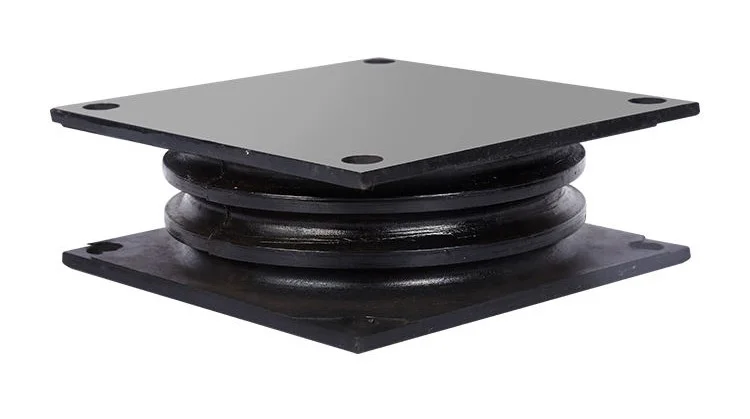
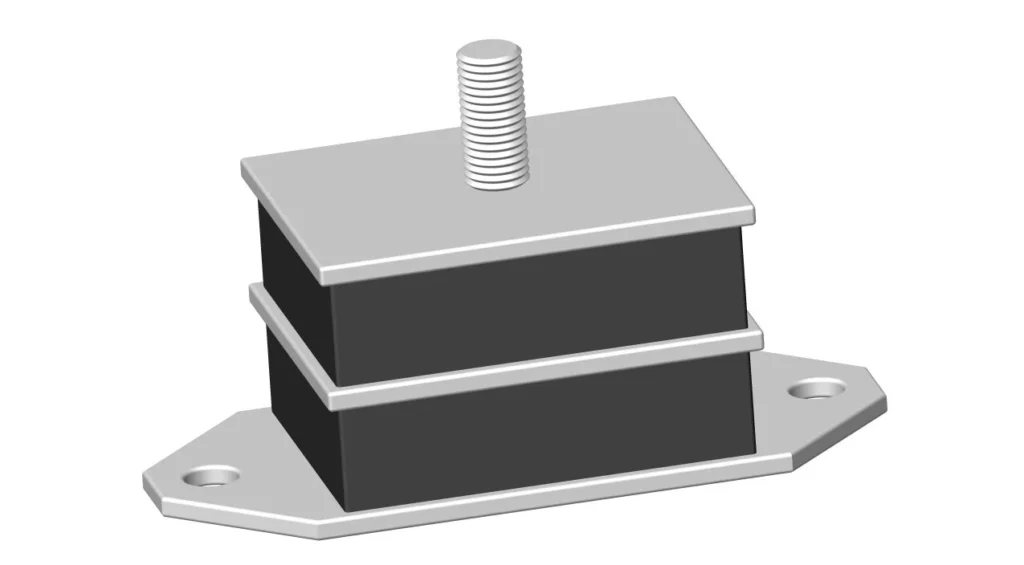
You can think of sandwich mounts as “layered vibration-damping mounting components.” Typically, one or more layers of rubber are securely bonded between parallel metal plates. They can be rectangular or cylindrical in shape, and different models may feature through-holes, threaded holes, studs, or plate-mounting structures.
This structure is called a “sandwich mount” precisely because it consists of metal layers and elastic layers, much like a “sandwich.”
The advantage of these rubber sandwich mounts lies not in their “softness,” but in their ability to provide both flexibility and load-bearing capacity. For many pieces of equipment, the goal isn’t simply to be as soft as possible, but to absorb vibrations in specific directions while maintaining structural stability in others. Sandwich mounts are specifically designed to meet this need.
How do sandwich mounts work?
In principle, sandwich mounts primarily absorb mechanical energy through the elastic deformation of the rubber layer. Depending on the structure and installation method, they can withstand:
- Compression loading
- Shear loading
- Combined compression and shear loads
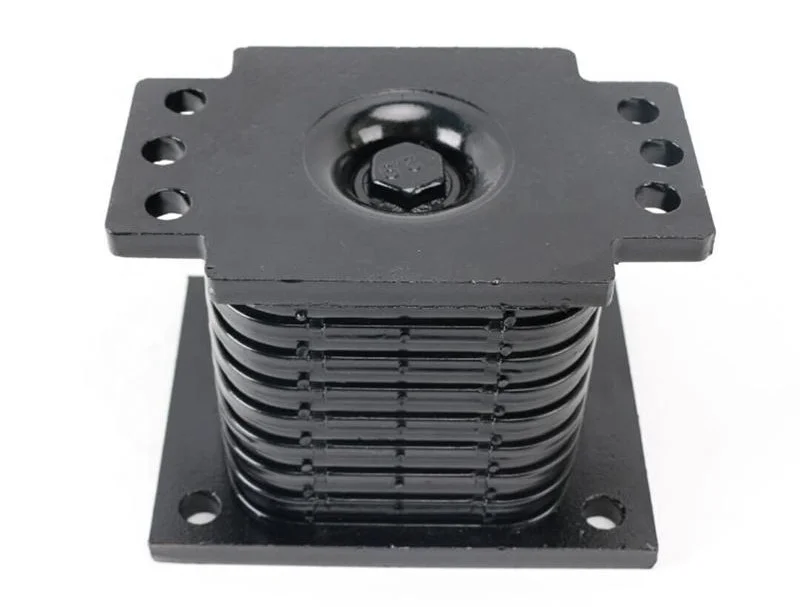
Sandwich mounts can operate directly under compression, shear, or combined loading conditions; certain designs incorporate steel interleaves to adjust the ratio of compression stiffness to shear stiffness, thereby facilitating system tuning. Some products also feature a V-shaped arrangement to provide the mounting system with more appropriate stiffness responses in different directions.
This is why many engineers prioritize anti-vibration sandwich mounts when addressing equipment vibration. Rather than simply acting as a “cushion,” they actively manage vibration pathways through structural design.
In which scenarios are sandwich mounts suitable?
If your equipment exhibits the following characteristics, sandwich mounts are typically a suitable choice:
The equipment is heavy, and the mounting points are subject to long-term loads
s are commonly used in applications involving high compressive loads, heavy machinery, and large equipment installations. Compared to smaller anti-vibration s, they are generally better suited for handling higher loads and continuous operating conditions.
Equipment that vibrates in multiple directions
Many machines do not simply “bounce up and down,” but exhibit simultaneous longitudinal, lateral, and torsional movements. A key advantage of sandwich mounts is their ability to provide differentiated stiffness in different directions through structural orientation, rubber hardness, and metal layer design.
You need both vibration damping and displacement control
These products are commonly found in engines, conveying equipment, hoppers, generator sets, heavy machinery, mobile equipment, and acoustic equipment. The reason is simple: these applications are not only susceptible to vibration but also to excessive displacement, connection point fatigue, and loosening of structural components.
Sandwich Mounts vs. Bobbin Mounts
This is a very common search query; many procurement and engineering professionals compare sandwich mounts with bobbin mounts.
If you want a quick comparison, here’s how to think about it:
- Bobbin mounts are better suited for relatively compact, general-purpose applications with moderate loads and limited installation space;
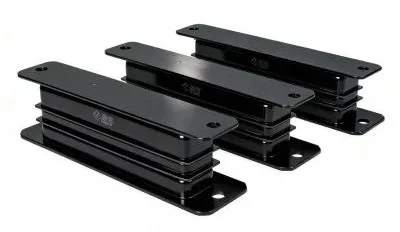
- while sandwich mounts are often better suited for larger, heavier equipment with more complex loading conditions—particularly when both compression and shear forces are present, where they typically perform more stably.
- Sandwich mounts are better suited for applications that are heavier and larger than those using bobbins, such as tilted engine mounts, vehicle body mounts, conveyor systems, hoppers, and large machinery.
So, if your priorities are “compactness, versatility, and quick replacement,” you should consider bobbin mounts first;
but if your priorities are “higher load capacity, complex force conditions, and greater flexibility for system tuning,” Sandwich Mounts are usually the better choice.
How to choose the right sandwich mounts?
What truly influences the selection is not the name of a part, but the following parameters.
Load Capacity
First, determine the actual load each mounting point bears, rather than just looking at the total weight of the entire machine.
The load capacity of a sandwich mount is not a fixed number; it is influenced by dimensions, rubber hardness, the number of metal layers, mounting orientation, and the type of force applied. The mechanical properties of these products are closely related to rubber hardness and the number of metal layers.
Vibration Frequency and Amplitude
You need to determine whether the primary issue with the equipment is high-frequency noise, low-frequency impact, or repetitive vibration during long-term operation.
This determines whether you should prioritize material damping or displacement control.
Direction of Force
This is the root cause of many selection failures. The same sandwich mount model may perform completely differently under compressive versus shear loads.
If you ignore this difference and purchase based solely on external dimensions, you will often encounter the problem of “it fits, but it doesn’t work” after installation.
Installation Space
Some equipment has very limited space at the bottom, while other equipment is better suited for side mounting, angled mounting, or V-shaped arrangements. The advantage of sandwich mounts is their structural flexibility, but this requires that you clearly map out the installation space and hole placement logic before selecting a model.
Environmental Conditions
Indoor equipment, outdoor equipment, humid environments, and oily environments all have different requirements for rubber materials and corrosion-resistant coatings.
Some sandwich mounts utilize elastomers such as neoprene and apply anti-corrosion treatments to metal plates to enhance weather resistance and resistance to environmental exposure.
Lifespan and Maintenance Expectations
If the equipment requires long-term continuous operation, you should not focus solely on unit price, but rather on long-term stability, the reliability of the bond between the rubber and metal, batch consistency, and the supplier’s ability to control dimensional tolerances.
What are the most common mistakes when installing sandwich mounts?
If you have decided to use sandwich mounts, the installation phase is equally critical. In many projects, the problem is not choosing the wrong product, but installing it in the wrong orientation.
There are three main categories of common errors:
Failure to distinguish between compression and shear directions
You may think you’re implementing vibration damping, but in reality, you might be subjecting the rubber to stress in an undesirable direction. Public documentation repeatedly emphasizes that sandwich mounts can be used under compression, shear, or combined conditions, which means the installation orientation must align with the design assumptions.
Focusing only on total weight, not point loads
The four mounting points do not necessarily bear the load equally. A shift in the equipment’s center of gravity, startup impacts, and the layout of attachments can all cause a specific mounting point to fail first.
Overemphasizing the notion that “softer equals quieter”
While overly soft mounts may indeed provide more noticeable vibration isolation, they also increase the risk of excessive displacement, structural instability, misalignment of mounting holes, and long-term fatigue. A truly mature selection process seeks a balance between vibration isolation and structural support, rather than simply reducing stiffness.
What’s the most time-efficient way to communicate with suppliers?
If you’re requesting a quote for Sandwich Mounts, the most effective approach isn’t just to send a simple “Please quote,” but to provide the following information clearly in one go:
- Equipment name and application
- Point load or total machine weight
- Primary vibration direction
- Mounting method: bottom, side, angled, or V-shaped
- Available space dimensions
- Thread, hole spacing, and plate thickness requirements
- Operating environment: indoor, outdoor, humid, oily, or corrosion-resistant requirements
- Do you require custom hardness, metal lamination, or surface treatment?
The benefit of this approach is clear: instead of receiving a “generic quote,” you’ll get selection recommendations that are much closer to real-world operating conditions.
Summary
Ultimately, Sandwich Mounts are not just ordinary small components; they act more like “shock absorbers” and “protective layers” for equipment stability.
Choose the right one, and it can help reduce vibration, minimize noise, protect equipment structures, and extend component lifespan; choose the wrong one, and you may find yourself making repeated adjustments after installation.
If you’re currently evaluating Sandwich Mounts, the best approach isn’t to simply order based on pictures—instead, start by clearly defining your load, available space, installation orientation, and operating environment.
This will significantly improve efficiency later on, whether you’re purchasing standard parts or opting for drawing-based customization.
If you already have drawings, samples, or can at least provide the equipment weight, mounting hole locations, and application scenario, the next step is to move into a more efficient communication phase.
For Vista Motion, true value lies not in “quoting the lowest price,” but in helping you streamline the selection of Sandwich Mounts, matching metal components, ensuring dimensional compatibility, and mitigating batch delivery risks all at once. This way, you’re not just purchasing an isolated part, but a more reliable vibration damping solution.
FAQ
What types of forces can Sandwich Mounts withstand?
Typically, they can withstand compression, shear, or a combination of both. Some designs also allow for adjusting system stiffness through mounting angles or the design of the intermediate metal layer.
How do I determine if the load rating of a Sandwich Mount is appropriate?
When determining the load capacity of a sandwich mount, one must not rely solely on its external dimensions; instead, factors such as rubber hardness, the number of metal layers, the installation orientation, and the actual load distribution must all be taken into account.
Are sandwich mounts suitable for high-load equipment?
Yes. Many anti-vibration sandwich mounts are specifically designed for high compressive loads and heavy-duty installation scenarios.
What should be the primary consideration when installing sandwich mounts?
The most critical factors are confirming that the force direction, point load, installation space, and mounting method align with the design specifications. In particular, the difference between compression and shear directions must not be overlooked.
Can sandwich mounts be customized?
Yes. Many suppliers offer various sizes, thread types, mounting holes, metal layers, and hardness options, allowing for customization based on specific operating conditions or drawings. To order custom sandwich mounts, please contact Vista Motion
Does the rubber material affect the performance of Sandwich Mounts?
Yes. The type of elastomer, hardness, and environmental adaptability all affect vibration damping performance, load-bearing capacity, and service life. Some publicly available information indicates that products use different rubber materials depending on the application, often combined with anti-corrosion treatments.
