
What Are Rubber Dampers?
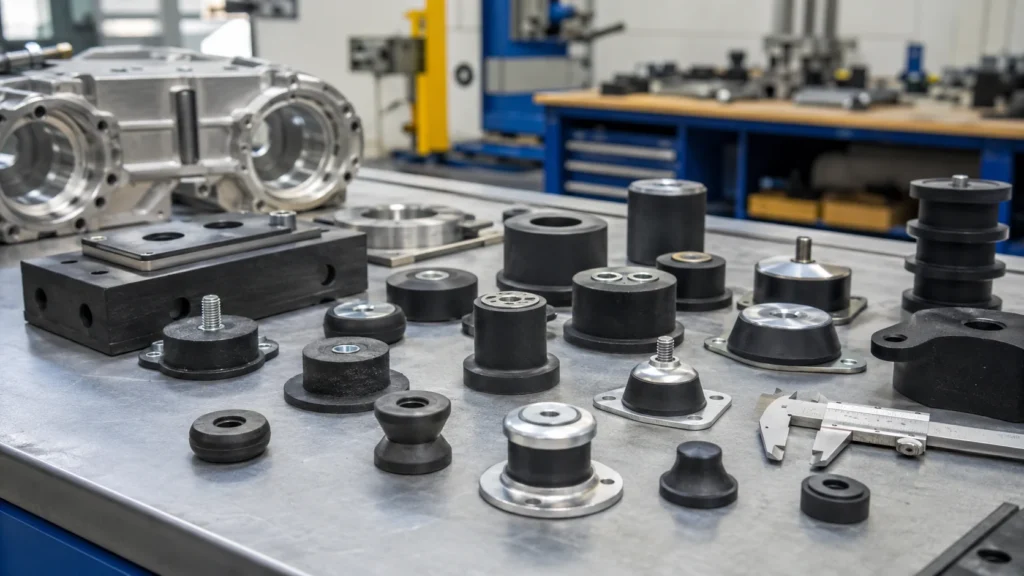
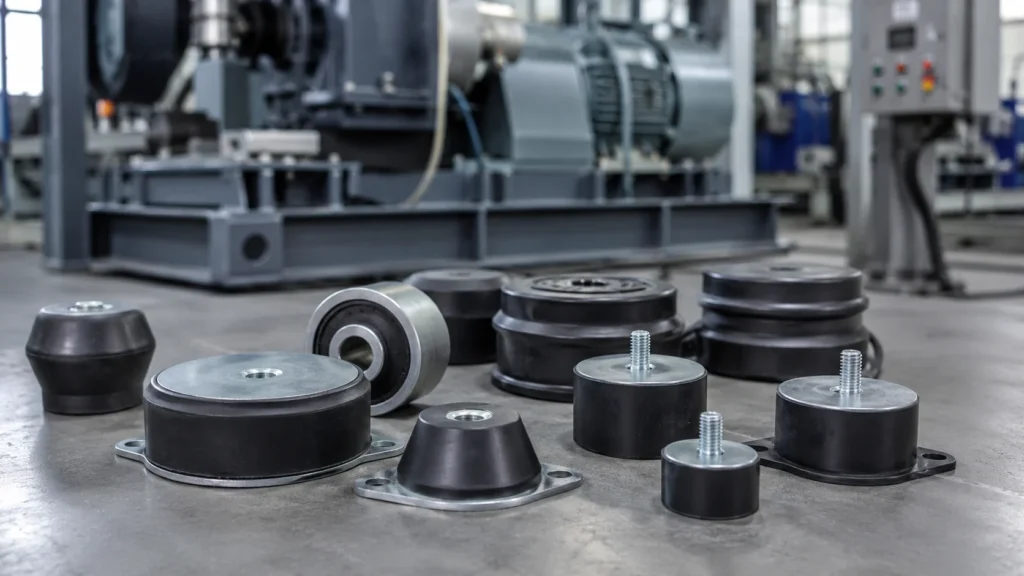
Rubber dampers are commonly referred to in Chinese as rubber shock absorbers, rubber buffers, rubber vibration dampers, or rubber isolators. They can be made of pure rubber or be rubber-to-metal bonded dampers, which are composite structures where rubber is vulcanized and bonded to metal components.
Common types include:
- rubber damper mounts
- rubber shock absorber mounts
- rubber vibration isolators
- rubber bushings
- rubber buffer pads
- rubber anti-vibration mounts
- Rubber-to-metal bonded mounts
Different designs are suitable for different loads, installation spaces, vibration frequencies, and operating environments. For example, some rubber dampers primarily withstand compressive loads, some primarily withstand shear loads, and others must withstand impacts, torsion, and vibrations in complex directions simultaneously.
A truly effective rubber damping solution is not simply a matter of “installing a rubber component”; rather, it requires a comprehensive assessment that considers load, frequency, hardness, structure, material, temperature, environmental conditions, and service life.
Benefit 1: Rubber Dampers Absorb Shock and Reduce Impact Force
The most direct function of rubber dampers is to absorb shocks and reduce instantaneous impact forces.
During equipment startup, shutdown, acceleration, braking, collisions, or when subjected to cyclic loads, impacts occur between structural components. If these impacts are not effectively absorbed, they are directly transmitted to metal brackets, bearings, welded structures, bolted joints, or precision components, which can lead to fatigue damage over time.
Rubber materials possess elastic deformation capabilities. When an impact occurs, rubber dampers first undergo compression, tension, or shear deformation, helping the equipment cushion the instantaneous load. Compared to rigid metal connections, rubber dampers can soften the impact process, reducing the direct damage caused by peak loads to the structure.
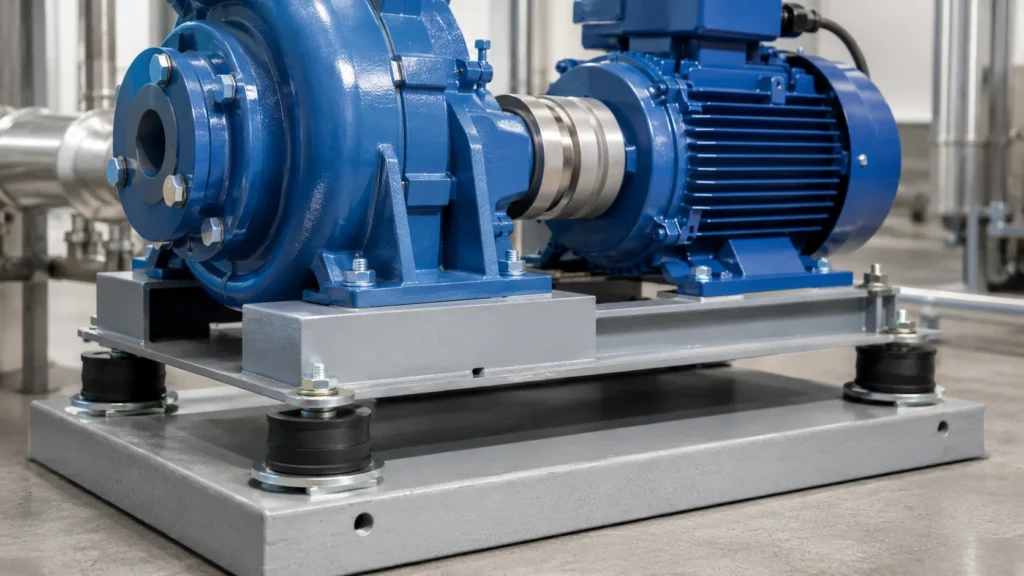
Here’s a simple example: If a piece of equipment is directly mounted on a metal base, the impacts generated during operation are rapidly transmitted throughout the entire structure; however, if appropriate rubber damper mounts are installed, the impact force is partially absorbed by the rubber layer, resulting in more stable equipment operation.
This is the fundamental value of rubber dampers in industrial shock absorption: not to eliminate impacts entirely, but to make them controllable.
Benefit 2: Rubber Vibration Dampers Help Reduce Noise
Much of the noise generated by equipment does not originate solely from motors, gears, or enclosures, but rather from the transmission of vibrations.
As mechanical vibrations continuously propagate through metal structures, the equipment housing, brackets, base, or connecting plates may resonate, further amplifying the noise. This type of noise is common in factories, vehicles, rail transit, and industrial equipment.
The role of rubber vibration dampers is to create an isolation layer along the vibration transmission path. Rubber inherently possesses damping properties that reduce the transfer of vibration energy, thereby lowering structural noise.
For equipment requiring operational noise control, anti-vibration rubber dampers are typically a cost-effective and efficient solution. They do not require complex electronic control systems or significant modifications to the overall structure; as long as the installation location, hardness, and structural design are appropriate, they can effectively address vibration and noise issues.
Such applications are commonly found in:
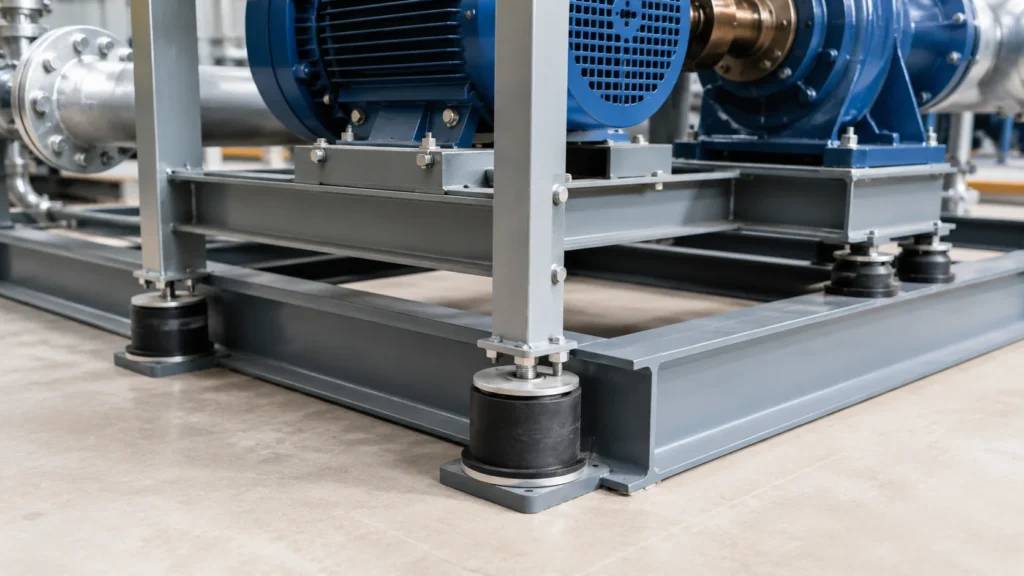
- Motors and pump equipment
- Air compressors and fans
- Industrial printing equipment
- Agricultural machinery
- Rail transit components
- Medical equipment frames
- Structural components for telecommunications equipment
- Marine and Vehicle Systems
If your customers are concerned about noise reduction, vibration isolation, or operator comfort, rubber dampers are often one of the top vibration control solutions to consider.
Benefit 3: Rubber Dampers Protect Equipment and Extend Service Life
Vibration itself may not immediately cause failure, but long-term vibration can cause cumulative damage.
Bolts may gradually loosen, welds may develop fatigue cracks, bearings may wear prematurely, pipe connections may leak, and electronic components may become less stable due to continuous vibration. Many equipment failures are not caused by a single impact, but are the result of the continuous accumulation of long-term, minute vibrations.
The value of rubber dampers lies in their ability to reduce vibration transmission, minimize hard contact between components, and help equipment maintain a more stable operating state.
From a maintenance perspective, appropriate rubber shock absorber mounts can help customers mitigate the following issues:
- Structural fatigue
- Loose connections
- Abnormal noise
- Premature component wear
- Frequency of equipment downtime
- Maintenance and replacement costs
Especially in equipment operating over long periods, rubber dampers are not merely simple small components, but functional parts that affect the reliability of the entire machine.
Of course, it must be objectively noted that rubber dampers cannot solve all mechanical problems. If the equipment itself suffers from severe imbalance, installation errors, structural design flaws, or excessive loads, rubber dampers alone cannot fully resolve the issue. The correct approach is to analyze the equipment’s structure, operating conditions, and failure causes together before selecting appropriate vibration isolation solutions.
This is also the difference between professional suppliers and ordinary parts suppliers. The former considers the application context, while the latter looks only at the dimensions on the drawings.
Benefit 4: Rubber Dampers Improve Stability and Comfort
In certain equipment or vehicle systems, shock absorption serves not only to protect components but also to enhance the user experience.
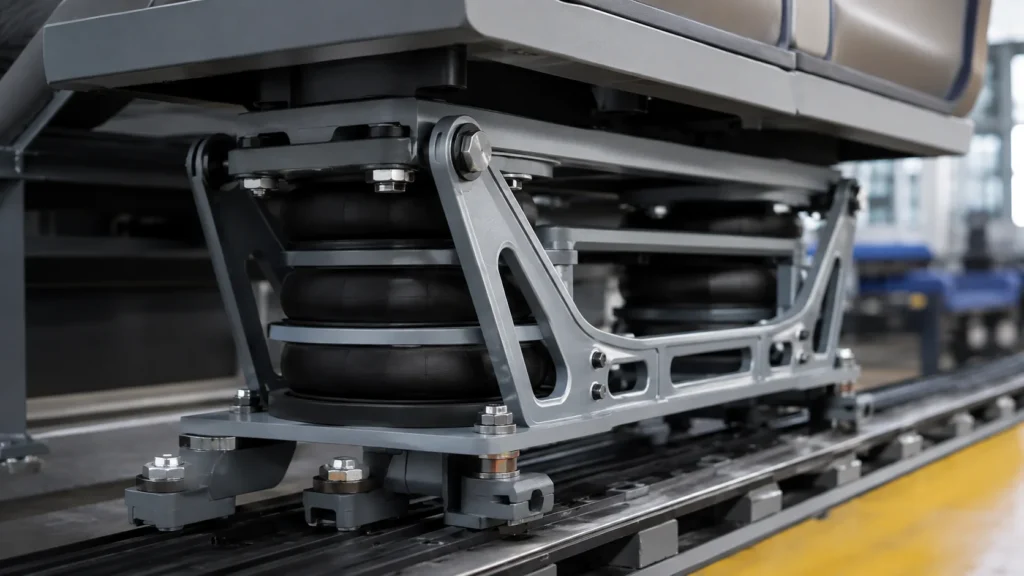
For example, in rail transit, construction machinery, agricultural equipment, seat structures, armrest structures, or mobile machinery, vibration directly affects the comfort of operators, passengers, or equipment users. Excessive vibration not only causes discomfort but can also compromise operational precision and safety.
Rubber dampers can make equipment run more smoothly by cushioning impacts and reducing vibration transmission. For mobile equipment, rubber dampers can improve the impact sensation at structural joints; for stationary equipment, they can reduce the vibration impact on the ground or frame; and for structural components with metal frames, they can reduce the vibration sensation caused by rigid connections.
This is why custom rubber dampers are frequently used in non-standard equipment and custom machinery projects. Since equipment dimensions, loads, and operating environments vary by customer, standard components may not provide a perfect fit. By customizing rubber hardness, metal structures, mounting methods, and dimensions, the damping performance can be tailored to meet specific requirements.
In practical projects, engineers typically focus on several key parameters:
- Load range
- Rubber hardness
- Compression
- Operating direction
- Installation space
- Vibration frequency
- Ambient Temperature
- Exposure to oil, water, salt spray, or chemical media
- Does the metal component require anti-corrosion treatment?
These factors all affect the actual performance of rubber dampers in shock absorption.
Benefit 5: Rubber Dampers Offer Cost-Effective Vibration Control
From a cost perspective, rubber dampers are a highly cost-effective vibration control solution.
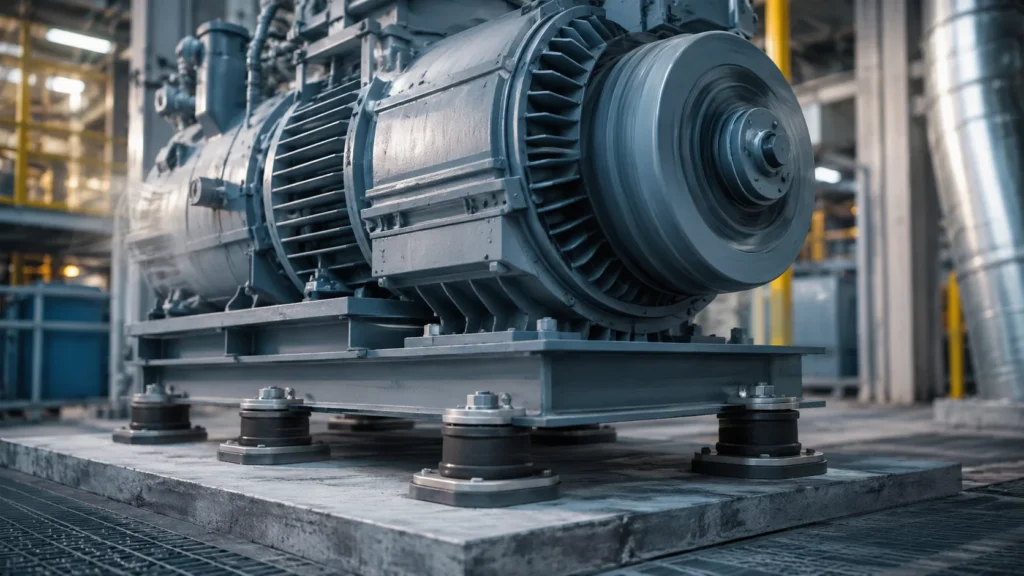
Compared to complex hydraulic, pneumatic, or active control systems, rubber dampers have a simpler structure, are easier to install, and require less maintenance. For many industrial equipment and mechanical structures, as long as the right model is selected, rubber dampers can provide stable shock absorption and vibration isolation at a lower cost.
This is why rubber damper mounts are widely used in industrial manufacturing. They do not require complex control logic, additional power sources, or frequent adjustments. This is particularly important for mass-produced equipment.
However, low cost does not mean one can choose them arbitrarily. The rubber material, hardness, structure, metal inserts, bond strength, and surface treatment all affect the final quality.
If material quality and manufacturing processes are neglected in an effort to reduce unit costs, the following issues may arise later:
- Rubber cracking
- Delamination between rubber and metal
- Excessive compression set
- Deterioration of shock absorption performance
- Corrosion of metal parts
- Deformation of mounting holes
- Insufficient service life
Therefore, the true cost advantage does not lie in “buying cheap rubber dampers,” but in selecting a rubber vibration damping solution that is suitable for the operating conditions, offers a stable service life, and ensures controllable quality. For B2B procurement, the purchase price is only part of the cost; downtime losses, after-sales costs, quality complaints, and replacement frequency must also be taken into account.
Benefit 6: Rubber Dampers Can Be Customized for Different Applications
Different equipment has varying requirements for shock absorption, which is why custom rubber dampers are so valuable.
Some customers require high load-bearing capacity, while others need better flexible cushioning; some products are exposed to the outdoors for extended periods, while others require resistance to oil, aging, or salt spray; some have very limited installation space, while others require a stable bonded structure between rubber and metal components.
Common areas for customization include:
- Rubber Material Selection
- Rubber hardness adjustment
- Customization of dimensions
- Metal insert machining
- Rubber-to-metal bonding
- Surface Treatment
- Mounting Hole Design
- Optimization for Compression or Shear Directions
- Matching for Different Load Ratings
- Adaptation to special environments
For example, rail transit components may prioritize fatigue life and safety stability; construction machinery may prioritize impact loads and durability; agricultural machinery may prioritize mud, water, dust, and complex outdoor environments; and industrial equipment may prioritize noise, ease of installation, and long-term maintenance costs.
This is why, in custom projects, suppliers cannot simply ask, “What are the dimensions?” They must also understand where the product will be installed, what loads it will bear, its operating frequency, the environmental conditions, and the specific challenges the customer aims to address.
A suitable rubber damper should not merely conform to the dimensions on the drawing but must also meet the demands of real-world operating conditions.
How to Choose the Right Rubber Dampers for Shock Absorption
If you are selecting rubber dampers for equipment, focus on the following aspects.
Identify the Load and Direction of Force
Rubber dampers perform differently under compression, shear, tension, and torsion. Before selecting a model, confirm the actual direction of force rather than relying solely on the product’s appearance.
Selecting the Appropriate Rubber Hardness
If the rubber hardness is too low, support may be insufficient; if it is too high, the shock absorption effect may not be significant. The appropriate hardness should be determined based on the load, deformation, and frequency of use.
Consider the operating environment
Temperature, oil contamination, water, salt spray, UV radiation, and chemical agents can all affect the service life of rubber. Outdoor equipment, vehicle components, and industrial machinery typically have different material requirements.
Inspect Metal Components and Bonding Quality
For rubber-to-metal bonded dampers, the machining quality of metal components, surface treatment, and rubber bond strength are critical. If the bond is unstable, the product may fail prematurely.
Evaluate Testing and Quality Control Capabilities
Reliable suppliers typically focus on dimensional inspection, material testing, bond quality, fatigue performance, visual quality, and batch consistency. For critical applications, static load, fatigue, or endurance testing should be conducted as necessary.
Quality Control Matters in Rubber Dampers
Rubber dampers may appear structurally simple, but quality control is far from straightforward.
Rubber materials inherently possess elastic and aging properties, while metal components involve machining precision, surface treatment, and corrosion protection requirements. For rubber-to-metal bonded structures, attention must also be paid to vulcanization, the bonding interface, and long-term stability.
For B2B industrial procurement, when evaluating rubber damper suppliers, it is recommended to focus on:
- Whether the supplier has the capability to manufacture both rubber and metal components
- Whether they can develop products based on drawings or samples
- Do they understand the actual operating conditions?
- Whether they can provide material and dimensional testing
- Whether they can support fatigue testing or durability testing
- Do you have the capability for stable, high-volume delivery?
- Can you collaborate on OEM/ODM project development?
These capabilities are more important than a simple quote. This is because rubber dampers are not used in isolation but are installed within the customer’s equipment systems. The failure of even a single small component can affect the reliability of the entire machine.
Applications of Rubber Dampers in Industrial Shock Absorption
Rubber dampers have a wide range of applications and are particularly suitable for mechanical systems requiring vibration damping, cushioning, sound insulation, and structural protection.
Common applications include:
- Industrial equipment bases
- Motor and pump equipment
- Air compressor and fan systems
- Agricultural machinery components
- Structural components for construction machinery
- Rail transit components
- Marine equipment
- Vehicle suspension and support structures
If your product involves rigid metal connections, periodic vibrations, impact loads, or noise issues, rubber vibration dampers are likely a solution worth evaluating.
Summary
Although rubber dampers may not be large in size, they play a very practical role in shock absorption and vibration isolation. They can absorb shocks, reduce noise, protect equipment, enhance stability, lower maintenance costs, and be customized for different operating conditions.
For industrial customers, selecting rubber dampers should not be based solely on size and price; instead, a comprehensive evaluation of load capacity, materials, hardness, structure, bonding quality, testing capabilities, and the supplier’s manufacturing experience is essential.
Vista Motion can provide rubber dampers, rubber-to-metal bonded parts, metal components, CNC-machined parts, sheet metal structures, and related testing support based on customer drawings, samples, or application requirements. We focus not only on whether a part can be manufactured but also on whether it can operate reliably under real-world conditions. If your project requires custom rubber dampers, rubber-to-metal bonded parts, or a complete mechanical manufacturing solution, please contact us to discuss your specific application scenarios, drawings, and technical requirements.
FAQ
What are rubber dampers used for?
Rubber dampers are used to absorb shock, reduce vibration, lower noise, and protect mechanical components from impact and fatigue. They are commonly used in industrial equipment, vehicles, rail systems, agricultural machinery, pumps, motors, and custom metal assemblies.
How do rubber dampers work in shock absorption?
Rubber dampers work by deforming under load and absorbing part of the impact energy. The rubber material helps reduce the transmission of shock and vibration between connected parts with , making the equipment run more smoothly and protecting surrounding components.
What is the difference between rubber dampers and rubber vibration isolators?
Rubber dampers primarily focus on absorbing shock and reducing impact force, while rubber vibration isolators are often used to reduce the transmission of continuous vibration. In many industrial applications, a single component can provide both damping and vibration isolation functions.
Are rubber dampers suitable for industrial machinery?
Yes. Rubber dampers are widely used in industrial machinery because they are cost-effective, easy to install, and effective at reducing vibration, shock, and noise. They are especially useful for motors, pumps, compressors, equipment bases, machine frames, and metal structures.
What materials are used for rubber dampers?
Common rubber materials include natural rubber, neoprene, nitrile rubber, EPDM, silicone rubber, and other synthetic rubber compounds. The appropriate material depends on the load, temperature, oil resistance, weather resistance, aging resistance, and working environment.
Can rubber dampers be customized?
Yes. Custom rubber dampers can be designed according to drawings, samples, load requirements, hardness, installation space, metal inserts, surface treatment, and application environment. Customization is common in OEM and ODM industrial projects.
What are rubber-to-metal bonded dampers?
Rubber-to-metal bonded dampers are components in which rubber is chemically or mechanically bonded to metal parts during the manufacturing process. This structure enhances installation strength and makes the damper suitable for higher-load or more complex mechanical applications.
How do I choose the right rubber damper mount?
To choose the right rubber damper mount, you need to consider load direction, load capacity, rubber hardness, installation space, vibration frequency, operating temperature, environmental exposure, metal structure, and expected service life.
Do rubber dampers reduce noise?
Yes. Rubber dampers can reduce noise by limiting the transmission of vibrations through metal structures. When vibrations are controlled, structural resonance and equipment noise are often reduced as well .
How long do rubber dampers last?
The service life of rubber dampers depends on material quality, load, compression level, temperature, chemical exposure, UV exposure, installation method, and vibration conditions. In demanding applications, fatigue testing and durability testing can help evaluate long-term performance.
