
This article focuses primarily on powertrains for passenger and commercial vehicles, while also providing a universal logic for selecting “engine vibration isolation mounts” for construction machinery, generator sets, and similar applications. It does not replace specific vehicle repair manuals or OEM specifications.
What is an Engine Mount?
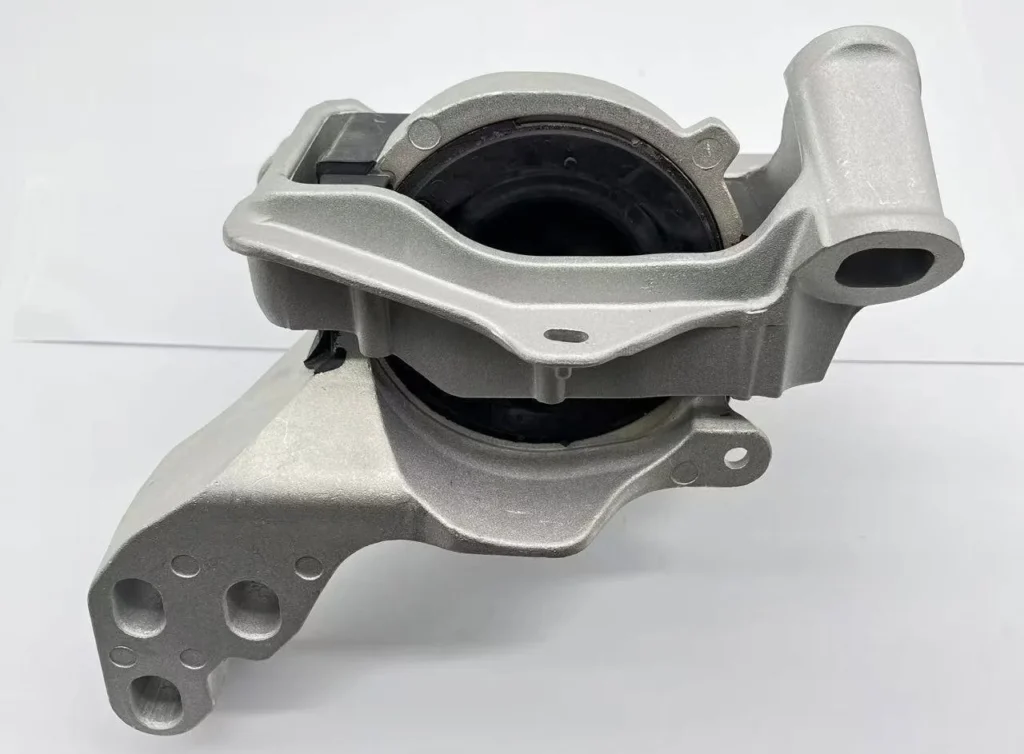
Engine mounts, also commonly referred to as motor mounts or engine mount pads/rubber blocks, are components that connect the engine to the vehicle body/chassis. Typically constructed from metal and rubber elastomers through vulcanization or bonding, one end attaches to the engine block while the other connects to the body/subframe. Their fundamental function combines structural linkage with vibration isolation.
Functionally, engine mounts serve two core purposes: First, they secure the engine’s position to prevent powertrain movement during acceleration, braking, or over bumps. Second, they absorb/dampen the transmission of vibration and noise (NVH).
Most vehicles typically feature three engine mounts, plus one or two transmission mounts. Transverse powertrains often require additional front and rear torque mounts to control engine twisting.
How Engine Mounts Work
“Rubber acts like a spring, damping like a brake”
The engine generates periodic excitation (combustion, reciprocating inertia, gear meshing, accessory imbalance, etc.). If rigidly connected to the body, this vibration would directly transmit into the cabin. Engine mounts use rubber/hydraulic chambers to provide elasticity and damping, acting as buffers and energy dissipators to reduce NVH.
First Avoid Resonance, Then Discuss Isolation Efficiency
This is the root cause of many incorrect engine mount rubber selections
The isolation system fears resonance most when “excitation frequency ≈ system natural frequency,” causing transmission rates to peak. Engineers commonly use the “frequency ratio fd/fn” to judge: when the ratio is insufficient, an amplification zone may occur where “installation actually increases vibration”; only when the ratio exceeds √2 (approximately 1.414) does the isolation zone begin. In practice, the target frequency ratio is often set higher to achieve stable isolation.
For OEM/aftermarket selection, this implies: Engine mounts’ “static deflection/stiffness” isn’t about maximum rigidity, but about suppressing natural frequencies within an optimal range while ensuring proper alignment and durability.
Engine Mount Types
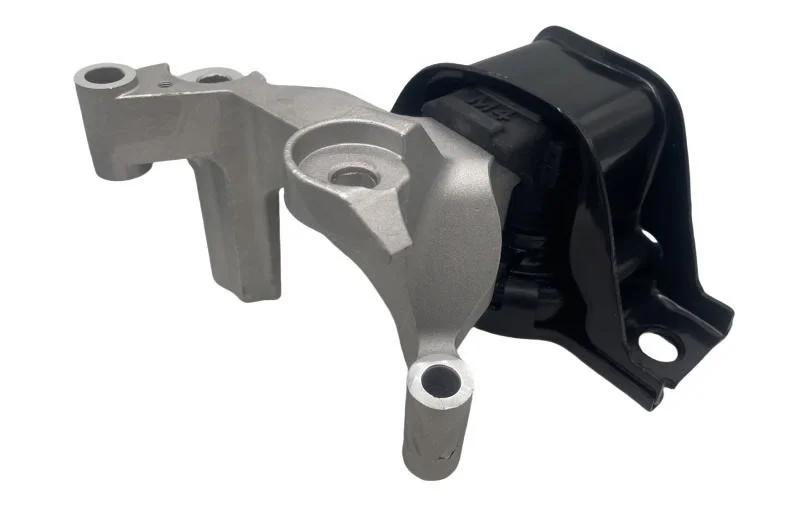
Based on operating principles and structure, mainstream types can be categorized into three classes (often used interchangeably by OEMs):
Passive Rubber Mount
A typical “metal-rubber-metal” bonded structure offering balanced cost and reliability, this is the most common engine mount solution.
Applications: Most vehicle models, basic construction machinery, generator sets, etc.
Passive Hydraulic Mount
Features internal fluid chambers and flow channels that utilize fluid friction to generate stronger damping, particularly improving idle and low-frequency vibration control. However, it carries risks such as leakage and temperature sensitivity; once failed, it often requires complete assembly replacement.
Active Mount
Adjusts equivalent stiffness/damping through vacuum/electrically controlled valves or more complex electronic strategies, even generating counter-vibrations to cancel NVH. Used for models with higher NVH targets or more complex excitation patterns.
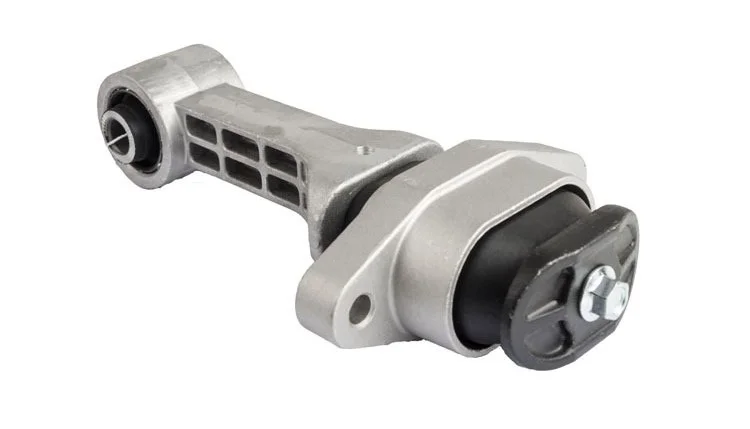
Torque Mount and Transmission Mount
Transverse platforms commonly use front and rear mounts to “manage torque,” suppressing powertrain oscillations caused by acceleration nose-up and deceleration nose-down. These mounts, together with the engine main mount, form the powertrain mounting system.
Symptoms of a Failed Engine Mount
Whether rubber engine mounts or hydraulic mounts fail, the three most typical consequences are: increased vibration, more abnormal noises, and noticeable engine displacement.
Common perceptible symptoms (listed by frequency of occurrence):
- Noticeably increased vibration during idle or acceleration, with intensified steering wheel/dashboard shaking.
- Clunking, knocking, or dull thuds during rapid acceleration/deceleration, resembling metal impacts; fundamentally caused by insufficient constraint allowing the powertrain to lift and rebound.
- Shifting jerks/body jolts, particularly related to transmission side mounts; increased clearance may also cause misalignment.
- Visible damage: Rubber cracking, tearing, or separation from metal bonding; hydraulic mount leakage.
- Abnormal engine posture (sagging/tilting) accompanied by abnormal noise and vibration.
Why do engine mounts fail?
Engine mounts inherently operate under complex conditions: high dynamic stress + high temperatures + exposure to fluids/salt spray. Typical failure pathways include:
- Rubber fatigue aging: Long-term dynamic loading causes crack propagation, hardening, and loss of elasticity in rubber; fluids corrode rubber and accelerate degradation.
- Hydraulic chamber leakage: Seals degrade or rupture due to impact, causing rapid loss of damping performance or even collapse.
- Installation and operating conditions: Improper bolt preload, misalignment during assembly, accident impacts, frequent aggressive driving/hard braking significantly accelerate damage.
Diagnostic and Replacement Strategy
Diagnosis should prioritize a combined “visual inspection + operating condition trigger” approach: Check for cracks, tears, leaks, or bond separation; monitor engine displacement and abnormal noises during acceleration, throttle release, or gear shifts.
Traditional methods may observe engine lift/drop during D↔R shifts with brakes fully applied; excessive lift suggests potential mount issues. However, such procedures carry risks and should follow professional repair protocols.
Replacement strategies diverge between engineering and maintenance perspectives:
- “Same-Batch, Same-Condition” Approach: If one bracket fails, others are typically nearing end-of-life. Recommend replacing the entire set to prevent uneven load distribution between new and old components.
- “Cost-Compromise” Approach: For cost reasons, only damaged components are often replaced in practice. However, new parts may endure higher uneven loads, potentially shortening their lifespan.
Selection and Procurement Considerations
If your objective is OEM/original equipment procurement or engine mounts for equipment, rather than simply “replacing identical parts,” it is recommended to write RFQs using an “input parameter-driven” approach. This avoids procuring engine mounts that “appear to fit but deliver incorrect NVH performance” based solely on a vehicle model number.
Three Essential Input Categories
Single-point load: Static/dynamic load range per mount (including center of gravity offset).
Minimum operating frequency/RPM: Idle and minimum operating conditions are the most susceptible to resonance.
Objective: Prioritize either “vibration isolation and noise reduction” or “displacement limitation/impact resistance” (often mutually restrictive).
Key Performance Indicators
Static stiffness/dynamic stiffness curves (at different frequencies and temperatures)
Damping characteristics (hydraulic supports require attention to leakage and low-temperature performance)
Maximum displacement and limiting strategies (preventing powertrain impact)
Durability and Environmental Resistance: Oil resistance, heat resistance, salt spray/mud water resistance, fatigue life (the harsher the operating conditions, the more critical it is to include validation in the contract)
Common Pitfalls
Selecting “stiffer” supports based solely on load capacity leads to insufficient static deflection, resulting in inadequate frequency ratio, vibration isolation failure, or even amplification.
Neglecting installation orientation and constraint paths (especially for torque mounts) intensifies vibration during acceleration/shifting.
Summary
When selecting engine mounts/vibration isolation supports for rotating/reciprocating equipment like vehicle platforms, construction machinery, generator sets, or compressors, elevate your approach from “buying a rubber mount” to “developing a powertrain isolation solution”: First define single-point load, minimum rotational speed frequency, and target isolation/displacement limits. Then use frequency ratio analysis to avoid resonance zones before finalizing material, structure, and durability validation.
We specialize in two service categories: First, custom-engineered components like rubber-to-metal bonded engine mounts, torque shackle bushings, and transmission mounts tailored to your drawings and installation space. Second, addressing issues like “idle vibration, gearshift shock, pronounced resonance points, and short lifespan” through load/frequency-based selection recommendations and iterative prototyping.Simply provide your application scenario, load/RPM range, mounting interfaces, and target NVH/displacement requirements. We will deliver a quotable technical specification list and prototype solution (including inspection and consistency requirements), transforming procurement from “price comparison” to “risk and total cost comparison.”
FAQ
What are the most typical symptoms of a failed engine mount?
Common signs include increased idle vibration, abnormal noises during acceleration/deceleration (clunking/knocking), and noticeable engine displacement.
What is the typical lifespan of engine mounts?
Related to load, temperature, oil corrosion, and road conditions; prioritize inspection for cracks, leaks, adhesive separation, or vibration/abnormal noise.
What distinguishes hydraulic engine mounts from standard rubber mounts?
Hydraulic mounts provide stronger damping through fluid chambers and valve-controlled flow, often delivering better idle NVH performance, but carry leakage risks and higher costs.
What causes engine mount fluid leakage?
Possible causes include fluid leakage due to failure of the hydraulic mount’s chamber or seals, resulting in reduced damping. Typically requires replacement of the entire assembly.
Should all engine mounts be replaced simultaneously?
Industry recommendation: If one fails, others are likely nearing end-of-life, making a complete set replacement more reliable. However, some opt to replace only the damaged unit for cost reasons.
How many engine mounts are typically present?
Most vehicles have about 3 engine mounts, plus 1–2 transmission mounts. Transverse platforms may use 4–5 mounts to control torque and vehicle posture.
Is engine vibration always caused by mount rubber failure?
Not necessarily, but worn engine/transmission mounts are a significant cause of vibration and noise. Diagnosis should combine visual inspection of damage with operational conditions ( ).
Is “stiffer mounts are always better” correct?
Generally not. Excessive stiffness reduces static deflection and increases natural frequency. Insufficient frequency ratio may cause resonance in the amplification zone, leading to increased vibration.
What causes “clunking/impact noises” from engine mounts?
When mounts provide insufficient restraint, the powertrain accelerates upward during throttle application and rebounds downward during throttle release, causing collisions and abnormal noises. In severe cases, this can also affect the driveshaft or accessory lines.
When requesting OEM-custom engine mounts, what key information must be provided in the RFQ?
Single-point load capacity, minimum rotational speed/frequency, target vibration isolation or displacement limits. Supplement with installation space, mounting interface dimensions, environmental conditions (temperature/lubricants/salt spray exposure), and service life requirements.
