
What exactly are vehicle control arms?
Control arms (also commonly referred to as A-arms, wishbones, or suspension arms) serve as the “positioning links” within the suspension system. They connect the body/subframe to the steering knuckle (or hub carrier) on the wheel side. Through their pivot points, they allow the wheel to move vertically while simultaneously “locking the wheel’s position within the designed geometry” in both the fore-aft and lateral directions.In short: Control arms are not the metal rods that “carry the load.” They are the critical components that “control the wheel’s movement path and alignment angles.”
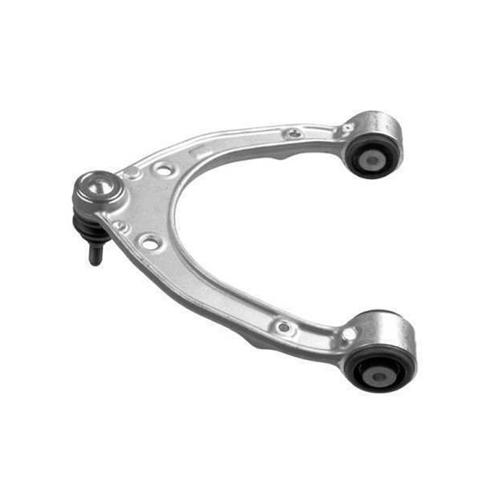
Core Functions of Control Arms
From an engineering perspective, control arms primarily address three functions:
Positioning
Restricting the wheel’s longitudinal/lateral freedom to ensure it moves only along the intended path, thereby maintaining stable geometric relationships such as camber, caster, and toe.
Vibration Isolation
Typically connected to the body end via bushings, it absorbs shocks and noise vibrations while allowing for oscillation.
Cooperative Steering
The wheel end is typically connected to the steering knuckle via a ball joint, enabling simultaneous suspension movement and steering rotation without mutual locking.
What are the “critical failure points” of control arms?
Most control arm assemblies can be disassembled into three key components:
Arm Body
Manufactured from stamped steel, cast/forged steel, or aluminum alloy casting, providing strength and stiffness.
Control Arm Bushing
The elastic pivot point at the body end determines vibration isolation and geometric retention capability; aging and cracking can cause positioning drift and abnormal noises.
Ball Joint
Universal joint at the wheel end. Increased play not only affects handling but also poses significant safety risks.
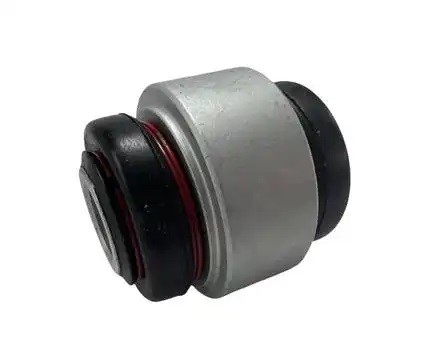
Common industry misconception: Treating control arms as “ordinary linkages” by solely checking for fractures. In reality, most issues stem from elastic degradation and increased clearance in bushings and ball joints—which steadily erode positioning accuracy without breaking.
What do control arms look like in different suspension systems?
MacPherson Strut
Typically lacks an upper control arm, relying primarily on the lower control arm (or lower swing arm) to position the wheel in conjunction with the shock absorber strut; the lower control arm handles both lateral and longitudinal positioning functions, making it one of the most common configurations for front suspensions.
Double Wishbone / SLA
A pair of upper and lower control arms jointly position the steering knuckle; this allows for more precise engineering control over camber changes and geometric characteristics throughout the suspension travel.
Multi-link
May lack a single “large triangular arm,” instead using multiple positioning links to collectively achieve the functions of control arms; some models still refer to key links as control arms.
What are the symptoms of a broken control arm?
The following symptoms are typically associated with worn control arm bushings or ball joints:
1) “Thumping” noises over potholes/speed bumps: Commonly caused by loose bushings or metal-to-metal contact.
2) Steering drift, poor self-centering, or pulling: Dynamic load-induced camber angle drift.
3) Abnormal tire wear: Particularly localized uneven wear or accelerated wear often indicates unstable alignment.
4) Increased brake dive or acceleration nose-up: Greater elasticity at control arm pivot points under longitudinal forces.
5) Visible signs: Cracked or delaminated bushing rubber; ruptured ball joint boot with oil leakage/dust ingress.
Diagnostic Logic Recommendations: Avoid conclusions based solely on “presence of abnormal noise.” Combine “symptoms + visible damage + clearance testing + four-wheel alignment data” for more robust diagnosis.
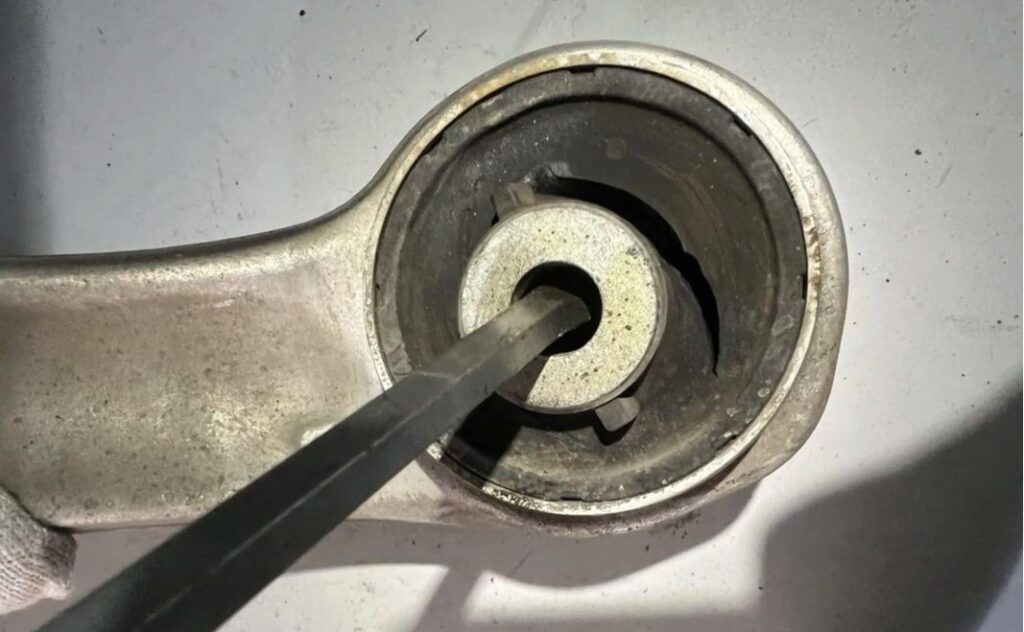
On-site Inspection Checklist
Without disassembling the vehicle, the standard inspection sequence is as follows (recommended for professional technicians):
1) Visual inspection: Check for cracks, bulges, or delamination in bushings; inspect ball joint dust boots for tears or grease leakage.
2) Pry bar load test: Apply slight prying force to the bushing and observe for abnormal displacement or metallic knocking sounds.
3) Clearance and Play: With vehicle lifted, check for abnormal wheel play in specific directions (requires standardized techniques and tools).
4) Road Test Reproduction: Reproduce abnormal noises and drifting by driving over small potholes at low speed, applying light brakes/acceleration, and turning the steering wheel.
5) Alignment Data Comparison: If camber/toe settings cannot be stably reset or drift rapidly after adjustment, strongly suspect bushing/ball joint or related linkages for elasticity degradation.
Repair Strategy: Replace Bushings or Entire Assembly? When is Replacement Mandatory?
1) Replace bushings only: Suitable when control arms are intact, bushings can be replaced individually, and process conditions permit; however, this requires high labor efficiency, press-fit equipment, precise installation angles, and exhibits strong directional specificity across vehicle models.
2) Replace control arm assembly: More suitable when both ball joint and bushing age simultaneously, control arm body is deformed, or higher consistency is required; provides more controllable restoration of geometry and NVH in one operation.
3) Situations requiring priority attention: Noticeable ball joint play, ruptured dust boots causing looseness, abnormal noises accompanied by significant drift/steering instability.
Key takeaway: For most vehicles, replacing the entire assembly + proper tightening + wheel alignment typically restores chassis geometry and long-term consistency more reliably than piecemeal repairs.
Two Most Overlooked Tasks After Replacing Control Arms
1) Wheel Alignment: Control arms directly determine alignment geometry. Replacement typically requires recalibration to prevent pulling and uneven tire wear.
2) Tightening Conditions: Many bushings must be tightened to specified torque values with the vehicle lowered to near normal ride height. This prevents premature wear and abnormal noises caused by pre-torsion (refer to the repair manual for details).
Conclusion
Within the vehicle chassis, what truly “determines driving experience and safety” regarding control arms is often not the metal arm itself, but the connection interfaces at the body and wheel ends—particularly the bushing’s ability to manage impact, vibration, and displacement.Vista Motion provides a typical engineering comparison in its rubber bushing specifications: When traversing speed bumps, the instantaneous impact force on identical chassis components without rubber bushings can reach 1,200 kg, whereas with rubber bushings installed, it drops below 400 kg.Simultaneously, rubber bushings permit 0.3–1.2 mm of elastic displacement to absorb thermal expansion/contraction and assembly deviations, reducing stress concentration and fastener failure risks. For readers, this implies that assessing “control arm reliability” should prioritize examining higher-probability failure points like bushing aging, cracking, delamination, and dynamic clearance—rather than solely focusing on arm fractures.
From a manufacturing and supply chain perspective, the consistency of “rubber-to-metal bonding” components like control arm bushings heavily relies on verifiable engineering and quality systems.Vista Motion possesses several key capabilities: design and application support with in-house finite element analysis (FEA), proprietary vulcanization molds, automated control of compounding and mixing, 100% inspection of rubber batches with full traceability, CMM inspection of metal components, and vulcanization under controlled parameters to ensure rubber-to-metal bond strength.Our “design-to-batch-control-to-inspection closed-loop” approach provides a supply chain with batch traceability, inspection records, and clearly defined operating parameters—often reducing rework and safety risks more effectively than price alone.
FAQ
Are control arms and swing arms the same thing?
In many vehicle models and repair contexts, “swing arm” typically refers to the lower control arm. However, terminology varies by region and model, so it’s best to confirm based on structural location (upper/lower, front/rear).
Can I keep driving with a broken control arm?
Driving with a damaged control arm is not recommended. Loose bushings can cause alignment drift and reduced braking/steering stability. If the ball joint shows significant play or the dust boot is torn and loose, the safety risk is even higher—prompt inspection and repair are essential.
What are typical symptoms of worn control arm bushings?
Common signs include abnormal noises over bumps, slight steering drift, increased body roll during braking or acceleration, unstable alignment, and uneven tire wear.
What are the signs of a failed control arm ball joint?
More common symptoms include steering looseness, “clunking/thumping” noises when turning or over bumps, and abnormal wheel end play. In severe cases, handling risks increase significantly.
Is wheel alignment mandatory after replacing control arms?
It is generally recommended. Control arms are critical components for alignment geometry. Failure to recalibrate after replacement can lead to pulling and abnormal tire wear.
How often should control arms be replaced?
There’s no fixed mileage. It depends more on road impact, rubber bushing aging, ball joint seal condition, and vehicle usage environment. We recommend a comprehensive assessment based on “inspection results + symptoms + alignment data” rather than just mileage.
Can I just replace the bushings? Why do many repair shops recommend replacing the entire assembly?
Yes, but only if the vehicle model supports individual replacement, the press-fit and installation angles are correct, the arm body shows no deformation, and the ball joint is in good condition. Replacing the entire assembly saves labor time, ensures consistent replacement of both bushings and ball joints in one go, and typically reduces the likelihood of needing repairs later.
Does control arm noise always indicate control arm failure?
Not necessarily. Similar noises can originate from ball joints, stabilizer links/bushings, top mounts, shock absorbers, or steering tie rod ends. We recommend troubleshooting using a “visual inspection + clearance test + road test replication” process.
How much does control arm replacement cost?
Costs depend on vehicle model structure, whether ball joint/bushing assemblies are included, labor hours, and whether wheel alignment is required. When communicating with customers, it’s advisable to provide a breakdown: parts cost + labor cost + four-wheel alignment fee for greater transparency.
What’s the difference between upper and lower control arms?
In double wishbone suspensions, both upper and lower control arms position the steering knuckle, with the upper arm typically shorter to achieve specific camber changes. In MacPherson strut suspensions, the lower control arm usually serves as the primary positioning element, while the upper portion relies on the shock absorber strut and body structure for corresponding positioning functions.
