
Industrial manufacturing and HVAC, automotive and power transmission, rail transportation, construction machinery, marine and offshore engineering, renewable energy, and aerospace are seven representative application areas.
Next, we will analyze how these seven industries use anti-vibration mounts, taking into account typical equipment, actual operating conditions, common product designs, and procurement requirements, as well as the key considerations you should keep in mind during the design or procurement process.
What Are Anti-Vibration Mounts?
Common rubber vibration mounts utilize the elasticity and viscoelasticity of rubber to form a connection between equipment and its base that provides a certain degree of stiffness and damping.
You can think of it as a specially designed flexible support point.
When the equipment vibrates, the rubber deforms, altering the transmission of vibrational forces to the support structure through elastic support and energy dissipation within the material.
Insufficient stiffness may result in excessive equipment displacement, unstable support, or additional loads on connecting components; conversely, excessive stiffness may cause too much vibration to be transmitted to the frame.
If the excitation frequency is close to the natural frequency of the vibration isolation system, resonance may occur, making the vibration more pronounced than before installation.
Therefore, a sound industrial vibration isolation solution must balance at least four objectives:
- Reliable Load-Bearing: The ability to support the equipment over the long term and adapt to actual load variations.
- Vibration Isolation: Reduces vibration transmission within the target operating frequency range.
- Displacement Control: Prevent excessive movement during startup, shutdown, impact, or lateral forces.
- Environmental Adaptability: Meeting requirements for temperature, oil contamination, humidity, corrosion, aging, and service life.
Different industries will have entirely different requirements for these four objectives.
Industrial Manufacturing and HVAC Systems
Industrial manufacturing is one of the most typical and widely applied fields for industrial vibration isolation mounts.
Walk into a modern factory, and you’ll see all kinds of motors, compressors, pump sets, fans, processing equipment, and automated production lines. This equipment typically needs to run continuously, and some even need to operate around the clock.
Although their operating principles differ, many of these devices generate periodic vibrations.
Which pieces of equipment typically require vibration isolation mounts?
In industrial manufacturing and electromechanical systems, common applications include:
- Industrial Motors and Drive Units (Electric Motor Mounts)
- Centrifugal Pumps and Industrial Pump Sets (Pump Vibration Isolators)
- Air compressors (Air Compressor Anti-Vibration Mounts)
- Industrial fans, chillers, and air conditioning units (HVAC Vibration Isolators)
- Machine tools and certain precision machining equipment (Machine Vibration Mounts)
- Generator Sets and Auxiliary Equipment (Generator Vibration Mounts)
Take industrial pumps as an example.
Suppose a water pump is installed on a steel base. Even if the pump’s own vibration remains within acceptable limits, the vibrational force may still be transmitted to the surrounding area through the mounting feet, piping, and supporting structures.
If pipe connections, equipment foundations, or mounts are improperly designed, persistent humming noises, pipe vibrations, or structural resonance may occur in the vicinity.
A properly designed vibration isolation system helps reduce this vibration transmission.
However, there is one issue that is easily overlooked: the installation of vibration-isolating mounts at the bottom of the equipment does not mean that the entire system is fully vibration-isolated.
If the pump housing remains tightly connected to the building structure via rigid piping, vibrations may bypass the mounts and propagate along the piping. This phenomenon is commonly referred to as “vibration short-circuit.”
Therefore, for pump sets or HVAC equipment, in addition to the equipment base, it is necessary to comprehensively inspect flexible pipe joints, pipe supports, duct connections, and foundation stiffness.
How to Select the Right Vibration Isolation Mounts for Industrial Equipment?
First, you should understand the equipment’s total weight, the loads at each support point, the normal operating speed, and the vibration conditions during startup and shutdown.
For example, a motor operating at 1,500 RPM has a rotational frequency of 25 Hz. However, if the system is subjected to lower-frequency excitations or if the equipment uses variable-frequency control, selection should not be based solely on the rated speed.
At the same time, it is also necessary to determine whether the equipment is subject to significant lateral forces, impact loads, or a risk of overturning.
For equipment with limited installation space and specific damping requirements, rubber-to-metal bonded mounts can be a viable option. For heavy-duty equipment with more stringent low-frequency vibration isolation requirements, spring isolators or combined vibration isolation systems may need to be evaluated.
Recommendations for Industrial Equipment Manufacturers: If you are developing new pump sets, compressors, or motor equipment, it is best to consider the placement of vibration isolation mounts, load distribution, and required deflection during the base structure design phase, rather than waiting until vibration issues arise and then adding rubber pads as an afterthought.
Vista Motion’s General Engineering applications page introduces machine feet, drive mounts, flexible couplings, and related rubber vibration isolation products. For equipment requiring specific mounting dimensions or load-bearing capabilities, custom solutions can be discussed based on drawings and operating conditions.
Automotive and Drive Engineering
If you’ve ever driven a car with worn-out engine mounts, you may have felt noticeable vibrations through the steering wheel, seats, or body.
This does not necessarily indicate a serious malfunction in the engine itself. Sometimes, the problem stems from the mounting components responsible for supporting the engine and isolating vibrations.
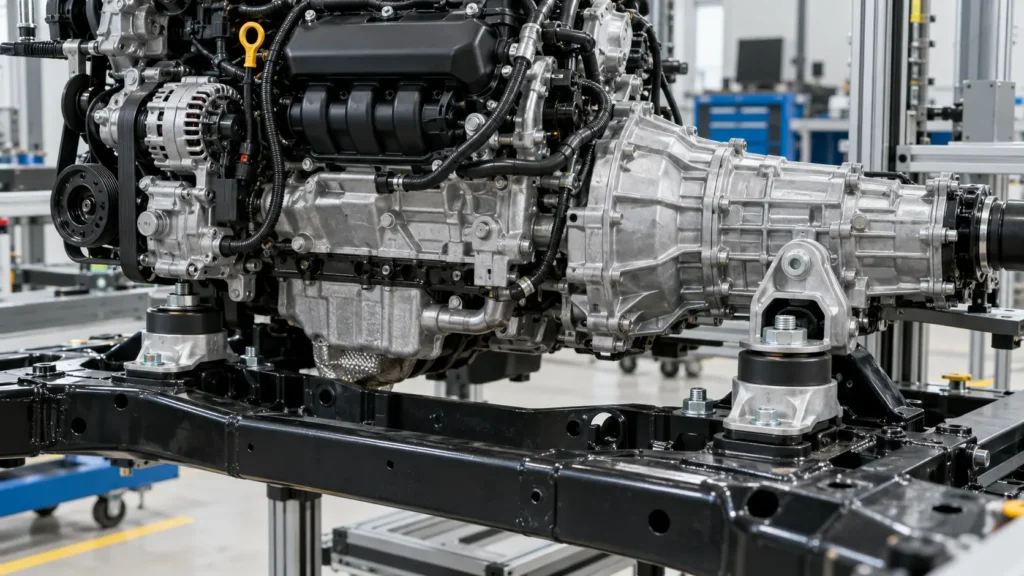
In automotive and drivetrain systems, vibration-damping mounts not only improve ride comfort but also perform the critical tasks of connecting the powertrain, limiting displacement, and controlling vibration transmission.
Where are vibration-damping mounts typically installed?
Typical applications include engine mounts, transmission mounts, powertrain mounting components, certain suspension rubber bushings, and related auxiliary mechanical equipment.
The operating conditions for these components are far more complex than those of ordinary static rubber mounts.
For example, an engine generates periodic excitation during idling, while the powertrain is subjected to reaction forces in different directions when the vehicle accelerates, decelerates, or shifts gears.
This means that engine mounts must possess both adequate flexibility and the ability to control the relative motion of the powertrain.
If the mount is too stiff, more vibration may be transmitted to the vehicle body; if it is too flexible, excessive powertrain displacement may occur, which in turn affects adjacent piping, the drivetrain, or connecting components.
Do new energy vehicles also require vibration control?
Yes, but their vibration characteristics are not entirely the same as those of conventional fuel-powered vehicles.
Traditional internal combustion engines exhibit distinct combustion-induced vibrations and reciprocating inertial forces. Although electric drive systems do not involve the same combustion process, they may still be affected by electromagnetic forces from the motor, gear meshing, bearings, and road-induced vibrations.
Therefore, the motor mounts, gearbox connections, and some auxiliary equipment in electric vehicles may also require specialized vibration control designs.
Furthermore, since electric vehicles lack the distinct background noise of an internal combustion engine, certain high-frequency whines and structure-borne noise that would otherwise go unnoticed may become more prominent.
This is why automotive vibration damping design cannot focus solely on “rubber hardness.”
The dynamic stiffness, damping, temperature sensitivity, and response at different frequencies of rubber materials can all affect the final NVH (Noise, Vibration, and Harshness) performance.
What should the automotive industry focus on during procurement?
For OEMs and automotive parts suppliers, simply verifying mounting hole spacing and overall dimensions is usually insufficient.
You should also clarify the powertrain weight, torque reaction, mounting orientation, compression and shear loads, long-term operating temperature, risk of contact with fluids, and product durability requirements.
If the product is to be used across multiple vehicle models or with different powertrain configurations, it is also important to determine whether the same design requires different rubber compounds or stiffness levels.
For engine mounts, transmission mounts, and specific rubber-to-metal composite parts, Vista Motion provides product and customization service information related to powertrain applications.
You can visit the Drive Engineering page to learn about the corresponding business areas and further confirm product compatibility based on actual design drawings.
Railway and Rail Transit
The vibration environment faced by rail transit equipment has distinct characteristics.
When a train is in operation, the contact between the wheels and the track, track irregularities, bogie movement, and the operation of on-board mechanical equipment all generate vibrations of varying frequencies and directions.
These vibrations not only affect ride comfort but can also impact onboard equipment, fasteners, and auxiliary mechanical systems.
For train manufacturers, vibration control is a critical component of vehicle dynamics, structural reliability, and passenger comfort design.
Typical Vibration Damping Applications in Rail Vehicles
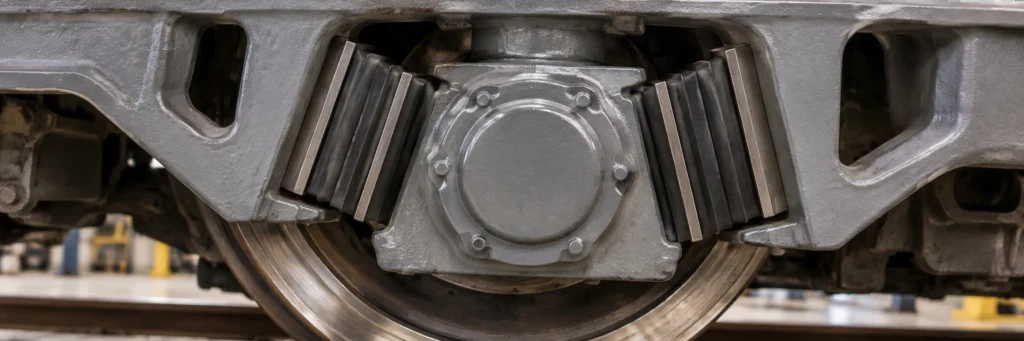
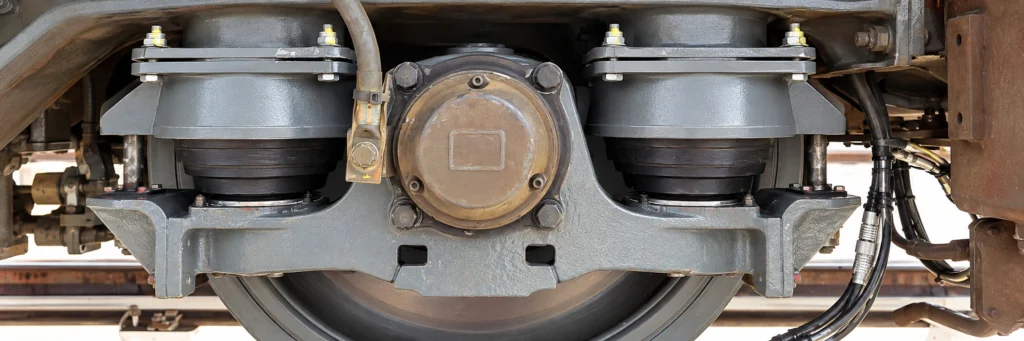
Rail vehicles may utilize various forms of rubber elastic elements, metal-rubber composite mounts, equipment-mounted vibration isolators, and specially shaped elastic support components.
Common application locations include on-board air compressors, auxiliary power equipment, electrical equipment enclosures, certain power transmission mounting locations, and suspension or support systems configured according to vehicle design requirements.
Operating conditions vary greatly from one location to another.
For example, mounts for auxiliary equipment installed inside the passenger car typically need to limit the transmission of equipment vibrations to the car body.
In contrast, elastic elements used in bogies or specific suspension systems must also withstand more complex dynamic loads and relative motion; their design cannot simply be adapted from rubber mounting feet used in ordinary industrial equipment.
Why does rail transit place such a high priority on dynamic performance?
Because a train may be subjected to constantly changing operating conditions—such as running, braking, accelerating, cornering, and track impacts—over long periods.
Under these conditions, it is difficult to fully assess the long-term performance of an elastic component based solely on static compression testing.
For vibration-damping components that perform critical functions, design and validation may need to consider:
- Changes in dynamic stiffness at different temperatures
- Fatigue and performance changes caused by repeated loading
- Creeper and permanent compression set under long-term loading
- Bonding reliability at the rubber-to-metal interface
- Flame Retardancy, Smoke Density, and Other Applicable Standards for Automotive Projects
In particular, flame retardancy and smoke toxicity requirements should be determined based on the specific installation location, vehicle type, and applicable regulations, rather than assuming that all rubber vibration isolation bearings require or already meet the same certification.
Can generic models be used directly for rail transit vibration-isolation mounts?
Standard products may be evaluated based on performance requirements for certain non-critical auxiliary equipment; however, components involving vehicle dynamics, critical connections, or specific safety requirements typically need to be designed, tested, and validated in accordance with actual project specifications.
If you are developing rail vehicle equipment, we recommend providing a complete load spectrum, installation space, allowable displacement, ambient temperature, and applicable standards when submitting a technical inquiry.
Vista Motion’s Railway Vehicles page provides an overview of rubber vibration isolation applications and customization services for rail transit.
For OEM projects with existing drawings, it is generally more meaningful to discuss rubber materials, metal structures, and validation requirements with the manufacturer than to simply compare prices of products of the same size.
Construction and Heavy Equipment
Excavators, loaders, bulldozers, road rollers, and other construction machinery often operate on uneven ground, in challenging weather conditions, and under constantly changing loads.
Compared to equipment fixed to a factory floor, construction machinery faces not only periodic vibrations but also transient impacts from driving, digging, loading, collisions, and sudden stops.
This makes the design of vibration-isolation mounts more complex.
Key Application Locations in Construction Machinery
Engine mounts, cab mounts, exhaust system mounts, certain equipment frame supports, as well as specific drum, suspension, and chassis connection components may all utilize rubber vibration-damping or cushioning structures.
Take cab mounts as an example.
When a loader travels over rough terrain, chassis vibrations are transmitted upward through the cab’s mounting connections.
A well-designed cab suspension system can alter the way these vibrations and impacts are transmitted to the cab, improving the driving environment while meeting necessary structural constraints.
However, the key here is not simply to increase the thickness of the rubber.
The cab must maintain the necessary positioning and structural safety during normal operation and under specified abnormal operating conditions. Therefore, the shear deformation, compressive stiffness, displacement limits, and anti-detachment design of rubber components must all be incorporated into the overall structural assessment.
Why are rubber-metal composite mounts commonly used in construction machinery?
Rubber possesses elastic and damping properties, while metal components provide threaded connections, flange mounting, structural positioning, and load transfer paths.
Through proper design, the two can form a compact, elastic connection assembly.
For example, certain conical rubber vibration-damping mounts can provide varying stiffness in different directions depending on their specific structural design. This is particularly relevant for equipment subjected to both vertical loads and lateral disturbances.
However, one cannot assume a product is suitable for multidirectional loading based solely on its external shape. Actual capacity must still be confirmed based on the product’s structure and load data.
The Most Overlooked Environmental Issues in Construction Machinery
Oil contamination and temperature are two critical factors.
Lubricating oil, hydraulic fluid, or fuel in the equipment may come into contact with rubber components, and there are significant differences in the resistance to these media among different rubber materials.
In addition, when construction machinery operates outdoors, it may also be affected by ozone, ultraviolet radiation, mud and water, dust, and temperature fluctuations.
If a bearing is selected based solely on static load conditions at room temperature, even if it is initially installed correctly, this does not guarantee its suitability for long-term use under harsh operating conditions.
For equipment manufacturers, it is recommended to clarify material compatibility, maximum displacement, installation preload, and maintenance inspection requirements during the design phase.
Vista Motion’s Construction Machines page covers cab mounts, engine mounts, rubber pads, and other products related to construction machinery. For newly developed equipment, providing installation drawings, expected loads, and actual operating environments can help suppliers discuss material and product design in a more targeted manner.
Marine and Offshore Engineering
Vibration issues in marine equipment have a distinctive characteristic: even when the mechanical equipment itself is operating normally, structure-borne noise may still propagate along the hull.
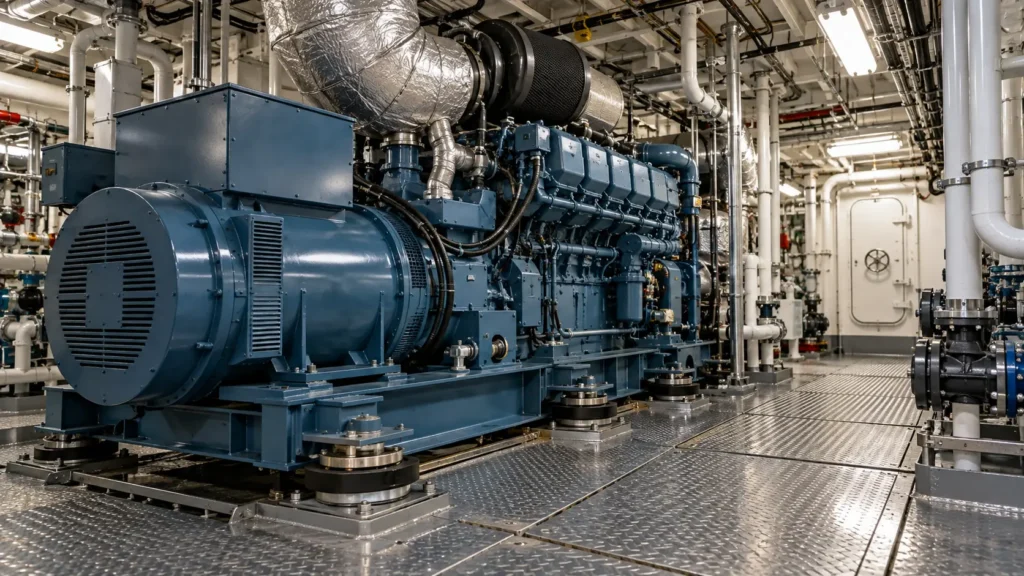
Marine engines, generators, gearboxes, pumps, and ventilation equipment can all transmit vibrations to the hull through mounting bases, shafting systems, or piping.
For commercial vessels operating over extended periods, this is not merely a noise control issue but also involves equipment layout, structural connections, and maintenance reliability.
Where are marine vibration isolation mounts typically installed?
Typical locations include:
- Marine engine and gearbox mounting systems
- Shipboard generator sets and auxiliary power units
- Marine pumps, compressors, and ventilation equipment
- Shipboard air conditioning and heating systems
- Certain communications, electrical, and navigation auxiliary equipment
Among these, the selection of marine engine mounts requires particular care.
The engine must be securely mounted and maintain the specified alignment with the drive shaft system. At the same time, engine vibrations should not be transmitted uncontrollably to the hull.
Vibration-damping mounts must therefore strike a balance between elastic support and displacement control.
If the mounting components deform excessively or the compression at each support point is inconsistent, it may affect equipment positioning and shaft alignment.
Therefore, when replacing marine engine mounts, relying solely on appearance, dimensions, or color to find similar products is not a reliable method for selection.
What special requirements does the marine environment place on rubber vibration-damping mounts?
First and foremost are salt spray, humidity, and corrosion.
The metal inserts, connecting plates, and fasteners in vibration-damping mounts require careful consideration of materials and surface protection measures based on actual exposure conditions.
Second is long-term dynamic loading.
Ships not only endure periodic vibrations generated by the engine but are also affected by changes in sailing attitude and sea conditions. For related equipment, the installation system may need to accommodate multidirectional loads and displacement limitations.
Furthermore, marine engineering projects often have specific requirements for equipment maintenance intervals; therefore, a product’s inspectability, replaceability, and long-term performance should also be included in the procurement evaluation.
How should a ship vibration isolation solution be customized?
For engine or gearbox installation projects, it is recommended to provide at least the equipment weight, support point layout, rated and idle speeds, center of gravity location, allowable displacement, and shaft connection requirements.
For marine pumps or ventilation equipment, piping, ductwork, or other rigid structures connected to the equipment should also be considered to prevent vibrations from bypassing the mounts and continuing to propagate.
Vista Motion’s Marine business covers vibration isolation installation applications for marine engines, gearboxes, pumps, and ventilation equipment.
For marine OEMs, equipment integrators, and replacement part purchasers, it is best to submit operating conditions and product drawings along with your request for quotation, and to specify whether approval documents from a specific classification society or project are required. Relevant compliance capabilities are subject to the actual product documentation.
Renewable Energy and Wind Power
Wind power and other renewable energy equipment typically require stable operation over long periods, and many projects are located in remote, coastal, or high-maintenance-cost areas.
This makes equipment reliability and ease of maintenance particularly important.
Take wind turbines as an example: they contain generators, transmission systems, yaw and pitch drive mechanisms, electrical cabinets, and other auxiliary devices.
Some of these components generate mechanical vibrations during operation and may also be affected by the movement of the entire machine structure.
Properly selected elastic mounting components and shock-absorbing parts can help control vibration transmission, limit localized impacts, or protect connecting structures at specific equipment locations.
How are vibration-damping components used in wind power equipment?
Typical applications in wind power equipment may involve auxiliary drive units, specific electrical equipment, control cabinets, mechanical mounting connections, as well as certain flexible couplings and shock absorbers.
For example, periodic vibrations from auxiliary equipment installed in the nacelle may be transmitted to the mounting brackets or nearby structures through rigid mounting points.
If the installation design permits, the use of appropriate rubber-metal composite vibration dampers can be evaluated to reduce vibration transmission within a specified frequency range .
However, a distinction must be made here between two entirely different types of requirements.
One category is the local vibration control of auxiliary equipment, cabinets, or connecting components; the other is the overall structural dynamics and load control of large wind turbines.
Ordinary rubber vibration isolation mounts cannot simply replace the main structural design of a wind turbine, nor can they solve all problems related to rotor vibration, drive train failures, or tower resonance.
For large rotating machinery, the first step should still be to investigate possible sources of vibration, such as imbalance, misalignment, bearings, gear meshing, and structural modes.
Why do wind power systems have high requirements for material durability?
Wind turbines may be exposed to temperature fluctuations, humidity, ozone, and outdoor corrosive environments over long periods.
For coastal or offshore wind power projects, attention should also be paid to the impact of salt spray on metal components, coatings, and structural connections.
Rubber materials, on the other hand, may be subject to the combined effects of temperature, aging, and repeated deformation.
Therefore, when evaluating vibration-damping products, in addition to initial hardness and load-bearing capacity, attention should also be paid to changes in material performance after aging, dynamic stiffness, fatigue characteristics, and, when necessary, verification of environmental adaptability.
What should be given special attention when procuring for wind power projects?
First, confirm which equipment subsystem the product will be used in, rather than describing it generically as a “wind turbine vibration isolator.”
Second, clarify the installation location, load direction, operating frequency, environmental conditions, maintenance accessibility, and applicable project specifications.
This information determines whether you need rubber vibration isolation mounts, flexible couplings, buffer stops, or other vibration control components.
On its Renewable Energies page, Vista Motion showcases product lines such as flexible couplings, conical mounting components, auxiliary unit mounting components, and cushioning components for renewable energy applications.
For wind turbine manufacturers and system integrators, specifying vibration control requirements down to specific subsystems can make product selection and communication with suppliers more efficient.
Aerospace and Aviation
The aerospace sector also requires vibration control, but its application logic differs significantly from that of general industrial machinery.
During flight, an aircraft may be subject to vibrations caused by the engines, auxiliary power units, aerodynamic forces, and the airframe structure.
Different types of equipment have varying degrees of sensitivity to vibration.
Some mechanical equipment requires limiting the transmission of vibrations to the airframe, while certain electronic devices, instruments, and onboard auxiliary systems require minimizing the impact of external vibrations and shocks on their operational performance.
Therefore, vibration isolation design in the aviation field not only involves vibration isolation capabilities but may also be constrained by factors such as weight, space, mounting reliability, temperature, and airworthiness or project specifications.
Where are aviation vibration isolation mounts primarily used?
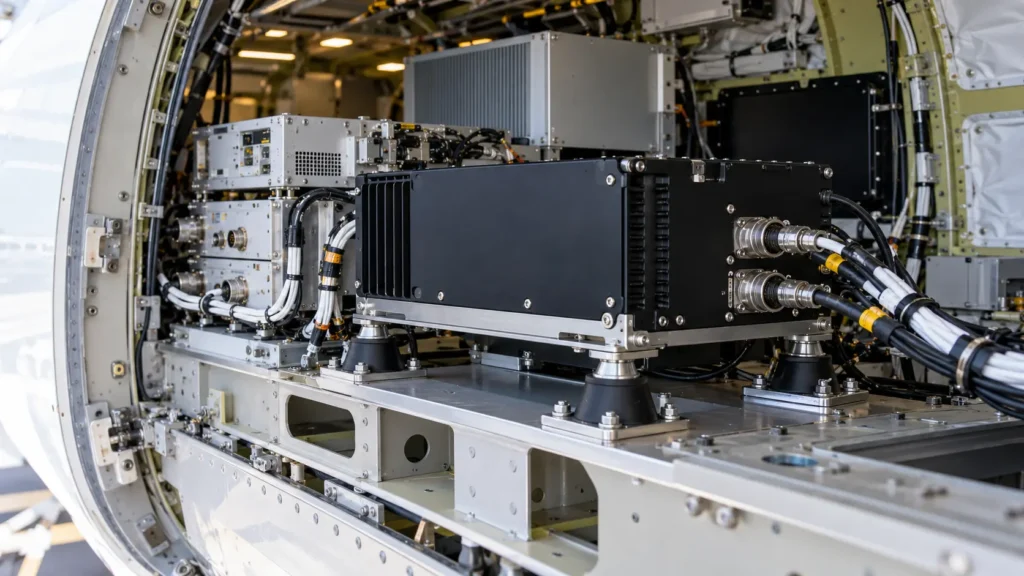
Under applicable design conditions, specialized vibration-damping mounts (Shock Mounts) may be used for airborne electronic equipment, instrument racks, in-cabin auxiliary equipment, and other components requiring flexible mounting.
Some applications also utilize specially shaped supports, metal-rubber composite connectors, or vibration-damping structures with limiting functions.
These components are not simply soft connections.
They must allow for controlled elastic deformation while ensuring that the equipment remains securely fastened under specified motion and load conditions.
Why can’t aerospace applications be selected based solely on hardness or dimensions?
Because the performance of a vibration-damping mount depends on the entire mounting system, not just a single material parameter.
You need to consider the operating frequency and the structure’s natural frequency, normal and abnormal loads, the equipment’s allowable displacement, the direction of vibration, as well as the strength and boundary conditions of the mounting structure.
For specific aerospace projects, vibration, shock, environmental, material, and traceability verification may also be required in accordance with project requirements.
Applicable standards depend on the equipment category, installation location, and project requirements; general-purpose industrial vibration isolation components cannot be directly considered certified for aerospace applications.
What is most important when procuring aerospace equipment?
In addition to product performance, the scope of validation must be clearly defined.
Procurement documents should clearly specify material requirements, dimensional tolerances, key performance indicators, test methods, acceptance criteria, and required quality documentation.
If existing standard products cannot meet installation space or load requirements, custom designs can be discussed; however, their ultimate applicability should be determined based on a comprehensive engineering evaluation and the necessary qualification verification.
Vista Motion’s Aircraft page provides an overview of aviation-related shock mounts, specialized vibration isolation assemblies, and custom solutions.
For aerospace equipment suppliers, it is recommended to clarify the specific technical specifications and quality requirements that must be met early in the project and then confirm the scope of feasible products with the manufacturer.
Standard shock mounts or custom shock mounts?
For equipment manufacturers, the decision to opt for a custom solution should not depend solely on the procurement budget.
The advantage of standard vibration isolation mounts is that they are relatively easy to select and replace. If their load capacity, frequency, mounting dimensions, and environmental performance all meet the equipment requirements, there is no need to opt for a custom solution just for the sake of it.
However, in some cases, off-the-shelf models may not fully address all issues.
For example, installation space may be limited, making it impossible to fit a standard mount; the mount may need to withstand both compressive and lateral loads simultaneously; the equipment’s operating temperature or the medium it comes into contact with may be unusual; or the OEM may wish to integrate rubber, metal inserts, and connecting structures into a single component.
In such cases, a custom rubber-metal composite vibration-isolation mount may be more suitable.
What design considerations are required for custom vibration-isolation mounts?
First are the structural dimensions. These include the overall shape, mounting holes, threads, metal inserts, and surrounding connection space.
Second are mechanical properties. These include static stiffness, dynamic stiffness, damping, maximum allowable deformation, and load-bearing requirements in different directions.
Third is materials and environmental conditions. This includes the selection of rubber compounds, operating temperature, oil resistance, weather resistance, and metal corrosion protection.
Fourth is production and validation. This includes mold design, the quality of the rubber-to-metal bond, dimensional inspection, performance testing, and batch consistency requirements.
These factors are interrelated. Changing the rubber’s hardness or geometry may not only affect load-bearing capacity but also alter the system’s dynamic performance.
Therefore, custom projects are best validated through collaboration among procurement, structural design, and supplier technical staff, rather than determining the final product based solely on a single outline drawing.
How can Vista Motion support your project?
Vista Motion is a manufacturer specializing in rubber vibration damping products and related applications. Its official website details the company’s industry background since 2003, as well as services related to standard products, custom manufacturing, technical support, and quality control.
OEM customers in industrial equipment, power transmission, rail transportation, construction machinery, and other related fields can discuss viable vibration isolation solutions with the Vista Motion team based on actual drawings, materials, and application requirements.
If you need further information on rubber-to-metal bonding structures, you can read Vista Motion’s Rubber-to-Metal Bonding Technical Guide.
You can use the Vista Motion contact page to provide your equipment type, drawings, and operating conditions to request a technical consultation or a custom quote.
What technical documentation should be prepared before purchasing vibration isolation mounts?
A complete set of technical inquiry materials can help suppliers more accurately assess product suitability.
If you are looking for an anti-vibration mount manufacturer or a custom rubber vibration mount supplier, we recommend prioritizing the following information:
| Technical Information | Recommended Information |
| Equipment Name and Application | Pumps, compressors, engines, mechanical equipment, etc. |
| Total Weight and Center of Gravity | Equipment Mass, Center of Gravity, and Related Loads |
| Support Point Design | Number, Location, and Mounting Orientation of Support Points |
| Operating Conditions | Rated Speed, Minimum Speed, Frequency Conversion Range, and Shock Conditions |
| Vibration Isolation Requirements | Target Frequency Range, Permissible Vibration or Noise Transmission Limits |
| Mounting Dimensions | 2D/3D drawings, hole spacing, threads, space constraints |
| Operating Environment | Temperature, fluids, ozone, salt spray, humidity, etc. |
| Quality and Testing Requirements | Applicable Standards, Test Methods, Acceptance Criteria |
| Procurement Requirements | Sample Requirements, Estimated Annual Usage, Target Delivery Time |
Not every project can provide all data at the initial stage.
If you have not yet determined the bearing model, you can at least provide the basic structure of the equipment, estimated load, operating speed, and installation space. Specific performance requirements can be supplemented later based on technical discussions.
For projects with drawings, providing STEP, PDF, or other applicable engineering documentation is generally more helpful for assessing the feasibility of customization than simply sending a single product photo.
From a procurement cost perspective, we also do not recommend comparing quotes based solely on the unit price.
A bearing that is lower in price but lacks sufficient dynamic performance or installation compatibility may result in additional costs for design modifications, validation, downtime, and replacement.
A more reasonable evaluation method is to consider product price, technical compliance, quality consistency, delivery terms, and the overall cost of ownership of the equipment simultaneously.
Conclusion
From industrial motors and automotive powertrains to rail vehicles, construction machinery, ships, wind power, and aviation equipment, vibration-isolation mounts play a role in a variety of structures and operating environments.
Their value extends beyond simply reducing perceptible vibration.
For equipment manufacturers, a suitable vibration isolation design also helps control vibration transmission, reduce the risk of localized structural fatigue, protect connected components, and improve the dynamic interaction between the equipment and the surrounding structure.
However, vibration damping performance is never determined solely by rubber hardness or product geometry.
A truly effective solution must be based on proper load analysis, frequency evaluation, material selection, structural design, and necessary testing.
If you are developing industrial equipment, looking for replacement mounting components, or need to procure custom rubber-to-metal vibration isolation products based on drawings, Vista Motion can be one of the suppliers you consider.
Send your equipment type, installation drawings, operating conditions, and estimated purchase quantity to Vista Motion to discuss products and manufacturing solutions suitable for your project.
Contact Vista Motion — Request a Custom Anti-Vibration Mount Quote
Frequently Asked Questions
What are anti-vibration mounts primarily used for?
Anti-vibration mounts are primarily used to support equipment and reduce the transmission of mechanical vibrations or shocks between the equipment and its foundation, frame, or other connected structures.
Common applications include motors, pumps, compressors, engines, industrial fans, generator sets, and vehicle auxiliary equipment. Properly designed mounts help control the transmission of vibration through the structure but are not a substitute for the equipment’s own dynamic balancing, alignment, or fault repair.
Which industries most commonly use anti-vibration mounts?
Industrial manufacturing, automotive, rail transportation, construction machinery, marine, renewable energy, and aerospace are seven representative application industries.
However, equipment within the same industry does not necessarily require the same type of vibration-isolation components. Suitability depends on the actual vibration source, loads, installation method, and performance objectives.
How do rubber vibration-damping bearings work?
Rubber vibration-isolation bearings provide support through elastic deformation and utilize the viscoelastic properties of rubber to dissipate a certain amount of energy.
When properly designed and with the excitation frequency within the effective vibration isolation range, they can reduce the transmission of some vibrations to the supported structure. Actual performance depends on the rubber’s dynamic stiffness, damping, preload, operating frequency, and installation conditions.
Which is better: rubber vibration-isolation bearings or spring isolators?
There is no single “better” option.
Rubber vibration isolation bearings are typically compact and possess inherent damping characteristics of the material itself. Spring isolators, on the other hand, are better suited for achieving lower system natural frequencies with appropriate structural design, and are therefore often used for equipment with high low-frequency vibration isolation requirements.
When making a selection, it is necessary to comprehensively consider frequency, load, displacement, damping, stability, and the operating environment.
If you’d like an in-depth comparison of the two technologies, read “Spring vs. Rubber Vibration Isolators.”
Can vibration isolators really reduce equipment noise?
They can reduce certain types of vibration-induced noise transmitted through solid structures, but the effectiveness depends on the source of the noise.
If the noise is primarily generated by vibrations transmitted through the frame, floor, or piping, appropriate vibration isolation measures may be effective.
If the noise primarily stems from airflow, exhaust, gear meshing, or other direct sound sources, simply adding rubber mounts usually won’t solve the entire problem.
How do you select vibration-isolation mounts for motors, pumps, or compressors?
First, determine the equipment weight, load at the support points, operating speed, primary excitation frequency, installation orientation, and allowable displacement.
Then, make a preliminary selection based on the load-deflection data, dynamic performance parameters, and installation requirements provided by the supplier.
For variable-frequency equipment, heavy-duty pump sets, and equipment subject to severe shock, it is also necessary to consider resonance, piping constraints, and start-up and shutdown conditions.
How much weight can a rubber vibration-isolation bearing support?
There is no universal load-bearing value applicable to all products.
Load-bearing capacity depends on the mount’s dimensions, structure, rubber material, direction of force, design deflection, and environmental conditions.
When selecting a model, do not rely solely on the nominal maximum load; also verify that the mount remains within a reasonable range of working deformation and that dynamic loads do not exceed permissible limits.
Which type of rubber should be selected for outdoor, oily, or high-temperature environments?
The choice depends on the specific environment.
EPDM is generally suitable for operating conditions with high weathering and ozone resistance requirements; NBR offers good resistance to many types of oils; certain silicone rubber formulations are suitable for a wide temperature range.
However, the material category does not directly determine the final performance in use. Specific oils, temperatures, dynamic loads, and service life objectives may all influence the material selection.
How long do rubber vibration-damping mounts typically last?
There is no standard, fixed service life.
It is influenced by factors such as operating loads, material formulations, vibration frequencies, ambient temperature, oil contamination, ozone exposure, and installation conditions.
If obvious cracking, separation of the rubber from the metal, abnormal permanent deformation, changes in equipment position, or increased vibration occur, check whether the mount needs to be replaced.
For critical equipment, it is recommended to establish an inspection and replacement schedule based on the manufacturer’s instructions and actual operating conditions.
Can rubber vibration isolation mounts be custom-made according to drawings?
Yes. Many industrial projects require custom rubber vibration isolation mounts based on installation space, load, material, stiffness, or connection structure.
Typically, you can provide 2D/3D drawings, equipment weight, operating frequency, environmental requirements, and estimated annual demand to allow the manufacturer to assess the feasibility of the design and production. Vista Motion offers customization services for rubber vibration isolation products. You can submit project details via Contact Vista Motion to further discuss technical requirements, samples, and quotes.
