
Below, we’ll help you determine which solution is best suited for your equipment by examining engineering principles, performance differences, typical applications, and procurement considerations.
What Are Spring Vibration Isolators and Rubber Vibration Isolators?
Spring Vibration Isolators
Spring vibration isolators typically use metal helical springs as the primary elastic element. When the equipment is in operation, the springs compress and rebound, creating a flexible connection between the equipment and the foundation, thereby reducing the transmission of some periodic vibrations.
Their primary advantage is not that metal is stronger than rubber, but rather that springs can achieve greater elastic deformation under appropriate load conditions.
This is crucial for vibration isolation systems: all other conditions being equal, lower system stiffness generally results in a lower natural frequency, and a lower natural frequency is more effective at isolating lower-frequency vibrations.
Therefore, spring isolators are commonly used in large HVAC equipment, chillers, industrial fans, pump sets, and equipment foundations with strict requirements for low-frequency vibration transmission.
However, standard steel springs have low internal damping. If the system’s operating frequency approaches its natural frequency, significant resonance amplification may occur.
In practical engineering applications, spring vibration isolation systems may need to be combined with rubber pads, additional dampers, limiting mechanisms, or anti-tilt structures to fully meet operational requirements.
Rubber Vibration Isolators
Rubber vibration isolators utilize the viscoelastic properties of rubber to provide support, vibration isolation, and energy dissipation.
When equipment generates vibrations, the rubber undergoes elastic deformation. Part of the mechanical energy is temporarily stored, while another part is converted into heat through the viscous action within the material .
This means that rubber not only provides elasticity but also offers a certain degree of damping.
Rubber vibration isolators in industrial applications are not limited to simple rubber pads. Depending on the installation method and load direction, the following options can also be used:
- Rubber-to-Metal Bonded Mounts
- Cylindrical rubber vibration-isolation mounts (Bobbin Mounts)
- Conical Mounts
- Shear-type rubber vibration isolators (Shear Mounts)
- Engine and Generator Mounts
- Center-Bonded Mounts
Different structures alter the way the rubber is loaded, as well as its static stiffness, dynamic stiffness, and allowable displacement.
For example, a compression-type rubber mount may be well-suited for vertical loading but may not be suitable for withstanding large lateral shear forces over the long term. In contrast, specially designed shear-type or composite-load mounts may be better suited for equipment subject to multidirectional vibrations.
Therefore, when selecting rubber vibration isolators, one must not only consider rubber hardness or dimensions but also verify their actual operating mechanism.
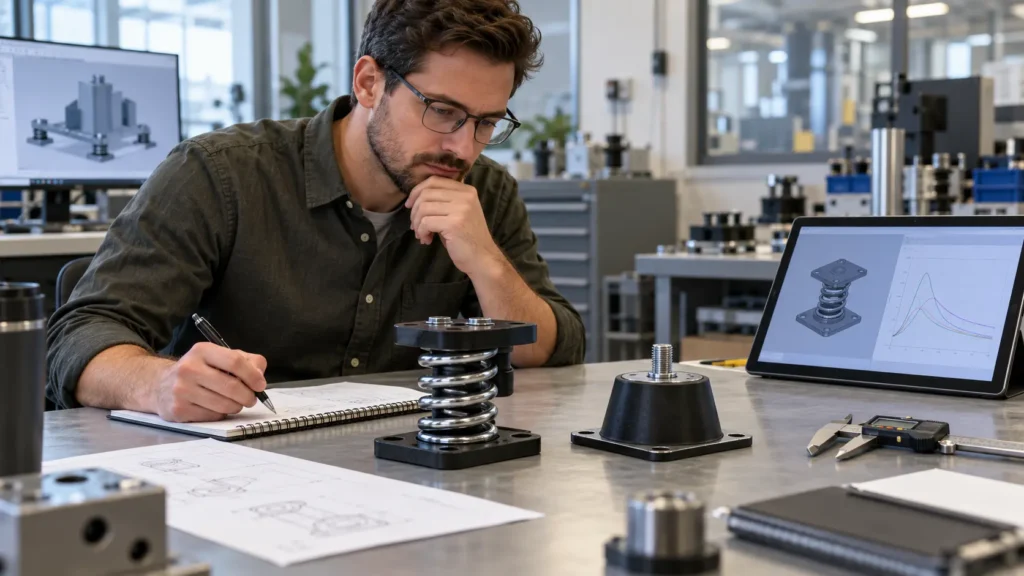
Spring vs. Rubber Vibration Isolators: A Comparison of Core Performance Characteristics
For a more intuitive comparison, let’s first examine the key differences between the two vibration isolation solutions.
| Comparison Criteria | Spring Isolators | Rubber Vibration Isolators |
| Primary Elastic Component | Metal springs | Natural rubber or synthetic rubber |
| Low-frequency vibration isolation capability | Typically easier to achieve low natural frequencies | Depends on the structure and dynamic stiffness; some low-frequency operating conditions are limited |
| Damping characteristics | Standard steel springs have low inherent damping | The material typically possesses inherent damping |
| Resonance Control | Additional damping is often required | Damping generally helps control resonance peaks |
| High-frequency vibration control | When properly designed, they can also effectively isolate vibrations | Properly designed rubber components help control certain high-frequency structural vibrations |
| Load-bearing capacity | Higher load-bearing capacity can be achieved through spring specifications | Depends on the structure, compound, dimensions, and load direction |
| Multidirectional Loads | Requires evaluation of lateral stability and load limiting | Can be accommodated through compression, shear, and composite structures |
| Installation space | Larger deflections may require more space | Typically allows for a relatively compact installation configuration |
| Environmental Adaptability | Prioritize corrosion and structural protection | Key considerations include fluid, temperature, ozone, and material aging |
| Initial cost | Depends on load capacity, damping, and constraint design | Standard parts typically offer a cost advantage; custom parts depend on tooling and manufacturing processes |
| Long-Term Maintenance | Focus on corrosion, spring condition, and limit mechanisms | Focus on aging, permanent deformation, cracking, and the condition of the bond |
There are two points here that are prone to misunderstanding.
First, spring isolators are not limited to handling low-frequency vibrations. As long as the system is properly designed, they can equally isolate higher-frequency excitations. Their main advantage lies in their ability to more easily achieve lower natural frequencies, rather than being limited to a specific frequency range.
Second, rubber isolators do not necessarily have a lower vibration isolation efficiency than spring isolators. If the equipment’s frequency, load, dynamic stiffness, and installation conditions are properly matched, rubber isolators can also provide effective vibration isolation.
Therefore, actual performance cannot be judged solely based on the name of the material.
Why are excitation frequency and natural frequency more important than the material?
If you are selecting industrial isolators for motors, pumps, compressors, or generators, this section is worth studying carefully.
Sometimes, two different isolators can both support the weight of the equipment, yet the results after installation are completely different.
The reason often lies not in product quality, but in whether the natural frequency of the isolation system matches the equipment’s actual vibration frequency.
First, understand the frequency ratio
There are two basic parameters in a vibration isolation system:
- Excitation Frequency (fd): The vibration excitation frequency generated when the equipment is in operation.
- Natural Frequency (fn): The frequency at which the system—comprising the equipment and the vibration isolation supports—is prone to free vibration.
The relationship between the two can be expressed as:
Frequency ratio r = fd / fn
In a classical linear single-degree-of-freedom passive vibration isolation model, the frequency ratio can be used to preliminarily determine the operating range of the system.
When r approaches 1, the equipment’s excitation frequency is close to the system’s natural frequency, and significant resonance may occur.
When r is greater than approximately 1.414, the system enters the theoretical vibration isolation range for the force transmission ratio or base displacement transmission ratio in this model.
To achieve a more pronounced vibration isolation effect, it is usually necessary to further increase the gap between the excitation frequency and the natural frequency.
However, actual mechanical systems often involve stiffness in multiple directions, complex vibration modes, and a variety of excitation frequencies. While a single-degree-of-freedom model can be used for preliminary assessment, it cannot directly replace a complete engineering design.
Why are springs generally better suited for low-frequency vibration isolation?
For an ideal linear elastic support system, the natural frequency can be approximated as:
fn = (1 / 2π) × √(k / m)
Where:
- fn: Natural frequency of the system, in Hz.
- k: Equivalent stiffness of the support system, in N/m.
- m: Equivalent mass of the supported system, in kg.
This indicates that, for a given mass, reducing the support stiffness can lower the natural frequency.
Metal springs can typically achieve a large static compression through structural design, thereby yielding a lower system natural frequency.
Rubber components can also achieve greater deformation by reducing stiffness, but they are subject to constraints related to material shape, strain range, load-bearing stability, and long-term durability.
It is particularly important to note that rubber is a viscoelastic material, and its dynamic stiffness is affected by frequency, temperature, preload, and vibration amplitude; actual values cannot usually be simply derived from static hardness.
This is why, when selecting low-frequency rubber isolators, engineers often focus more on the dynamic stiffness curve rather than looking solely at the Shore A hardness.
Does greater damping necessarily mean better vibration isolation?
Not necessarily.
Damping can suppress vibration amplification near the system’s resonance frequency, but in classical viscous damping models, excessive damping may also increase vibration transmission at higher frequencies.
Therefore, you need to distinguish between two objectives:
controlling resonance peaks versus reducing the vibration transmission rate at normal operating frequencies.
The former often requires sufficient damping, while the latter may place greater emphasis on a lower natural frequency and reasonable stiffness.
The advantage of rubber isolators lies in their ability to provide both elastic and material damping simultaneously, but this does not mean that higher damping is always better.
If your equipment requires both a low natural frequency and limited displacement during startup, shutdown, or external disturbances, a solution combining springs with additional damping is also worth evaluating.
A Practical Example of Selection Calculations
Let’s illustrate this with a simplified hypothetical operating scenario.
Suppose you are selecting vibration isolation mounts for a stationary piece of industrial equipment:
| Parameters | Assumptions |
| Equipment Operating Speed | 1,200 RPM |
| Primary rotational excitation frequency | 20 Hz |
| Support Configuration | Four-point support |
| Primary Direction of Interest | Vertical vibration |
| Equipment Objective | Reduce the transmission of vibration to the steel foundation |
For first-order excitation caused by rotational imbalance, the rotational speed can first be converted to frequency:
1,200 ÷ 60 = 20 Hz
Assume there are two candidate support systems:
Option A has an ideal linear support with a static deflection of 16 mm.
Option B has a static deflection of 3 mm.
For a vertical, approximately linear single-degree-of-freedom support system, the natural frequency can be estimated using the following relationship:
fn ≈ 15.76 / √δ
where δ is in mm.
For Option A:
f_n ≈ 15.76 / √16 ≈ 3.94 Hz
The corresponding frequency ratio is approximately:
r ≈ 20 / 3.94 ≈ 5.1
For Option B:
fn ≈ 15.76 / √3 ≈ 9.10 Hz
The corresponding frequency ratio is approximately:
r ≈ 20 / 9.10 ≈ 2.2
If both scenarios satisfy this simplified linear model and all other conditions are the same, Option A generally has better theoretical vibration isolation potential at a 20 Hz excitation frequency because it has a lower natural frequency.
However, this does not necessarily mean that Option A is the best choice for this equipment.
If Option A uses a standard low-damping spring, the equipment may experience significant displacement when passing through the resonance zone during startup and shutdown, requiring additional damping and limit stop designs.
If Option B uses a rubber-metal composite mount, it may more easily meet the requirements for compact installation, lateral stability, and damping.
Important Note: The above is a hypothetical calculation used to explain the relationship between frequency and static deflection; it is not an actual test case from Vista Motion, and the 3 mm static deflection of the rubber should not be directly equated with the actual dynamic natural frequency. For rubber isolators, the final determination should be based on dynamic stiffness data under the corresponding operating conditions and system validation results.
What this example truly illustrates is that selecting vibration isolation solutions requires comparing operating frequency, stiffness, damping, and allowable displacement simultaneously—rather than focusing solely on the rated load capacity.
How should one choose between spring or rubber isolators based on equipment type?
Different types of equipment have different sources of vibration, so the selection criteria naturally vary.
HVAC Units and Industrial Fans
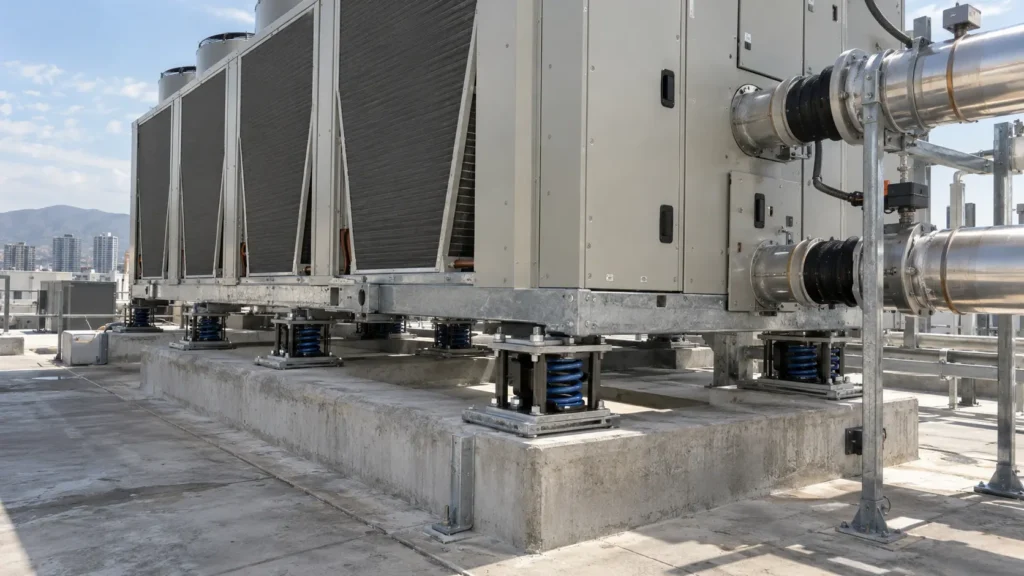
For large chillers, air-handling units, or industrial fans installed on flexible floor slabs, low-frequency vibrations and their transmission to the building structure are often the primary concern.
If the equipment operates at low frequencies and the building structure is sensitive to vibration, a spring isolation system with appropriate static deflection is generally worth evaluating first.
If the fan is smaller, operates at a steady speed, is supported by a relatively rigid structure, and the goal is to minimize installation space, rubber isolators should be considered.
For rooftop HVAC equipment, wind loads, equipment overturning, duct connections, and applicable building seismic requirements must also be considered.
One point deserves special attention: equipment vibrations do not necessarily propagate solely through the base. Rigid pipes, ductwork, or other connections may bypass the isolators, creating additional vibration transmission paths.
Generator Vibration Isolation
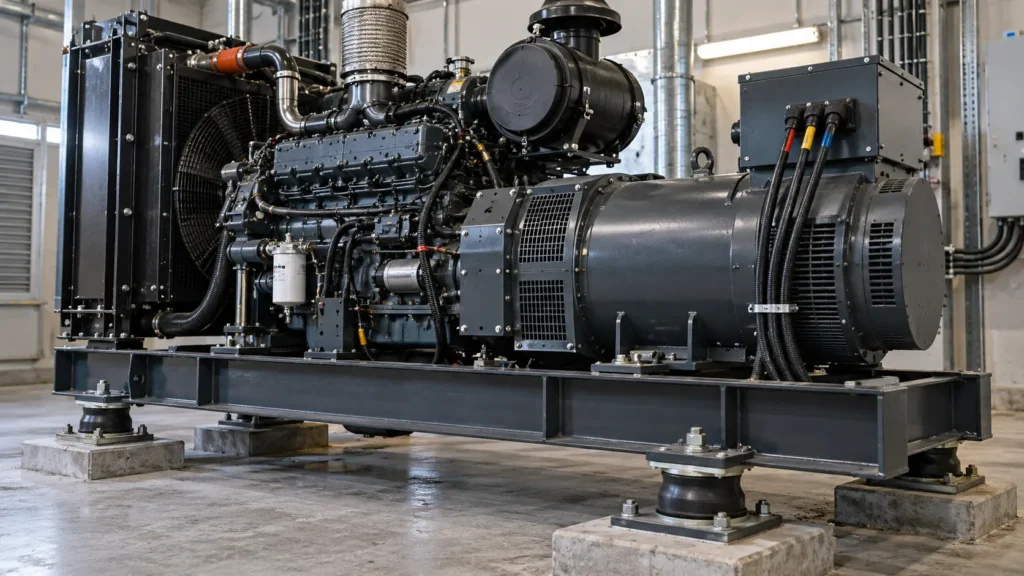
The choice of vibration isolation for a generator depends not only on its weight but is also influenced by engine excitation, operating speed, and start-stop conditions.
A diesel generator may experience rotational imbalance, combustion excitation, reciprocating inertial forces, and torque reaction simultaneously.
Selecting four mounts based solely on the generator’s total weight may overlook the mass distribution between the engine and the generator, as well as differences in dynamic loads.
For generator sets with limited space, multidirectional vibrations, or where equipment movement needs to be restricted, specially designed rubber-metal vibration isolation mounts may be the appropriate choice.
For example, a shear-compression composite structure can provide vertical elasticity while also ensuring a certain degree of lateral stability.
However, for large stationary units with high requirements for low-frequency vibration isolation, a spring-based solution may be more appropriate.
What truly needs to be clarified are the equipment’s excitation spectrum, support point loads, torque effects, and allowable displacement—rather than simply assuming that a generator must use rubber or springs.
Pumps and Compressors
Pumps and compressors are typical vibration isolation applications, but the excitation characteristics vary greatly among different types of equipment.
Centrifugal pumps typically require a focus on rotational frequency, imbalance, and associated fluid excitation; reciprocating compressors, on the other hand, may involve more complex periodic forces and piping pulsations.
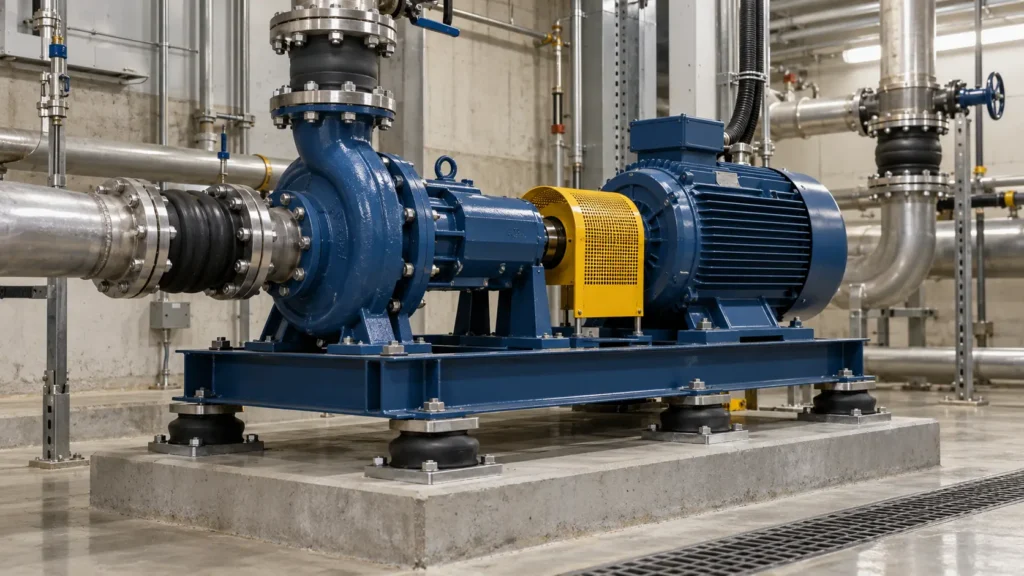
For pump sets with stable operation, suitable vibration frequencies, and limited installation space, rubber vibration isolation mounts may offer a more economical and compact solution.
If a compressor exhibits significant low-frequency excitation or if foundation isolation requirements are high, a comparison with spring isolation systems is necessary.
The actual selection process must also take into account the connection method between the equipment and the piping.
Even if the isolators themselves perform well, excessively rigid inlet and outlet piping may re-transmit vibrations to the building or equipment supports.
Therefore, when isolating a pump unit, the equipment base, support structure, and piping connections should be considered as a whole, rather than simply replacing a few vibration-isolating feet.
Construction Machinery, Mobile Equipment, and Engines
There is one key difference between mobile machinery and stationary industrial equipment: isolators must not only handle equipment operating vibrations but may also be subjected to dynamic loads caused by driving impacts, sudden acceleration, braking, and tilting.
Such operating conditions typically require attention to stiffness in multiple directions, maximum displacement, and fail-safe design.
Rubber-metal composite vibration isolation mounts can achieve a balance between vibration isolation, support, and motion restriction through a combination of structural configurations and elastomer properties.
For example, engine mounts can be designed with tapered, shear-compression composite, or stop-limit structures to accommodate different operating loads.
However, rubber components do not inherently provide fail-safe functionality. For equipment at risk of tension, impact, or overturning, design-verified stop and retention structures should still be employed.
For construction machinery OEM projects, it is recommended to clearly define the installation orientation, maximum impact load, metal connection method, and expected service life during the product design phase.
Precision Instruments and Vibration-Sensitive Equipment
Precision measuring equipment, testing platforms, and certain high-precision machining systems are highly sensitive to environmental vibrations.
The goal of this type of equipment may not be to reduce the transmission of its own vibrations to the ground, but rather to prevent ground vibrations from entering the equipment.
Although the direction of vibration isolation differs in these two scenarios, the frequency response of the isolation system must be considered in both cases.
If very low-frequency vibrations are present in the environment, standard rubber mounts may struggle to meet the requirements, and low-natural-frequency springs, air isolators, or other specialized systems may be more suitable.
However, for precision equipment, a low natural frequency alone is not sufficient; platform attitude stability, low-frequency oscillations, horizontal stiffness, and control requirements must also be considered.
Therefore, standard industrial rubber mounts or ordinary steel springs should not be used directly for high-precision equipment without systematic validation.
Six Engineering Criteria That Truly Influence the Selection of Industrial Vibration Isolators
After comparing different applications, the next step is to specify the selection criteria.
Actual Load-Bearing Capacity, Not Total Equipment Weight
When purchasing isolation mounts, many people simply divide the total weight of the equipment by the number of support points.
This method is suitable only for preliminary estimates when the load distribution is sufficiently uniform and the support geometry and other forces permit it.
For example, if a piece of equipment’s motor and transmission are concentrated on one side, the loads borne by the four support points may vary significantly.
If a support point is chronically overloaded, rubber isolators may experience excessive compression, creep, or fatigue damage; spring isolators may also experience excessive displacement, strike limit stops, or lose their normal operating stroke.
Therefore, when making a formal selection, the equipment’s center of gravity, mounting point coordinates, and actual operating loads should be provided.
For equipment with a high center of gravity, it is also necessary to check pitch, yaw, and overturning stability.
Dynamic Stiffness and Target Vibration Isolation Performance
Passing static load testing does not necessarily mean that dynamic vibration isolation performance will be satisfactory.
For rubber isolators, special attention must be paid to dynamic stiffness and its characteristics as a function of frequency, temperature, and preload.
For spring isolators, it is necessary to check the spring stiffness, working stroke, and system damping, and to confirm whether the target deflection can be achieved under actual loads.
If a supplier only provides parameters such as “100 kg load capacity” without corresponding deflection data or a range of applicability, it is difficult to determine whether the isolator is suitable for a specific piece of equipment.
For industrial projects with high requirements, it is recommended to specify the target vibration transmission rate before procurement and discuss the corresponding testing and validation methods.
Mounting Orientation and Multi-Axis Loads
Isolators may be subjected to compression, shear, tension, or a combination of these loads.
The stiffness of the same rubber mount may vary significantly in different directions.
For example, vibration-damping feet installed vertically may not be suitable for direct lateral use; a mount suitable for shear deformation may not necessarily be able to withstand large tensile forces over the long term.
For spring isolation systems, in addition to vertical load-bearing capacity, lateral stability, guidance requirements, and motion restrictions should also be evaluated.
Specifying the load directions in procurement drawings is more valuable than simply stating that “vibration isolation is required.”
Operating Environment and Material Compatibility
For rubber vibration isolators, material selection directly affects long-term performance.
If equipment may come into contact with lubricating oil, hydraulic fluid, or fuel, it is generally necessary to prioritize materials with appropriate oil resistance, such as NBR.
If the equipment is exposed to sunlight, ozone, and outdoor environments for extended periods, materials with good weather resistance, such as EPDM, should be evaluated.
CR (chloroprene rubber) is also commonly used in applications requiring a balance of weather resistance and overall performance.
For operating conditions with significant temperature fluctuations, silicone rubber or other specialty elastomers can be further evaluated, though it is still necessary to confirm that they meet strength and fatigue requirements.
Material selection should not be based solely on the name. Performance varies among different formulations and must ultimately be verified based on the actual contact media, temperature range, and design life.
For spring isolators, attention must be paid to metal corrosion, surface protection, and the structural condition after long-term use.
If the equipment is used in marine, port, or other corrosive environments, the materials and protective measures for the entire vibration isolation assembly should be included in the evaluation.
Allowed Displacement and Safety Limits
Generally, the softer the isolator, the easier it is to achieve a lower natural frequency; however, this also means the system may allow for greater displacement.
Therefore, it is necessary to determine the extent of vertical, lateral, and angular motion that the equipment can tolerate.
If the equipment is connected to rigid piping, precision transmission mechanisms, or position-sensitive accessories, excessive movement may cause other problems.
For machinery subject to impact loads, the maximum allowable displacement, limiting structures, and load variation range should also be specified.
An effective vibration isolation system must strike a reasonable balance between vibration isolation performance and mechanical stability.
Service Life and Total Cost of Ownership
When making a purchase, the initial unit price is often the easiest metric to compare, but it is not the only cost factor to consider.
For spring-based vibration isolation systems, it is necessary to evaluate additional damping, mounting bases, limiters, corrosion protection, and maintenance requirements.
For rubber isolators, it is necessary to consider the elastomer material, metal inserts, mold investment, product consistency, and replacement requirements due to aging.
If the equipment is planned to operate continuously for many years, the long-term stiffness changes, fatigue performance, and maintainability of the isolators may be more important than the initial purchase price.
For OEM volume projects, it is also necessary to comprehensively consider unit cost, tooling costs, annual demand, and supply stability.
The truly suitable isolator is not necessarily the product with the lowest purchase price, but rather the solution that achieves a reasonable total cost of ownership while meeting technical requirements.
Under what circumstances should custom rubber-metal isolators be considered?
Standard rubber mounts are suitable for many conventional pieces of equipment, but not all machinery can use off-the-shelf models directly.
Especially in OEM equipment development, you may encounter situations such as:
The equipment base has already been finalized, and existing standard vibration isolators do not align with the mounting holes; the equipment experiences not only vertical vibration but also significant lateral impacts; installation space is limited, yet there are strict requirements for flexibility and stability in specific directions; or the project requires specific rubber materials, metal inserts, and surface treatments.
In all these cases, custom rubber-metal composite isolators may be a worthwhile option to consider.
Custom design involves more than just changing dimensions; it may also include:
- Selection of rubber compounds and hardness ranges.
- Design of the rubber cross-sectional shape and load-bearing direction.
- Metal inserts, threads, and connection structures.
- Balancing compressive and shear stiffness.
- Bonding, vulcanization, and metal surface treatment.
- Sample performance validation and consistency in mass production.
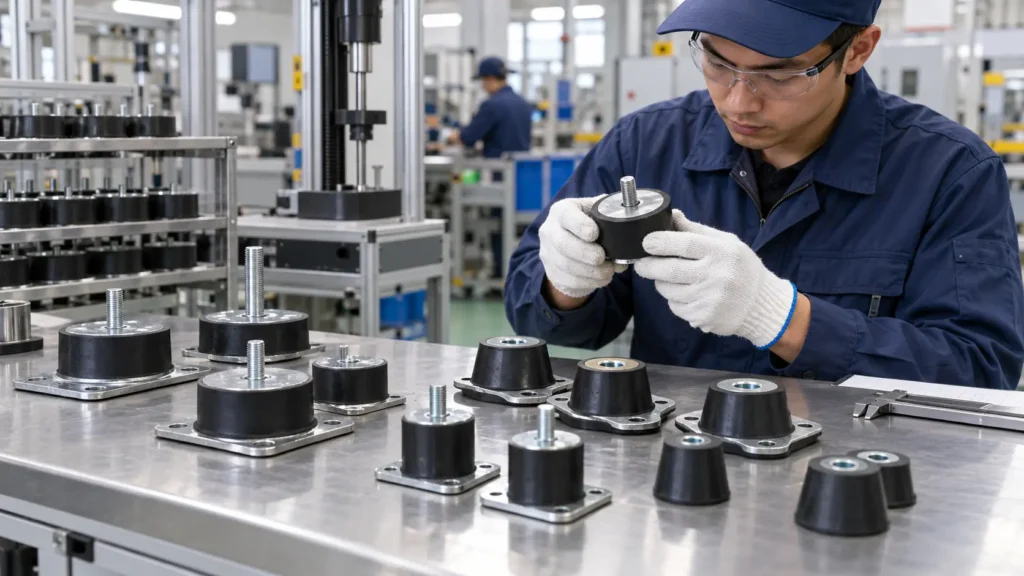
Vista Motion’s business encompasses industrial rubber vibration isolation products, rubber-to-metal composite components, and customized manufacturing support for various applications.
If you are designing vibration isolation mounts for pump sets, generators, construction machinery, transmission equipment, or other OEM products, please discuss the actual operating conditions with us rather than simply providing the part number you wish to replace.
We can discuss suitable rubber vibration isolation structures and manufacturing solutions based on your installation requirements, material needs, load directions, and product drawings.
Performance metrics requiring further verification should be confirmed during the product selection and sample validation stages, rather than judged solely on appearance.
You can also learn about Vista Motion’s industrial engineering solutions and rubber-to-metal bonding manufacturing technology.
Can springs be used in combination with rubber?
Yes. In certain projects, springs and rubber are not mutually exclusive options.
A typical approach is to use metal springs to provide significant elastic deformation, while allowing rubber components to handle local contact isolation, additional damping, or other auxiliary functions.
For example, certain spring-mounted vibration isolation mounts are equipped with rubber contact pads to reduce the transmission of structural noise caused by rigid contact.
However, it should be noted that adding rubber pads does not necessarily mean the entire system will achieve ideal damping.
The position, stiffness, precompression, and actual deformation behavior of the rubber pads all affect their performance.
If springs and rubber are combined to form a multi-stage vibration isolation system, additional vibration modes and resonance frequencies may be introduced, requiring the system to be designed as a complete unit.
Therefore, one cannot simply assume that “a spring combined with rubber is always better than using either alone.”
For complex projects involving low-frequency vibration isolation, shock control, and structural noise simultaneously, a combined design can be considered as a potential solution, but its actual effectiveness should be verified through engineering calculations and testing.
What should typically be checked if the vibration isolation performance is poor after installation?
If vibration dampers have been installed on equipment but there is no noticeable improvement in vibration, do not rush to conclude that the wrong materials were selected.
You can first check the following aspects.
Is the vibration isolator subjected to the design load?
If the selected mount has excessive stiffness, the actual compression may be minimal, resulting in a natural frequency higher than expected. Conversely, if the mount is too soft, excessive displacement or stability issues may arise.
Is the operating frequency close to the resonance range?
This is particularly true for variable-frequency equipment, where the operating range may span a resonance frequency of the vibration isolation system. In such cases, the actual excitation spectrum should be examined, rather than relying solely on the rated speed.
Are there any rigid connections acting as bypasses?
Anchor bolts, limiters, piping, brackets, or other attachments that form additional rigid connections during operation may reduce the effectiveness of the vibration isolation.
Is there structural resonance?
Some issues stem from the vibration modes of the equipment base, steel structural supports, or the floor slab itself, rather than the isolators.
Are the measurement locations and parameters correct?
An increase in vibration amplitude above the equipment does not necessarily mean that the vibration transmitted to the foundation has also increased.
The vibration isolation design may increase the equipment’s relative motion with respect to the foundation while simultaneously reducing the transmitted force. Therefore, it should be clarified whether the test is evaluating equipment body vibration, foundation vibration, structural noise, or other parameters.
For critical projects, it is recommended to compare data under the same operating conditions before and after installation and perform spectral analysis if necessary.
Only by confirming the actual vibration transmission path can one determine whether to replace the isolators, adjust their stiffness, or modify the mounting structure.
What information should you prepare before requesting a quote from an industrial vibration isolator manufacturer?
If you want to obtain products that are truly suited to your equipment—rather than going through a process of trial and error—we recommend providing as complete a set of engineering specifications as possible when sending your RFQ.
| Information to Provide | Why It’s Important |
| Equipment Type and Application | To understand the primary excitation and installation requirements |
| Total weight and working load of the equipment | Preliminary Determination of Load Capacity |
| Center of Gravity Location and Support Point Layout | Evaluate the Actual Loads at Each Support Point |
| Operating Speed and Primary Excitation Frequency | Determination of Natural Frequency Requirements for the Vibration Isolation System |
| Start-up, shutdown, speed variation, and shock conditions | Evaluate resonance, damping, and motion restrictions |
| Installation dimensions, drawings, and connection methods | Determining the Feasibility of Using Standard Components or Custom Solutions |
| Operating Temperature and Contact Media | Selection of rubber materials and metal protection solutions |
| Permissible Displacement and Load Direction | Stability Control and Limit Switch Risks |
| Target Vibration Isolation or Noise Performance Metrics | Define Performance Acceptance Requirements |
| Annual Demand and Project Phases | Determine prototyping, tooling, and volume procurement plans |
You do not necessarily need to have all the data available at the time of the initial inquiry.
However, you should at least specify the equipment weight, operating frequency, installation method, and primary operating environment.
If you have product drawings, existing vibration isolator models, or on-site records of equipment vibration issues, please provide them as well. This information is typically more helpful than simply asking, “Do you have a vibration isolator suitable for 500 kg?”
For OEM customers developing new equipment, we recommend considering the structural layout of the vibration isolators as early as possible. This reduces the likelihood of having to make design modifications later due to mismatches in installation space, mounting hole locations, and load directions.
To discuss customization requirements for rubber vibration isolators or rubber-metal composite components, please submit drawings and operating conditions via the Vista Motion contact page, or send an email toinfo@vista-motion.com .
FAQ
What is the difference between spring isolators and rubber isolators?
The main difference lies in the stiffness and damping characteristics of the elastic elements. Spring isolators typically make it easier to achieve lower system natural frequencies and are suitable for more stringent low-frequency vibration isolation requirements. Rubber isolators combine elasticity with material damping and are commonly used in industrial machinery requiring compact installation, resonance control, and multi-directional support. When selecting an isolator, one should compare the equipment’s frequency, actual load, and allowable displacement, rather than focusing solely on the material.
Should spring isolators or rubber isolators be used for low-frequency vibrations?
When the equipment’s primary excitation frequency is low and a very low system natural frequency is required, spring isolators are generally better suited to meet these requirements. However, there is no fixed cutoff point for low frequencies that applies to all equipment. Properly designed low-stiffness rubber mounts can also be used in certain low-frequency applications. The decision should be based on the target frequency ratio, dynamic stiffness, and stability requirements.
Can rubber isolators be used for heavy-duty industrial equipment?
Yes, but products with appropriate load-bearing capacity, structural design, and dynamic performance must be selected. Some heavy-duty machinery, engines, and generator sets use rubber-metal composite vibration isolation mounts. Suitability depends on the actual load, force direction, operating frequency, and maximum displacement at each support point; standard lightweight rubber pads cannot be used as direct substitutes for specially designed heavy-duty isolators.
The equipment operates at 1,500 RPM. How should I select an isolator?
A rotational frequency of 1,500 RPM corresponds to a fundamental frequency of 25 Hz. First, confirm whether the primary excitation actually comes from the rotational frequency or from engine combustion, gear meshing, or other frequency components. Next, determine the system’s natural frequency range based on the target vibration isolation performance, and then select the appropriate model using the load-deflection curves and dynamic stiffness data of candidate products. The final model cannot be determined based solely on 1,500 RPM.
Should spring isolators or rubber isolators be used for HVAC equipment?
Spring isolation systems often need to be evaluated for large chillers, certain rooftop air conditioning units, and building installation scenarios sensitive to low-frequency vibrations. For small fans, compact equipment, and applications with suitable operating frequencies, rubber isolators may also meet the requirements. Floor stiffness, equipment operating frequency, piping connections, and wind loads or seismic constraints should all be considered.
Which type of isolator is better for generators and air compressors?
There is no one-size-fits-all answer for all generators or compressors. For equipment requiring compact installation, multidirectional stability, and material damping, rubber-metal vibration isolators should be evaluated; if high-frequency vibration isolation is a priority, spring-based solutions should also be considered. Reciprocating compressors require special attention to periodic loads and piping pulsations. The final selection should be based on actual excitation and installation conditions.
Why does the machine vibrate more after installing vibration isolators?
Common causes include the vibration isolation system operating near its resonant frequency, a mismatch between the mount stiffness and the load, or the formation of a vibration transmission bypass via stop components or piping. It is also important to distinguish between the movement of the equipment itself and the vibrations transmitted to the foundation: a reduction in one does not necessarily result in a simultaneous reduction in the other. We recommend measuring the vibrations of both the equipment and the foundation under identical operating conditions at to determine the source of the problem.
Can spring isolators and rubber isolators be used in combination?
Yes. Some vibration isolation systems use metal springs to provide the primary elastic support, while rubber components are used to reduce contact vibration or achieve specific damping functions. However, a combined structure may alter the system’s natural frequency and potentially introduce additional resonance. This requires calculation and verification based on the overall structure; one cannot simply assume that stacking the two materials will result in better vibration isolation performance.
Which type of isolator has a longer service life?
Service life depends on the load, environment, structural design, and maintenance conditions. For springs, factors such as corrosion, fatigue, and the condition of the limit stops must be considered; for rubber, factors such as temperature, oils, ozone, creep, and fatigue aging must be taken into account. Neither has a fixed service life applicable to all operating conditions. When purchasing, you should ask the supplier to specify the applicable environment, maintenance recommendations, and necessary methods for verifying service life.
How do I purchase custom rubber isolators from a manufacturer?
It is recommended to provide the manufacturer with the equipment weight, support point layout, operating frequency, installation orientation, dimensional drawings, operating environment, allowable displacement, and annual demand. If there are target vibration isolation rates or failure issues with existing products, these should also be specified. Based on this information, Vista Motion can discuss the structure, materials, and custom manufacturing requirements for rubber-metal composite isolators and, if necessary, determine a sample validation plan.
Conclusion
Returning to the original question: Spring vs. Rubber Vibration Isolators—which is better?
If your primary goal is to achieve a lower natural frequency—especially for stationary equipment subject to strong low-frequency excitation—spring isolators are typically the more suitable option.
If you are more concerned with compact installation, material damping, multidirectional loads, structural connections, and equipment integration, then a properly designed rubber or rubber-metal composite isolator may better meet your needs.
However, before making a final decision, please consider the following three questions:
What frequency of vibration does the equipment actually generate? How much load will each isolator actually bear? Do you want to reduce vibration in the equipment itself, or vibration transmitted to the foundation and surrounding structures?
Once these questions are clarified, selecting an isolator is no longer merely a matter of comparing materials and prices, but rather an evaluation based on clear engineering parameters.
For industrial equipment manufacturers and OEM procurement professionals, Vista Motion offers rubber vibration isolation products and related custom manufacturing support to help you discuss suitable product designs based on drawings, materials, and operating conditions.
Looking for Custom Rubber Vibration Isolators or Rubber-to-Metal Bonded Mounts?
Please submit your project requirements and product drawings via the Vista Motion contact page to discuss rubber vibration isolation solutions tailored to your needs.
Technical Note: This article provides general guidance for selecting industrial passive vibration isolation solutions and is not a substitute for dynamic analysis of specific equipment, supplier performance data, or on-site testing. When safety limitations, fatigue life, or special operating conditions are involved, a specialized assessment should be conducted by relevant engineering personnel.
