
Have you ever experienced this while driving: a loud thud from the undercarriage when going over speed bumps, a slightly loose steering wheel, and uneven tire wear—but since the car still runs, you put it off for now? You might first suspect the shock absorbers, tires, ball joints, or steering system, but you’re overlooking a small yet crucial component: suspension bushings.
What Are Suspension Bushings
Suspension bushings are typically mounted on control arms, stabilizer bars, subframes, tie rods, or other suspension connection points. Their purpose isn’t to “make the car go faster,” but to keep the vehicle stable, quiet, and controllable while driving, turning, braking, and navigating potholes.
They act like shock absorbers within the suspension system, absorbing vibrations, reducing impact between metal components, and maintaining stable suspension geometry.
When suspension bushings age, crack, harden, or become loose, the vehicle won’t break down immediately, but it will gradually start to feel “off.” If you’re searching for “suspension bushings need replacing,” it’s likely that your car is already showing some early warning signs.
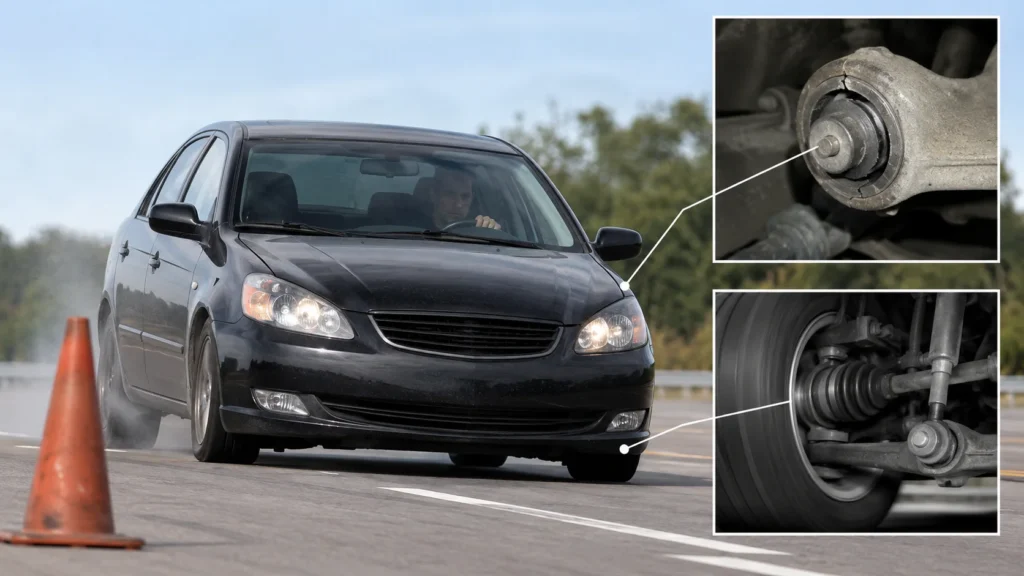
7 Signs You Need to Replace Your Suspension Bushings
Knocking noises from the undercarriage when driving over speed bumps or potholes
The most common symptom of bad suspension bushings is unusual noise from the undercarriage.
If you hear a:
- “thudding” sounds
- “Clicking” sounds
- Metal clanging
- A loose tapping sound
- A low thud from the front or rear suspension
The suspension bushings may be worn out.
Under normal conditions, rubber suspension bushings act as a cushion between suspension components, preventing direct, hard impacts on control arms, stabilizer bars, or connecting links. However, once the bushings age, crack, or become loose, the suspension components will experience excessive movement under load, resulting in these noises.
Many car owners mistakenly attribute this noise to a shock absorber issue, but if the shock absorbers aren’t leaking fluid and the vehicle’s rebound is normal, you should focus on inspecting the control arm bushings, anti-roll bar bushings, and subframe bushings.
Simply put: if your chassis starts clunking and rattling on the road like a toolbox, replacing suspension bushings should be added to your checklist.
Loose steering wheel, lack of direct steering response
Good suspension bushings aren’t just for comfort; they also affect steering precision.
When front suspension bushings or control arm bushings become loose, the suspension components may not respond immediately to steering input; instead, a slight play may occur first.
You’ll notice the steering feels less crisp than before, the front end reacts a split second too late, or even a sensation that “the car isn’t keeping up with the steering wheel.”
Common symptoms include:
- Increased steering play
- Sluggish front-end response when turning
- Lack of stability when changing lanes at high speeds
- Weakened steering return
- The vehicle feels unstable in corners
If you drive a commercial vehicle, SUV, pickup truck, or a vehicle that is frequently driven with a full load, these changes will be more pronounced. This is because the heavier the vehicle, the greater the tensile, torsional, and impact forces exerted on the suspension bushings.
This is why many mechanics, when inspecting steering issues, don’t just check the steering gear and ball joints—they also examine the suspension bushings for cracks or uneven wear.
A loose steering wheel doesn’t necessarily mean the steering system is faulty; it could also be that worn suspension bushings are causing the suspension structure to lose its original alignment accuracy.
Abnormal or Uneven Tire Wear
If one side of a tire wears down particularly quickly, or if the tread shows irregular wear, you’ll usually think of wheel alignment. But sometimes the problem isn’t just alignment.
When suspension bushings lose their support, the positions of control arms, tie rods, or suspension mounting points can shift slightly while driving. As a result, the vehicle’s camber, caster, or toe angles cannot remain stable. Even if you’ve just had a four-wheel alignment done, these angles may still drift when the vehicle is subjected to real-world road forces.
You may notice these tire issues:
- Abnormal wear on the inner or outer edges
- Sawtooth-shaped tread wear
- Uneven wear between left and right tires
- New tires developing uneven wear quickly
- Recurring misalignment issues
If you’ve already had an alignment done but your tires continue to show abnormal wear, you should check the car’s suspension bushings.
Pay particular attention to the control arm bushings, trailing arm bushings, and rear suspension bushings, as they directly affect the stability of the wheel alignment.
This issue should not be taken lightly. Uneven tire wear not only costs you the price of an extra set of tires, but it also affects braking distance, wet-weather traction, and high-speed stability.
If your tires are “wearing unevenly,” there is a high likelihood that the suspension bushings need replacing.
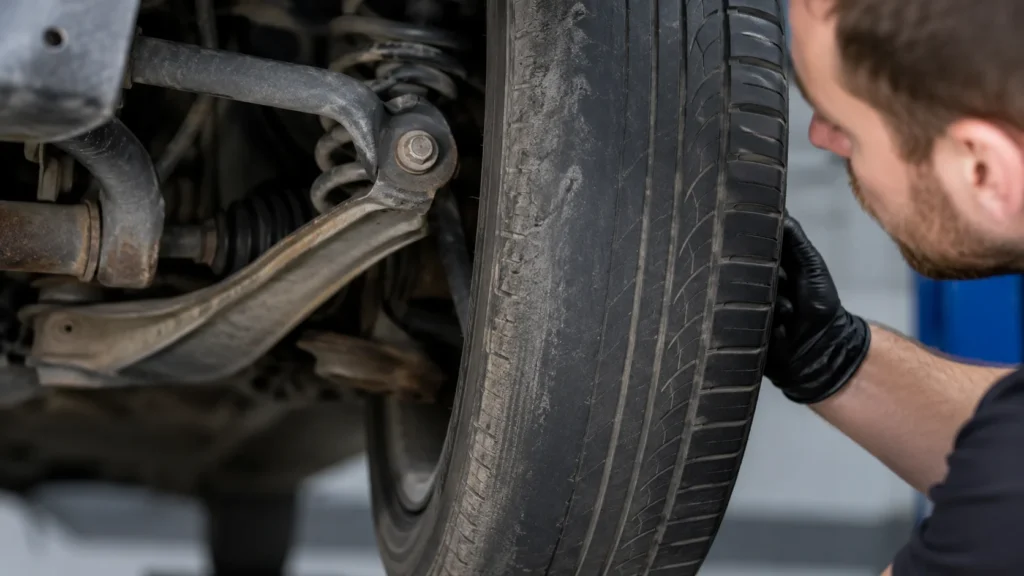
Body sway, nose-diving, or steering drift during braking
Vehicle instability during braking is a suspension bush issue that many people tend to overlook.
When you apply the brakes, the vehicle’s center of gravity shifts forward, placing significant load on the front suspension. If the front control arm bushings have become loose, the control arms may move abnormally under braking force. As a result, you may feel the front end wobble, experience steering instability, or even notice the vehicle drifting slightly to one side.
Common symptoms include:
- Steering wheel vibration during hard braking
- The vehicle pulls to the left or right when braking
- Increased front-end dive
- A knocking sound from the undercarriage when braking
- A loose feeling in the front suspension when braking to a stop at low speeds
Of course, brake pull may also be related to the brake rotors, brake pads, calipers, tire pressure, or the braking system. However, if these components are in good condition, the suspension bushings should be included in the inspection.
This is particularly true for vehicles that frequently transport cargo, travel long distances, or operate on poor road conditions. Suspension bushings subjected to prolonged braking impacts can easily deteriorate from loss of elasticity to structural loosening.
If the vehicle feels unstable during braking, it indicates that the transfer of forces through the chassis is no longer smooth. Delaying repairs at this stage will gradually increase the risk.
Increased body vibration leads to a noticeable decline in driving comfort
One of the key functions of suspension bushings is to isolate road vibrations.
New or well-maintained rubber suspension bushings can absorb some high-frequency vibrations, preventing all impacts from being transmitted to the vehicle body when driving on rough roads.
However, when the bushings harden, crack, or become compressed and deformed, their cushioning ability decreases, and the driving experience becomes rough.
You may notice:
- More minor road vibrations
- Increased chassis noise
- Increased resonance inside the cabin
- Harsher impacts when driving over potholes
- Long drives are more tiring
These changes usually don’t happen overnight but develop gradually. Many car owners only realize their vehicle had been “loose” for quite some time after replacing the suspension bushings.
Here’s a practical rule of thumb: if your shock absorbers, tires, and tire pressure are all in good condition, but the vehicle still feels stiff, noisy, and vibrates noticeably, then worn suspension bushings are worth investigating.
For commercial or construction vehicles, reduced comfort brings another issue: prolonged vehicle vibration can shorten the lifespan of surrounding components, such as mounts, fasteners, welded structures, control arms, and body mounting points.
Though small, these bushings determine whether vibrations are ultimately absorbed or harshly transmitted throughout the entire vehicle.
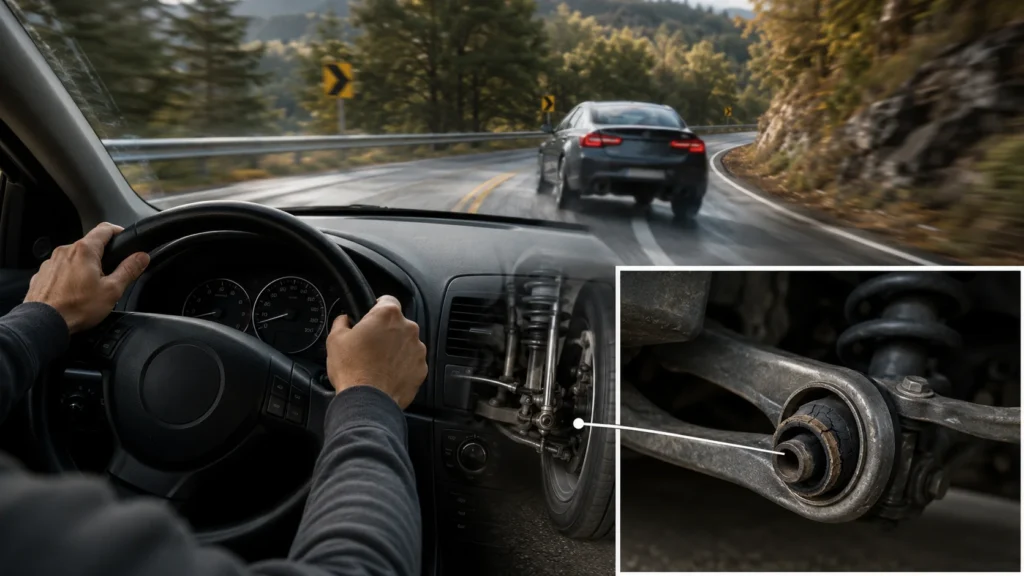
The vehicle feels unstable during acceleration, cornering, or lane changes
If you notice slight body sway during acceleration, poor rear-end tracking when cornering, or the need to constantly correct your steering while changing lanes at high speeds, this may not be a result of your driving—it could be that the suspension bushings are no longer able to stabilize the suspension components.
In particular, when rear suspension bushings, trailing arm bushings, and anti-roll bar bushings wear out, the rear of the vehicle may develop a “floating” sensation. The body does not follow the path precisely but exhibits slight lag, swaying, or lateral movement.
These issues are particularly noticeable in the following situations:
- Changing lanes on the highway
- Continuous turns on mountain roads
- Driving with a fully loaded vehicle
- Towing or transporting cargo
- Rainy weather or slippery road surfaces
- Sudden acceleration or deceleration
If the clearance in the suspension bushings has increased, the suspension geometry will change under dynamic conditions. A static inspection may not reveal any major issues, but once the vehicle is on the road and subjected to forces, the problem becomes apparent.
This is why determining whether suspension bushings are worn cannot rely solely on visual inspection; it must also take into account driving feel, unusual noises, tire wear, and a chassis inspection.
Vehicle instability is no minor matter. A decline in suspension system stability directly affects steering, braking, and evasive maneuvering capabilities.
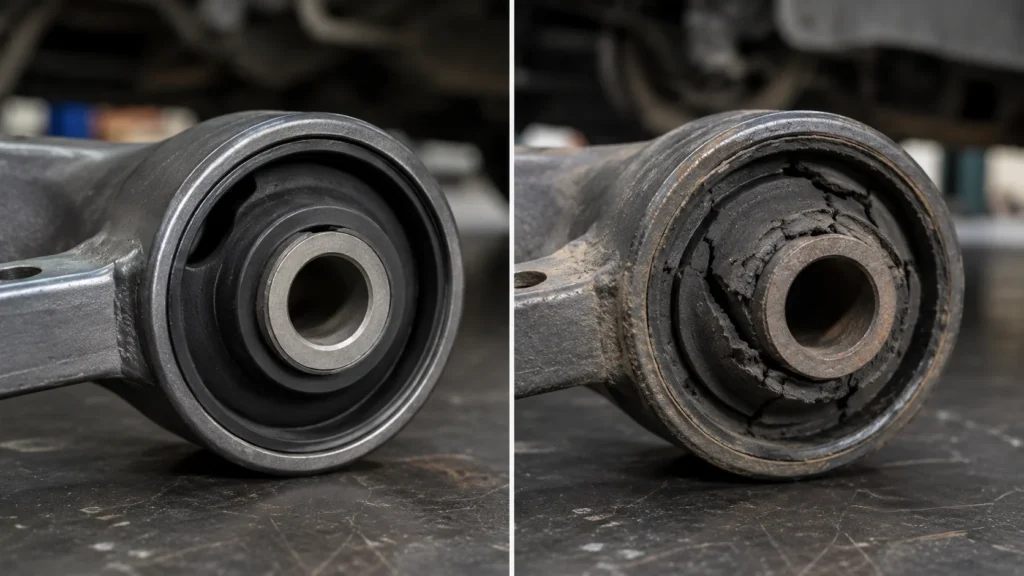
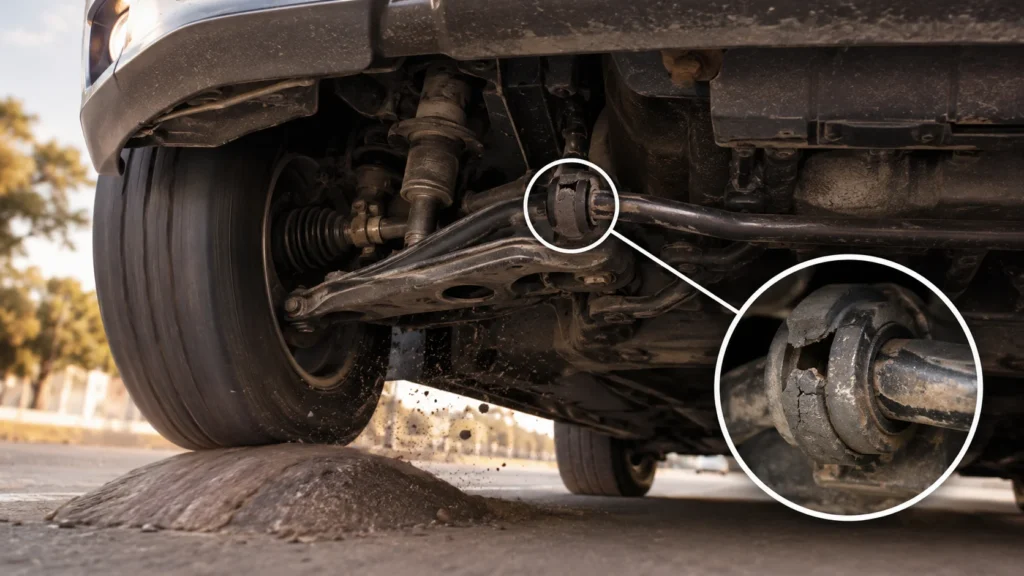
Visible signs include cracks, delamination, deformation, or exposed metal sleeves
The most direct way to assess this is to inspect the visual condition of the suspension bushings.
If, after lifting the vehicle, you observe any of the following conditions, it usually indicates that the suspension bushings need replacing:
- Visible cracks in the rubber
- Damaged edges
- Rubber separated from the metal sleeve
- The bushings are compressed and deformed
- Offset center hole
- Loose metal sleeve
- Hardening and cracking of the bushing surface
- Abnormal friction marks
Some minor surface cracks may not require immediate replacement, but if the cracks penetrate deep into the structure, the bushing is already deformed, or the suspension arm can be wiggled to reveal a noticeable gap, it is not recommended to continue driving.
Additionally, some vehicles use polyurethane suspension bushings. Polyurethane bushings are typically stiffer, offer more direct response, and may have different durability characteristics; however, if they are improperly installed, insufficiently lubricated, or subjected to abnormal loads over an extended period, they can also develop noise and wear.
Whether they are rubber suspension bushings or polyurethane suspension bushings, the criterion for judgment is not “whether the vehicle can still be driven,” but whether it can still perform its cushioning and positioning functions stably, quietly, and safely.
Why Do Suspension Bushings Wear Out?
Suspension bushings are typical components subjected to compression, torsion, and shock absorption. Operating under complex conditions over time, they naturally age. Common causes include:
Natural aging of rubber
Rubber materials are affected by time, temperature, ozone, oil contamination, and environmental factors. Even if a vehicle has low mileage, the bushings may harden or crack due to their age.
Poor Road Conditions
Potholed roads, gravel roads, construction sites, mining roads, and rural roads all increase suspension impact. For vehicles frequently driven on such challenging terrain, suspension bushings typically wear out faster.
Long-term Heavy Loading
Commercial vehicles, pickup trucks, logistics vehicles, and construction vehicles that are consistently fully loaded subject suspension bushings to sustained high loads. The greater the load, the more pronounced the compression and torsional fatigue on the bushings.
Incorrect Installation Angle
Some suspension bushings must be tightened while the vehicle is at its normal load height. If they are tightened while the suspension is off the ground, the bushings may remain in a pre-twisted state after the vehicle is lowered, shortening their service life.
Issues with surrounding components
Damaged shock absorbers, bent control arms, loose ball joints, deformed mounts, or incorrect alignment angles can all subject suspension bushings to abnormal stress.
What happens if suspension bushings aren’t replaced in a timely manner?
Many people ask: If the suspension bushings are worn but the car still runs, can I wait to replace them?
In the short term, the vehicle may still be drivable. However, from a professional perspective, prolonged delay can lead to several issues:
Therefore, when determining whether to replace suspension bushings, one should not focus solely on whether they are “completely worn out,” but rather on whether they have already compromised driving safety and vehicle stability.
How can you tell if suspension bushings need replacing?
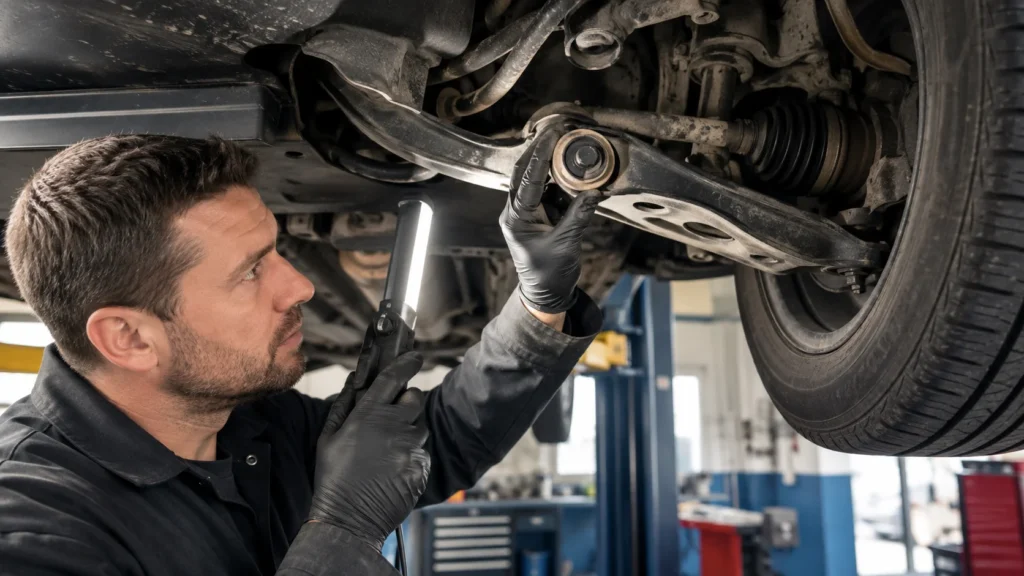
You can make some preliminary assessments, but ultimately, it’s recommended to have a professional mechanic or repair shop perform a chassis inspection.
Signs you can observe yourself
If your vehicle exhibits the following symptoms, you should schedule an inspection:
- Unusual noises from the undercarriage when driving over potholes
- Loose steering wheel
- Abnormal tire wear
- Pulling to one side or shaking when braking
- Unstable handling at high speeds
- Loose body feel when turning
- Noticeable increase in chassis vibration
- A professional inspection typically includes
A mechanic will generally check:
- whether the control arm bushings are cracked
- whether the anti-roll bar bushings are loose
- whether the trailing arm bushings are deformed
- whether subframe bushings are worn
- whether the suspension arms have abnormal displacement
- Are the metal sleeves separated from the rubber?
- Are there signs of oil contamination, corrosion, or improper installation?
- Are the wheel alignment measurements abnormal?
If a bushing is found to be damaged, it is generally not recommended to inspect only that single part. It is best to check the related suspension bushings on the same axle at the same time, as bushings on the left and right sides often experience similar operating conditions and have similar service lives.
How to choose between rubber suspension bushings and polyurethane suspension bushings?
This is a question frequently asked by many car owners and purchasers.
Rubber suspension bushings
Rubber bushings are more common, offer superior comfort, and provide excellent noise insulation and vibration damping. They are suitable for most passenger cars, commercial vehicles, and OEM replacement needs.
Suitable for:
- Everyday driving vehicles
- Passenger cars
- Commercial vehicles
- Vehicles with high comfort requirements
- OEM replacement
Polyurethane suspension bushings
Polyurethane bushings are typically stiffer, offering more direct steering response and better wear resistance in certain conditions; however, they may result in increased road feel, noise, or require more installation and maintenance.
Suitable for:
- Performance vehicles
- Modified vehicles
- Specific industrial or heavy-duty applications
- Vehicles requiring higher handling responsiveness
When choosing between them, the decision should not be based solely on “which is more durable,” but rather on the vehicle’s intended use, load conditions, NVH requirements, installation structure, and customer objectives.
For bulk purchases or OEM projects, attention must also be paid to material formulations, hardness, metal sleeve dimensions, bonding processes, fatigue testing, and consistency control.
When should suspension bushings be replaced immediately?
If there is only minor surface aging, follow-up inspections can be scheduled based on the mechanic’s recommendation. However, do not delay replacement if any of the following conditions are present:
- The bushings are completely cracked
- The rubber has separated from the metal sleeve
- Noticeable play in the control arm
- The vehicle pulls noticeably to one side when braking
- Instability during high-speed driving
- Rapid uneven tire wear
- Persistent knocking noise from the undercarriage
- Recurring misalignment of the four wheels
These symptoms indicate that the suspension bushings are not merely “worn out,” but are actually compromising the suspension system’s functionality.
Summary
If your vehicle exhibits unusual chassis noises, loose steering, uneven tire wear, unstable braking, increased vibration, or a tendency to drift at high speeds—or if an inspection reveals cracked or deformed bushings—it is highly likely that the suspension bushings need replacing.
Don’t wait until the suspension system suffers further damage before addressing the issue. Suspension bushings are small components in the vehicle’s chassis system, but they are crucial for ride comfort, handling, tire life, and driving safety.
For the average car owner, timely inspection and replacement of worn suspension bushings can restore the vehicle’s stability and quietness.
For automotive parts purchasers, selecting a reliable supplier of suspension bushings and related vehicle suspension parts directly impacts product lifespan, customer complaint rates, and brand reputation.
If your project involves suspension bushings, control arm bushings, anti-roll bar bushings, metal sleeves, suspension brackets, welded structural components, or custom mechanical parts, we can assist in evaluating materials, manufacturing processes, dimensional control, surface treatments, and quality inspection protocols based on drawings, samples, or application requirements. For customers who prioritize long-term, stable supply, reliable manufacturing capabilities and clear quality control are more important than simply low prices.
FAQ
Can suspension bushings be replaced separately, or do I need to replace the entire control arm?
This depends on the vehicle design and the bushing structure. In some vehicles, suspension bushings can be pressed out and replaced individually, but in others, the bushings are tightly integrated with the control arm assembly, so it is more common to replace the entire control arm during repairs.
In aftermarket repairs, technicians typically make this decision based on labor costs, the risk of pressing, parts availability, and the vehicle’s age. For buyers, it is crucial to confirm whether the product is an individual suspension bush or a complete control arm with bushings, as this directly impacts inventory structure and the customer’s installation experience.
Do I need wheel alignment after replacing suspension bushings?
In most cases, wheel alignment is recommended, especially after replacing control arm bushings, trailing arm bushings, or rear suspension bushings.
This is because these bushings affect the position of suspension connection points. Even if the new bushings are installed correctly, the vehicle’s toe, camber, or caster may still change. Performing a wheel alignment after replacement can reduce uneven tire wear and restore steering and driving stability to a more reliable state.
Why do new suspension bushings sometimes make noise?
Noise from new suspension bushings usually does not mean “the new parts are defective,” but rather may indicate installation or fitment issues. Common causes include:
- Failure to tighten to the correct load height during installation
- Poor fit between the metal sleeve and the mounting hole
- Lack of proper lubrication for polyurethane bushings
- Incorrect bolt torque
- Wear on the surrounding ball joints, stabilizer bar links, or the shock absorbers themselves
- Used a hardness or structural design unsuitable for this vehicle model
If squeaking or clunking noises occur immediately after replacement, it is not advisable to attribute this directly to the bushing material; instead, the installation process and adjacent suspension components should be inspected first.
Can worn suspension bushings affect braking distance?
They can have an indirect effect. Suspension bushings are not braking components themselves, but they affect the stability of tire-to-road contact.
When bushings are loose, abnormal changes in suspension geometry may occur during emergency braking, resulting in unstable tire grip. The vehicle may also experience nose-diving, pulling to one side, or swaying. This reduces the driver’s sense of control over the vehicle, which is particularly noticeable on slippery surfaces or during high-speed braking.
What is the difference between OEM and aftermarket suspension bushings?
OEM suspension bushings typically emphasize factory-matched specifications, comfort, NVH control, and long-term stability. Aftermarket suspension bushings, on the other hand, cover a broader range, including OEM replacement, reinforced, performance, and economy types.
For buyers, the key is not to simply assume that OEM is always better, but to verify whether aftermarket products meet standards for dimensional stability, material consistency, fitment data, batch testing, and packaging. A good aftermarket product should strike a balance between installation compatibility, durability, and price.
Can I replace suspension bushings myself?
Theoretically, yes, but it is not recommended for car owners without the proper tools and experience to attempt this themselves. Many suspension bushings require specialized press-fit tools, lifting equipment, and precise torque and installation angles.
If the press-fit direction is incorrect, the load angle on the bushings is wrong, or bolts are tightened while the suspension is unsupported, the new bushings may fail quickly. For control arm bushings, subframe bushings, and rear suspension bushings, it is best to have them handled by professional technicians.
What material is best for suspension bushings?
There is no single material that suits all vehicles.
Rubber suspension bushings are better suited for vehicles prioritizing comfort, low noise, and a stock driving feel. Polyurethane suspension bushings are better suited for vehicles requiring more direct handling feedback, but may result in increased road feel and noise.
For manufacturers and buyers, the key considerations should be material hardness, resistance to aging, oil resistance, fatigue life, bonding strength to metal sleeves, and the specific application scenario—rather than simply asking, “Is rubber better than polyurethane?”
