
Although suspension bushings are small, they directly affect a vehicle’s comfort, handling stability, steering response, and tire life.Many chassis noises, pulling to one side, or abnormal tire wear are often related to them. This article will explain in simple terms what they are, how they work, what symptoms appear when they wear out, and what quality factors to consider when purchasing or customizing them. This will help you more accurately assess product quality and application risks, while also providing practical guidance for project selection and subsequent inquiry communications.
What Are Suspension Bushings?
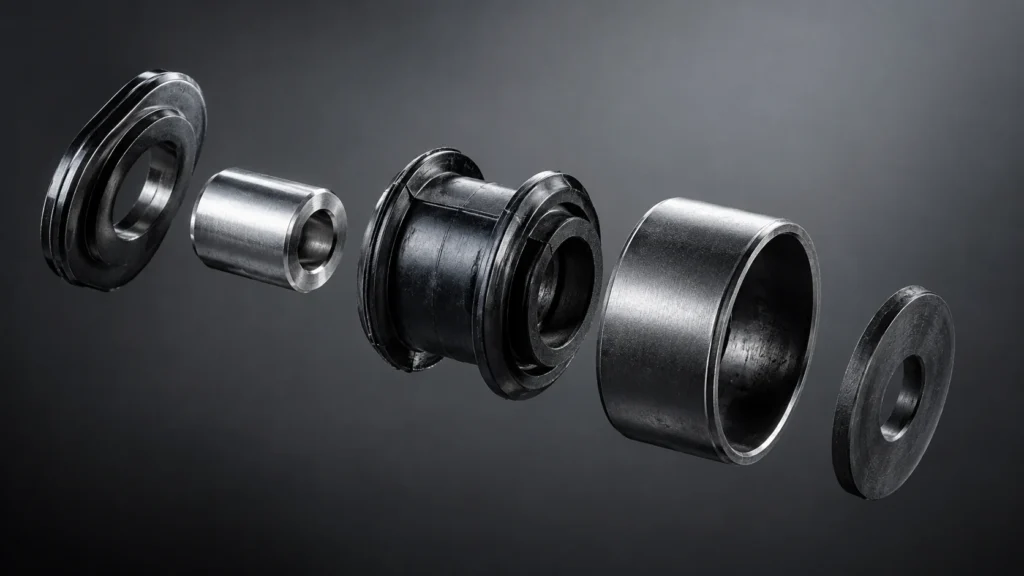
Suspension bushings are flexible components installed between suspension parts and the vehicle chassis to absorb vibration, control movement, reduce noise, and help maintain suspension geometry.
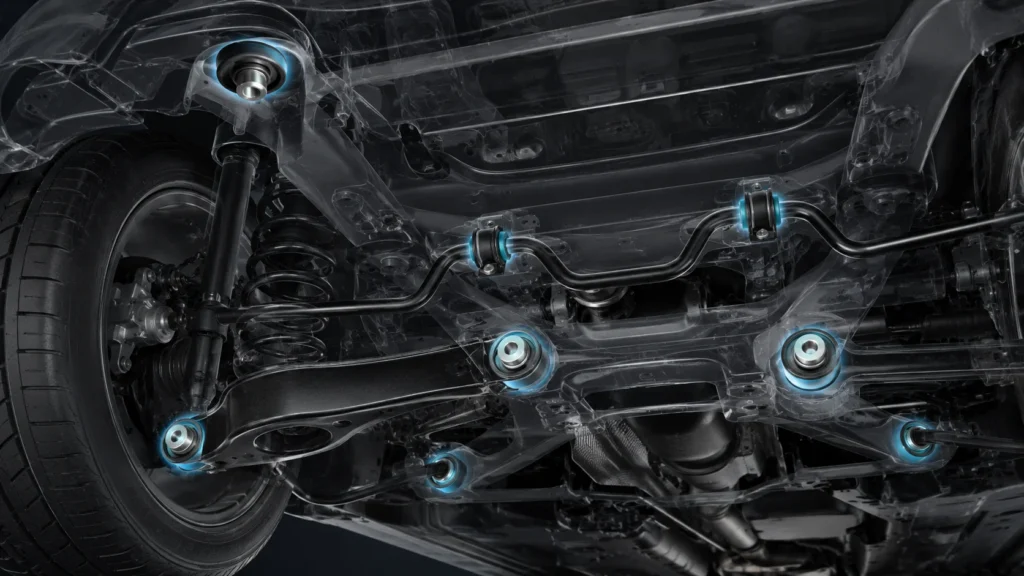
- Suspension bushings act as connectors. They are typically located between control arms, stabilizer bars, trailing arms, subframes, shock absorber mounting points, or other chassis structures.
- They act as shock absorbers. Vehicles generate significant impact and vibration while driving; if all metal components were rigidly connected, the interior would be very noisy, and vibrations would be transmitted directly to the body and steering wheel.
- They are control components. Good suspension bushings are neither the softer the better nor the harder the better. They need to strike a balance between comfort and handling precision. If they are too soft, the vehicle will feel loose; if they are too hard, noise and vibration will increase.
Structurally, common suspension bushings are typically made of rubber, polyurethane, or a combination of rubber and a metal sleeve. Some high-performance products utilize rubber-to-metal bonding, where the rubber is bonded to a metal skeleton to form a single unit, ensuring the bushing maintains stable elastic performance under torsion, compression, and shear.
Where Are Suspension Bushings Used in a Vehicle?
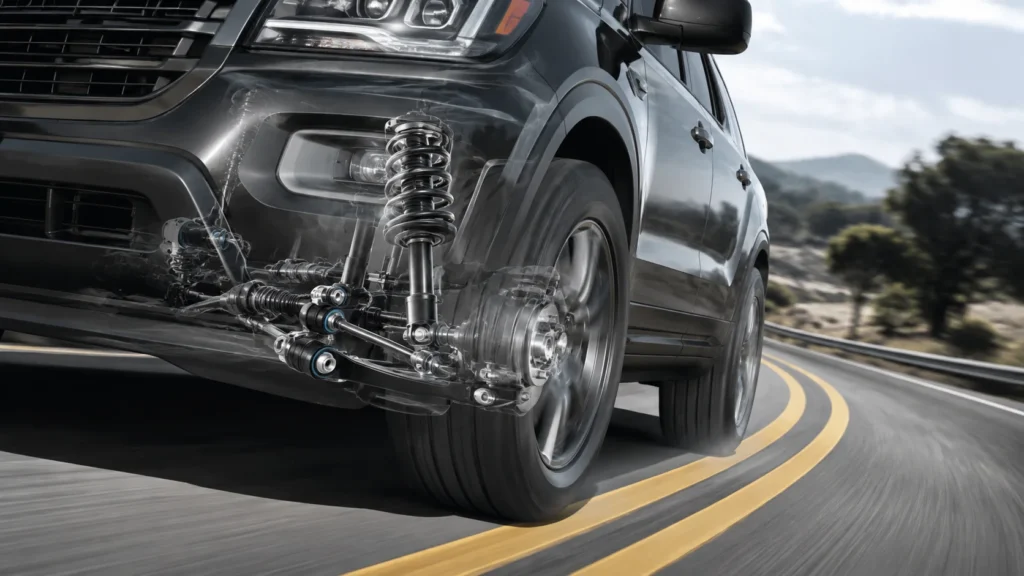
Suspension bushings are not installed in just one location. They are distributed across multiple critical connection points in the vehicle’s chassis and suspension system. Common locations include:
| Position | Common Name | Main Function |
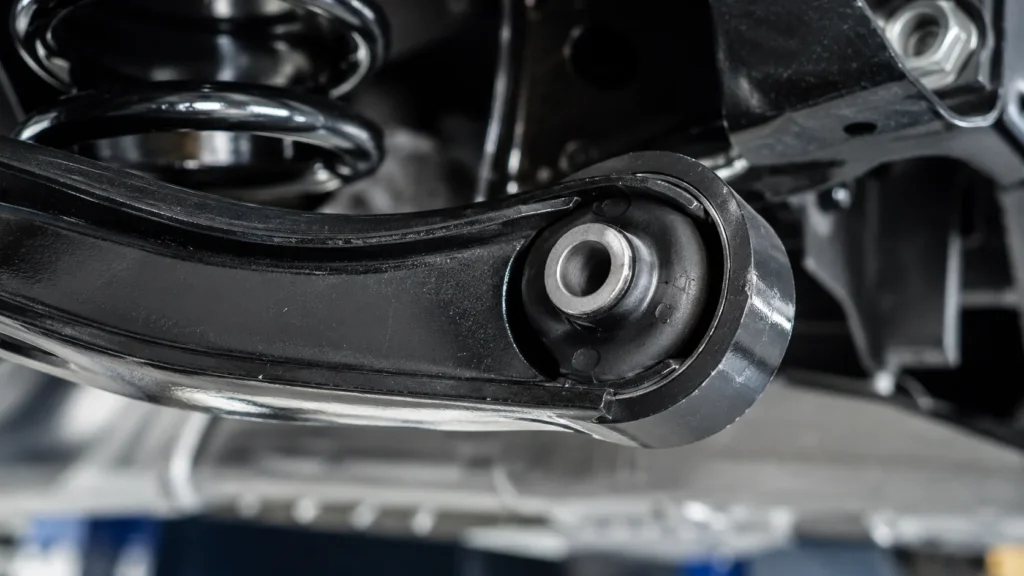
| Control arm | Control arm bushings / wishbone bushings | Controls the wheel’s movement path, affecting steering and positioning stability |
| Anti-roll bar | Sway bar bushings / stabilizer bar bushings | Reduces body roll and improves cornering stability |
| Trailing arm | Trailing arm bushings | Controls rear suspension movement and affects rear wheel stability |
| Shock absorber mount | Shock absorber bushings | Reduces vibration and shock at the shock absorber mounting points |
| Subframe | Subframe bushings | Isolates vibrations between the body and the subframe |
| Leaf spring / suspension link | Suspension link bushings | Support, connect, and cushion suspension movement |
Suspension bushings in different locations operate under varying conditions. Control arm bushings prioritize positioning accuracy and handling response; stabilizer bar bushings focus on roll control; while subframe bushings emphasize vibration isolation, noise reduction, and overall vehicle comfort.
Therefore, when designing or procuring automotive suspension bushings, one must not only ask, “What material is this bushing made of?” but also consider where it is installed, what loads it bears, which vehicle models it is designed for, and whether the vehicle prioritizes comfort or handling.
Why Are Suspension Bushings Important to Vehicle Performance?
Many people view suspension bushings as mere consumables that can simply be replaced when they fail. However, from a vehicle performance perspective, they actually play a role in the dynamic control of the chassis system.
They Help Maintain Suspension Geometry
The geometric parameters of a vehicle’s suspension system—including wheel alignment, camber, toe-in, and wheel travel paths—all influence the vehicle’s handling performance. One of the functions of suspension bushings is to ensure these components remain in their proper positions when subjected to forces.
When the bushings are in good condition, suspension components can move along their intended paths. When the vehicle turns, the contact between the wheels and the road surface is more stable; during braking, the suspension connection points do not experience excessive abnormal displacement.
However, if suspension bushings become worn, cracked, or develop excessive play, suspension components will experience unwanted movement. This looseness can lead to poor steering feel, body roll, abnormal tire wear, and even affect the results of wheel alignment.
They Reduce Noise, Vibration, and Harshness
When a vehicle is in motion, road impacts are transmitted from the tires to the suspension and then to the body. Without suspension bushings to isolate these forces, the driver would clearly feel noise, vibration, and impact.
This is why rubber suspension bushings are common in passenger cars, commercial vehicles, and construction vehicles. Rubber materials can absorb some of the impact energy, making the ride smoother. Start Rescue’s basic explanation of suspension bushings also mentions that their functions include reducing noise and vibration, and helping to improve handling and comfort.
However, NVH control is not simply a matter of “making things soft.” If suspension bushings are too soft, the vehicle will lack support during braking and cornering, and body roll will become more pronounced. Truly high-quality bushings require a balance between comfort and stability achieved through material hardness, structural design, metal sleeve dimensions, and bonding strength.
They Improve Steering Response
When you turn the steering wheel, the directness of the wheel response is closely related to the condition of the suspension bushings.
If the control arm bushings are worn, the control arms will experience additional movement when under load. The driver will feel play in the steering wheel, a sluggish response from the front end, and may even need to constantly make minor adjustments while driving at high speeds.
High-quality suspension bushings help maintain a more stable position at the suspension connection points. This results in clearer steering response when changing lanes, turning, or swerving, making it easier for the driver to assess the vehicle’s condition.
For ordinary passenger cars, this is a matter of comfort and safety; for SUVs, pickup trucks, commercial vehicles, off-road vehicles, and heavy-load vehicles, it is a critical issue of chassis stability.
They Protect Other Suspension Components
Suspension bushings also reduce direct impact between metal components. If a bushing fails, the clearance between suspension components increases, and impact loads are transmitted directly to the control arms, ball joints, stabilizer bars, shock absorber mounts, and the vehicle frame.
Operating under these conditions for an extended period is not merely a matter of replacing a single bushing. Other chassis components may also experience premature wear.
This is why worn suspension bushings should not be ignored for long periods during actual repairs or procurement. The failure of these small parts can increase maintenance costs for the entire suspension system.
Common Symptoms of Worn Suspension Bushings
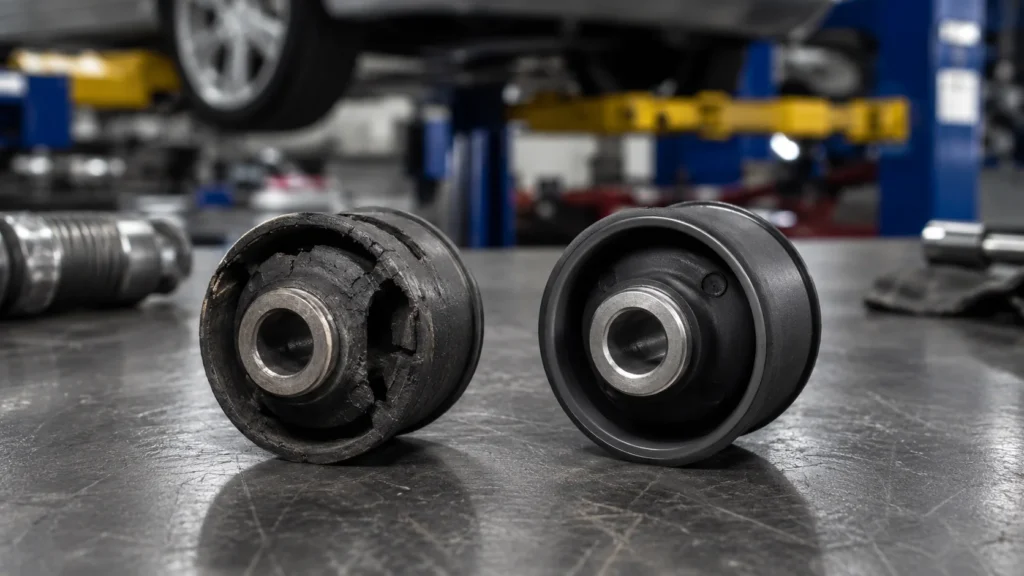
Suspension bushings typically do not fail suddenly and completely, but rather gradually age, harden, crack, delaminate, or wear out. Vehicle performance issues may also progress from minor rattling noises to noticeable handling problems.
Knocking or Clunking Noise
If you hear a “thudding” or “clunking” sound when driving over potholes, speed bumps, or while turning, it may be caused by loose suspension joints due to worn suspension bushings.
This noise does not necessarily originate solely from the bushings; it could also come from ball joints, shock absorbers, stabilizer bar links, or loose bolts. Therefore, you should not rely solely on the sound to make a diagnosis; it is best to combine this with a visual inspection of the undercarriage.
Loose Steering Feel
When suspension bushings age, suspension components can move unnecessarily during steering and braking. Drivers may feel that the steering wheel lacks firmness, the front end doesn’t respond directly, and the vehicle feels like it’s “drifting” or “floating.”
Capital One Auto Navigator notes in its description of suspension bushings that worn bushings can cause abnormal wheel movement during braking or acceleration, unstable steering, and uneven tire wear.
Excessive Vibration
As rubber ages and hardens, its ability to dampen vibrations decreases. While driving, the steering wheel, chassis, or body may experience increased vibration. Drivers will feel this discomfort more acutely, especially on rough roads, at high speeds, or when turning at low speeds.
Uneven Tire Wear
If suspension bushings cannot maintain stable suspension geometry, the wheel alignment angles may change. This results in faster wear on one side of the tire or irregular tread wear.
Such issues are often mistaken for simple wheel alignment problems. However, if the bushings are already loose, the problem may recur after a period of driving, even if the alignment is reset.
Poor Braking Stability
During braking, the front suspension bears a significant load. If the control arm bushings or other critical suspension bushings are in poor condition, the wheel position may shift abnormally. The driver may notice the vehicle pulling to one side during braking, significant nose-diving, or a lack of steering stability.
These symptoms affect driving safety and should not be treated merely as a comfort issue.
What Causes Suspension Bushings to Wear Out?
There is no fixed mileage for the lifespan of suspension bushings. It depends on the material, construction, vehicle weight, road conditions, driving habits, temperature, oil contamination, salt spray, and load conditions.
Common causes of wear include:
Age and Rubber Degradation
Rubber ages over time. Even if a vehicle has low mileage, prolonged exposure to air, temperature fluctuations, ozone, and moisture can cause the rubber to harden, crack, or lose its elasticity.
Road Impact and Repeated Loads
Vehicles endure road impacts on a daily basis. Potholes, gravel roads, speed bumps, heavy loads, and frequent hard braking all increase the workload on suspension bushings.
Heat, Oil, and Chemicals
High temperatures can accelerate rubber aging. Oil, grease, cleaning agents, or road chemicals can also affect rubber performance. These environmental factors are particularly pronounced in commercial vehicles, construction vehicles, and off-road vehicles.
Poor Material or Bonding Quality
If the quality of the rubber-to-metal bond is inconsistent, delamination may occur between the rubber and the metal sleeve. Once delaminated, the bushing cannot bear loads as intended, making noise, displacement, and premature failure more likely to occur.
This is why, when purchasing suspension bushings, one should not focus solely on appearance and price. True differences in quality are often reflected in material formulations, bonding processes, dimensional accuracy, rubber hardness control, and fatigue testing capabilities.
Rubber Suspension Bushings vs. Polyurethane Suspension Bushings
In the aftermarket and custom chassis parts markets, many customers compare rubber suspension bushings with polyurethane suspension bushings.
Rubber Suspension Bushings
Rubber bushings are better suited for vehicles requiring comfort, low noise, and a stock driving feel. They absorb minor vibrations more effectively, making them widely used in original equipment for passenger cars and commercial vehicles.
Advantages:
Good comfort
Strong vibration damping
Effective noise control
Suitable for most everyday driving scenarios
Disadvantages:
May degrade over time
May fatigue more quickly under high loads or in extreme conditions
Handling response is typically less direct than with stiffer materials
Polyurethane Suspension Bushings
Polyurethane bushings are typically harder and exhibit less deformation; they are commonly used in modified vehicles, race cars, or scenarios where higher handling responsiveness is required.
Advantages:
Better support
More direct handling feedback
Better resistance to deformation
Disadvantages:
Comfort may be reduced
Potential increase in NVH
May produce noise if improperly lubricated or installed
How Suspension Bushings Affect Different Types of Vehicles
Different vehicles have different requirements for suspension bushings.
Passenger Cars
Passenger cars prioritize comfort, low noise, and a stable daily driving experience. For these vehicles, rubber suspension bushings are typically more suitable. They must strike a balance between shock absorption, noise insulation, and handling.
SUVs and Pickup Trucks
SUVs and pickup trucks are heavier and face more complex operating conditions, which may include off-roading, towing, heavy loads, or challenging road surfaces. Suspension bushings require superior fatigue resistance and structural stability.
Commercial Vehicles
Commercial vehicles often operate for extended periods and carry varying loads. Bushings must not only be durable but also ensure minimal deformation under high loads. Otherwise, this can affect tire wear, vehicle stability, and maintenance costs.
Performance Vehicles
Performance vehicles prioritize steering response and chassis feedback. The hardness, structural rigidity, and assembly precision of bushings directly influence the driving experience. For these applications, material selection and testing standards must be more stringent.
What Makes High-Quality Suspension Bushings?
If you are a purchaser, brand owner, aftermarket distributor, or project manager for automotive components, you cannot judge the quality of suspension bushings based solely on price quotes. You should at least consider the following aspects.
Material Consistency
Rubber hardness, aging resistance, heat resistance, tear resistance, and compression set all affect the service life of suspension bushings. Inconsistent material batches can lead to significant performance variations among different batches of the same product.
Dimensional Accuracy
Suspension bushings typically require precise alignment with metal brackets, control arm mounting holes, bolts, and sleeves. Excessive dimensional deviations can make installation difficult; if the fit is too loose, it can cause noise; if too tight, it may result in abnormal rubber preload, shortening the service life.
Rubber-to-Metal Bonding Strength
For automotive suspension bushings with metal reinforcements or sleeves, bonding strength is critical. Poor bonding can cause the rubber to separate from the metal, causing the product to quickly lose its intended functionality.
Fatigue Resistance
Suspension bushings are constantly subjected to torsional, compressive, and shear loads while the vehicle is in motion. High-quality suspension bushings should undergo fatigue testing to verify their stability under repeated loading.
Surface Treatment of Metal Components
Many suspension bushings incorporate metal inner sleeves, outer sleeves, or brackets. The rust and corrosion resistance, surface roughness, and machining precision of these metal components all affect product lifespan and assembly quality.
Traceable Quality Control
For B2B procurement, quality traceability is more important than simply claiming “high quality.” Suppliers should be able to provide records of material batches, dimensional inspections, visual inspections, hardness tests, bonding inspections, and final shipment inspections.
How to Inspect Suspension Bushings
For vehicle owners, the most intuitive method is to observe vehicle performance; for repair technicians and purchasers, a more systematic inspection is required.
Common inspection methods include:
Check for cracks, deformation, peeling, or aging in the rubber;
Checking whether the metal sleeves are loose, corroded, or misaligned;
Use a pry bar to check for abnormal play at connection points;
Checking the vehicle’s wheel alignment data for abnormalities;
Check for irregular tire wear;
Conduct a road test to assess for abnormal noises, pulling to one side, steering play, and body sway.
It is important to note that issues with suspension bushings cannot be determined by visual inspection alone. Some bushings may appear intact on the outside, but may have internal fatigue or delamination. For bulk purchasing and project development, it is best to combine material testing, dimensional inspection, and fatigue verification.
When Should Suspension Bushings Be Replaced?
There is no fixed replacement interval for suspension bushings that applies to all vehicle models. Their service life depends on operating conditions rather than mileage alone.
If a vehicle exhibits the following symptoms, a thorough inspection is warranted:
Noticeable chassis noise;
Loose steering wheel or vehicle pulling to one side;
Irregular tire wear;
Body instability during braking;
Abnormal body roll when cornering;
Issues persist even after wheel alignment;
Visible cracking, aging, or delamination of rubber components.
For the aftermarket, it is recommended to inspect the condition of suspension bushings when replacing control arms, stabilizer bars, shock absorbers, or related chassis components. This is because many suspension issues are not caused by a single part, but rather are the cumulative result of gradual aging at multiple connection points.
How to Choose the Right Suspension Bushings Supplier
If you are an overseas buyer, an automotive parts brand, or a procurement professional for engineering projects, when selecting a suspension bushings supplier, you should focus on whether the supplier has stable manufacturing and quality control capabilities.
You can start by asking the following questions:
- Does the supplier understand the product’s installation location and load conditions?
- Can they control the dimensions, tolerances, and surface treatments of metal components according to drawings?
- Can they provide quality control for rubber hardness, material properties, and bonding?
- Do they have a process for prototype development, trial assembly, and feedback-based optimization?
- Can they ensure consistency in mass production?
- Can they support the development of customized suspension bushings or related metal components?
- Do you have clear inspection reports and a quality traceability system?
For chassis components, a low price does not necessarily equate to low cost. If a product fails prematurely, the resulting customer complaints, returns, repairs, and damage to the brand’s reputation will far exceed the price difference of a single part.
Vista Motion Manufacturing Perspective: Why Precision Matters
From a manufacturing perspective, while suspension bushings may appear small, they demand high standards for materials, dimensions, assembly, and quality consistency. This is particularly true for products featuring metal sleeves, brackets, bushing housings, or related mounting structures, where the machining precision of metal components directly impacts the quality of the final assembly.
If your project involves custom suspension bushings, rubber-to-metal suspension parts, control arm bushings, stabilizer bar bushings, or related chassis metal components, we recommend confirming the following information before requesting a quote:
- 2D drawings or 3D files;
- Material specifications;
- Rubber hardness or performance requirements;
- Metal material and surface treatment;
- Critical dimensions and tolerances;
- Annual purchase volume or batch requirements;
- Vehicle models or application scenarios;
- Whether sample testing or PPAP/inspection documentation is required.
For mechanical manufacturing suppliers, truly valuable collaboration goes beyond simply quoting a price; it involves helping customers identify risks as early as the drawing review stage.
This type of early communication can reduce rework on prototypes and improve the stability of mass production.
Summary
Suspension bushings are small components, but they play a major role in vehicle performance. They affect not only comfort but also steering response, suspension geometry, braking stability, tire wear, and chassis durability.
If the quality of suspension bushes is inconsistent, the vehicle will feel loose, noisy, and unstable, and may even affect the lifespan of other suspension components. Conversely, high-quality suspension bushes help maintain better handling, lower noise levels, more stable wheel alignment, and a longer lifespan for the chassis system.
For buyers and project developers, selecting suspension bushings should not be based solely on price; instead, a comprehensive evaluation of materials, structure, precision of metal components, bonding quality, fatigue performance, and the supplier’s quality control capabilities is essential.
If you are developing or sourcing suspension bushings, control arm bushings, stabilizer bar bushings, or require custom automotive chassis metal components, we can assist in evaluating materials, manufacturing processes, tolerance control, and mass production solutions based on your drawings, samples, and application scenarios. Resolving issues during the sample stage is typically more valuable than addressing quality complaints after mass production has begun.
FAQs
What are suspension bushings in a car?
Suspension bushings are flexible components fitted between suspension parts and the vehicle chassis. Their function is to absorb vibrations, reduce noise, control the movement of suspension components, and help the vehicle maintain stable suspension geometry. Common installation locations include control arms, stabilizer bars, trailing arms, subframes, and shock absorber mounting points.
What do suspension bushings do?
Suspension bushings primarily serve three functions: first, they reduce direct impact between metal components; second, they absorb road vibrations to improve ride comfort; and third, they control the range of motion of suspension components under load, ensuring more stable handling performance during cornering, braking, and acceleration.
What are the signs of worn suspension bushings?
Common symptoms of worn suspension bushings include unusual noises from the chassis, loose steering, vehicle pull to one side, unstable cornering, body sway during braking, irregular tire wear, and increased body vibration. If these issues occur simultaneously, it is recommended to inspect the control arm bushings, stabilizer bar bushings, and other chassis connection points.
Are worn suspension bushings dangerous?
Yes, severely worn suspension bushings can compromise vehicle stability and handling safety. Once bushings fail, suspension components may experience abnormal movement, leading to poor steering response, reduced braking stability, and abnormal tire wear. Prolonged neglect may also accelerate damage to other suspension components.
How long do suspension bushings last?
There is no fixed answer to the lifespan of suspension bushings. It depends on material quality, driving habits, road conditions, load, temperature, and exposure to salt spray and oil contamination. Vehicles frequently driven on bumpy roads, under heavy loads, or in harsh environments typically experience faster bushing wear.
Can I drive with worn suspension bushings?
You may still be able to drive short distances at low speeds, but long-term use is not recommended. Worn suspension bushings can impair vehicle handling and may cause abnormal tire wear and damage to other suspension components. If you notice noticeable rattling, pulling to one side, or unstable braking, you should have them inspected and replaced as soon as possible.
Rubber suspension bushings or polyurethane bushings: which is better?
It depends on the application. Rubber suspension bushings are better suited for daily driving because they provide good vibration damping, low noise, and a comfortable ride. Polyurethane bushings are typically stiffer and offer more direct handling feedback, making them suitable for modified or performance-oriented vehicles, but they may result in more noise and vibration.
Do suspension bushings affect wheel alignment?
Yes. If suspension bushings are worn out or loose, abnormal movement at the suspension joints can occur, potentially altering the wheel alignment angles. This manifests as the vehicle pulling to one side, unstable steering, or uneven tire wear. Sometimes, even after a four-wheel alignment, the problem will recur if the bushings are not replaced.
What causes suspension bushings to fail?
Common causes include rubber aging, prolonged road impact, heavy-load driving, high temperatures, oil contamination, salt spray corrosion, inconsistent material quality, dimensional deviations in metal components, and poor rubber-to-metal bonding. For bulk purchases, material and process consistency are key to preventing premature failure.
How do I choose a suspension bushings manufacturer?
When selecting a suspension bushings manufacturer, don’t focus solely on price. You should prioritize confirming whether the supplier can control material properties, metal component dimensions, tolerances, surface treatments, rubber hardness, bond strength, fatigue performance, and batch consistency. For custom projects, also assess whether the supplier can participate in drawing reviews, prototype development, and quality traceability.
