
What Are Suspension Mounts? Why Are They So Important?
A suspension mount is a mounting and vibration-damping component that connects suspension parts to the vehicle body, chassis, or other supporting structures. Mounts vary across different suspension designs, differing in their load-bearing mechanisms, degrees of freedom, and actual functions.
Common types include:
- Upper Strut Mounts: Located at the top of a MacPherson strut, these connect the strut to the vehicle body. Some front suspension mounts incorporate steering bearings, allowing the strut to rotate smoothly during steering maneuvers.
- Shock Absorber Mounts: Used to secure the shock absorbers and isolate some vibrations. The specific design depends on the shock absorber’s mounting configuration.
- Rubber-to-Metal Suspension Mounts: These provide connection and load-bearing through a metal structure, while rubber or elastomers control vibration transmission and relative displacement.
- Suspension Bushings: Typically located at the joints of control arms, stabilizer bars, or subframes. Strictly speaking, not all of them are shock absorber mounts, but they serve similar functions of providing flexible connections and vibration isolation.
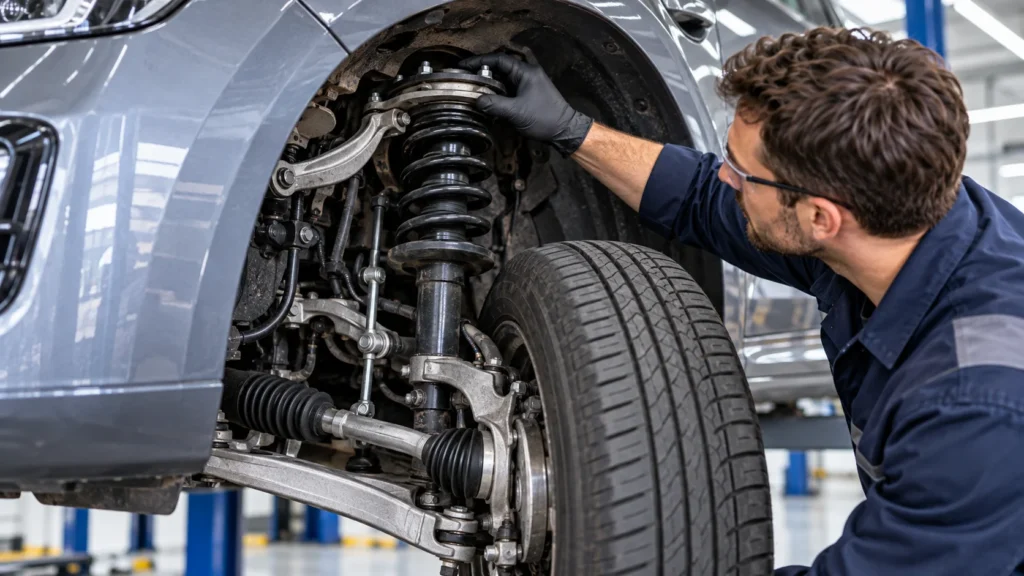
How can you quickly determine what might be wrong with a suspension mount?
Before removing any components, first observe the specific conditions under which the problem occurs.
| Vehicle Performance | Areas to Check First | Other Possible Causes |
| Knocking noises when driving over speed bumps | Upper mounting brackets, fasteners, rubber mounts | Stabilizer bar links, ball joints, shock absorbers |
| Squeaking or Sticking During Low-Speed Steering | Upper mount bearings, spring seats | Steering tie rods, ball joints, and other steering components |
| Noticeable increase in interior vibration | Rubber mounts, installation condition | Tires, wheel balancing, shock absorbers |
| Vehicle pulls to one side, vague steering feel | Mounting bracket clearance, control arm bushings | Tires, alignment parameters, steering system |
| Rubber cracking, deformation, or collapse | Rubber body and metal contact surfaces | Material aging, overloading, installation misalignment |
| Noise persists even after replacing parts | Assembly sequence, fasteners, part compatibility | Pre-existing faults in adjacent components |
This checklist is intended to help you narrow down the scope of your inspection; it is not a substitute for a professional diagnosis. If the vehicle exhibits obvious steering abnormalities, structural looseness, or uncontrollable handling, you should stop driving immediately and arrange for a professional inspection.
Issue 1: Clunking or Knocking Noise
If you hear a dull “thudding” sound coming from the front or rear of the vehicle when driving over speed bumps, potholes, or uneven roads, there may be abnormal displacement in the suspension mounting.
Under normal conditions, the metal structure of the mounting should remain securely connected, while the rubber components undergo limited deformation as intended by the design. If the rubber has collapsed, the internal connections have failed, or there is an unexpected gap at the mounting point, impact noises may occur as the suspension moves up and down.
Why does this happen?
Common causes include deformation of the rubber in the mounting bracket, metal-to-metal contact, insufficient preload on fasteners, or wear at the connection points.
Note that the knocking sound does not necessarily originate from the mounting bracket. Excessive play in the stabilizer bar links, worn ball joints, and internal damage to the shock absorbers can also produce similar sounds under the same road conditions.

How should this be addressed?
First, document the conditions under which the noise occurs: Does it happen when a single wheel passes over a pothole, or is it more noticeable when both wheels roll over a speed bump simultaneously? Does braking, steering, or vertical movement of the vehicle body alter the sound?
Next, have a professional technician inspect the top of the shock absorber strut, the mounting bolts, the rubber joints, and adjacent suspension components.
If it is confirmed that the issue is simply loose fasteners, check whether the threads, nuts, and connecting components still meet the requirements for reuse, and then address the issue according to the vehicle manufacturer’s specified procedures and torque specifications.
If the mounting bracket shows structural wear, rubber fractures, or abnormal play, the corresponding parts should be replaced rather than simply increasing the tightening torque.
Key Point: Do not purchase new suspension mounts based solely on knocking sounds. First identify the source of the noise; this usually helps reduce unnecessary repair costs.
Issue 2: Strut Mount Bearing Failure
Have you ever heard a “clunk,” “creak,” or brief snapping sound near the front wheels when turning at low speed in a parking lot?
If the noise occurs as you turn the steering wheel—rather than only when driving over potholes—the strut mount on the front strut with a bearing warrants close inspection.
In many MacPherson strut front suspensions, the strut must rotate as the wheels turn. The top bearing serves to make this process as smooth as possible.
When the bearings inside become worn, contaminated, corroded, or seized, steering resistance may become uneven. Sometimes the spring will twist slightly first and then suddenly release, producing a snapping sound.
How to determine this?
If you notice the following symptoms simultaneously, you should inspect the upper mount bearing:
- A grinding noise or clicking sound during low-speed steering.
- The steering wheel does not turn smoothly and exhibits intermittent resistance.
- The steering return behavior has changed noticeably compared to before.
- There is a noticeable difference in noise or resistance when turning left and right.
However, steering ball joints, tie rods, and other steering system components may also exhibit similar symptoms, so it is still necessary to isolate the source of the problem.
Correct Troubleshooting Procedure
A professional technician can, based on the vehicle’s design and under safe conditions, check whether the mounting bearing rotates smoothly and whether the spring seat exhibits abnormal bounce .
If the bearing is confirmed to be damaged, the bearing, mounting bracket, or corresponding assembly should be replaced according to the original manufacturer’s design.
For some upper mounts, the bearing can be replaced individually, while other designs require replacement of the entire assembly; there is no one-size-fits-all solution.
During installation, it is also essential to verify that the bearing orientation, spring seat positioning, and all connecting components meet the requirements for the specific vehicle model. Incorrect assembly may cause a brand-new bearing to develop abnormal noise again within a short period of time.
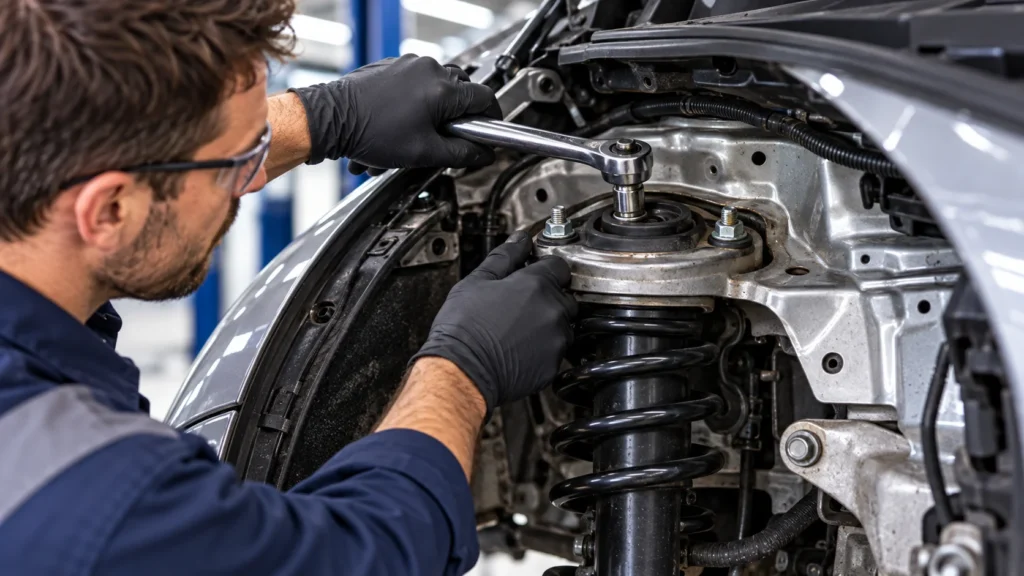
Problem 3: Increased Vibration Inside the Vehicle
The vehicle used to ride smoothly, but recently, whenever driving over rough roads, vibrations transmitted through the steering wheel, floor, or seats have become more noticeable.
You might first suspect that the shock absorbers have aged, but a decline in the vibration-damping performance of the rubber mounts could also be a contributing factor.
The rubber in suspension mounts is not merely a filler material. It undergoes elastic deformation under load and influences vibration transmission through the material’s inherent damping properties.
Engineers typically use NVH (Noise, Vibration, and Harshness) to evaluate a vehicle’s overall performance in these areas.
If the rubber ages and hardens, collapses in certain areas, or if the original vibration isolation path is short-circuited by metal contact, more vibration may be transmitted to the body.
How can this be resolved?
Do not simply opt for a softer rubber mount.
The correct approach is to first identify the source of the vibration. Steering wheel shake that varies significantly with vehicle speed may be related to the wheels, tires, or wheel balancing; body vibration that changes with road impacts requires further inspection of the suspension system.
If the problem is confirmed to originate from the mount, assess whether the rubber has hardened, undergone permanent deformation, developed abnormal gaps, or sustained structural damage.
For parts that have lost their normal vibration-isolation performance, replacing the mount with one that meets the original design requirements is generally more reliable than attempting a local repair.
For engineers developing new vehicle models or improving existing products, resolving vibration issues also requires consideration of the rubber’s dynamic stiffness, damping characteristics, operating frequency, and mounting location.
Lower hardness does not necessarily mean better vibration isolation. The material and structure must be matched to the actual loads and vibration characteristics.
Issue 4: Rubber Aging, Cracking, or Permanent Deformation
If you observe cracks, noticeable collapse, localized bulging, or permanent deformation in the rubber on the mounting surface, this indicates that its service condition requires further evaluation.
Rubber is a material with viscoelastic properties. Under long-term alternating loads, temperature fluctuations, and the influence of environmental media, its performance may gradually change.
Common contributing factors include:
- Long-term repeated compression, shearing, and tension.
- Changes in material properties caused by high-temperature environments.
- Surface aging caused by ozone and other environmental factors.
- Loads or displacements exceeding the design limits.
- Oils or chemical media incompatible with the material.
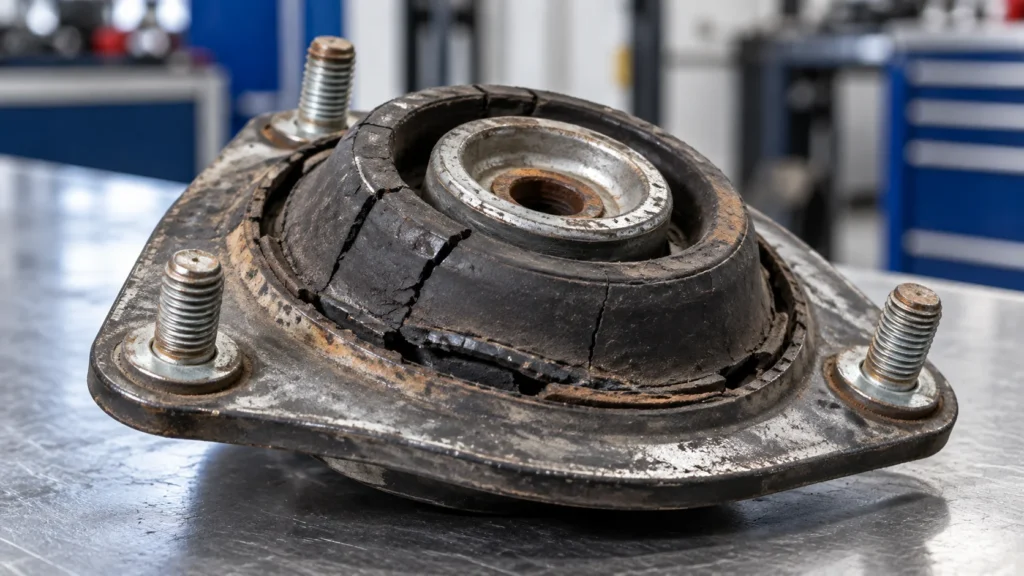
Does every crack mean the part must be replaced immediately?
Not necessarily.
Some fine surface cracks require evaluation based on crack depth, location, structural condition, and the manufacturer’s inspection requirements. The mere presence of superficial signs of aging does not directly indicate that the part has lost its functionality.
However, if a crack has progressed into a load-bearing area, or is accompanied by rubber tearing, noticeable displacement, metal-to-metal contact, separation, or abnormal driving behavior, it can no longer be considered a normal cosmetic change.
How should this be handled?
For mounting brackets that have already sustained functional damage, it is recommended to replace them with new parts that meet the vehicle model and operating conditions requirements.
It is not recommended to fill cracks in load-bearing rubber with ordinary adhesives or to restore the support height by adding temporary shims to the mounting bracket. Such methods typically cannot verify the restored mechanical properties and durability.
From a manufacturing perspective, reducing premature rubber aging requires a comprehensive selection of polymer systems, reinforcing systems, vulcanization conditions, and anti-aging solutions, which must be validated through appropriate thermal aging, fatigue, and environmental adaptability tests.
Issue 5: Delamination at the rubber-to-metal interface
Many suspension mounting components consist of metal brackets, inner and outer sleeves, and vulcanized rubber.
If delamination occurs at the rubber-to-metal interface, additional displacement may occur at the connection point, which, in severe cases, can affect normal load-bearing and positioning functions.
The rubber is responsible for elastic deformation, while the metal provides the connection and transmits loads; a reliable bond between the two determines whether the component can function as intended.
How can delamination be identified?
Look for the following signs:
- An abnormal separation gap appears between the rubber and metal.
- Displacement of the inner sleeve relative to the outer sleeve that exceeds the design specifications.
- Abnormal noises at the connection point when the part is under load.
- Simultaneous occurrence of rubber tearing and separation at the rubber-to-metal interface.
Some cases of internal delamination cannot be determined by visual inspection alone and require confirmation through appropriate inspection methods or testing.
Why does this happen?
Delamination may be related to long-term fatigue, abnormal loads, environmental corrosion, and the manufacturing process.
During manufacturing, the cleanliness of the metal surface, surface treatment, choice of adhesive system, curing conditions, and material compatibility can all affect the final bond performance.
If these processes are not consistently controlled, potential durability risks may exist even if the parts appear visually acceptable.
How should this be addressed?
For components where delamination has already occurred at the load-bearing interface, they should be replaced in accordance with the manufacturer’s repair requirements; it is not recommended to re-bond them with ordinary adhesive and continue to subject them to the original design loads.
For OEM and bulk procurement projects, the key is not merely to replace failed parts, but to investigate whether the delamination occurred in the rubber body, the adhesive layer, or at the metal interface, and to analyze the cause based on the failure location and batch records.
Appropriate peel, bond strength, and fatigue tests can provide a basis for process improvement.
Issue 6: Loose Mounting Bolts or Insufficient Preload
Sometimes the mounting bracket itself shows no obvious damage, yet the problem lies with the bolts, nuts, or connecting structures used to secure it.
Especially after replacing the shock absorber, if the vehicle emits a metallic knocking sound that was not present before, you should check for fastening issues during installation.
Failure of fasteners may result from insufficient preload, thread damage, incorrect part specifications, deformation of the mating surfaces, or failure to replace single-use fasteners as required.
However, not all unusual noises indicate that the nuts are not tightened properly. In some cases, even if a certain tightening torque is measured, damaged threads or deformed parts may still fail to provide reliable clamping force.
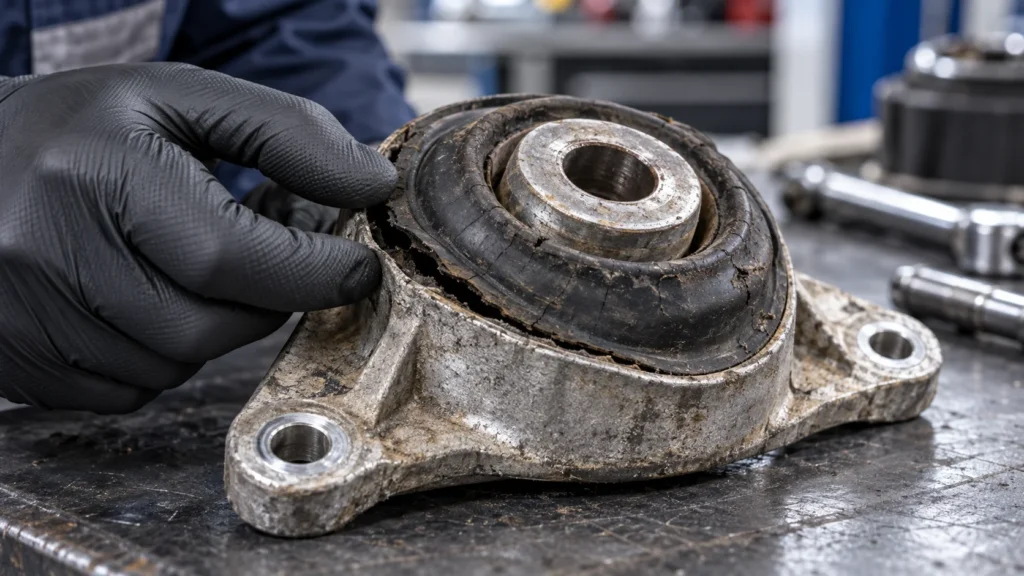
How should this be inspected?
A professional technician should inspect the mounting bracket and shock absorber strut connection points to check for loose fasteners, thread damage, tensile deformation, or abnormal wear on the contact surfaces.
If a bolt is found to be damaged, replace it with a new part that meets the original equipment manufacturer’s specifications.
Do not apply generic torque values without access to vehicle-specific data. Torque values and assembly sequences can vary significantly depending on the vehicle model, fastener location, and connection design.
Similarly, do not assume that tighter is safer. Over-tightening may damage threads, crush bearings, or cause abnormal deformation of the mounting bracket.
After repairs are completed, the connection must be rechecked under specified conditions to verify that the original abnormal noise has been eliminated.
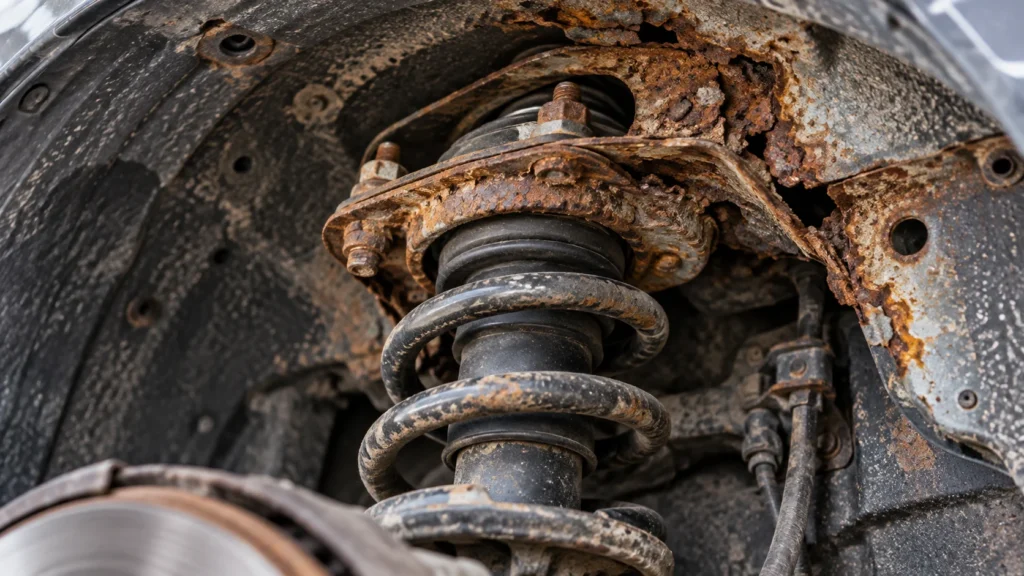
Issue 7: Metal Corrosion, Bracket Deformation, or Cracking
Suspension mounting brackets are frequently exposed to water, mud, sand, moisture, and road de-icing salt.
If the metal surface protection fails, corrosion may gradually develop and affect the serviceability of fasteners, connecting plates, or other structural components.
Minor surface rust is not the same as obvious structural corrosion.
A small amount of surface rust does not necessarily mean the part needs to be scrapped immediately. However, if corrosion has already led to a loss of cross-sectional area, damaged threads, failed mating surfaces, or cracks in the mounting bracket’s load-bearing structure, serious attention is required.
How to address this?
First, determine the extent of the corrosion and the severity of the structural damage.
If the metal load-bearing structure has developed cracks, severe deformation, or significant thinning due to rust, the relevant components should be replaced in accordance with maintenance requirements.
Simply applying anti-rust paint cannot restore structural strength that has already been lost.
At the same time, check whether the bracket has been subjected to abnormal impact, whether there is any assembly interference, and whether the surrounding drainage or protective conditions are normal.
For new product development, engineers must select base materials and corrosion protection solutions based on the actual operating environment and establish corresponding corrosion testing requirements.
For example, parts subject to long-term exposure to salt-laden moisture may require a focused evaluation of the corrosion resistance of the surface treatment system and the joint structures.
However, the duration of a salt spray test cannot be directly converted into the service life under real-world road conditions. It is more suitable for comparison and validation under clearly defined standards and evaluation conditions.
Question 8: Vehicle Pulling to One Side, Unresponsive Steering, or Abnormal Tire Wear
If your vehicle requires constant steering corrections to maintain a straight path, or if there is significant uneven wear on the inner and outer sides of the tires, you should inspect the entire suspension and steering systems, rather than simply performing a four-wheel alignment.
If certain suspension mounting brackets exhibit excessive play, abnormal deformation, or structural looseness, this may cause the relevant components to deviate from their designed positions when under load.
However, mounting brackets are not the direct cause of all abnormal tire wear. Tire pressure, toe-in, camber, ball joints, control arm bushings, and shock absorber performance can all affect tire contact with the road.
Why might a simple four-wheel alignment be ineffective?
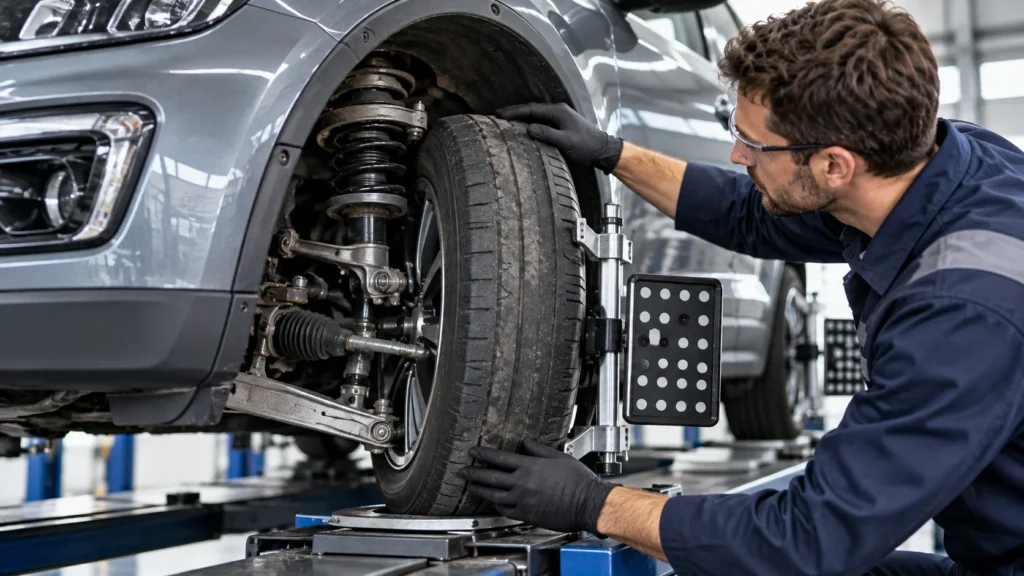
Wheel alignment typically involves measuring and adjusting a vehicle’s geometric parameters under specified conditions.
If suspension components are severely worn, even if the static alignment data temporarily meets requirements, the components may still experience abnormal displacement under actual driving loads.
In such cases, simply adjusting the alignment parameters without addressing loose or deformed components may allow the problem to persist.
The Correct Procedure
First, check the condition and pressure of the tires, then inspect the suspension components, steering ball joints, control arms, and mounting brackets for abnormal play or deformation.
After confirming that any related mechanical faults have been resolved, perform a four-wheel alignment check and make any necessary adjustments according to the vehicle manufacturer’s specifications.
If components affecting alignment parameters were removed during repairs, the alignment data should be verified even more carefully.
For newly developed suspension mounting components, attention must be paid to actual deformation under design loads; one cannot rely solely on dimensional inspections when the components are unloaded.
Question 9: A strange noise reappears shortly after replacing the mounting bracket
Shortly after replacing the suspension mounting bracket, the vehicle began making abnormal noises again.
Many people immediately assume there is a quality issue with the new part, but the actual cause may be more complex.
If the mounting bracket’s orientation, bearing position, spring seat, or tightening sequence is incorrect, even a new, compliant part may not function properly.
For example, in a shock absorber strut assembly with a steering bearing, incorrect loading during assembly can result in bearing damage or rotational binding.
For components such as control arms that use bonded rubber bushings, final tightening at an incorrect suspension height may cause the rubber to bear additional torsional stress even in the normal driving position.
It is important to note: This requirement regarding tightening at normal ride height applies primarily to the relevant rubber bushings and specified connection structures; it cannot be directly applied to all shock absorber mounting brackets.
How should this be handled?
First, reconfirm that the part numbers, orientation, installation sequence, and fasteners comply with the vehicle’s specifications.
Then, check for any undetected faults in nearby components, such as spring seats, stabilizer bar links, or shock absorbers.
If the installation process meets requirements but early failures still occur frequently in the same batch of products, the supplier needs to further inspect dimensional consistency, material properties, bonding quality, and fatigue performance.
For bulk-purchase customers, recording the time of failure, mileage, batch number, installation conditions, and specific location of damage is more helpful in determining the cause than simply describing the product as “poor quality” .
Special Note: Removing and installing shock absorbers poses safety risks
Vibration-damping struts with coil springs may store a high amount of elastic potential energy. Removing the center locking nut or improper use of a spring compression tool may result in serious personal injury.
Operations involving spring compression, mounting bracket removal and installation, and structural fastening should be performed by a service technician with the appropriate equipment and training, in accordance with the service manual for the specific vehicle model.
Issue 10: Mismatched Mount Selection
The last type of issue tends to occur more frequently during new vehicle development, modification projects, or when sourcing replacement parts.
Just because a mounting bracket fits into the installation location does not mean it is necessarily suitable for actual operating conditions.
Even if two products have the same external dimensions, their rubber hardness, static stiffness, dynamic stiffness, limit displacement, bonding structure, and environmental resistance may differ.
What are the consequences of incorrect selection?
If the stiffness of the mounting bracket deviates significantly from the design requirements, it may result in suboptimal vibration isolation, abnormal relative displacement, or subject other components to unexpected loads.
If the metal connection structure, mounting hole positions, or part orientation do not match, assembly stress or structural interference may also occur.
Under continuous alternating loads, these issues may further compromise durability.
How do you select the right mounting base?
Do not base your decision solely on appearance, hardness, or price.
For general vehicle maintenance, prioritize confirming the vehicle’s make, model, year of manufacture, suspension configuration, and applicable part numbers, and adhere to the original equipment manufacturer’s (OEM) compatibility requirements.
For OEM/ODM custom development, it is recommended to clarify the following conditions:
- Load requirements: static loads, dynamic loads, and any potential impact loads.
- Displacement Range: Design-allowed compression, shear, and other directions of movement.
- Stiffness and Damping: Target static and dynamic performance, as well as operating frequency range.
- Environmental Conditions: Operating temperature, humidity, road salt, oils, and other media with which the system comes into contact.
- Structural Constraints: Installation space, metal structure, connection methods, and critical dimensional tolerances.
- Service Life and Validation: Target service life, fatigue testing, and other necessary performance standards.
If these conditions are not clearly defined, simply choosing a harder or softer rubber is likely to merely replace one problem with another.
A truly sound design should be based on actual operating conditions and determine a solution through material selection, structural analysis, and performance validation.
How can suspension mount failures be reduced during the manufacturing process?
If you are responsible for developing or procuring suspension mounts, the most critical consideration is not merely whether the product passes factory inspection, but whether it can maintain stable performance over the long term.
Rubber material properties must be matched to operating conditions
Rubber hardness is only one of the material evaluation indicators and cannot alone determine a product’s service life.
Engineers must also consider static and dynamic stiffness, fatigue, thermal aging, compression set, and media compatibility based on actual applications.
Material selection should be based on specific performance objectives, rather than simply assuming that a single type of rubber is suitable for all suspension mounts.
Prioritize the quality of the bond between rubber and metal
For vulcanized rubber-to-metal assemblies, the quality of the connection surface treatment directly affects the reliability of the bond.
It is necessary to control the metal surface condition, bonding materials, vulcanization process, and production consistency, and to verify product performance through appropriate testing.
The integrity of the rubber-to-metal interface is particularly important in applications subject to continuous shear, compression, and alternating loads.
Control Critical Dimensions and Assembly Tolerances
The position of mounting holes, the dimensions of metal sleeves, the location of bonding surfaces, and the coaxiality of parts can all affect the actual assembly condition.
If there are deviations in the dimensions of the metal structure, the rubber component may be subjected to abnormal loads after assembly, even if its own performance meets the requirements.
For mass production, key characteristics and corresponding inspection methods should be clearly defined.
Develop a validation plan consistent with the application scenario
Meaningful quality validation goes beyond simply inspecting the product’s appearance or measuring rubber hardness.
Depending on the specific project, it may also be necessary to conduct load-displacement performance evaluations, dynamic characteristic tests, fatigue endurance, environmental aging, corrosion testing, and connection strength verification.
These tests should be determined based on applicable standards, customer specifications, and actual operating conditions; a product cannot be claimed to be suitable for all vehicles simply because it has passed a single test.
Establish a traceable quality management process
If a batch of products exhibits abnormalities, the ability to trace raw material batches, manufacturing parameters, inspection results, and delivery records will help improve the efficiency of failure analysis.
For long-term OEM partnerships and automotive parts procurement projects, this is also a factor worth considering when evaluating a supplier’s manufacturing capabilities and quality consistency.
Summary
When faced with abnormal knocking sounds, rubber aging, bearing seizure, metal corrosion, or premature failure, the truly effective approach is not to blindly replace parts, but to identify the source of the failure and then develop repair measures based on the actual damage.
For automakers, parts brands, and OEM/ODM procurement clients, reliable products must be built on a foundation established during the design and manufacturing stages.
Vista Motion is committed to providing customers with custom manufacturing support for rubber vibration dampers and rubber-metal composite parts. Based on the capabilities published on our official website, we can collaborate with customers to advance product development and manufacturing projects across various stages, including rubber material formulation, vulcanization and bonding, metal part preparation, dimensional inspection, and relevant performance verification.
If you are looking for a custom manufacturing supplier for suspension rubber mounts, vibration-damping mounts, or rubber-metal composite components, or wish to improve the vibration isolation, assembly, and durability of your existing products, please feel free to contact Vista Motion.
FAQ
What are the symptoms of faulty suspension mounts?
Common symptoms include abnormal knocking noises when driving over bumpy roads, friction or clicking sounds during low-speed steering, increased vibration, and visible rubber cracking or damage to the mounting structure.
If the mount is already affecting suspension movement and alignment, this may also be accompanied by abnormal handling or uneven tire wear. However, these symptoms overlap with other suspension issues, so mount failure cannot be confirmed based on a single symptom alone.
Why does my suspension make a clunking noise over bumps?
Suspension clunking may originate from worn mounts, loose fasteners, stabilizer bar links, ball joints, or shock absorbers.
If the rubber on the strut mount has collapsed or there is abnormal play at the connection, knocking may occur during suspension movement. It is recommended to first identify the source of the noise and the conditions under which it occurs, then have a professional technician inspect the relevant components one by one.
Why does my strut mount make noise when turning?
For front strut mounts equipped with steering bearings, wear, seizure, or improper installation of the internal bearings can cause squeaking, grinding, or clicking noises during steering.
If the bearing does not rotate smoothly, the spring may also twist abnormally. However, other components of the steering system can also produce noise, so an inspection must be conducted based on the specific vehicle model.
Can faulty suspension mounts cause steering wheel vibration?
It is possible.
If the rubber damping layer in the mount loses its normal performance, or if there is abnormal play in the mounting structure, vibrations may be more easily transmitted to the vehicle body and the steering wheel.
However, steering wheel vibration is also often related to wheel balancing, tires, the braking system, and other suspension components. You should first determine the relationship between the vibration and vehicle speed, braking, or road conditions before deciding whether to replace the mounts.
Can you drive with a bad strut mount?
It depends on the extent of the damage, but it is not recommended to ignore a confirmed failure.
The risks associated with minor aging are not the same as those associated with severe structural damage. If there is noticeable looseness, metal structure fractures, steering stiffness, or difficulty maintaining a straight path while driving, you should stop driving immediately and seek professional repair or towing services.
Even if you only hear a slight, unexplained noise, you should have it inspected as soon as possible rather than assuming the vehicle is safe based on the sound alone.
How long do suspension mounts last?
There is no fixed mileage that applies to all vehicles.
The lifespan of suspension mounts depends on the materials, design, load, road conditions, environmental factors, and installation quality. Vehicles that frequently travel on bumpy roads, are exposed to road salt over extended periods, or carry heavy loads may subject these components to harsher operating conditions.
It is recommended to follow the vehicle manufacturer’s maintenance guidelines for inspections and to have any abnormal symptoms diagnosed promptly; the decision to replace parts should not be based solely on mileage.
How much does strut mount replacement cost?
The cost depends primarily on the vehicle model, installation location, part design, local labor rates, and whether bearings or other suspension components need to be replaced.
If the shock absorber and coil spring need to be removed, labor costs may account for a significant portion of the total.
When requesting a quote, it’s best to confirm whether the price includes the strut mounts, bearings, related fasteners, labor for removal and installation, and any necessary wheel alignment costs. Repair costs vary significantly by vehicle model, so it’s not possible to provide a uniform price applicable to all vehicles.
Do you need a wheel alignment after replacing strut mounts?
An alignment isn’t always necessary, but it’s generally recommended to check the alignment parameters after replacing strut mounts or removing suspension components that affect alignment geometry.
Whether an adjustment is needed depends on the vehicle’s suspension design, the specific components removed or installed, and the manufacturer’s maintenance requirements.
If the vehicle was already pulling to one side or experiencing abnormal tire wear prior to the replacement, it is especially important to check the alignment data and confirm that there are no other unresolved mechanical issues.
What is the difference between suspension mounts and suspension bushings?
Suspension mounts typically perform specific mounting, connecting, and vibration-damping functions, such as strut mounts or shock absorber mounts.
Suspension bushings, on the other hand, are typically installed at connection points such as control arms, stabilizer bars, and subframes to provide controlled elastic movement, isolate vibrations, and influence suspension geometric stability.
Both may use rubber-metal composite structures, but their mounting locations, load directions, and motion requirements are not necessarily the same; they cannot be substituted for one another based solely on their similar appearance.
Why do new strut mounts fail prematurely?
Common causes include parts that are incompatible with the vehicle model, incorrect installation orientation, abnormal forces on the bearing during installation, improper tightening procedures, or pre-existing faults in the surrounding area that have not been thoroughly resolved.
If installation factors have been ruled out but similar failures continue to occur repeatedly, it is necessary to verify whether the part’s material, dimensions, rubber-to-metal bond performance, and actual load conditions meet design requirements.
For bulk procurement projects, it is recommended to retain failed samples and batch records to facilitate a more accurate root cause analysis.
