
When you turn the steering wheel, drive over speed bumps, or brake while cornering, the front wheels do not operate independently. The front suspension system works together to control the wheels’ position, vertical movement, steering angle, and road impacts.
What components make up the front suspension?
Common automotive front suspension systems typically include:
- Shock absorbers or struts
- Coil springs
- Upper mounts and mount bearings
- Control arms
- Control arm bushings
- Suspension ball joints
- Steering knuckle
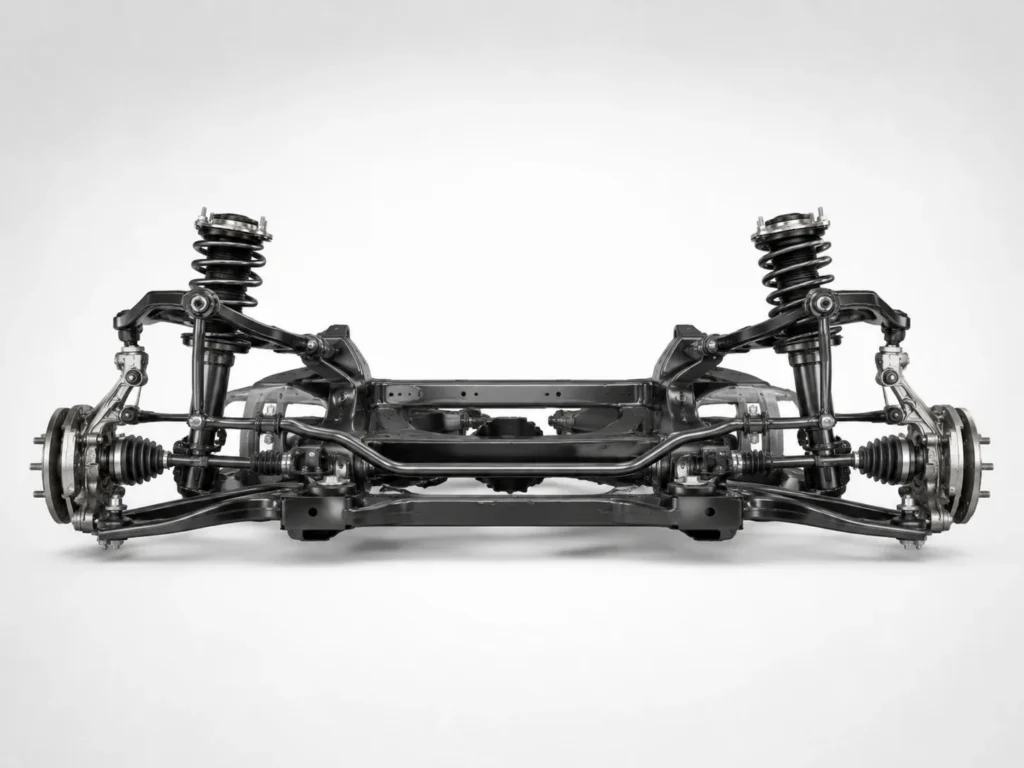
- Anti-roll bar
- Anti-roll bar link
- Anti-roll bar bushings
- Subframe
- Stop blocks and dust boots
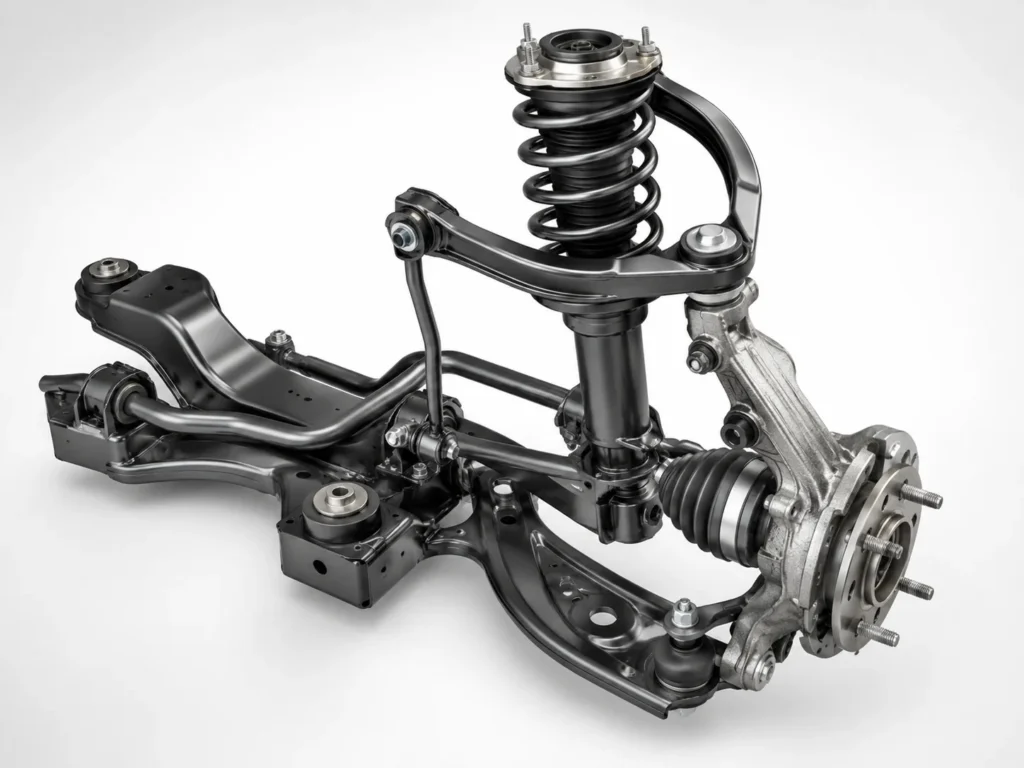
Wheel bearings, tie rod ends, and steering links are also often classified as “front suspension components.” However, from a strict system classification perspective, tie rods belong to the steering system, and wheel bearings belong to the wheel assembly; they are merely closely connected to the front suspension and are not entirely equivalent to the suspension itself.
Front suspension configurations vary by vehicle model, so not every car will have exactly the same number of components. MacPherson strut, double wishbone, and multi-link front suspensions share the same basic objective but differ in how they position the wheels and transfer loads.
What is the function of the front suspension system?
Before we go through the names of the front suspension components one by one, you need to first understand what this system actually does. A complete automotive front suspension system primarily performs five tasks.
Supporting the vehicle’s front-end weight
The weight of the engine, transmission, body, occupants, and other loads is transferred through the body and subframe to the springs, control arms, steering knuckles, and wheels.
The springs are responsible for bearing most of the vertical load, but since the load must ultimately be transferred through multiple connecting components, the control arms, ball joints, mounts, and bushings must also possess sufficient strength and fatigue life.
Absorbing Road Impacts
When the wheels encounter potholes, road joints, or speed bumps, they move rapidly upward. The springs allow the wheels to undergo relative displacement, while the shock absorbers control the rate at which the springs compress and rebound.
If there were only springs and no effective damping, the vehicle body would continue to vibrate up and down after an impact. The primary function of shock absorbers is not to support the entire weight of the vehicle, but to suppress the repetitive oscillations of the springs and the vehicle body.
Maintaining Tire-to-Road Contact
The front suspension must maintain optimal camber, toe, and kingpin geometry as much as possible during wheel up-and-down movement, steering, braking, and body roll.
Control arms, steering knuckles, ball joints, and various linkages collectively determine the wheel’s path of movement. If the connection points become deformed or worn, the tire’s contact with the road and the four-wheel alignment parameters may change.
Supporting Vehicle Steering
The front wheels typically move both vertically and laterally. Therefore, the front suspension cannot be a simple vertical sliding mechanism.
Ball joints allow for multidirectional angular movement between the control arm and the steering knuckle; bearings in the upper mount of the strut allow the MacPherson strut to rotate with the wheel; and the steering link transmits the steering gear’s motion to the steering knuckle.
Controlling Vehicle Body Posture During Braking, Acceleration, and Cornering
During braking, the vehicle’s center of gravity shifts forward; during cornering, the vehicle experiences body roll, and the front wheels are subjected to both longitudinal and lateral forces.
The geometry of the front suspension, the stiffness of the anti-roll bar, spring stiffness, shock absorber damping, and the characteristics of the bushings all affect the vehicle’s stability, comfort, and steering response.
Main Components of the Front Suspension and Their Functions
The following explains the functions of common front suspension components one by one, as well as the symptoms that may occur if these parts fail.
Shock Absorbers and Struts
Many people mistake shock absorbers for struts, but the two are not exactly the same.
What Is a Shock Absorber?
A standard shock absorber is primarily responsible for providing damping and controlling the speed at which the spring compresses and rebounds. It is generally not a primary structural component for positioning the wheels, nor does it take over the wheel-guiding function of the control arms.
What is a shock strut?
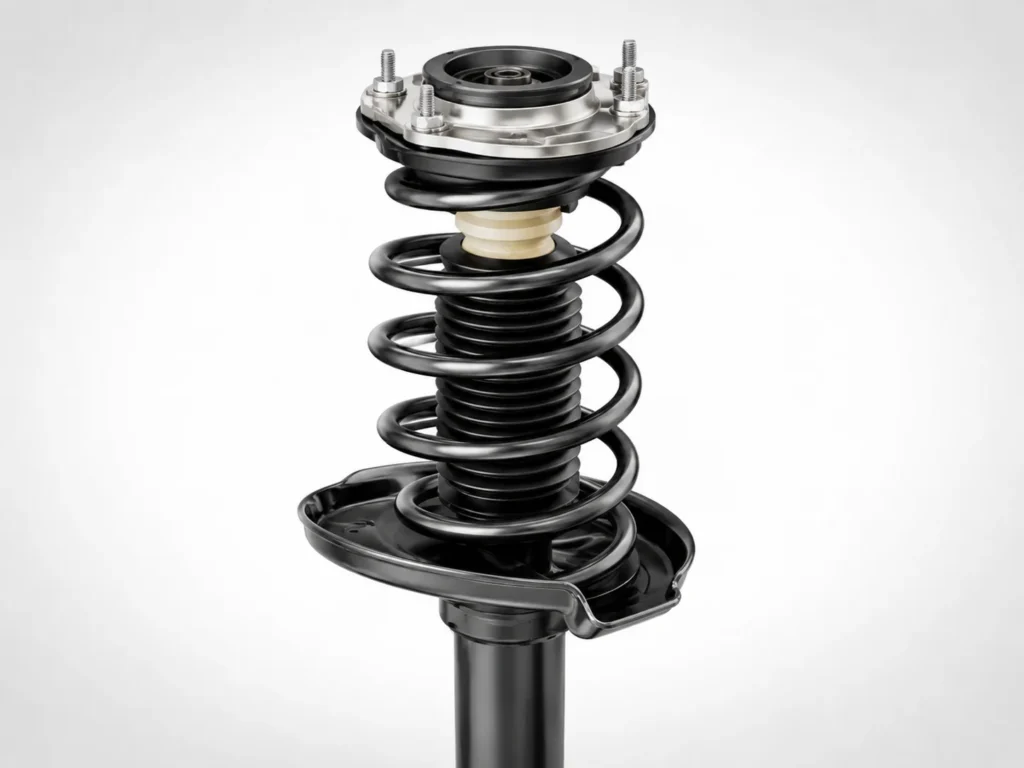
A strut not only provides the damping function of a shock absorber but may also serve as part of the suspension structure, connecting the body to the steering knuckle.
In a MacPherson strut front suspension, the strut replaces the upper control arm found in a traditional double-wishbone configuration. The upper end of the strut connects to the body tower, while the lower end is rigidly connected to the steering knuckle, thereby controlling wheel position and absorbing multidirectional loads from steering, braking, and the road surface.
A typical front strut assembly may include:
- Shock absorber barrel
- Piston rod
- Coil spring
- Upper and lower spring seats
- Upper mount
- Flat bearing or support bearing
- Dust cover
- Stop block
- Fastener
Common Signs of Damaged Shock Absorbers or Struts
You may notice:
- The vehicle continues to sway after driving over uneven roads
- The front of the vehicle dips noticeably when braking
- Increased body roll when turning
- Visible fluid leaks from the shock absorbers
- Irregular, uneven tire wear
- Reduced stability when driving at high speeds
- Knocking or scraping noises in the strut area
It is important to note that a slight oil stain does not necessarily indicate that the shock absorber has completely failed. Whether replacement is necessary should be determined by comprehensively evaluating the extent of the leak, damping tests, tire wear, driving performance, and the manufacturer’s maintenance standards.
Coil Springs
Coil springs are one of the primary elastic components in the front suspension. They support the vehicle’s weight and allow the wheels to move up and down when encountering road irregularities.
Springs and shock absorbers serve different functions:
Springs store and release impact energy
Shock absorbers dissipate vibration energy and control the rate of movement
What are the signs of a damaged front suspension spring?
Common signs include:
- A noticeable drop in the vehicle’s ride height on one side
- A broken spring or a missing spring end
- Unusual metallic noises when turning
- Uneven clearance between the tires and wheel wells on the left and right sides
- Abnormal sagging of the vehicle when loaded
- Severe corrosion on the spring surface
- Misalignment at the contact point between the spring and the seat ring
When replacing springs, verify the free height, wire diameter, number of coils, material, stiffness, direction of winding, and installation position. Similar appearance does not mean that two springs are interchangeable.
Upper Mount and Mount Bearings of the Shock Absorber
The upper mount is located between the shock absorber strut and the vehicle body and typically consists of a metal frame, rubber vibration-isolating material, and mounting structure.
Its functions include:
- Transmitting suspension loads to the vehicle body
- Isolating some vibrations and noise
- Maintaining the strut’s correct mounting position
- Allowing the front suspension to rotate during steering
In many MacPherson strut front suspensions, the upper mount also contains a bearing. When you turn the steering wheel, the strut assembly needs to rotate with the steering knuckle, and the bearing in the mount reduces rotational resistance.
Common Symptoms of a Damaged Upper Mount
- A clicking noise when turning the steering wheel while stationary
- The steering wheel does not turn smoothly
- Springs suddenly bounce during steering
- A knocking sound from the strut tower when driving over potholes
- Cracks or noticeable sagging in the upper mount’s rubber
- Displacement at the top of the strut
Sometimes, if abnormal noises persist even after replacing the shock absorbers, the problem may stem from the old upper mount, bearings, stop blocks, or spring seats. Therefore, when disassembling the strut assembly, it is usually necessary to inspect these associated components at the same time.
Control Arm
Control arms, also known as swing arms, suspension arms, or A-arms, are critical structural components that connect the body or subframe to the steering knuckle.
They allow the wheels to move up and down along their designed path while restricting unwanted front-to-back and side-to-side movement. Control arms are generally connected to the subframe via bushings and to the steering knuckle via ball joints.
Common control arm constructions include:
- Stamped steel welded control arms
- Forged steel control arms
- Cast steel or cast iron control arms
- Forged aluminum alloy control arms
- Cast aluminum alloy control arms
- Single-link control arms
- A-shaped or L-shaped control arms
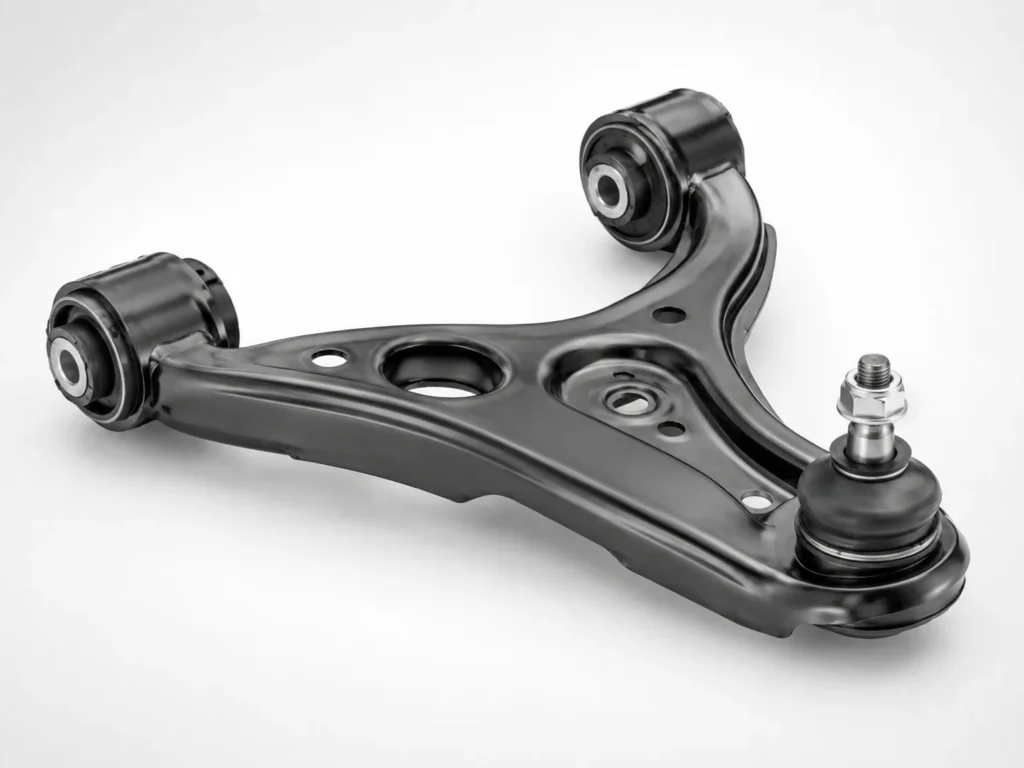
Different materials and manufacturing processes affect a part’s weight, strength, stiffness, corrosion resistance, fatigue life, and manufacturing cost.
Common Causes of Control Arm Damage
- Vehicle impact with curbs or deep potholes
- Fatigue damage caused by long-term alternating loads
- Corrosion leading to localized thinning of the cross-section
- Cracks in welds or formed areas
- Wear or deformation of the ball joint mounting hole
- Abnormal loads due to aged bushings
- Incorrect tightening torque during maintenance
If the control arm itself is bent, cracked, or severely corroded, you should generally not simply replace the bushings and continue using it.
Control Arm Bushings
Control arm bushings typically consist of a combination of rubber, a metal inner sleeve, and a metal outer sleeve; hydraulic bushings or other elastomeric structures may also be used.
It is located between the control arm and the vehicle body or subframe, and its primary functions are:
- To allow the control arm to move in a controlled manner
- to isolate road vibrations and impacts
- To reduce noise caused by direct metal-to-metal contact
- Control the displacement of the wheels during braking and cornering
- Strike a balance between comfort and handling
A bushing is not necessarily better the stiffer it is.
Softer bushings generally promote vibration isolation and comfort, but may result in greater geometric displacement under high loads; harder bushings can improve response speed but may transmit more vibration to the vehicle body.
When designing control arm bushings, factors such as rubber compound, hardness, radial stiffness, axial stiffness, torsional stiffness, preload, bond strength, temperature, environment, and fatigue life must all be considered.
What are the symptoms of a failed control arm bushing?
- A muffled noise from the front of the vehicle when accelerating or braking
- Sluggish steering response
- The vehicle pulls to one side during braking
- Abnormal tire wear
- Noticeable movement of the front wheels under load
- A loose feeling when driving over rough roads
- Cracks, delamination, or eccentricity in the rubber bushings
The presence of fine cracks on the rubber surface alone does not necessarily indicate bushing failure. During inspection, it is also necessary to check for through cracks, separation of metal from rubber, abnormal gaps, or excessive displacement under load.
Suspension Ball Joints
A suspension ball joint is a movable joint that connects the control arm to the steering knuckle.
It typically consists of a ball stud, ball seat, housing, grease, and dust boot, and allows for multi-directional rotation while restricting linear displacement, enabling the front wheels to steer while moving up and down with the suspension.
MacPherson strut front suspensions typically have one lower ball joint on each side, while double-wishbone configurations may use both upper and lower ball joints. The specific number depends on the suspension design.
What are the symptoms of a faulty ball joint?
- A knocking sound when driving over bumpy roads at low speeds
- A feeling of play or instability when turning
- The steering wheel does not return to center on its own
- Abnormal wear on the inner or outer sides of the tires
- Detectable vertical or lateral play in the front wheels
- Cracked ball joint dust boots with grease leakage
- The vehicle pulls to one side when braking or turning
Ball joints are safety-critical components. Severe wear can lead to loss of wheel alignment control; therefore, the risk cannot be assessed based solely on the intensity of abnormal noises.
When inspecting ball joints, the components should be unloaded or loaded according to the load-bearing characteristics of the corresponding suspension structure. Inspection methods vary slightly by vehicle model.
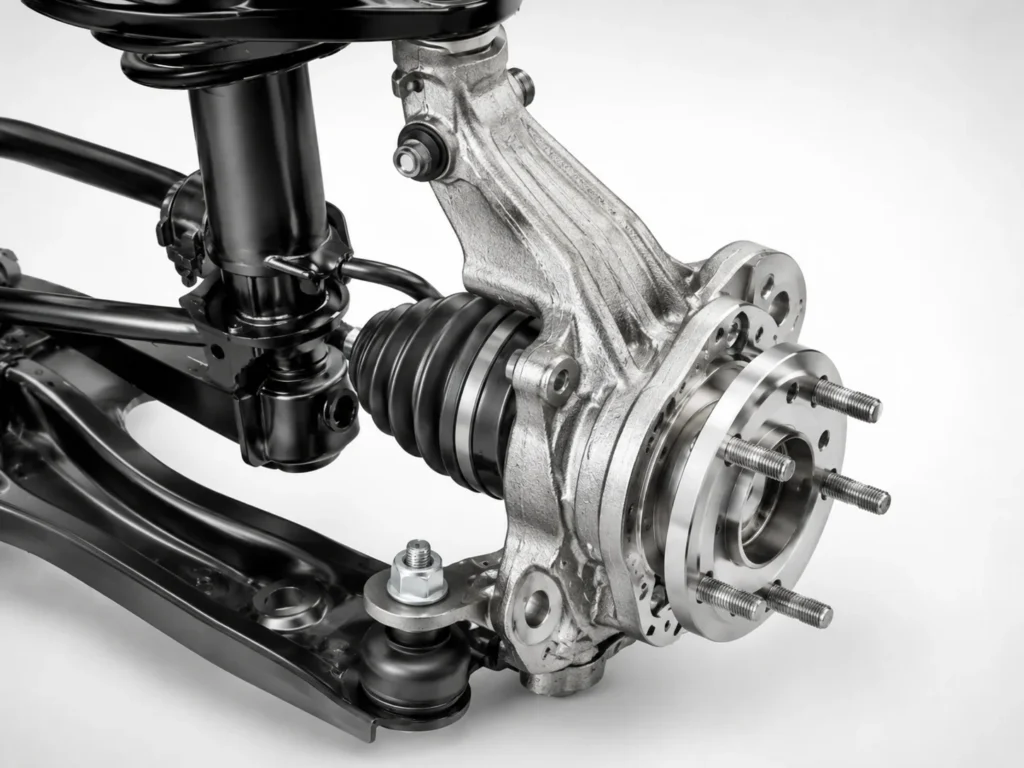
Steering Knuckle
The steering knuckle—also known as the steering arm, steering bearing housing, or wheel hub—is a critical connecting component between the front suspension and the steering system.
The wheel hub or bearing is typically mounted at the center of the steering knuckle, while control arms, ball joints, shock absorber struts, and steering links are connected to various positions on the steering knuckle. It not only supports the wheel assembly but also transmits steering, braking, and road loads to other suspension components.
Common manufacturing processes for steering knuckles include:
- Ductile iron casting
- Cast steel
- Aluminum alloy casting
- Steel forging
- Aluminum alloy forging
- Precision Machining After Casting or Forging
Since steering knuckles include bearing bores, ball joint tapered bores, strut mounting holes, and brake mounting surfaces, dimensional accuracy, positional accuracy, concentricity, material properties, and fatigue strength are all critical.
What problems can occur with steering knuckles?
- Bending or deformation following an impact
- Wear in the bearing bore
- Damage to threads or mounting holes
- Deformation of the ball joint tapered bore
- Corrosion or cracks
- Machining dimensions do not meet specifications
- Misalignment of mounting surfaces
- Loose hub bearing fit
Deformation of the steering knuckle may not always produce noticeable noise, but it can prevent the four-wheel alignment from ever returning to the normal range.
Anti-roll bar
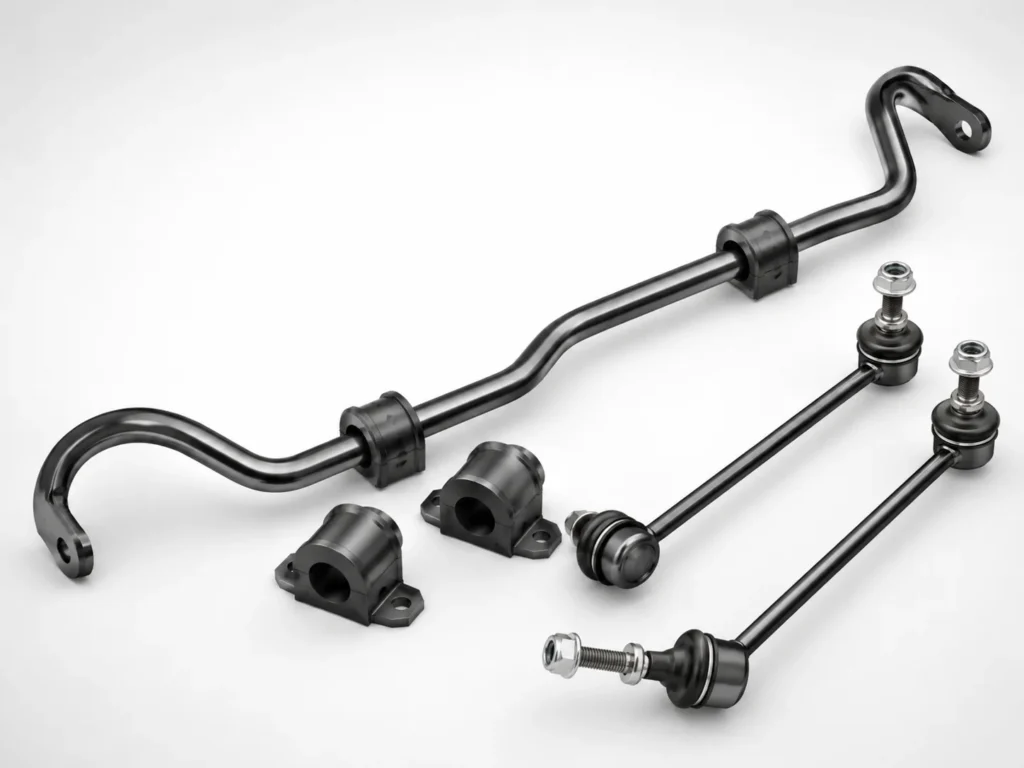
An anti-roll bar is also known as a stabilizer bar, transverse stabilizer bar, or sway bar.
It is typically mounted transversely at the front of the vehicle and connects the left and right suspension systems. When the vehicle turns and the left and right wheels experience different vertical displacements, the sway bar twists, thereby suppressing body roll.
When the left and right wheels move up and down simultaneously, the torsional effect produced by the sway bar is relatively small; when the wheels on one side rise and those on the other side drop, its effect is more pronounced.
Is a thicker anti-roll bar always better?
Not necessarily.
Increasing the torsional stiffness of the anti-roll bar can generally reduce body roll, but it also alters the distribution of roll stiffness between the front and rear axles, changes tire load distribution, and affects the vehicle’s steering characteristics.
Therefore, the size of the anti-roll bar cannot be selected in isolation from the vehicle’s total weight, suspension structure, spring stiffness, tire performance, and target handling characteristics.
Sway Bar Link
A sway bar link is also known as a stabilizer bar link, small link, or sway bar link. It connects the sway bar to the control arm or shock absorber strut .
Both ends of the link typically feature small ball joints, though rubber bushings may also be used. Because the connection points are located near the wheels, these components are subjected to frequent, minor reciprocating motion, road impacts, and environmental contamination.
Symptoms of a Damaged Sway Bar Link
- A sharp knocking sound when driving at low speeds over gravel roads or through a series of small bumps
- Unusual noise from a single wheel when driving over a speed bump
- Cracked ball joint dust cover
- Play in the ball joint
- Bent connecting rod
- Loose fasteners
- A change in the sensation of body roll when the vehicle turns
Noises from the anti-roll bar links are often mistaken for shock absorber failure. During diagnosis, check potential noise sources such as the ball joints, anti-roll bar bushings, upper mounts, control arm bushings, and brake calipers separately.
Anti-roll bar bushings
Stabilizer bar bushings secure the stabilizer bar to the vehicle body or subframe while allowing the bar to rotate within a certain range.
When the bushings age, wear out, or develop excessive clearance relative to the stabilizer bar, a dull thud may be heard from the front of the vehicle during minor bumps or when load shifts from side to side.
During inspection, pay attention to the following:
- Whether the rubber is cracked
- Whether the inner bore of the bushing is worn
- Whether the stabilizer bar surface is corroded
- Whether the mounting brackets are deformed
- Are the mounting bolts loose?
- Do the bushing specifications match the stabilizer bar diameter?
The same vehicle model may use stabilizer bars of different diameters depending on the powertrain, chassis version, or performance package; therefore, bushings should not be selected based on appearance alone.
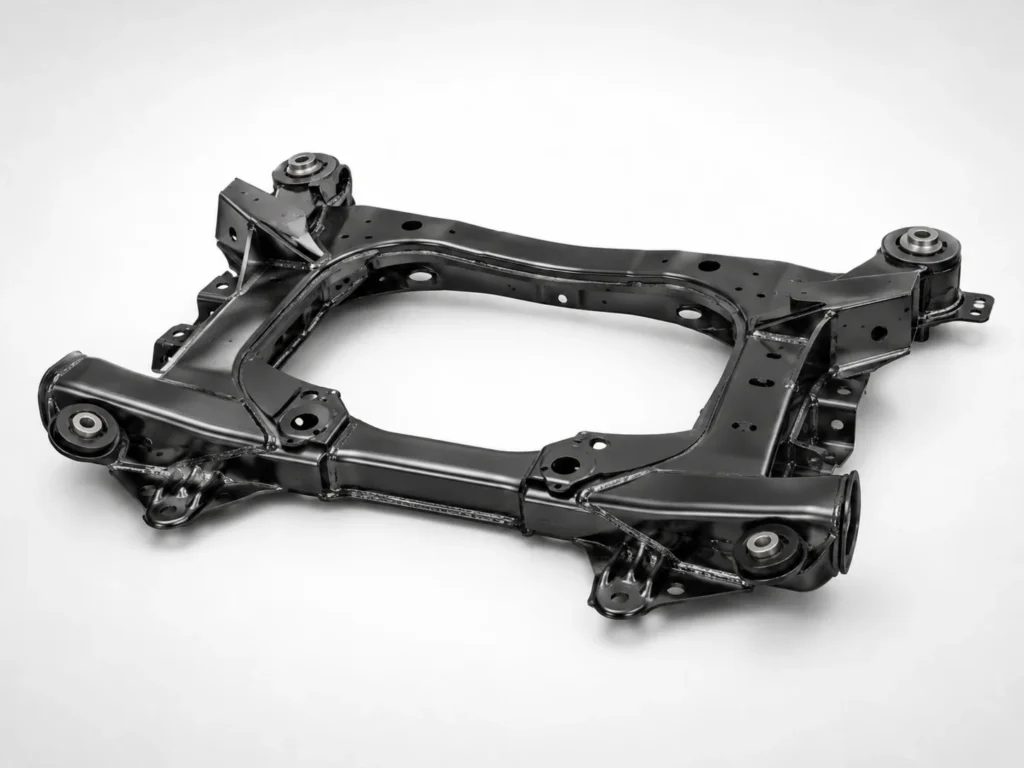
Subframe
The subframe is also known as the suspension crossmember, front axle frame, or subframe.
It is mounted beneath the body and provides a mounting base for the control arms, steering gear, anti-roll bar, and powertrain mounts. The subframe distributes the loads generated by the front suspension and powertrain and transfers them to the body.
Common subframe manufacturing methods include:
- Stamped and welded steel sheet
- Welded steel tubes and stamped parts
- Aluminum alloy casting
- Combination of aluminum alloy extrusions and castings
- Multi-part welded assemblies
Welding distortion, mounting hole placement, structural rigidity, and fatigue performance of the subframe directly affect the location of suspension mounting points and the overall vehicle assembly accuracy.
What problems can a damaged subframe cause?
- Abnormal alignment parameters following a collision
- Misalignment of control arm mounting points
- Loose mounting of the steering gear or stabilizer bar
- Low-frequency noises from the chassis
- Cracks in welds or base metal
- Corrosion causing a reduction in structural strength
- Damaged bushings between the subframe and the body
If the subframe is replaced or disassembled, it must be aligned and secured according to the manufacturer’s specifications during reassembly, and the four-wheel alignment parameters must be checked.
Stop Blocks and Dust Covers
Although stop blocks and dust covers are small in size, they often affect the actual service life of shock absorbers.
Stop blocks
When the suspension is compressed near its travel limit, the stop block provides progressive cushioning to prevent a hard impact on the shock absorber or other components.
If the stop block is damaged, a noticeable impact noise may occur when the vehicle undergoes significant compression.
Dust Covers
Dust boots are designed to protect the piston rod surface and reduce the entry of mud, water, and particulate matter into the oil seal area.
If the piston rod surface is scratched by foreign objects, this may accelerate oil seal wear and cause the shock absorber to leak.
Which parts are often considered front suspension components but actually belong to adjacent systems?
When you search for “front suspension parts diagram” or purchase a front suspension repair kit, you’ll often come across the following parts.
While they are closely related to the front suspension, they require further distinction from an engineering systems perspective.
Steering tie rods and tie rod ends
The tie rod transmits movement from the steering gear to the steering knuckle and is used to control the steering angle of the wheels.
They are part of the steering system, not strictly suspension components. However, play in the tie rod ball joints can also cause steering wheel play, pulling to one side, unusual noises, and abnormal tire wear, so they are typically inspected along with the front suspension during repairs.
Wheel Hubs and Wheel Hub Bearings
Wheel hub bearings are mounted in the steering knuckle or wheel hub assembly, allowing the wheel to rotate with minimal resistance.
Common symptoms of damaged wheel bearings include a humming noise that increases with speed, wheel play, or ABS-related malfunctions. It is part of the wheel end assembly but is directly connected to the steering knuckle and front suspension.
Driveshaft and Constant-Velocity Joints
In front-wheel-drive vehicles, the drive shaft passes through the center of the wheel hub, transmitting power from the transmission to the front wheels.
The drive shaft and constant-velocity (CV) joints are part of the drivetrain. When the outer CV joint wears out, a continuous clicking sound may occur during cornering or acceleration; this sound is often mistaken for a noise coming from the front suspension.
Brake Calipers and Brake Rotors
Brake calipers are typically mounted on the steering knuckle but are part of the braking system.
Loose caliper slides, abnormal brake pad clearance, or damaged anti-loosening components may also produce a sound similar to suspension play when driving on bumpy roads.
What Should Be Considered When Designing or Procuring Front Suspension Components?
For automakers, chassis system suppliers, and parts procurement professionals, understanding the components that make up the front suspension is only the first step. What truly determines whether a part will perform reliably is the seamless integration of design, materials, manufacturing, heat treatment, surface treatment, assembly, and validation.
Load Conditions
The following must be clarified:
- Static Vertical Loads
- Braking longitudinal loads
- Cornering Lateral Loads
- Impact Loads
- Torsional loads
- Limit conditions
- Fatigue load spectrum
- Load Direction and Point of Application
Providing only the vehicle’s total weight is typically insufficient for designing suspension structural components.
Materials and Manufacturing Processes
Different front suspension components are suited to different manufacturing processes.
For example:
- Steering knuckles can be made of ductile iron, cast steel, forged steel, or aluminum alloy
- Control arms can be produced using stamping and welding, forging, or casting
- Subframes typically involve stamping, cutting, forming, and welding
- Ball joint housings and ball studs may involve forging, machining, and heat treatment
- Bushings involve metal cage fabrication, surface treatment, and rubber bonding
- Brackets and connecting components may be produced using precision casting, forging, or CNC machining
Even if material names are the same, this does not necessarily mean their properties are identical. It is also necessary to specify material standards, chemical composition, heat treatment conditions, mechanical properties, and inspection requirements.
Key Dimensions and Geometric Tolerances
The front suspension mounting points determine wheel alignment and the vehicle’s trajectory; therefore, the following must be strictly controlled:
- Bore diameter
- Hole spacing
- Position Tolerance
- Coaxiality
- Flatness
- Perpendicularity
- Taper angle
- Bearing fit dimensions
- Ball joint mounting surface
- Support Mounting Surface
- Reference Position of the Welded Assembly
When welding control arms or subframes, it is not sufficient to inspect the dimensions of individual parts alone; the spatial position of the assembled unit after welding must also be verified.
Fatigue Performance
Control arms, steering knuckles, subframes, and brackets are subjected to alternating loads over long periods. Even if static strength is sufficient, this does not guarantee that fatigue life will meet requirements.
The validation plan may include:
- Unidirectional Fatigue Testing
- Multi-axis load testing
- Stiffness testing
- Static ultimate load testing
- Ball joint endurance testing
- Radial and Axial Stiffness Testing of Bushings
- Rubber Adhesion Strength Testing
- Fatigue Testing After Corrosion
- Road Load Spectrum Simulation
Specific test conditions should be determined based on the design requirements of the complete vehicle or system; data from other vehicle models cannot be directly applied.
Surface Treatment and Corrosion Protection
Front suspension components are continuously exposed to water, mud, sand, gravel, and road salt.
Common treatments include:
- Electrophoretic coating
- Powder coating
- Zinc or zinc alloy plating
- Zinc flake coating
- Anodizing
- Chemical conversion coating
- Anti-corrosion oil or wax
- Localized sealing treatment
The choice of surface treatment must take into account the base material, assembly tolerances, corrosion rating, fastener friction coefficient, and subsequent welding requirements.
Summary
Back to the original question: What are the parts of the front suspension?
Common front suspension components include shock absorbers or struts, springs, upper mounts, control arms, bushings, ball joints, steering knuckles, anti-roll bars, stabilizer bar links, subframes, stop blocks, and dust boots. Although steering links, wheel bearings, drive shafts, and brakes are not strictly part of the suspension itself, they are directly connected to the front suspension and can also affect fault diagnosis results.
For projects requiring custom development of front suspension structural components, steering knuckles, control arms, mounting brackets, subframe components, or rubber-to-metal damping parts, Vista Motion combines casting, forging, precision CNC machining, sheet metal welding, rubber-to-metal bonding, and inspection capabilities to provide customers with collaborative support ranging from technical analysis, prototype development, and process validation to mass production.
To improve evaluation efficiency, we recommend providing 2D drawings, 3D models, material standards, critical tolerances, load conditions, test specifications, surface treatment requirements, and estimated annual demand when requesting a quote or initiating a project. The more complete the documentation, the easier it is to identify manufacturing risks early in the project, optimize processes, and establish a stable quality control plan.
FAQ
What are the main components of the front suspension?
The front suspension primarily consists of shock absorbers or struts, coil springs, upper mounts, control arms, control arm bushings, ball joints, steering knuckles, stabilizer bars, stabilizer bar links, subframes, stop blocks, and dust boots.
The specific number of parts depends on whether the vehicle model uses a MacPherson strut, double-wishbone, or multi-link front suspension.
What are the symptoms of a faulty front suspension?
Common symptoms include unusual noises from the chassis, body shake, loose steering, the vehicle pulling to one side, nose-diving during braking, increased body roll when turning, the steering wheel not returning to center, and abnormal tire wear.
These symptoms may also stem from the tires, steering system, wheel bearings, or brakes; therefore, further inspection is required, and parts should not be replaced based on a single symptom alone.
What are the most common causes of front suspension noise?
Common causes include loose anti-roll bar links, worn stabilizer bar bushings, cracked control arm bushings, worn ball joints, damaged upper mounts, internal shock absorber wear, or loose fasteners.
The road conditions, speed, steering angle, and braking status under which the noise occurs can help narrow down the source of the problem.
What is the difference between a shock absorber and a strut?
Shock absorbers primarily provide damping to control spring oscillations; struts, in addition to providing damping, may also serve as structural components for positioning the wheels.
MacPherson strut front suspensions typically use strut-type shock absorbers, while some double-wishbone configurations separate the shock absorber from the wheel-guiding structure.
What are the components of a MacPherson strut front suspension?
A typical MacPherson strut front suspension includes a strut assembly, coil springs, upper mount, mount bearing, lower control arm, lower ball joint, steering knuckle, anti-roll bar, stabilizer bar link, bushings, and subframe.
It typically does not have a separate upper control arm, as the strut performs the upper positioning function.
Can you continue driving if a control arm is damaged?
If the bushings are only slightly worn, the vehicle may still be drivable for a short time, but it should be inspected as soon as possible. If the control arms are bent, cracked, or severely corroded, or if there is noticeable play in the ball joints, continuing to drive may affect wheel alignment and vehicle control.
Safety risks cannot be determined solely by appearance or the volume of unusual noises; they must be assessed by a professional.
What sounds does a faulty ball joint make?
Worn suspension ball joints may produce clicking, knocking, or rattling noises when driving over potholes, braking, or turning.
However, similar noises may also be produced by stabilizer bar links, control arm bushings, and steering tie rod ball joints. An accurate diagnosis requires inspection of the ball joint dust boots, lubrication condition, and clearance under load.
Is a four-wheel alignment necessary after replacing the front control arm?
It is recommended to at least check the wheel alignment. Replacing a control arm reestablishes the connection between the body, subframe, and steering knuckle; mounting hole tolerances, bushing condition, and fastener positions can all affect wheel alignment.
If, after the repair, you experience steering wheel misalignment, the vehicle pulls to one side, or abnormal tire wear, you should immediately check the alignment data and relevant mounting points.
How often should front suspension components be replaced?
There is no standard replacement interval for front suspension components. Their service life depends on vehicle design, road conditions, driving habits, load, climate, materials, and maintenance.
A more reliable approach is to perform regular inspections in accordance with the vehicle’s maintenance schedule and to diagnose issues promptly when unusual noises, play, leaks, deformation, cracked rubber, or abnormal tire wear occur.
What materials and manufacturing processes are typically used for front suspension components?
Steering knuckles and control arms may be made of ductile iron, cast steel, forged steel, cast aluminum alloy, or forged aluminum alloy; subframes are often made of stamped steel sheets and welded structures; ball joint components typically involve forging, machining, and heat treatment; and bushings are manufactured from a combination of rubber and a metal reinforcement core.
The specific materials and processes are determined based on load, weight, fatigue life, corrosion resistance requirements, production scale, and cost targets.
