
If you’re looking for the right rubber buffer solution for your industrial equipment, we’ll now introduce the seven most common applications for rubber buffers and explain the key considerations for different operating conditions, helping you determine more accurately which product is best suited for your equipment.
What Is a Rubber Buffer? How Does It Work?
A rubber buffer is a mechanical component that utilizes the elasticity and viscoelasticity of rubber to control impact, limit displacement, or reduce vibration transmission.
Depending on structural and installation requirements, it can be either a separately molded rubber block or a composite product combining rubber and metal components. Common configurations in industrial equipment include cylindrical buffers, conical buffers, threaded rubber stops, rubber buffer pads, and custom rubber-metal composite parts.
You can think of it as a “controlled deformation zone” within the equipment.
When two rigid metal parts collide directly, the moving part may decelerate over a very short distance, resulting in a sudden increase in impact force.
If a suitable rubber buffer is installed at the point of contact, the rubber will compress or deform in other ways under the applied force, allowing the deceleration process to occur over a certain distance. At the same time, the viscoelastic properties of the rubber cause some of the energy to be dissipated as heat.
This helps mitigate the impact on the frame, connecting parts, and surrounding structures.
Vibration Isolation in Industrial Machinery
Reducing the Transmission of Mechanical Vibrations to Surrounding Structures
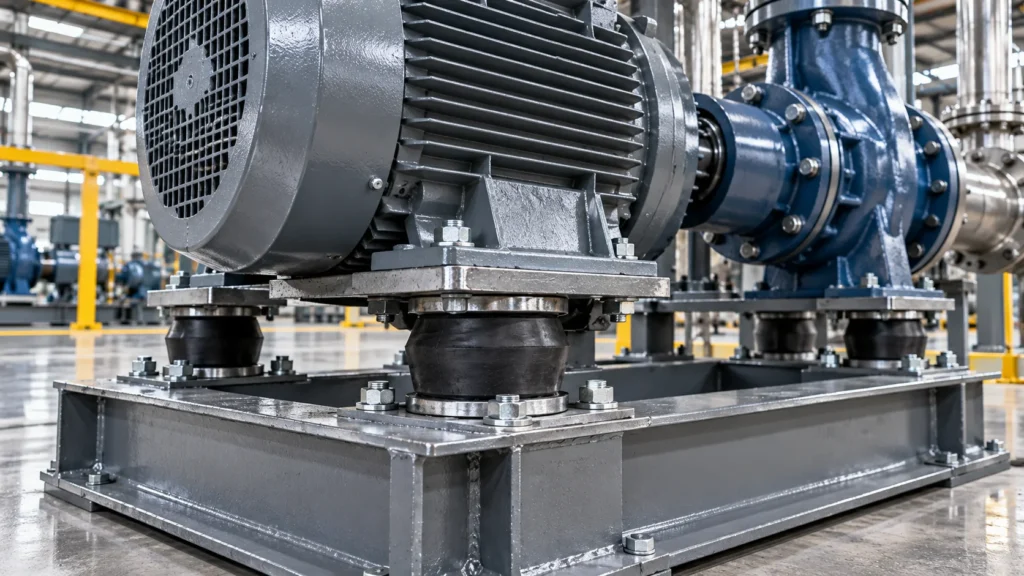
In factories, motors, pumps, air compressors, generators, and other rotating equipment typically generate periodic vibrations during operation.
These vibrations may result from rotor imbalance, reciprocating motion, mechanical excitation, or interactions between the equipment and the foundation.
If the equipment is rigidly connected to the frame, vibrations can propagate outward through the mounting base, bolts, and supporting structures.
You may have encountered a situation where the equipment itself shows no obvious malfunction, but when it is running, nearby metal brackets or enclosures emit a constant humming sound, and even adjacent equipment vibrates.
In such cases, the problem may not necessarily lie solely with the vibration source itself but may also be related to the vibration transmission path.
For equipment that must simultaneously bear loads and control vibration, consider using appropriately designed rubber anti-vibration mounts or rubber-metal composite components. In locations where moving parts may collide, rubber buffer stops can provide additional protection.
Which industrial equipment is suitable for this application?
Typical applications include:
- Motors and drive equipment: Reducing vibration transmission in support structures or providing cushioning protection at boundaries that allow for displacement.
- Pumps and air compressors: Reducing the transmission of operational vibrations from the equipment to the base and surrounding structures.
- Generator sets: Controlling operational vibrations and abnormal displacement in conjunction with appropriate support and stop designs.
- Industrial fans: Reducing structural noise caused by mechanical vibration and additional loads on connection points.
- Automation equipment: Mitigate repeated impacts in reciprocating mechanisms, slide tables, or mechanical stop positions.
However, standard rubber stops are not entirely interchangeable with specially designed vibration-isolation mounts.
If your goal is to isolate vibrations generated by continuous motor operation, you need to consider the relationship between the equipment’s operating frequency and the natural frequency of the support system. Installing rubber components that are too stiff may not necessarily improve vibration isolation performance.
Selection Recommendations
For industrial machinery vibration isolation, focus on understanding the equipment’s weight, operating speed, number of support points, vibration direction, and allowable displacement. For stop mechanisms subject to frequent contact, the speed and cycle frequency of each impact must also be provided.
Impact Absorption for Heavy-Duty Equipment
Protecting Equipment from Transient Impact Loads
Unlike continuously operating rotating machinery, the primary issue faced by certain heavy-duty equipment is sudden impact.
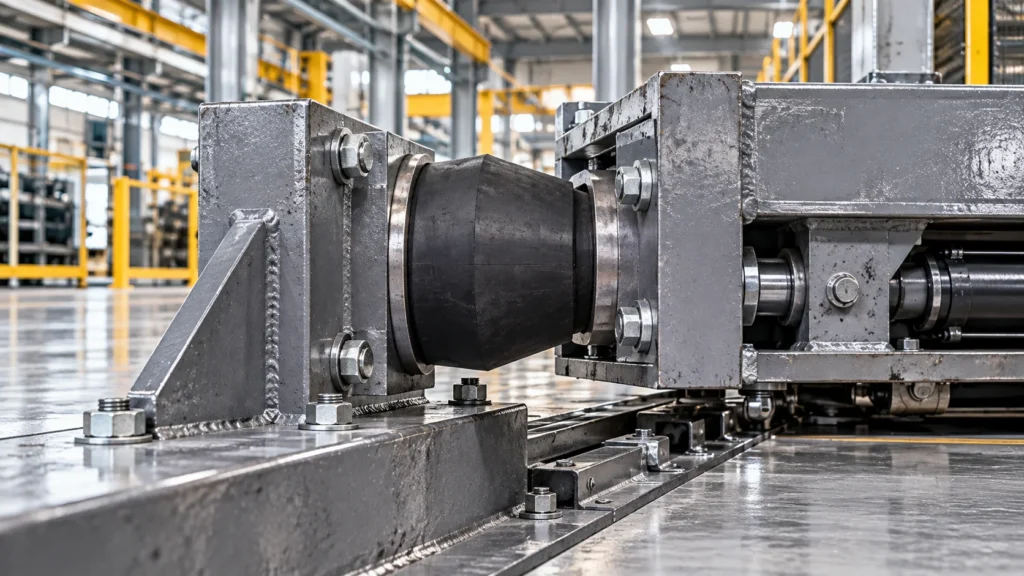
For example, a hydraulically driven mechanism stops at the end of its stroke, a heavy-duty industrial platform moves to its limit position, or the moving structure of loading and unloading equipment comes into contact with a mechanical stop.
Although these impacts may be of short duration, they can concentrate large loads at a few contact points.
Without an effective cushioning design, the impact may affect not only the two parts involved in the collision, but also the supporting frame, welded joints, mounting bolts, and surrounding mechanisms.
Heavy-duty rubber buffers are typically required to withstand large compressive loads within a limited space and provide a certain amount of deformation travel.
They can serve as end-of-travel cushioning elements for equipment, mitigating the impact of hard collisions on the structure within the design load range.
Why can’t selection be based solely on equipment weight?
Suppose two sets of equipment have moving parts of the same weight, but one set contacts the stop block at a lower speed, while the other collides at a higher speed.
Although their masses are the same, the impact energy they must handle is not the same.
For an idealized horizontal motion model, kinetic energy can be expressed as:
E = ½mv²
where E is kinetic energy, m is the equivalent mass of the moving part, and v is the impact velocity.
This means that, all other conditions being equal, doubling the impact velocity will quadruple the kinetic energy.
Actual industrial equipment may also involve gravity, driving forces, mechanical elasticity, and other energy sources; therefore, this formula can only serve as a preliminary assessment and cannot directly replace a complete shock absorber selection calculation.
The key consideration is whether the rubber buffer can absorb or dissipate the required energy within the allowable stroke while keeping the maximum force transmitted to the structure within an acceptable range.
Suitable Product Designs
For heavy-duty equipment, common options include large-sized cylindrical rubber buffers, buffer blocks with metal base plates, conical stops, and custom rubber-metal composite buffer components.
The load-bearing characteristics vary depending on the structure. For example, certain conical buffers can be designed with a geometry that allows the contact area and stiffness to change gradually during compression.
If the equipment has a high impact velocity, high energy, or requires very precise control of deceleration, rubber buffers may not be the optimal choice. In such cases, other energy-absorbing devices, such as industrial hydraulic buffers, should be evaluated.
Selection Recommendations
In addition to the maximum load, it is best to provide the impact direction, impact velocity, available cushioning stroke, number of impacts per hour, and the maximum reaction force that the mechanical structure can withstand.
Suspension for Passenger and Commercial Vehicles
Controlling Suspension Movement on Complex Road Conditions
Passenger cars, trucks, buses, trailers, and certain industrial transport vehicles must maintain structural stability under varying loads and road conditions.
When a vehicle travels over potholes, speed bumps, or uneven surfaces, the suspension system responds to road inputs through a combination of springs, shock absorbers, and linkages.
However, the suspension’s travel is not unlimited.
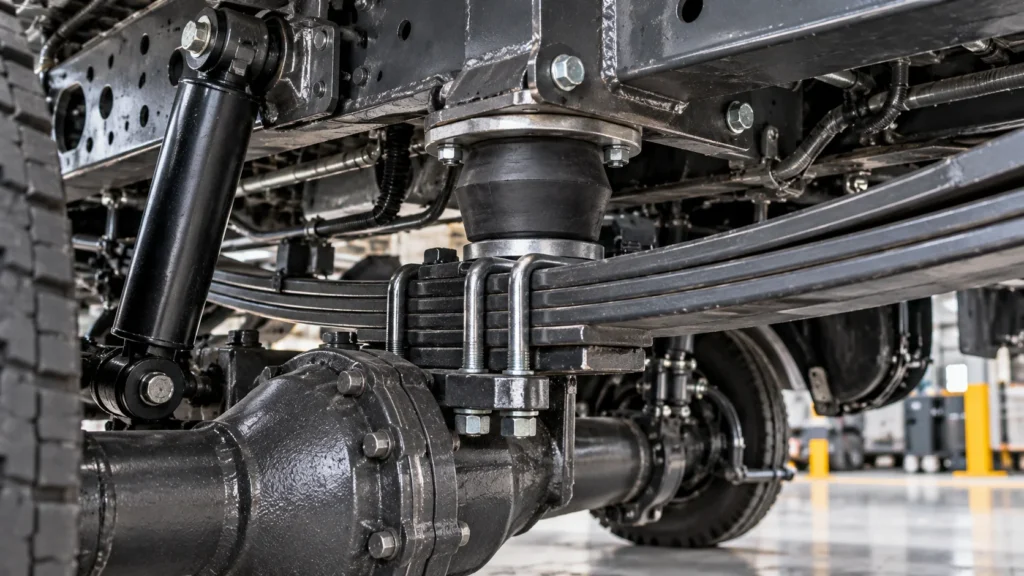
When the wheels undergo significant vertical displacement, the suspension may approach its compression limit. At this point, rubber bump stops can act as auxiliary components to mitigate the impact as the suspension nears the end of its travel.
You can think of them as the final segment of the suspension system’s controlled travel, rather than simply rubber blocks designed to prevent metal-on-metal contact.
Why is buffer design even more critical for commercial vehicles?
Operating conditions for commercial vehicles often vary significantly.
A truck’s suspension bears different static loads when empty versus fully loaded; if the vehicle also frequently travels on construction sites, in mining areas, or on other uneven roads, the dynamic impacts on the suspension system will increase.
An improperly selected limit buffer can cause two types of problems.
If the buffer is too stiff, a significant impact may be felt when the suspension contacts the stop, and additional load may be significantly transferred to the chassis.
If the buffer is too soft or undersized, it may compress to its limit prematurely under large displacements, failing to provide sufficient end-of-travel protection.
Therefore, the design of rubber buffers should be matched to the suspension travel, spring characteristics, and the vehicle’s expected load.
Common Installation Locations and Procurement Requirements
Rubber buffer components in vehicles can be used for suspension compression stops, chassis contact points, certain body and accessory support structures, and mechanisms requiring elastic stops.
When purchasing replacement parts, it is recommended to verify the original part’s installation dimensions, unloaded height, contact surface shape, mounting method, and material requirements.
For OEM projects, compression characteristics under different vehicle load conditions should also be considered; one should not assume that two products are directly interchangeable based solely on similar external shapes.
It is particularly important to note that while suspension limit buffers, engine mounts, rubber bushings, and hydraulic shock absorbers are all part of a vehicle’s vibration control system, their primary functions differ.
Rail Transit Systems
Coping with Long-Term Cyclic Loads and Complex Vibrations
During operation, rail vehicles are subject to track irregularities, vehicle dynamics, traction and braking forces, and various structural vibrations.
These loads not only affect ride comfort but also act on the bogies, suspension connections, and other mechanical components.
Rubber cushioning and vibration-damping components in rail transit typically need to balance structural strength, deformation characteristics, and long-term durability.
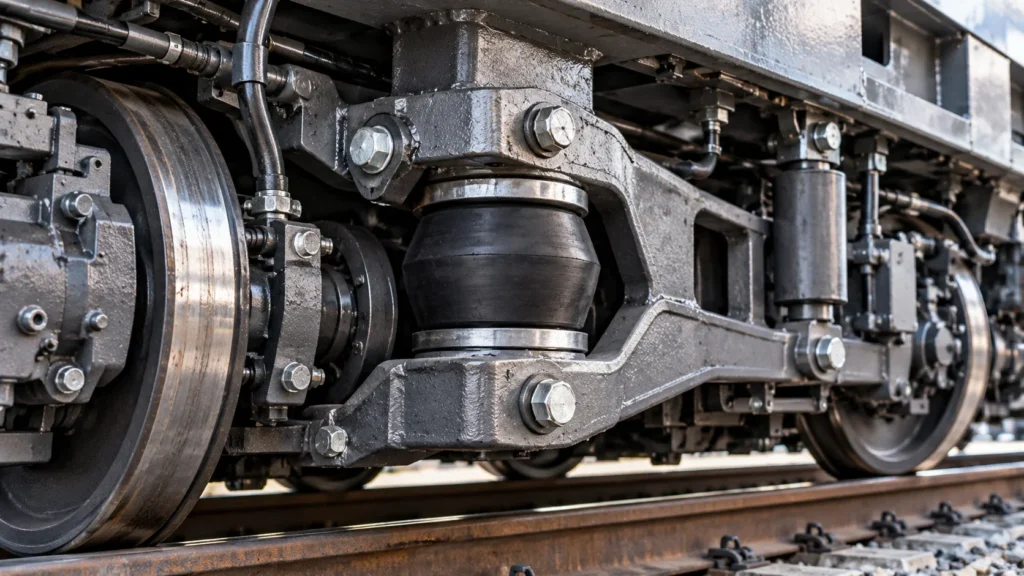
Depending on the specific design, they can be used to limit mechanical displacement, cushion component contact impacts, or provide elastic support in suspension and connection systems.
Where can rubber buffers be installed?
The specific location depends on the vehicle structure and intended use, but common applications include:
Auxiliary stops in suspension systems
When a vehicle’s suspension approaches the limits of its design travel, specialized elastic stops help control the contact process between components and mitigate rigid impacts.
Bogie and Related Linkage Mechanisms
Certain rubber-metal composite components can provide elastic support within the permitted range of motion while controlling displacement and load transfer in specific directions.
Mechanical Stops and Auxiliary Equipment
In vehicle auxiliary equipment, mechanical structures, and certain maintenance mechanisms, rubber cushioning elements can be used to reduce impact during end-of-travel contact.
It should be noted that rubber stops, rubber springs, and air springs in rail vehicles are not the same type of product.
Air suspension primarily relies on compressed air to provide support and elastic properties, whereas rubber components may serve various functions such as sealing, elastic connections, auxiliary support, or limit protection. It cannot be simply assumed that rubber buffers can directly replace an entire air suspension system.
What Should Be Prioritized in Validation for Rail Transit Projects?
Compared to general industrial machinery, rail transit components typically require more rigorous consideration of long-term cyclic loads, material performance under varying temperature conditions, and design life.
When project requirements involve flame retardancy, fire resistance, weather resistance, fatigue resistance, or other specialized performance characteristics, validation must also be conducted based on the specific application of the components and applicable standards.
For rubber buffers used in rail vehicles, static load data can only reflect a portion of their performance. Actual projects may also require data on dynamic stiffness, compression set, fatigue performance, and the reliability of the rubber-to-metal interface.
Procurement Recommendations
If you are procuring rubber components for rail vehicles, you should provide the original technical drawings, installation locations, actual loading conditions, and applicable project specifications whenever possible to enable suppliers to determine the required materials and verify project requirements.
Construction Machinery and Mining Equipment
Designed for High-Impact, Dust-Heavy, and Harsh Outdoor Environments
In construction machinery and mining equipment, impacts arise not only from the machinery’s own movement but may also be influenced by terrain, operational loads, and environmental conditions.
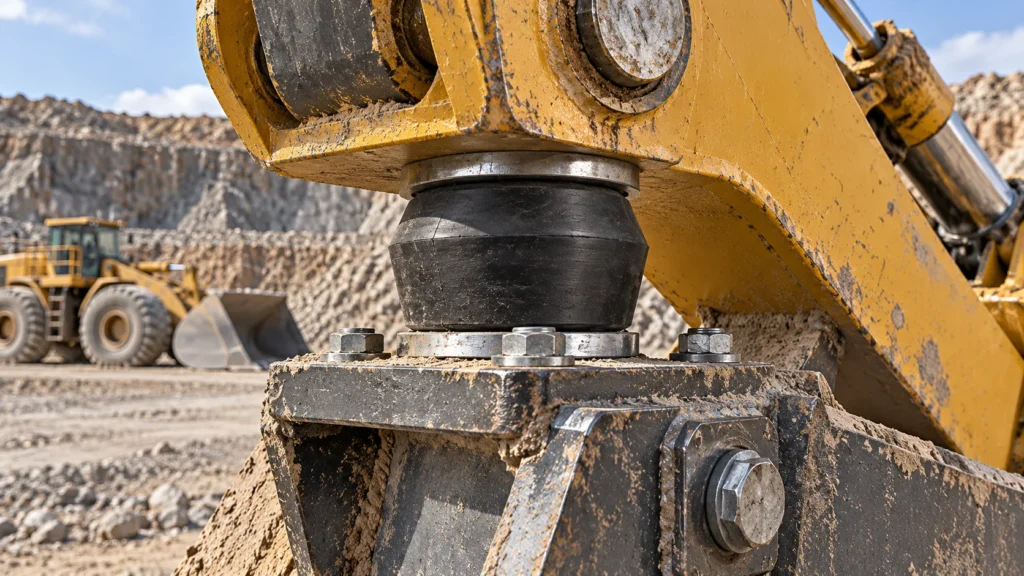
Excavators, loaders, mining vehicles, crushing equipment, and other heavy construction machinery often need to operate on uneven ground, in dusty environments, and under conditions of significant temperature fluctuations.
In this equipment, rubber buffers can be used, as required by the design, for mechanical limiting, cushioning the contact of moving parts, and providing auxiliary protection for the cab or related structures.
For example, the moving mechanisms of certain engineering machines may come into contact with fixed stops when returning to their original positions; if this contact is borne entirely by metal surfaces, long-term repetitive impacts may exacerbate localized wear and stress on the connection points.
Installing appropriate rubber stops can mitigate the impact of such contact within the specified operating range.
What are the challenges with construction machinery buffers?
Compared to indoor equipment, rubber components in outdoor machinery are more likely to be exposed to mud, water, dust, oil, sunlight, and temperature fluctuations.
These environmental factors can affect material performance.
For example, for shock absorbers that are in long-term contact with industrial oils, it is essential to evaluate the rubber material’s oil resistance and compatibility; for products exposed to sunlight and ozone, weather resistance and aging must be considered; and for cold environments, changes in material stiffness and elasticity under low-temperature conditions must also be examined.
If a rubber compound unsuitable for the operating environment is selected, the product may exhibit hardening, cracking, swelling, or performance degradation after long-term operation, even if it performs normally at the time of initial installation.
Structural design is more important than external dimensions
Heavy-duty rubber buffers used in construction machinery often also require consideration of the structural strength of metal mounting components.
Under high-impact conditions, in addition to the rubber body itself, the thickness of the metal plate, the fastening method, the bond strength between the rubber and metal, and the stiffness of the mounting bracket can all affect the final performance.
Therefore, one cannot simply assume that a replacement part is fully suitable based solely on “identical diameter and thread.”
For equipment continuously exposed to dust and particle impact, attention should also be paid to whether the shock absorber’s installation location is prone to direct wear and whether additional structural protection is required.
Selection Recommendations
For construction machinery and mining equipment, it is recommended to first clarify the load variation range, operating temperature, contact medium, number of impacts, and maintenance and replacement conditions before determining the rubber material and mounting structure.
Ships and Offshore Engineering Equipment
What special requirements does the marine environment place on rubber components?
Ships and offshore engineering equipment are constantly exposed to humidity, salt spray, temperature fluctuations, and complex motion environments.
Marine engines, generators, pumps, ventilation equipment, and deck machinery may generate vibrations during operation; hatches, moving mechanisms , and certain deck installations may also be subjected to impact during opening, closing, or limit-of-travel operations.
These operating conditions may all require different types of rubber cushioning or vibration-damping components.
For example, the primary issue with marine generator sets may be the periodic vibrations generated by equipment operation, whereas certain hatch mechanisms require control of contact impacts at the end of their travel.
Although both situations may involve rubber vibration-damping products, the design objectives differ, and the product selection cannot be the same.
Why aren’t standard industrial buffers necessarily suitable for marine environments?
First, seawater and salt spray not only affect rubber but can also cause corrosion of metal mounting components.
If a cushioning structure combining rubber and metal is used, the durability of the metal materials, surface protection, and bonding interfaces must be evaluated based on exposure conditions.
Second, marine equipment may be subjected to dynamic loads generated by the combined effects of equipment vibration and hull movement over long periods, so attention must be paid to the direction of force and the range of deformation of the buffer.
Furthermore, different rubber formulations vary in their resistance to seawater, oils, temperature, and ozone.
This means that so-called “Marine Rubber Buffers” are not sufficient merely because they are waterproof.
A truly suitable product must be matched to the equipment’s actual installation environment.
Typical Application Locations
When properly designed, rubber buffering and vibration-damping components in ships and offshore engineering equipment can be used for:
- supporting and providing auxiliary stops for marine machinery and equipment;
- Contact cushioning for hatches and other movable structures;
- Motion limiting for deck machinery;
- Mechanical protection for winches and related equipment;
- Vibration control for ventilation equipment and auxiliary power units.
If your equipment is installed on an open deck, it is recommended that you inform the supplier of salt spray exposure, potential contact with oils, operating temperatures, and expected maintenance intervals.
For critical equipment, you should also clarify whether there are any classification society requirements, customer project specifications, or other specialized inspection and certification requirements. Generic industrial rubber buffers cannot be directly considered to meet all requirements for critical marine equipment without prior verification.
Elevators, Cranes, and Material-Lifting Equipment
Collision at the End of Travel in Control Mechanisms
In hoisting and lifting systems, motion control and end-of-travel protection are critical.
For example, when a bridge crane runs along a track, certain material-handling devices move along guide rails, or lifting mechanisms approach the end of their mechanical travel, protective buffer elements may be required in conjunction with limit switches.
Rubber buffer stops can be used at end positions that meet design requirements to mitigate direct impact between moving mechanisms and fixed structures.
However, there is one very important distinction in these applications: ordinary mechanical limit buffers should not be confused with end-of-travel buffer devices that serve a legally mandated safety function.
Rubber Buffers in Lifting Equipment
For certain cranes, rail-mounted handling equipment, and industrial lifting mechanisms, rubber buffers can be installed at the limit contact points of trolleys, end beams, or related travel mechanisms.
When the moving mechanism approaches the end of its travel, the buffer undergoes compressive deformation within its design limits, reducing the severity of the impact.
When selecting a model, attention must be paid to the equivalent mass of the moving parts, the contact speed, the available cushioning stroke, and the forces the mechanism is designed to withstand.
If the lifting equipment operates at high speeds or must handle significant kinetic energy, specialized hydraulic cushioning devices should be evaluated, or the equipment designer should determine other suitable end-of-travel protection solutions.
Ordinary rubber blocks should not be used directly as the sole safety measure to prevent overtravel accidents.
Buffers in Elevator Systems
Buffers may be installed at the bottom of elevator shafts for specific safety conditions, but their product design, applicable speeds, energy absorption capacity, and certification requirements are subject to relevant safety regulations.
Some systems use compliant elastic energy-storage buffers, while others require specialized energy-dissipating buffer devices.
This does not imply that ordinary industrial rubber buffers can be used in elevator pits, nor should they be used as direct replacements for existing safety components merely because of their similar appearance.
Buffers involving passenger safety or other mandatory safety requirements must be selected and verified by appropriately qualified design, manufacturing, and installation entities in accordance with applicable standards and equipment parameters.
Why do lifting devices require more stringent selection criteria?
Because buffers may need to withstand high impact energy, and the system has clear requirements for stopping distance, maximum deceleration, operational safety, and reliability.
In addition to mechanical strength, designers must also consider emergency conditions, performance after repeated cycling, installation tolerances, and the interaction between the buffer and the overall safety system of the machine.
Therefore, in lifting and hoisting equipment, the suitability of rubber buffers should be determined through clear engineering calculations and verification, rather than based solely on the product name.
How to Select the Right Rubber Buffer for Different Industrial Applications?
After reviewing the seven major application scenarios, you may find that cushioning requirements vary significantly across different industries.
A rubber buffer suitable for limiting the movement of conveying equipment may not necessarily be suitable for heavy-duty vehicles; a standard buffer block used for indoor machinery may not necessarily withstand long-term exposure to a marine environment.
Therefore, when selecting a rubber buffer, it is recommended to first answer the following questions.
First, determine whether the equipment needs to control impact or continuous vibration
If the primary issue is impact when a moving mechanism reaches the end of its travel, the focus should typically be on analyzing the buffer’s load-displacement characteristics and energy absorption capacity.
If the primary issue is structural vibration generated by the continuous operation of motors, pumps, or compressors, priority should be given to the natural frequency, dynamic stiffness, and damping characteristics of the vibration isolation system.
If both operating conditions exist simultaneously, a combined design may be necessary, rather than expecting a single standard rubber stop to solve all problems.
Second, accurately assess the loads and installation space
At a minimum, the following information should be clarified:
- The static weight of the equipment or the actual load at the support points;
- The maximum dynamic load and the direction of impact;
- The impact velocity of moving parts;
- Maximum allowable deformation and cushioning travel;
- Installation space, contact surfaces, and mounting method;
- Operating cycle frequency and expected service life.
It is particularly important to note that when multiple shock absorbers operate together, the load may not be distributed evenly. The equipment’s center of gravity, structural stiffness, and installation errors can all cause variations in the forces applied at different locations.
Therefore, for complex structures, it is best to conduct an evaluation based on the actual load conditions of the entire machine.
Next, select the rubber material based on the operating environment
Different rubber materials have distinct typical characteristics.
| Rubber Materials | Key Characteristics | Points to Consider When Selecting |
| Natural Rubber (NR) | Generally offers good elasticity and dynamic performance | Oil resistance, ozone resistance, and weather resistance are generally limited |
| Nitrile rubber (NBR) | Offers good resistance to many industrial oils | Weather and ozone resistance must be evaluated in conjunction with the formulation |
| Ethylene Propylene Diene Monomer (EPDM) | Generally exhibits good weather, ozone, and water resistance | Generally not suitable for long-term exposure to most mineral oils |
| Chloroprene rubber (CR) | Offers a balanced combination of weather resistance, ozone resistance, and some oil resistance | Specific media and temperature requirements must still be verified |
These are merely typical characteristics of common materials and do not imply that every formulation will exhibit exactly the same performance. The actual performance of rubber buffers is also influenced by formulation, hardness, geometry, vulcanization process, and operating conditions.
Finally, evaluate performance—not just compare prices
In B2B equipment procurement, the unit price of a product is typically not the only cost factor.
If a buffer’s performance is not suited to the actual operating conditions, it may result in frequent replacements, equipment downtime, structural repairs, or labor costs for maintenance.
Therefore, when comparing different suppliers, you should focus on product dimensional tolerances, hardness ranges, load-displacement data, material information, quality inspection requirements, and whether they can provide customization support tailored to your project’s needs.
If the buffer is required to perform a critical safety function, you should also verify the applicable product standards and certification requirements.
Summary
From industrial machinery, heavy equipment, and commercial vehicles to rail transit, construction machinery, marine vessels, and lifting systems, rubber buffers perform tasks such as impact control, displacement limitation, and structural protection in various applications.
However, what truly determines a product’s performance is not how thick the rubber buffer appears or how high its hardness is, but whether its design is well-suited to the actual load, motion patterns, environmental conditions, and service life requirements.
If you are looking for a reliable supplier of industrial rubber buffers, or if standard products cannot meet the specific installation requirements of your equipment , Vista Motion can provide support for your project in the areas of rubber buffering, vibration damping products, and custom manufacturing.
Vista Motion has been engaged in the rubber vibration damping industry since 2003, serving sectors such as industrial machinery, rail vehicles, construction equipment, and marine applications. We can assist in evaluating materials, product structures, installation methods, and corresponding manufacturing and quality requirements based on customer drawings, samples, and application needs.
Whether you need standard industrial rubber buffers, rubber-metal composite buffer components, or custom rubber vibration damping products developed for specific operating conditions, please feel free to contact Vista Motion.
Visit Vista Motion or submit your inquiry via the “Contact Us” page.
FAQ
What are rubber buffers used for?
Rubber buffers are primarily used to absorb mechanical shocks, limit the displacement of moving parts, reduce direct metal-to-metal contact, and—when properly designed—control vibration transmission.
They are commonly found in industrial machinery, vehicle suspensions, automation equipment, construction machinery, rail transit, and marine equipment. Structural and performance requirements can vary significantly depending on the application, so it is essential to clearly define the specific operating conditions before making a selection.
How do rubber buffers absorb shock?
When an external load acts on a rubber buffer, the rubber undergoes elastic and viscoelastic deformation. Part of the mechanical energy is temporarily stored in the material, while another part is converted into heat through internal hysteresis loss.
Within appropriate structural and deformation limits, this can extend the deceleration distance and mitigate instantaneous impacts. However, the buffering effect still depends on the load, impact velocity, stiffness, and available travel; it cannot be determined solely by the material name.
What is the difference between rubber buffers and rubber mounts?
Rubber buffers typically emphasize shock absorption, limit protection, and prevention of hard impacts; rubber mounts, on the other hand, are more commonly used for equipment support, flexible connections, and vibration isolation.
While certain rubber-metal composite components can indeed serve both functions, they are not entirely interchangeable.
If your equipment primarily experiences continuous vibration, you should prioritize evaluating vibration-damping mounts; if the issue occurs at the end of a mechanical motion, you should focus on buffer stops.
Rubber Buffers vs. Hydraulic Shock Absorbers
There is no absolute superiority between the two; the choice depends primarily on the impact energy, allowable travel, and required deceleration characteristics.
Rubber buffers have a relatively simple structure and are suitable for a wide range of conventional impact and limit-stop protection applications; hydraulic shock absorbers, on the other hand, can control energy dissipation through fluid damping and are more suitable for certain high-energy applications or those requiring precise control of the deceleration process.
If the impact velocity is very high or the stopping distance is strictly limited, it is recommended to perform engineering calculations first before selecting a cushioning method.
How do you calculate the load a rubber buffer must withstand?
First, determine whether the buffer is intended for static support or dynamic impact.
For static support, the actual load at each mounting point must be calculated; for dynamic impact, the equivalent mass, impact velocity, cushioning stroke, and allowable force must also be specified.
Buffers should not be selected based solely on the total weight of the equipment. Even if two products have the same nominal load capacity, their actual compression stiffness and impact performance may differ significantly.
What Shore Hardness Is Best for Rubber Buffers?
There is no single Shore A hardness that is suitable for all industrial rubber buffers.
Harder rubber typically has higher stiffness but may result in insufficient cushioning travel; softer rubber is prone to greater deformation and may also compress excessively under high loads.
Even if two buffers have the same hardness, their load-displacement characteristics may differ due to variations in shape, dimensions, and material formulation.
Therefore, when selecting a buffer, one should consider the actual load and compression characteristics rather than simply comparing hardness values such as 40, 60, or 70 Shore A.
Which rubber material is suitable for outdoor or marine environments?
For long-term outdoor exposure, key considerations typically include weather resistance, ozone resistance, temperature adaptability, and resistance to aging. EPDM is one of the materials worth evaluating for many outdoor applications.
However, in marine environments, the impact of salt spray on metal fasteners must also be considered. If the equipment comes into contact with engine oil, hydraulic fluid, or other media, the chemical compatibility of the rubber compound must be further verified.
Material selection should not be based solely on general descriptions such as “waterproof” or “corrosion-resistant.”
Are Rubber Buffers Suitable for High-Frequency Vibration?
Properly designed rubber components can be used in some relevant equipment, but a distinction must be made between buffer stops and true vibration-isolation mounts.
For high-frequency vibration, the effectiveness of vibration isolation is primarily influenced by the system’s natural frequency, dynamic stiffness, damping, and installation conditions.
Even if a standard rubber buffer can withstand static loads, this does not mean it can effectively isolate vibrations at a specific frequency. For motors, compressors, and precision equipment, specialized vibration isolation solutions should be selected based on actual vibration parameters.
How long do rubber buffers typically last? When do they need to be replaced?
There is no standard service life for rubber buffers; their lifespan is influenced by material formulation, load, operating frequency, temperature, exposure to media, and maintenance conditions.
During inspections, look for obvious cracks, abnormal hardening, permanent compression deformation, delamination between the rubber and metal, metal corrosion, as well as new vibrations or abnormal impacts that occur during equipment operation.
For critical equipment, replacement intervals should be determined based on the manufacturer’s maintenance requirements and actual inspection results; safety should not be judged solely by the product’s appearance.
Can rubber buffers be customized according to drawings? What factors affect the price?
Yes. Custom rubber buffers typically require adjustments to dimensions, structure, materials, and mounting methods based on the equipment’s installation space, load, cushioning requirements, and operating environment.
Factors affecting price primarily include the rubber compound, part dimensions, metal inserts, mold development, production quantity, dimensional tolerances, and required testing procedures.
If you have existing drawings, 3D models, or samples, you can provide them directly to the supplier. If the specific structure has not yet been determined, you can first submit the equipment weight, installation location, impact conditions, and expected purchase quantity to facilitate a preliminary technical evaluation and quotation.
